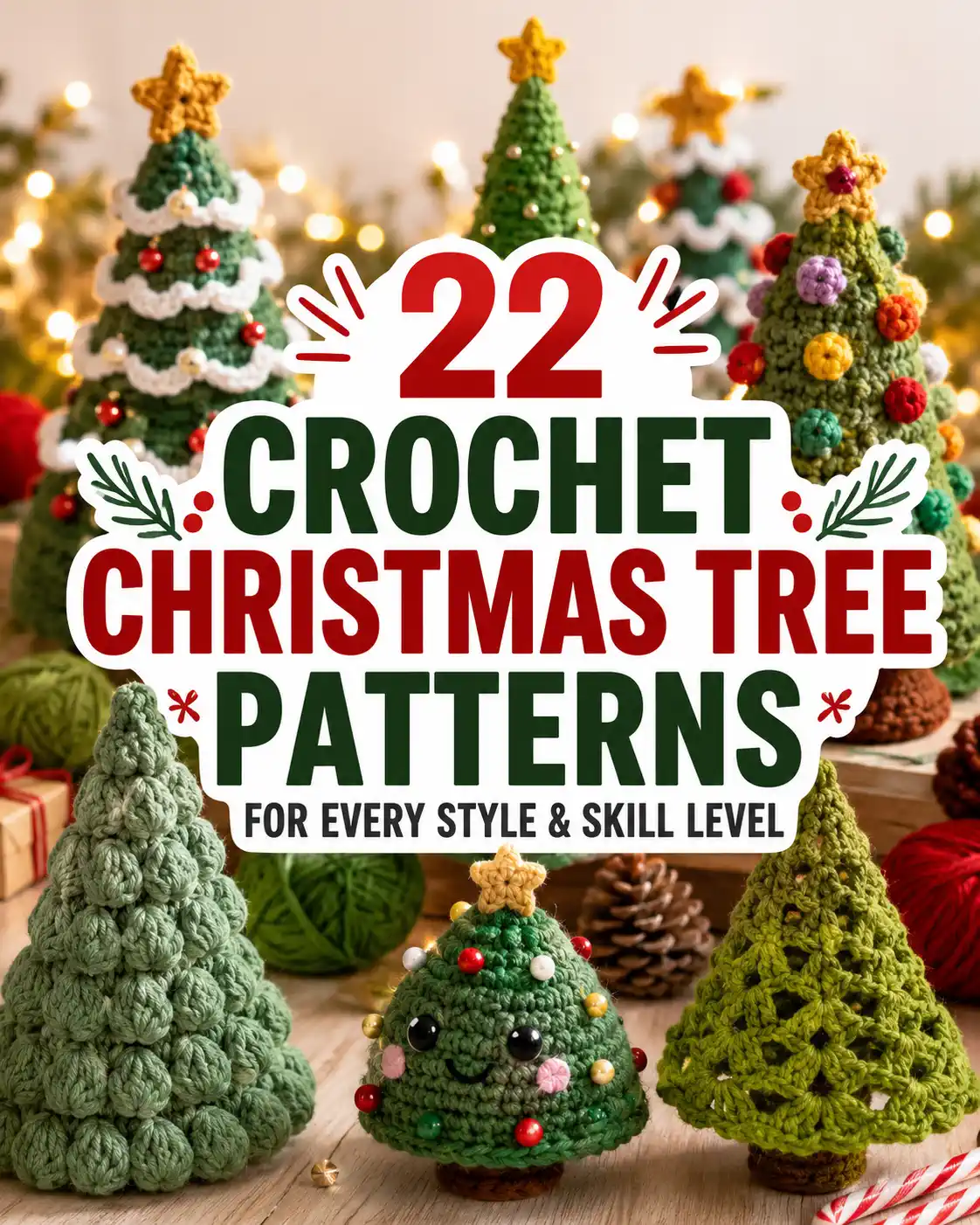
A crochet Christmas tree can be as simple as a flat ornament or as detailed as a stuffed 3D centerpiece, which makes this one of the easiest holiday motifs to adapt to your skill level. For yarn-and-hook matching, the Craft Yarn Council recommends relying on millimeter hook sizing and checking pattern gauge, because letter and number hook labels can vary between manufacturers.
I love this project because one tiny Christmas-tree shape can turn into crochet Christmas ornaments, garlands, gift toppers, table decorations, or a whole miniature forest. You can keep your trees traditional in deep green and red, use soft neutral yarn for a modern look, or work through leftover scraps for something much more playful.
Key Takeaways
- Start with a flat tree if you are a beginner.
- Use yarn weight to control size and structure.
- Turn small trees into ornaments, garlands, or gifts.
- Add texture with bobbles, puffs, or ruffles.
- Search “crochet christmas trees free” for simple inspiration.
- Keep detachable decorations away from very young children.
What Makes a Crochet Christmas Tree Project Easy to Customize?
Crochet Christmas trees are easy to customize because you can change their construction, yarn weight, color, texture, size, and decorations without changing the basic holiday-tree shape.
At a Glance:
- Work flat for ornaments and garlands.
- Crochet in rounds for standing trees.
- Change yarn weight to adjust finished size.
- Add texture instead of separate decorations.
- Use scraps for stripes and color changes.
The best thing about a crochet Christmas tree is that you are not locked into one shape, yarn, or decorating style. You can work a simple triangle back and forth, crochet in the round for a cone, add stuffing for a soft ornament, or build several layers for a fuller tree.
Yarn choice changes the look quickly. The Craft Yarn Council’s Standard Yarn Weight System places DK/light-worsted yarn in the “light” category and worsted/Aran yarn in the “medium” category, with different typical hook and gauge ranges for each. That is why swapping yarn weight can noticeably change the size and firmness of the same basic tree shape.
If you are following a written pattern, also check whether it uses U.S. or U.K. crochet terminology before you start. The Craft Yarn Council notes, for example, that a U.S. single crochet corresponds to a U.K. double crochet, so mixing the systems can completely change your finished fabric.
Quick Crochet Christmas Tree Guide
| Project Style | Best For | Shape | Skill Level | Nice Yarn Choice |
|---|---|---|---|---|
| Flat triangle tree | Ornaments, cards, garlands | 2D | Beginner | DK or worsted |
| Stuffed mini tree | Gifts, hanging decor | Soft 3D | Beginner–Easy | DK |
| Cone tree | Mantel or table decor | 3D | Easy | Worsted |
| Granny tree | Scrap yarn projects | 2D | Easy | DK or worsted |
| Textured tree | Statement ornaments | 2D or 3D | Easy–Intermediate | Worsted |
| Amigurumi tree | Cute tabletop decor | 3D stuffed | Intermediate | DK or worsted |
For readers searching “crochet christmas trees pattern”, the easiest starting point is usually a flat triangle because you can control the width with increases or decreases and stop when the tree reaches the size you want.
Which Materials Work Best for Crochet Christmas Trees?
Most crochet Christmas tree projects only need yarn, a suitable crochet hook, scissors, and a yarn needle, with stuffing and embellishments added only when the design requires them.
At a Glance:
- Choose yarn that suits the project size.
- Match hook size to yarn and pattern.
- Use stuffing only for 3D designs.
- Keep a yarn needle for finishing.
- Add embellishments only when they are appropriate.
You do not need a huge supply list. Most of these projects can be made from leftover green, white, brown, red, gold, or neutral yarn.
A useful basic kit includes:
- Yarn in one or more Christmas colors
- A crochet hook suited to your yarn
- Scissors
- Yarn needle
- Stitch marker for projects worked in rounds
- Small amount of stuffing for 3D trees
- Optional ribbon, beads, buttons, pom-poms, bells, or stars
The Craft Yarn Council recommends using the millimeter measurement on the hook as the most dependable size reference and adjusting hook size if your gauge is larger or smaller than the pattern calls for.
For ornaments that will be around small children, be careful with beads, buttons, bells, or other detachable decorations. The U.S. Consumer Product Safety Commission advises keeping small parts away from children younger than three and recommends extra care with holiday decorations around children.
22 Crochet Christmas Tree Ideas
These 22 crochet Christmas tree ideas cover beginner ornaments, textured designs, standing trees, garlands, gift holders, wall decor, and amigurumi so you can choose a project that matches your skill level and decorating style.
At a Glance:
- Choose flat trees for quick projects.
- Try cones for freestanding Christmas decor.
- Use texture for built-in visual detail.
- Turn motifs into gifts or garlands.
- Combine several sizes into a miniature forest.
22 Crochet Christmas Tree Ideas to Make Your Holidays Extra Cozy
1. Want the Easiest Mini Flat Tree Ornament?
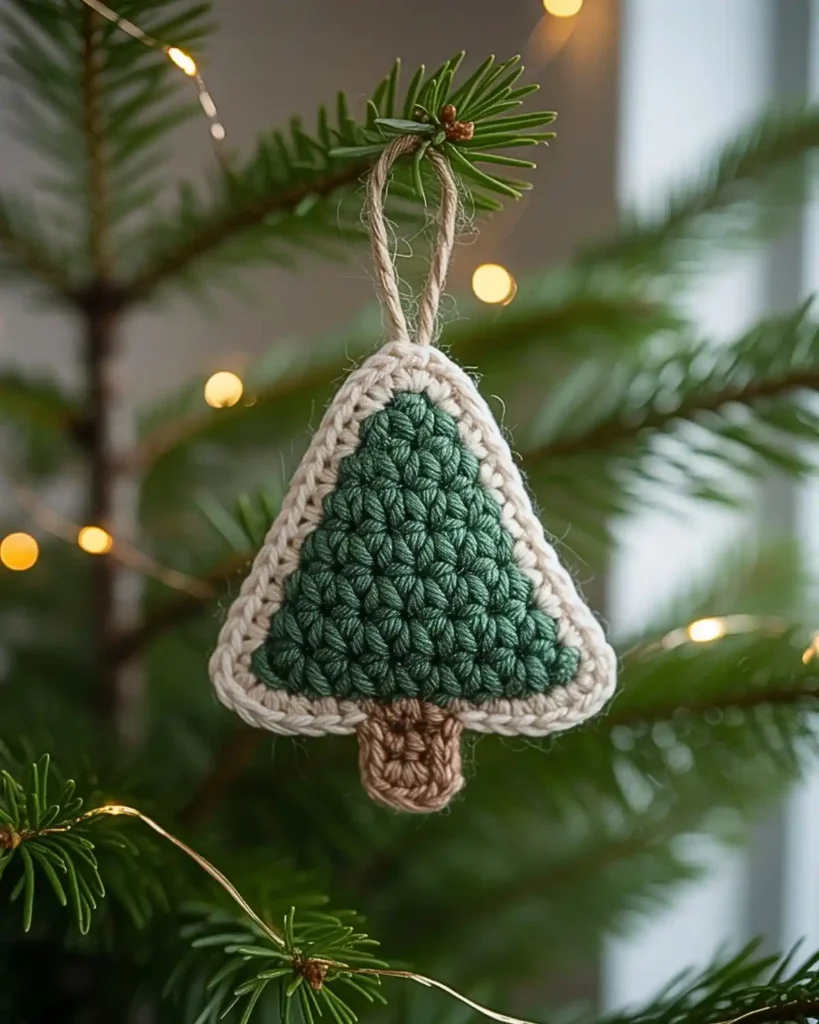
The mini flat tree ornament is the project I would choose when I want something festive without committing an entire evening to one piece. Instead of building a complicated cone, you simply create a neat triangular silhouette and finish it with a tiny trunk and hanging loop. It is especially handy when you want matching ornaments for gift bags, teacher gifts, or a small apartment tree. If quick holiday crafting is your priority, the best part is how easily one basic shape can become five or ten different-looking trees.
Try dark forest green for a traditional version, cream for Scandinavian-style decor, or dusty sage for something softer. A contrasting border can make the triangle look much more finished.
Special Tip: Crochet the hanging loop directly into the top point so you do not have to sew on a separate ribbon later.
2. How About a Soft Stuffed Christmas Tree Ornament?
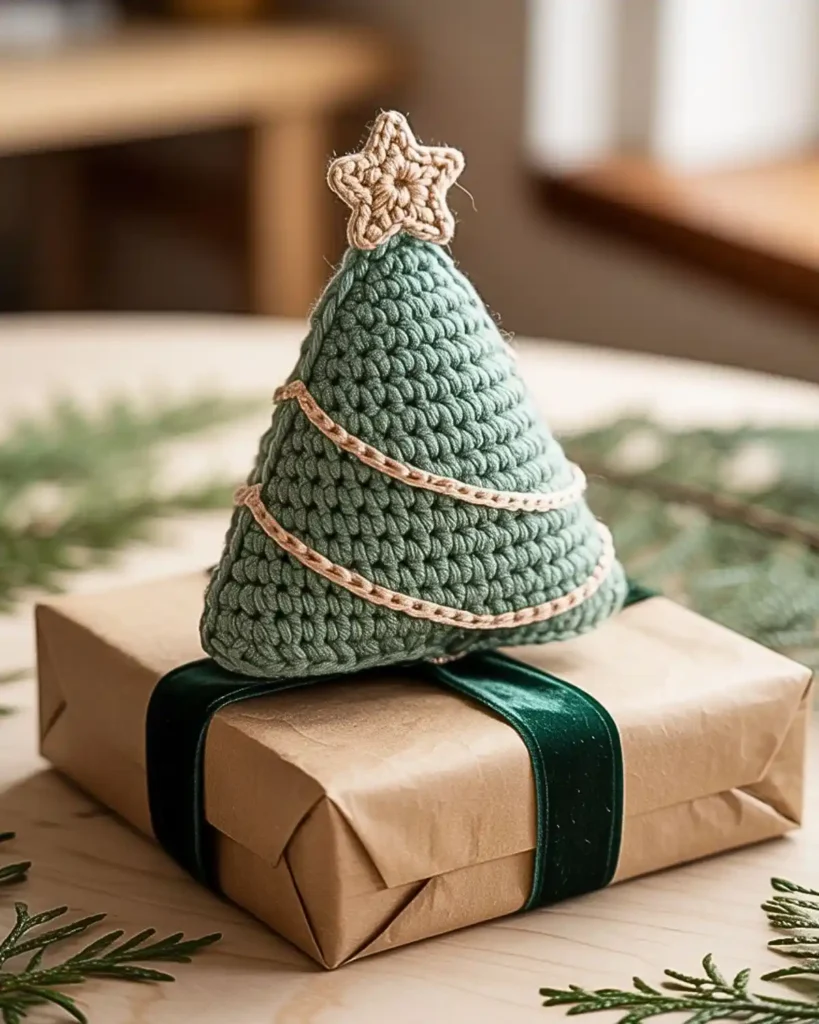
A stuffed crochet Christmas tree feels a little more special because it has the softness of a tiny plush decoration without needing a full amigurumi construction. Two matching tree panels can be joined around the edges and lightly filled, which gives you more dimension than a single flat ornament. I like this style for handmade gift toppers because the recipient can move the tree straight from the package to their Christmas tree. It is a good choice if you want a beginner-friendly project with a polished payoff.
Keep the stuffing light. Too much can stretch the stitches and make the tree lose its crisp shape.
You can finish it with:
- A brown crocheted trunk
- A tiny embroidered star
- Surface-stitched garland
- A simple hanging loop
3. Love Granny Squares? Try a Granny Christmas Tree
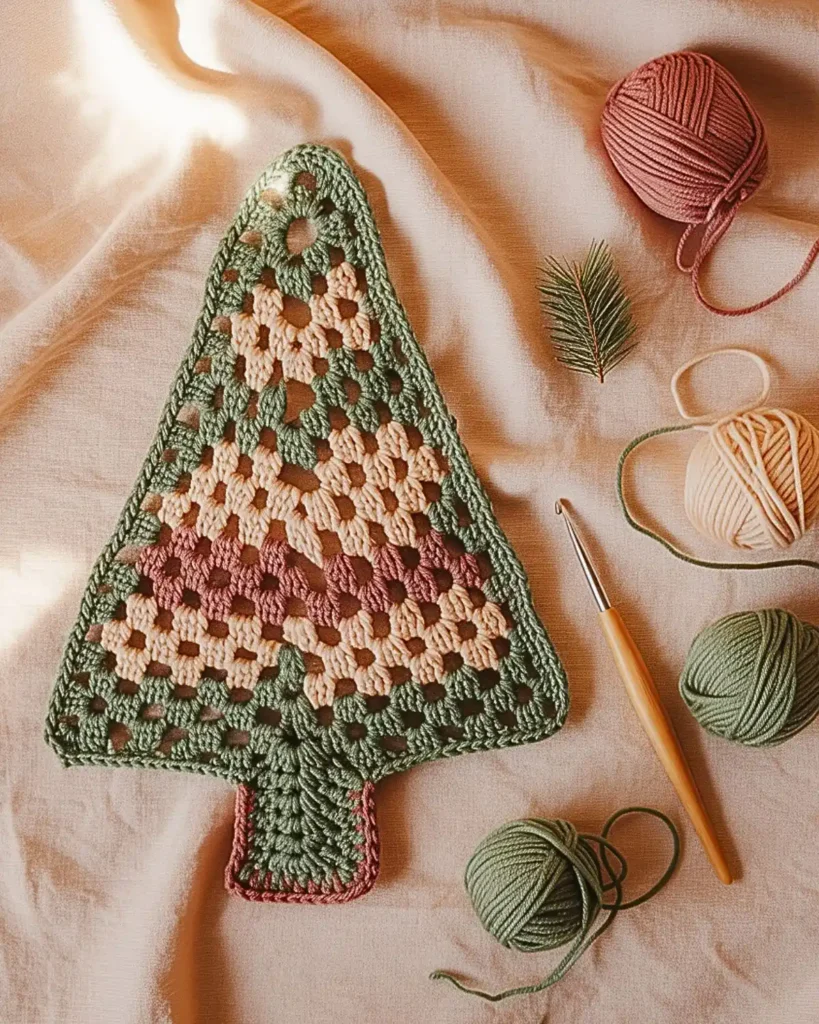
If you already enjoy crochet granny square patterns, the granny Christmas tree takes a familiar crochet idea and turns it into something much more seasonal. Rather than working one plain triangle, you can use granny-style clusters to create an open, slightly vintage texture that looks especially good in traditional Christmas colors. This is the tree I would make when my scrap basket is full of small green, cream, and red leftovers that are too good to throw away. It suits crocheters who enjoy classic motifs, and the biggest advantage is how naturally color changes fit into the design.
Make one large triangle for a bold ornament, or join smaller granny-inspired triangles to create a layered tree.
A cream border gives bright scrap colors some breathing room and helps the tree look intentional rather than random.
4. Want a Tree That Stands Up? Make a 3D Cone Tree
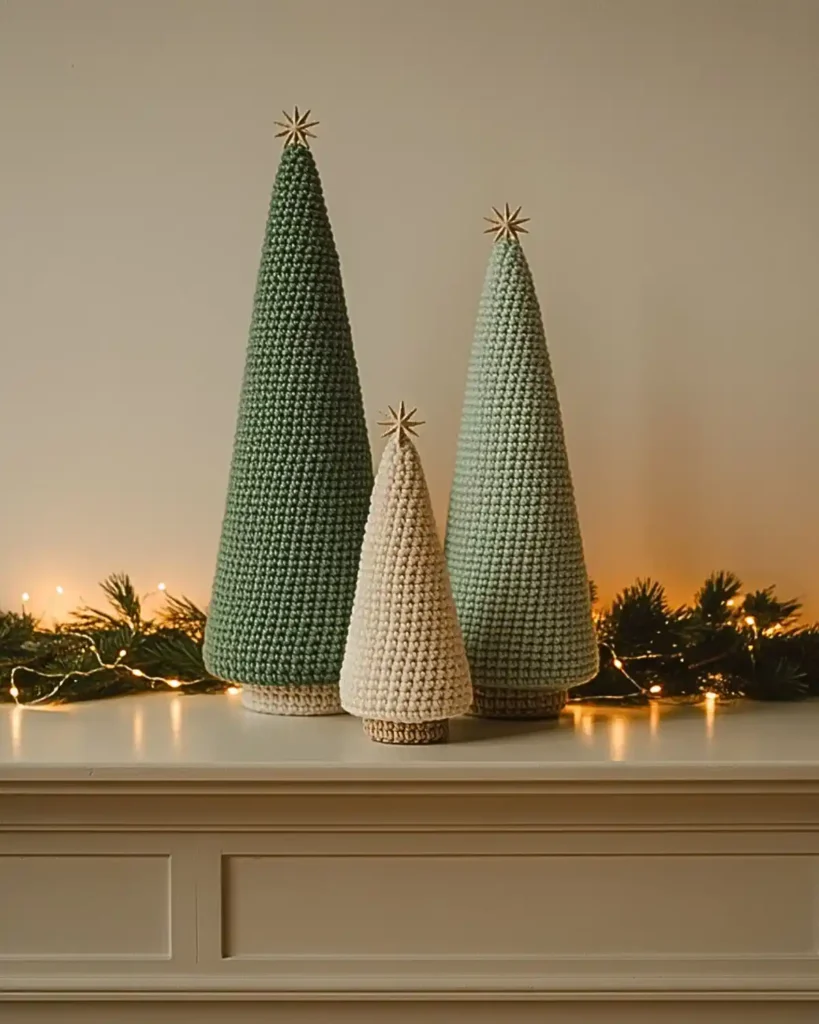
A 3D cone crochet tree is one of the best options when you want actual holiday decor rather than something that only hangs on a branch. The cone shape gives you instant height and looks cleaner than many heavily stuffed designs. I would use a set of three in different sizes on a mantel, entry table, bookshelf, or Christmas dinner centerpiece. Choose this idea when you want reusable seasonal decor, because a simple cone can be restyled every year with different toppers or garlands.
Work the cone in continuous rounds for a smooth finish. Then place it over a lightweight cone form or stuff it gently if the construction is designed to hold its shape.
Special Tip: Make three trees using the same yarn but different hook sizes or row counts for an easy coordinated forest.
5. Do You Want a Full, Ruffled Crochet Christmas Tree?
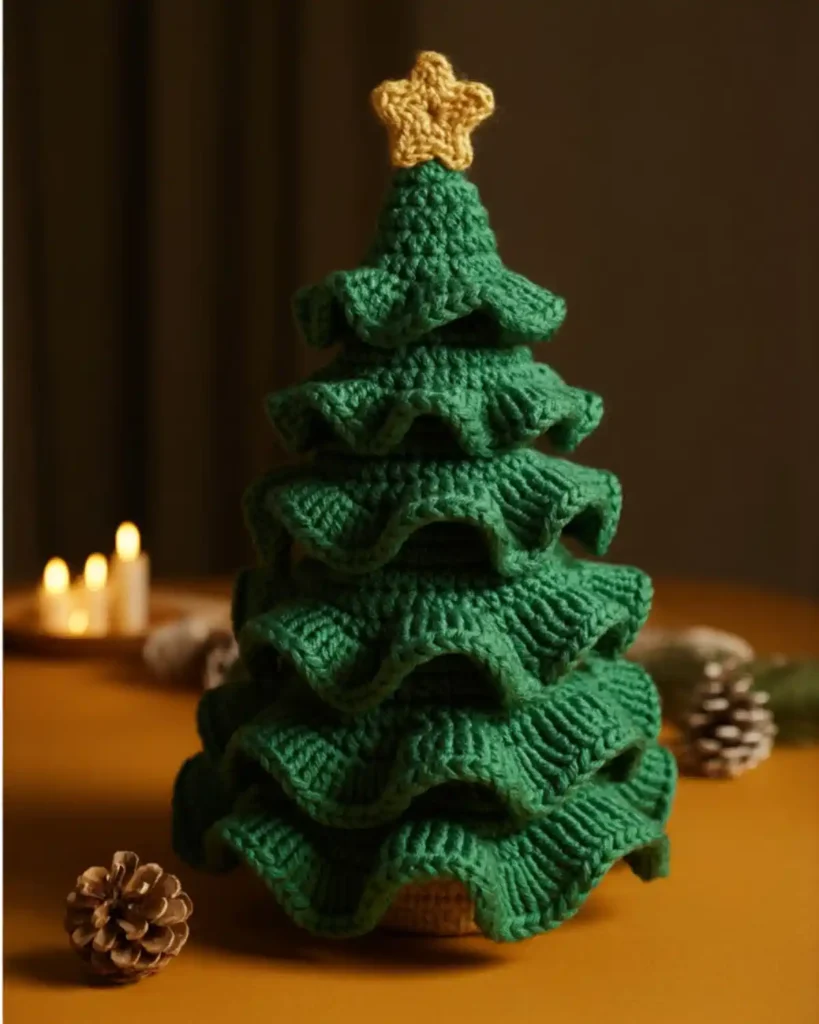
The ruffled Christmas tree is the one to make when a plain cone feels too simple. Layered ruffles create branch-like tiers, so the tree looks fuller and more decorative without requiring dozens of separate pieces. This style works beautifully as a table centerpiece because the texture catches light and gives even one solid yarn color plenty of movement. If you enjoy projects that look more complicated than they actually are, the ruffled finish is the payoff.
Start with a stable cone or central tree body. Add the ruffles in rounds, working into selected loops or surface stitches depending on your construction.
Deep green gives a classic fir-tree look, while cream or white turns the same design into a snowy holiday decoration.
6. Try a Bobble Stitch Christmas Tree for Extra Texture
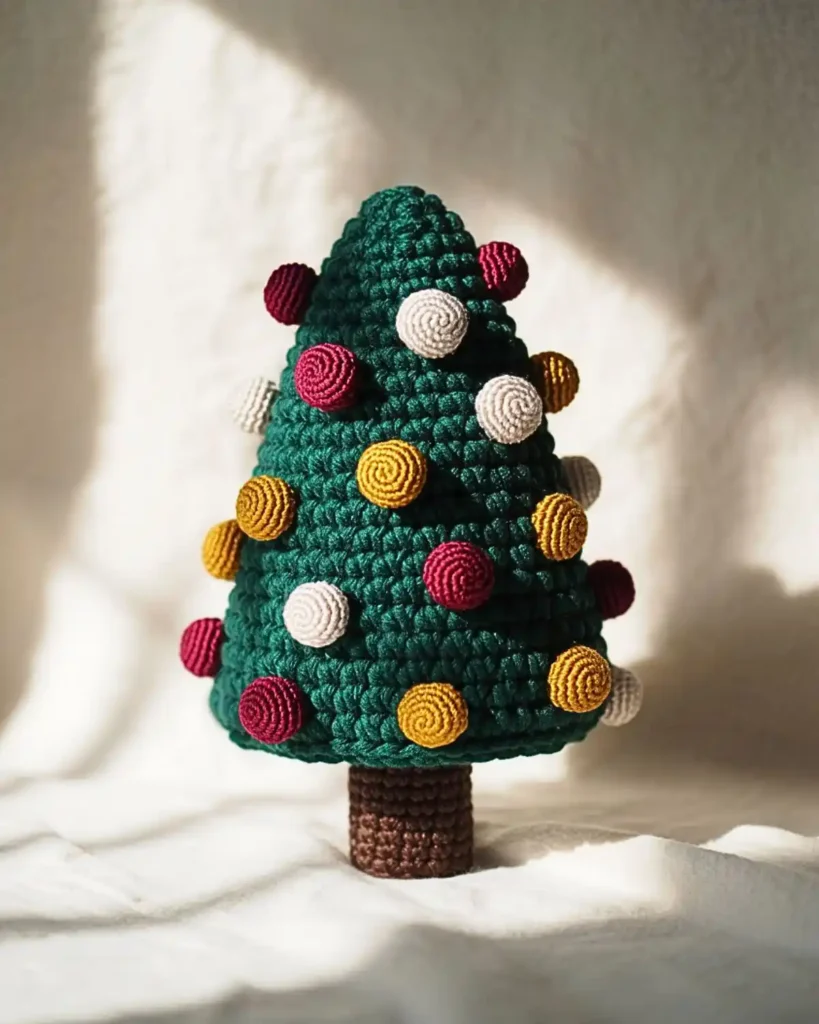
A bobble stitch Christmas tree brings built-in “ornaments” to the fabric before you add a single decoration. Bobbles stand out more than ordinary flat stitches, which makes the tree interesting even in one color. I would use this for a wall hanging or larger ornament where the raised texture is easy to see. It is ideal if you already know basic stitches and want your crochet to do most of the decorating for you.
You can place bobbles randomly like baubles or line them up in diagonal rows to mimic a garland.
For a subtle look, keep everything green. For something playful, work selected bobbles in red, gold, white, or pink.
7. Want a More Elegant Tree? Use Alpine-Style Texture
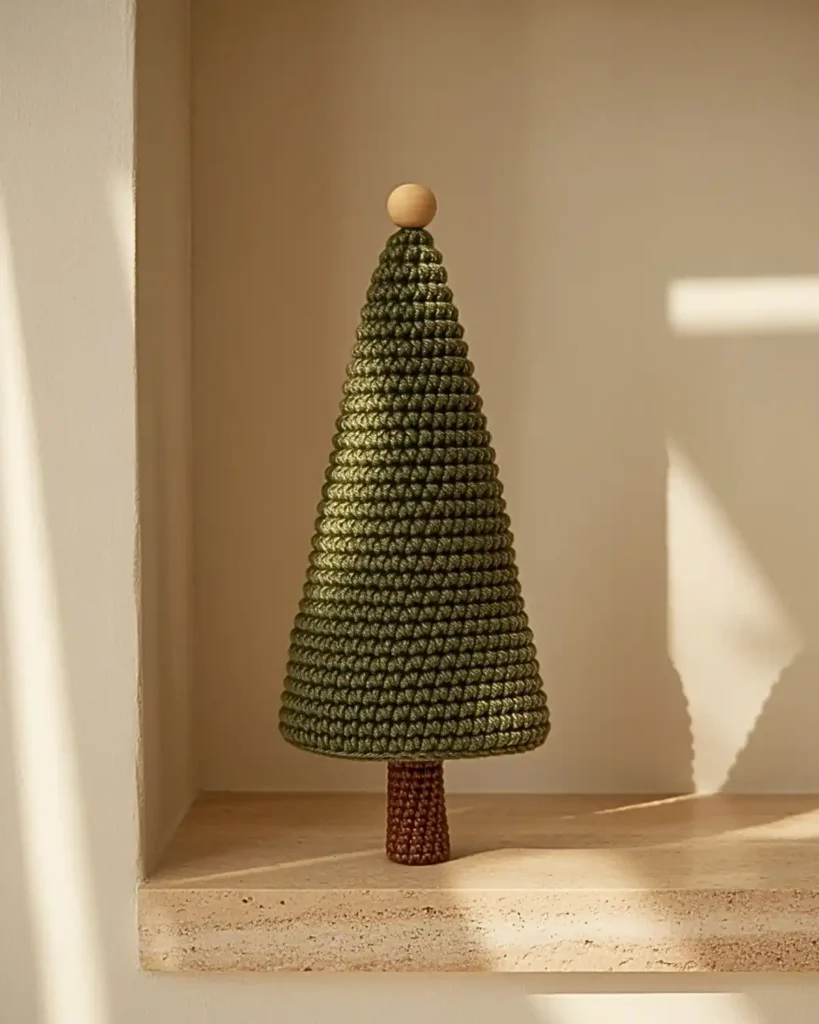
An Alpine-style textured tree has a tall, structured surface that gives simple green yarn a richer, almost carved appearance. It looks more refined than a basic single-crochet triangle, yet you can keep the rest of the design minimal. I especially like this idea for neutral holiday decor where the texture matters more than bright embellishments. Choose it when you want a crochet Christmas tree that feels grown-up and decorative without becoming fussy.
Use the textured section for the tree body, then finish the edge with a simple border so the stitch pattern stays the focus.
A wooden bead or understated star at the top works better here than lots of tiny decorations.
8. Could a Puff Stitch Tree Be Your Coziest Ornament?
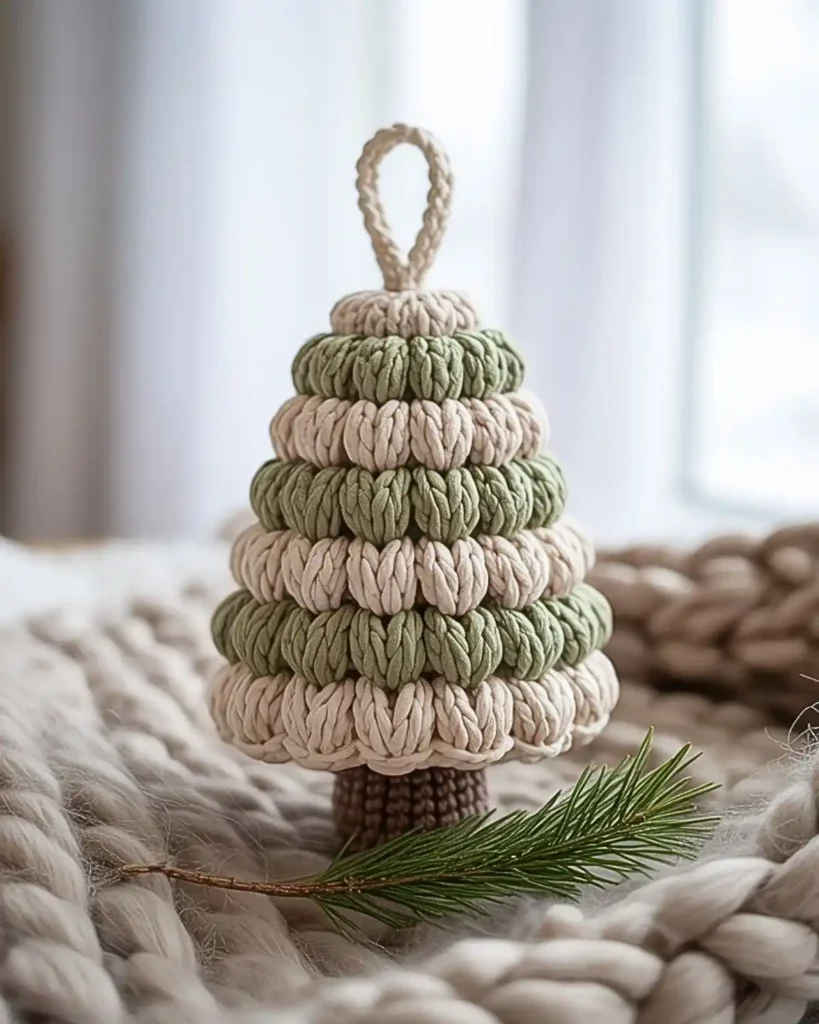
If you are learning how to make puff stitch crochet, the puff stitch Christmas tree is a fun seasonal way to practice because it looks soft, rounded, and almost snowy even before you change colors. Puff stitches give more cushion than a flat fabric, making this style perfect for tactile ornaments and cozy winter garlands. I would make these when I want a handmade tree that looks good in close-up photos as well as on the actual Christmas tree. It is best for anyone who loves texture, and its strongest feature is that a simple silhouette becomes visually rich without extra sewing.
Use puffs for the whole tree or only on selected rows. Alternating puff rows with basic stitches can keep the fabric from becoming too thick.
Special Tip: Make the trunk flatter and simpler than the tree body so the texture does not compete everywhere at once.
9. Have Leftover Yarn? Make a Scrap-Yarn Striped Tree
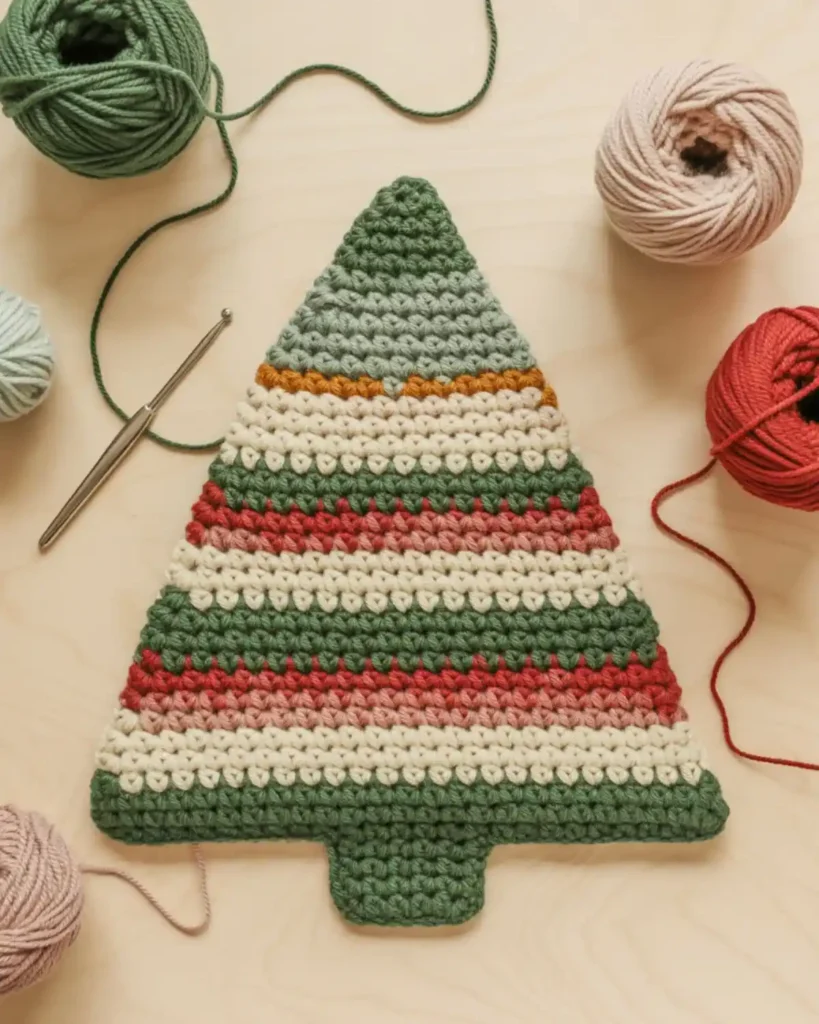
The scrap-yarn striped tree turns small leftovers into a project that actually looks better because the colors are mixed. A single-color tree can be elegant, but stripes add personality and make every finished piece slightly different. This is the project I would save for an evening when I want to use whatever is already in my yarn basket rather than buy another skein. It is perfect for stash-busting, with the bonus that no two trees need to match.
Try combinations such as:
- Forest green + cream + red
- Sage + ivory + gold
- Pink + white + burgundy
- Emerald + navy + silver-gray
- Mixed greens for a natural look
Keep the trunk and outer border consistent across the set if you want all the different stripes to feel connected.
10. Want a Winter Look? Crochet a Snow-Tipped Tree
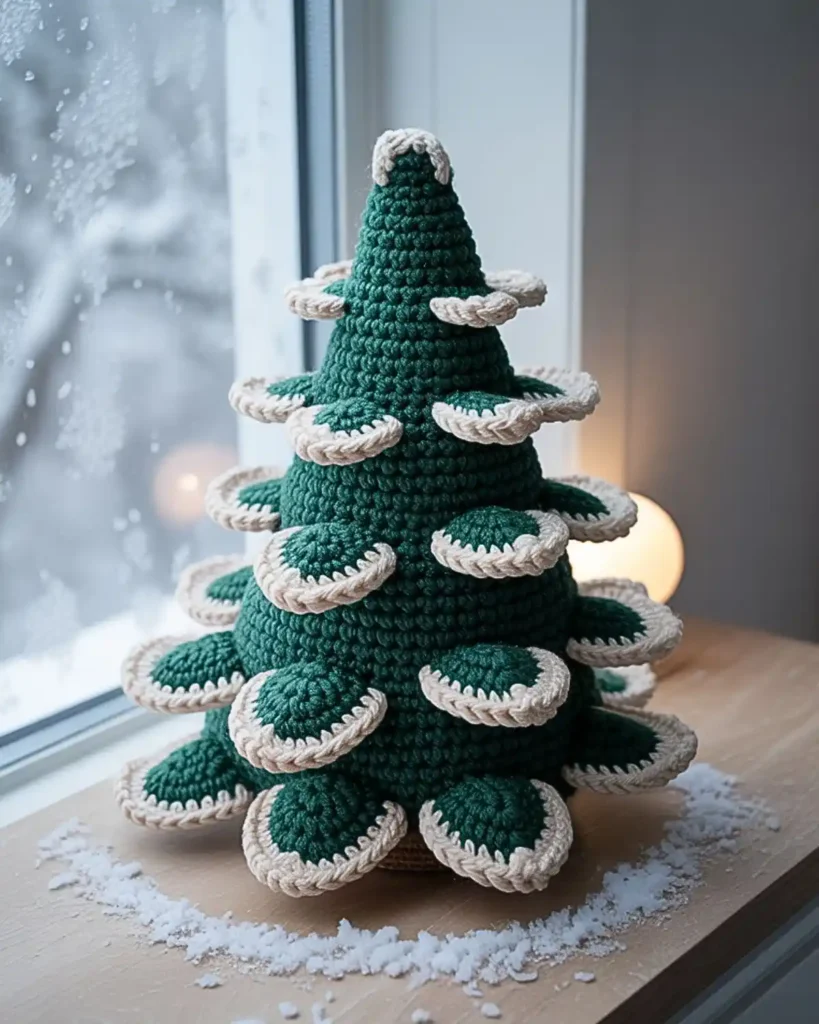
A snow-tipped crochet tree adds a wintry finish without covering the entire project in white. Instead of making the whole tree one pale color, you can keep the body green and add cream or white along branch edges, ruffles, or the final border. I love this on mantel trees because the contrast shows up from across the room. Make it if you want a familiar Christmas palette with one extra detail the snowy edging does most of the visual work.
A brushed or fuzzy white yarn can make the “snow” look softer, but even ordinary smooth yarn works if you keep the edging uneven enough to feel natural.
Use white sparingly around the top and outer edges rather than outlining every single stitch.
11. Prefer Rustic Decor? Add a Chunky Brown Trunk
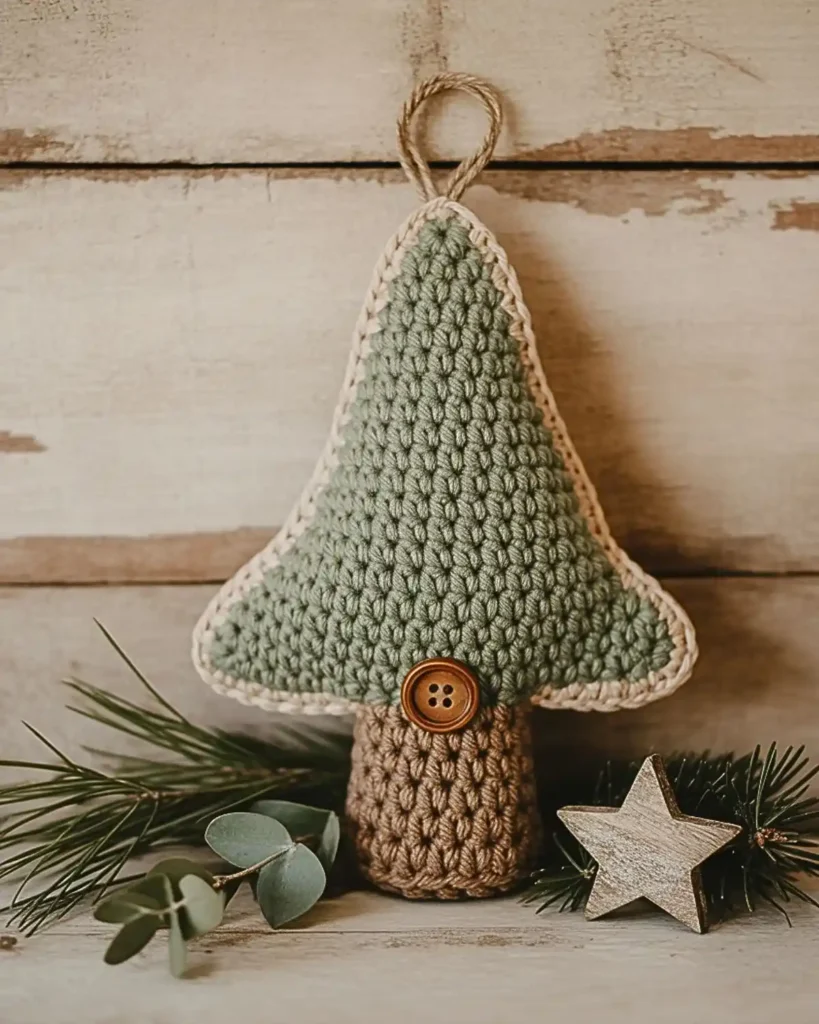
The rustic trunk Christmas tree is less about changing the green tree and more about giving the base some character. A thicker brown trunk, wood-toned button, or simple wrapped stem creates a warmer farmhouse look than a tiny flat rectangle. I would pair this with natural green, oatmeal, cream, or muted red if I were decorating a basket, shelf, or handmade gift. It is for anyone who leans rustic rather than glittery, and the best part is how one small base detail changes the entire mood.
Keep the tree itself fairly simple so the earthy materials stand out.
A loop of jute-style cord can also work visually with this design, but keep hanging hardware secure and appropriate for where the ornament will be used.
12. Can You Decorate a Crochet Tree With Beads?
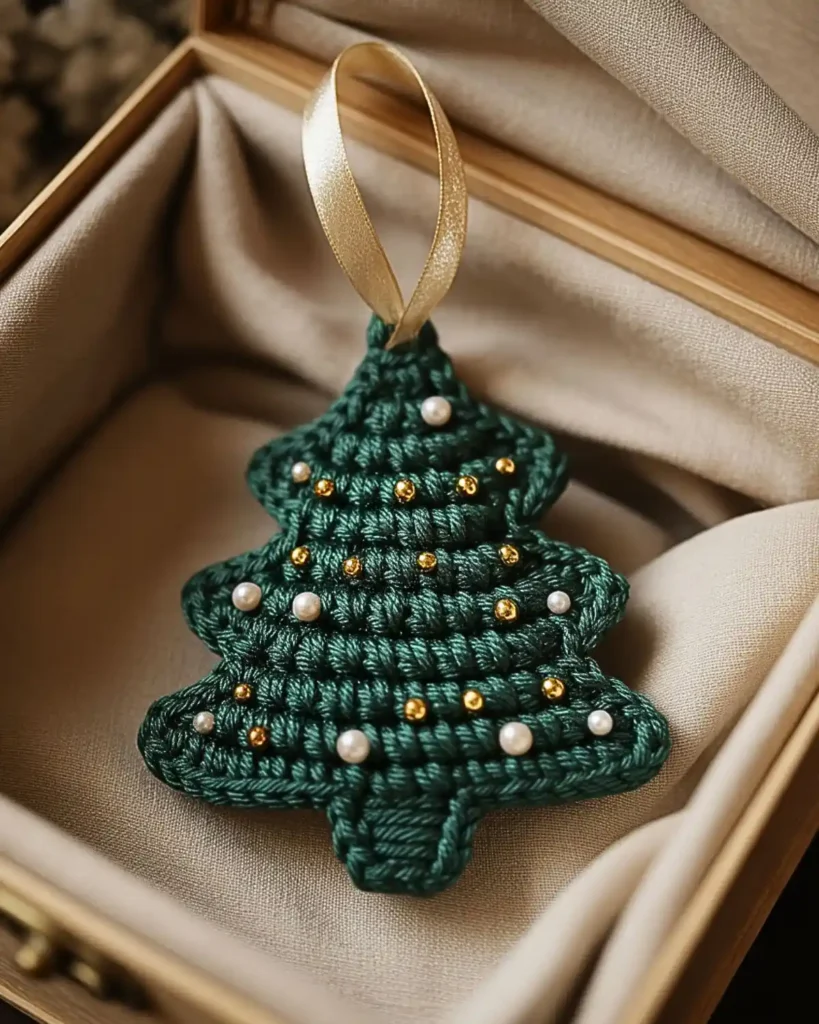
A beaded crochet Christmas tree gives you sparkle without needing metallic yarn across the entire piece. Beads catch points of light more sharply than stitched decorations, so even a small ornament can look dressed up. I would use this idea for adult gift sets, keepsake ornaments, or a tree displayed where the details can be seen up close. Choose beads when you want a more jewelry-like finish, the contrast between soft yarn and hard sparkle is what makes it work.
Plan your bead placement before attaching anything. A few evenly spaced accents usually look cleaner than filling every row.
If the decoration will be around young children, skip detachable beads and use embroidered dots or contrasting bobbles instead; CPSC guidance emphasizes keeping small parts away from children under three.
13. Want Something Playful? Add Tiny Pom-Pom Ornaments
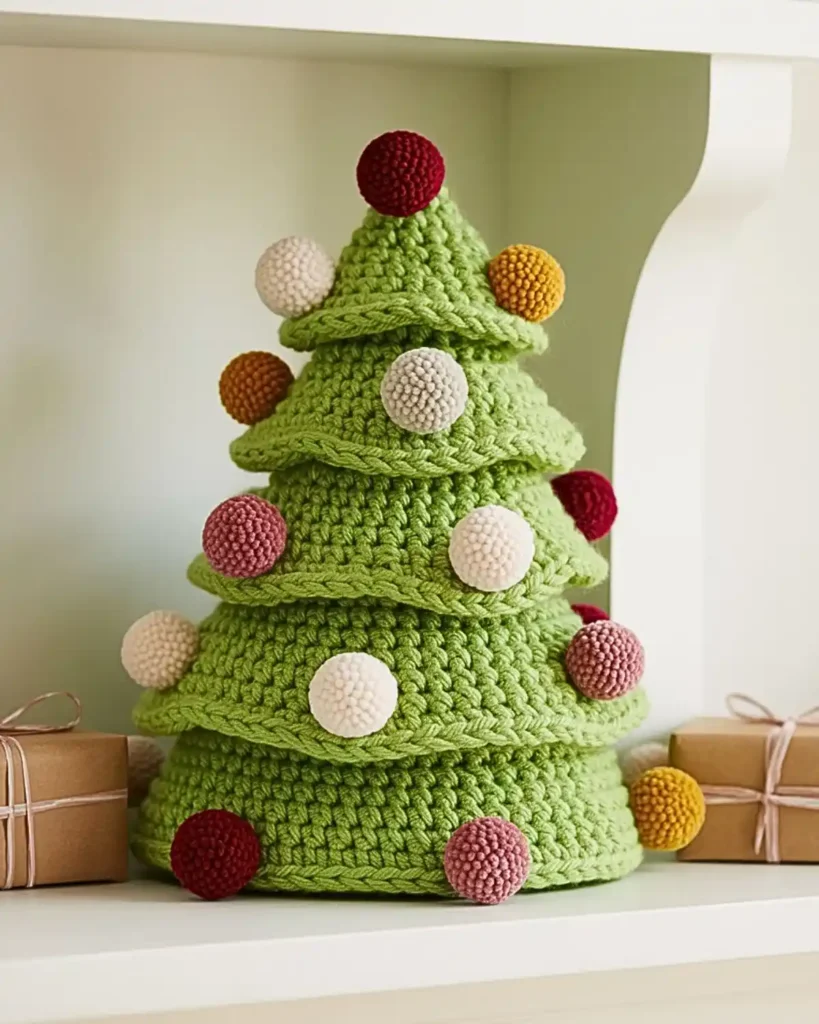
A pom-pom crochet tree feels cheerful almost instantly. Tiny pom-poms create round ornaments with more softness than buttons or beads, making them a natural match for yarn. This is the version I would choose for colorful holiday decor, a craft-room tree, or a playful garland across a child’s room where the piece can be kept safely out of reach if it has detachable parts. If your Christmas style is bright and fun, the biggest payoff is how much color you can add without changing the crochet itself.
Use three or four colors repeatedly instead of a completely random palette. That small rule keeps the finished tree from looking too busy.
For a no-sew variation, crochet small bobbles directly into the fabric instead.
14. How Do You Finish a Tree With a Crochet Star Topper?
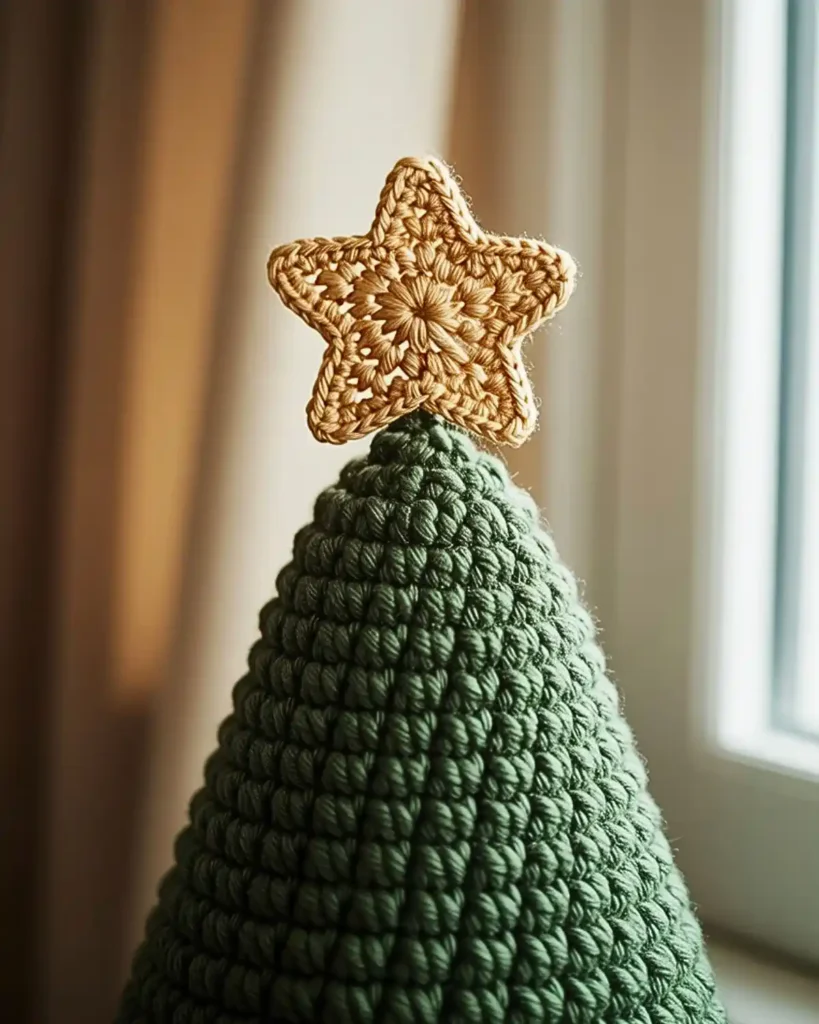
A star-topper crochet tree looks complete in a way that an undecorated pointed triangle sometimes does not, especially if you already enjoy making crochet stars for holiday projects. A tiny star creates a clear focal point and gives you a chance to bring in gold, cream, white, or a contrasting accent color. I like it on tabletop trees where the topper can be slightly oversized without getting lost among other ornaments. It is a good finishing idea when the tree body is simple because the star becomes the one detail everyone notices first.
Make the star separately and sew it securely to the tree, or work a simplified point motif directly at the top.
For flat hanging ornaments, keep the star lightweight so the tree does not flop forward.
15. Need More Than One? Make a Crochet Christmas Tree Garland
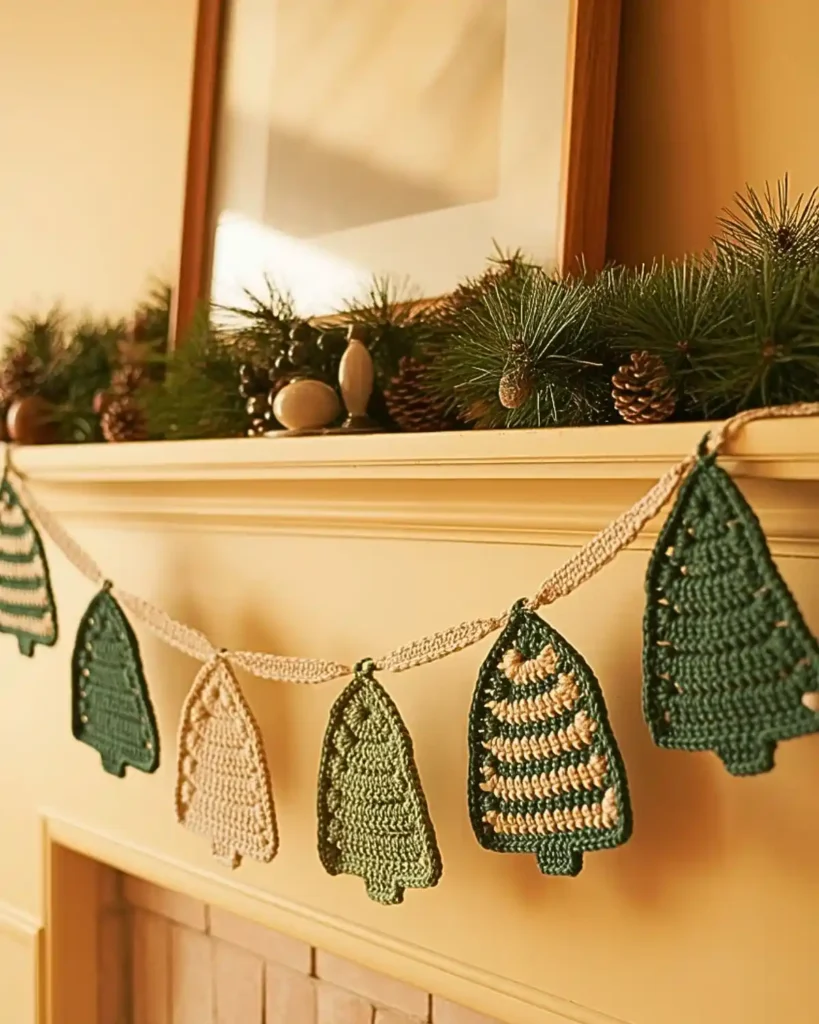
A crochet Christmas tree garland turns the repetition of a small motif into the whole design. One tiny tree might disappear on a large wall, but a row of six, eight, or ten can stretch across a mantel, window, shelf, or headboard. This is what I would make when I want a project I can pick up for ten minutes at a time and still see steady progress. It is ideal for batch crocheting, and the real advantage is that every leftover scrap can become another flag in the garland.
Keep each tree identical for a clean look, or alternate styles:
- Solid green
- Green and cream stripe
- White “snow” tree
- Granny-style tree
- Textured tree
Join them with a long crochet chain, leaving enough space between motifs so each silhouette is easy to see.
16. Could a Crochet Tree Become a Mug Coaster?
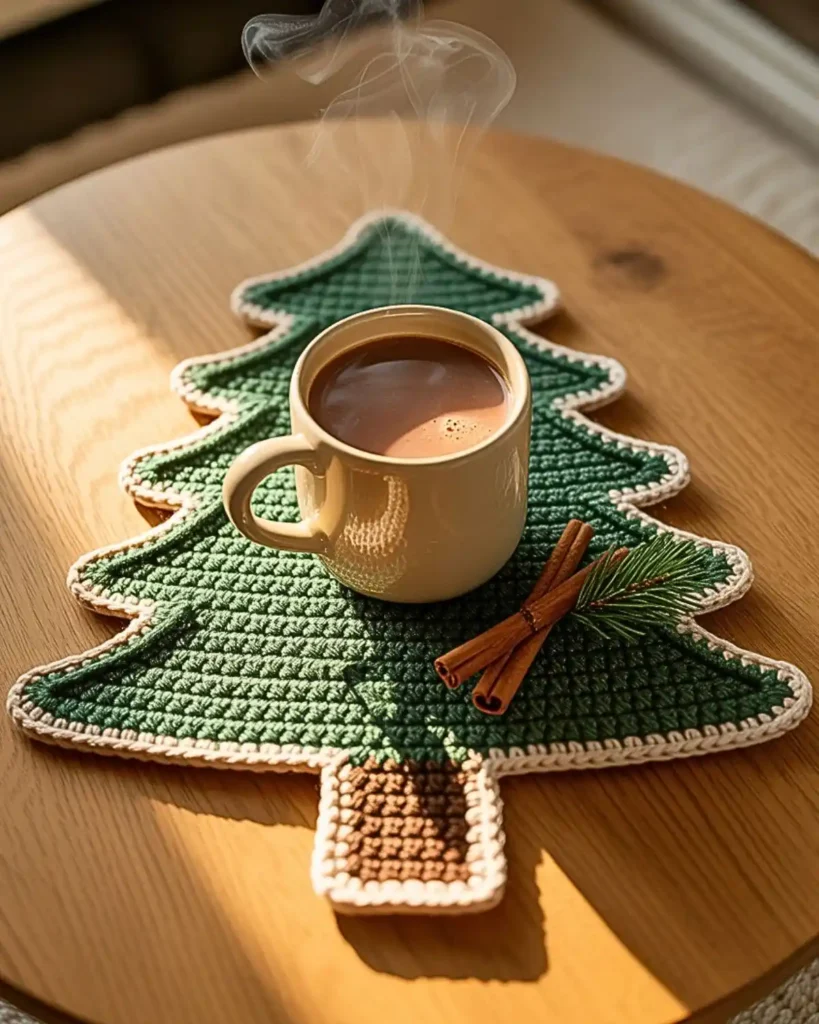
A Christmas tree coaster makes holiday crochet useful without losing the fun shape. A hanging ornament is only seen as decoration, but a flat tree coaster can bring the same motif to a coffee table, desk, or Christmas movie night setup. I would make a set of four in slightly different greens so each one feels handmade but still coordinated. It is a practical choice for crocheters who prefer small functional projects, with the added benefit that flat pieces store easily after the season.
Keep the branches broad enough that a mug has a stable center area. A firm, dense fabric will usually sit flatter than a very open lace stitch.
Add a contrasting border if the tree shape needs more definition against the table.
17. Want a Bigger Statement? Make a Crochet Tree Wall Hanging
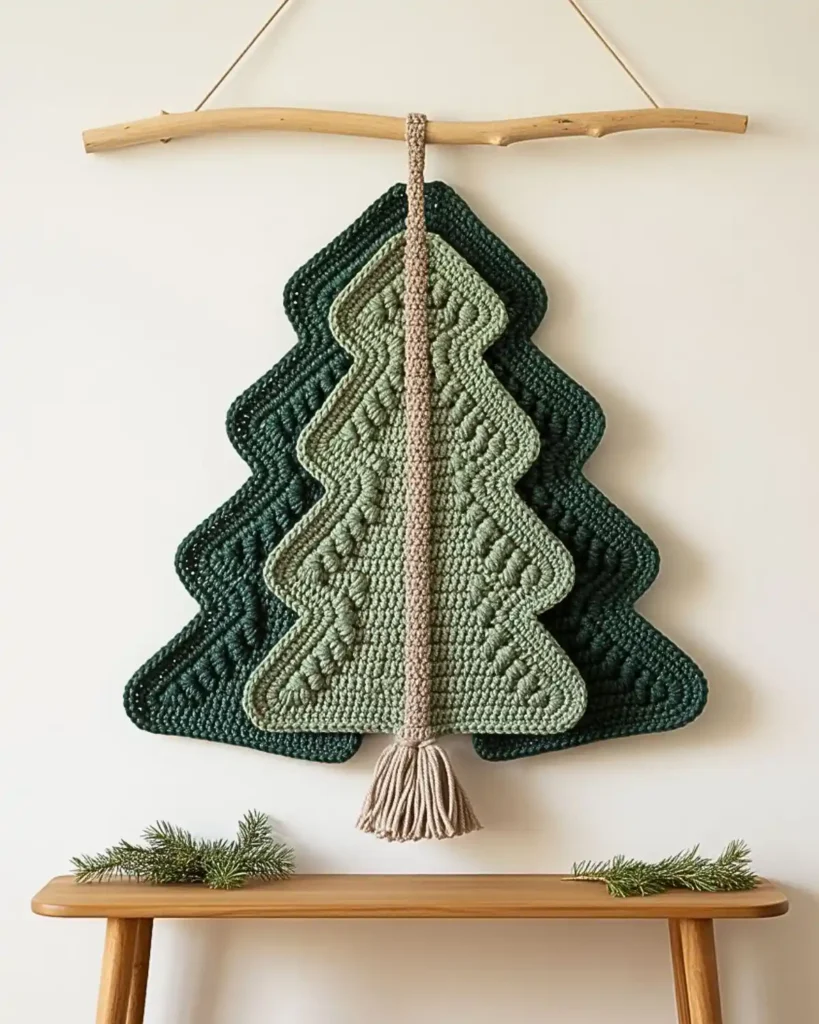
The crochet Christmas tree wall hanging takes the familiar tree motif off the tabletop and gives it enough scale to fill an empty seasonal wall. Unlike a tiny ornament, it gives you room for texture, tassels, color blocks, bobbles, and a proper trunk. I would use it above a console table, in an entryway, or in a small home where there is not enough floor space for another decorative tree. It is best when you want one handmade focal point, and the biggest advantage is that it packs flat when Christmas is over.
You can build the tree from stacked triangles, rows of textured stitches, or several joined motifs.
A wooden dowel creates a clean top edge, while a long yarn loop makes hanging simple.
18. Looking for a Cute Gift? Try a Tree Gift Card Holder
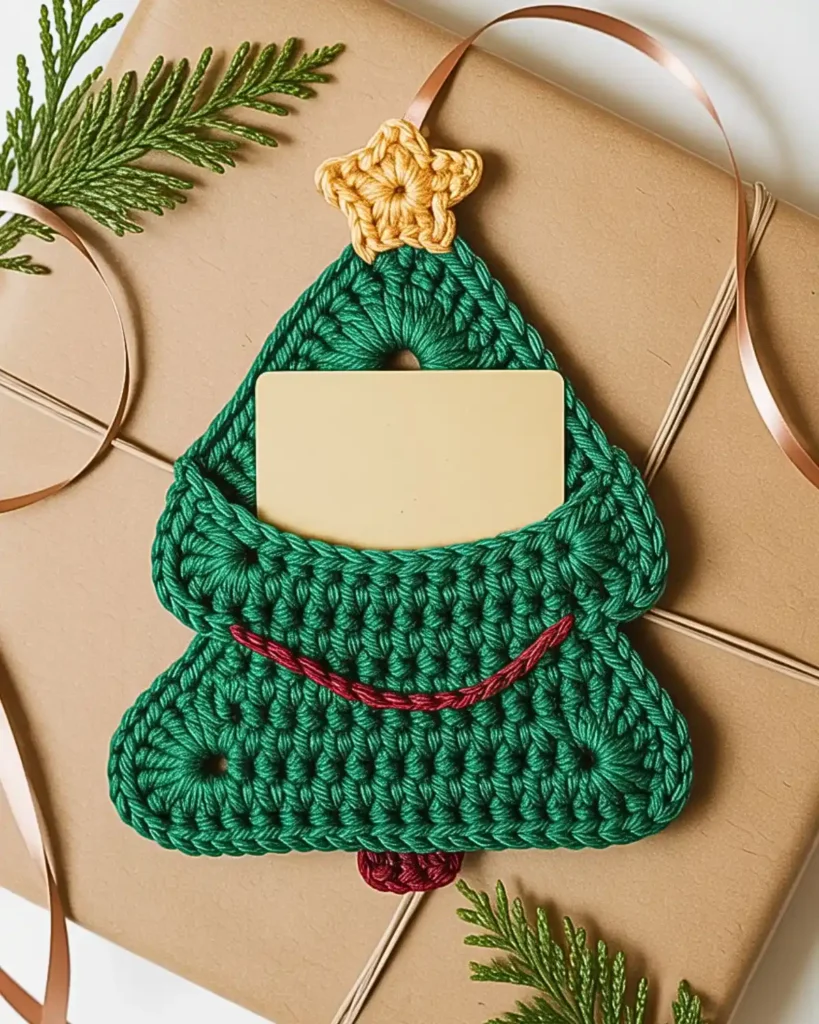
A crochet Christmas tree gift card holder makes a small present feel much more personal. Instead of slipping a card into a paper envelope, you can crochet a tree-shaped pocket that becomes part of the gift. This is exactly the sort of project I would batch-make for teachers, coworkers, older teens, or last-minute holiday presents. It is worth choosing when the gift itself is tiny, because the handmade holder gives you something substantial to present.
The easiest construction is two flat pieces joined around the sides and bottom, leaving an opening large enough for the card.
Add a loop and the holder can become an ornament after the gift card is removed.
19. Need Holiday Packaging? Crochet a Christmas Tree Treat Bag
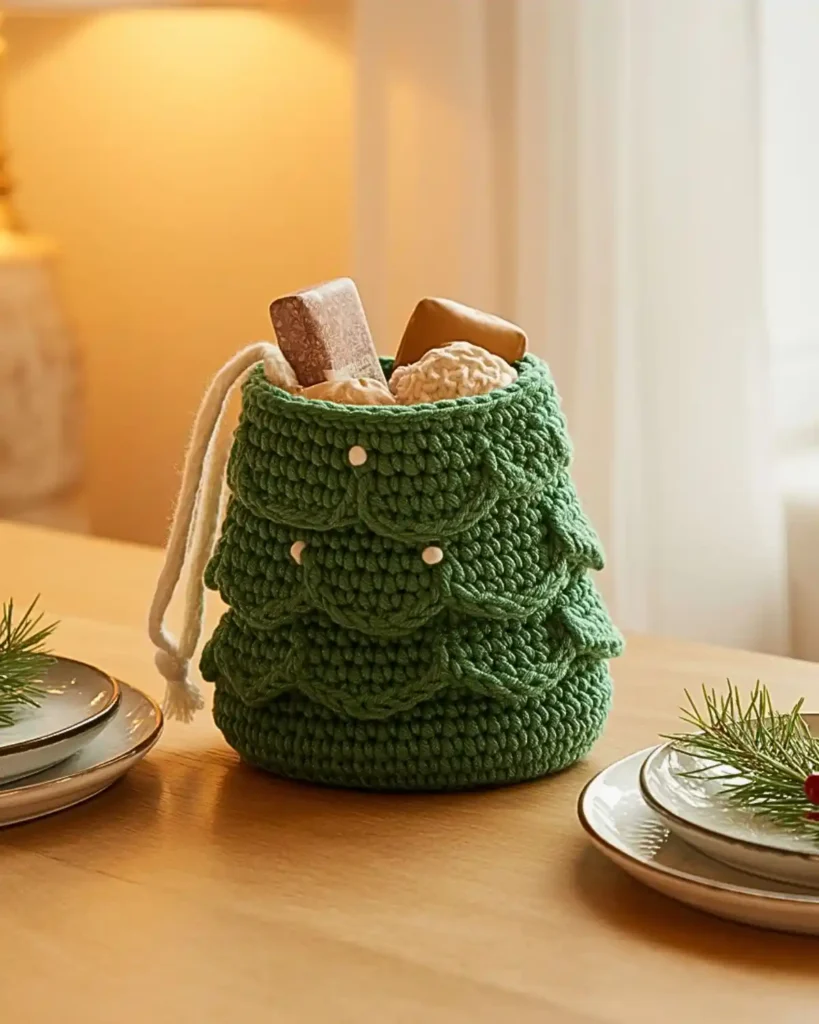
The Christmas tree treat bag combines decoration and wrapping in one reusable little project. A paper favor bag does the job once, but a crocheted pouch can hold candy, a note, jewelry, or a small handmade gift and still be used again. I would place these at holiday table settings or fill a few for neighbors when I want the packaging to feel just as thoughtful as the contents. Choose this idea for small gifting, and its strongest feature is that the tree shape makes even simple treats look festive.
Keep the bag body roomy and use a drawstring or flap that is easy to open.
For children, avoid loose buttons, beads, or other small removable embellishments; simple embroidery or colorwork is a safer decorative direction around very young children. CPSC holiday guidance specifically warns about small parts and other decoration hazards.
20. How About a Tiny Forest for Your Mantel?
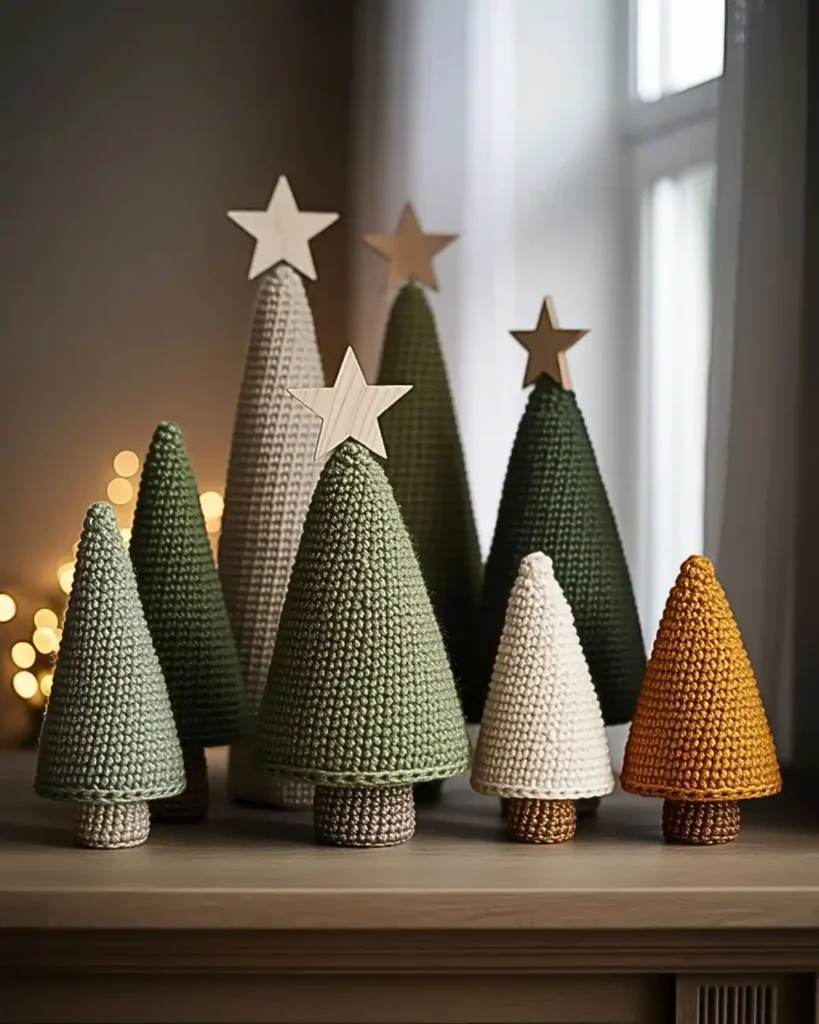
A crochet Christmas tree forest looks more impressive than one standalone tree even though every piece can use the same basic construction. Mixing heights makes the arrangement feel layered, while repeating yarn colors keeps it calm. I would group three to seven trees on a mantel, bookshelf, windowsill, or dining table and let the difference in size do most of the styling. This is perfect if you enjoy making the same pattern more than once, because the finished collection looks intentional rather than repetitive.
Try one of these simple formulas:
| Tree | Height | Color Idea |
|---|---|---|
| Small | 4–5 in | Cream |
| Medium | 6–7 in | Sage |
| Tall | 8–10 in | Forest green |
You can also use one yarn color for every tree and vary only the texture.
21. Want a Cute Character? Make an Amigurumi Christmas Tree
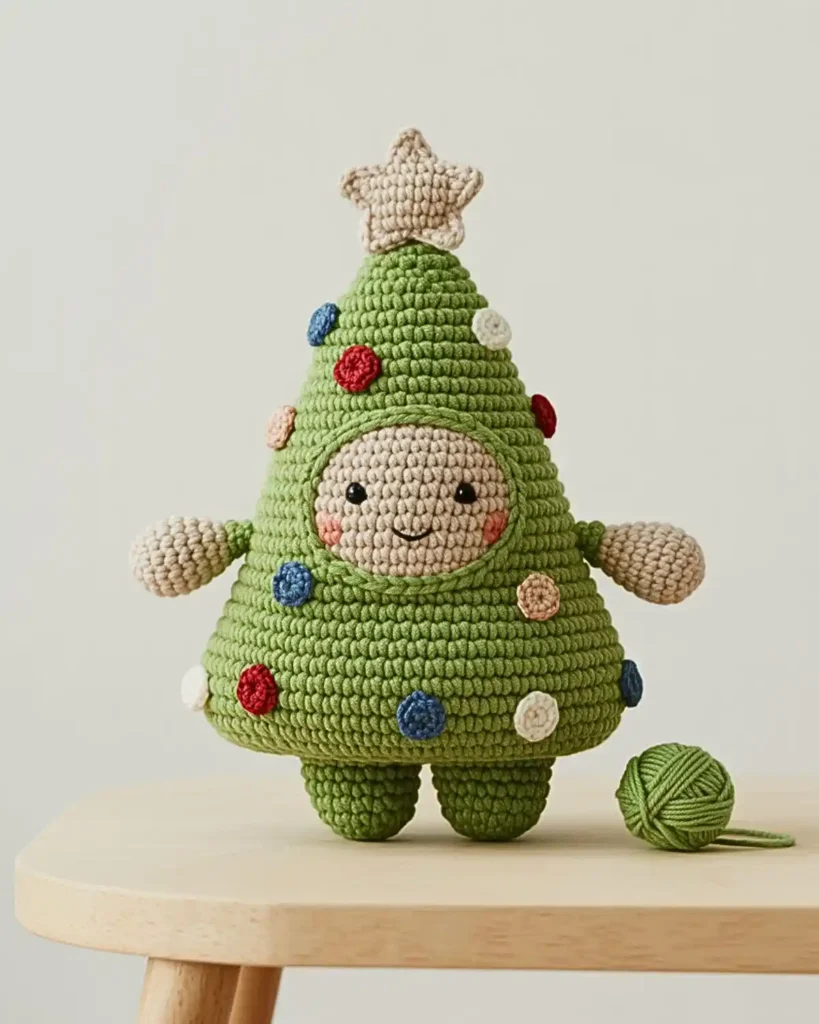
If you enjoy free amigurumi crochet patterns, an amigurumi Christmas tree takes the holiday motif in a sweeter, more toy-like direction. Instead of a flat triangle or hollow cone, you crochet a stuffed body in rounds and can add a face, little arms, or tiny stitched decorations. I would put one on a desk, tuck it into a holiday gift basket, or make a small family of trees with different expressions. It suits crocheters who enjoy shaping and stuffing, and the best part is how much personality you can give a very simple silhouette.
Use a stitch marker so you always know where each round begins. Keep stuffing even as you work, especially around the tip and base.
If you add facial features, embroidery keeps the surface soft and avoids relying on detachable embellishments.
22. Want the Simplest Modern Tree? Try a Minimalist Neutral Design
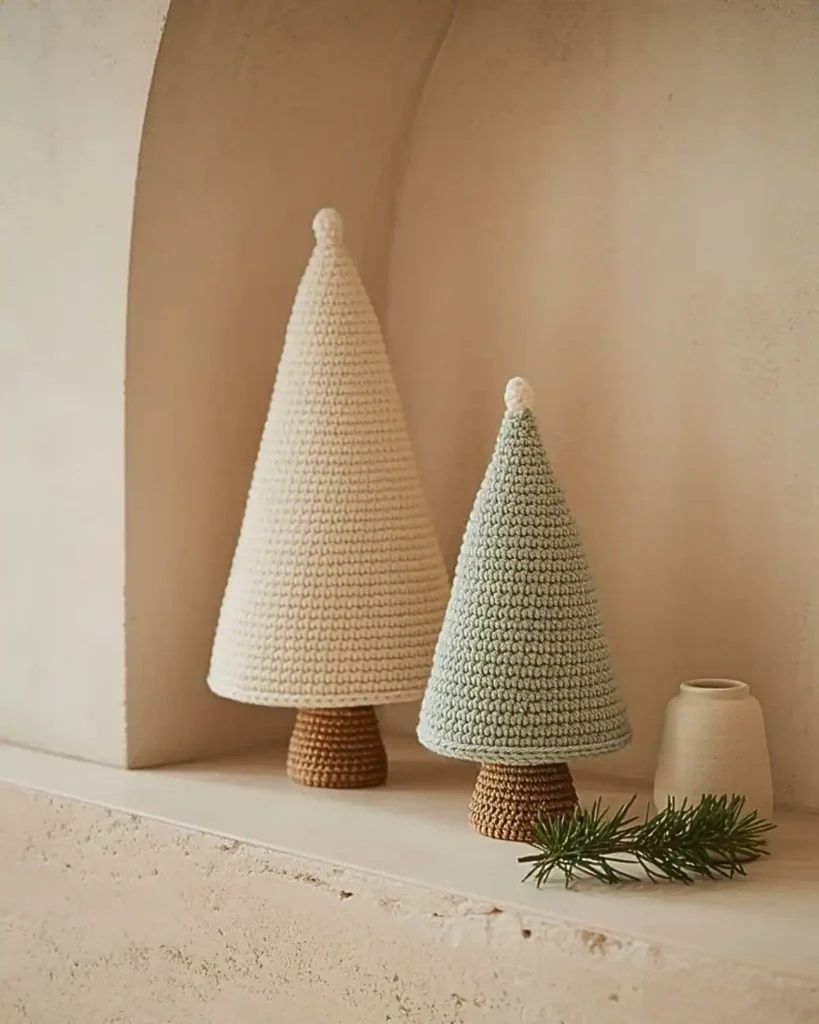
The minimalist crochet Christmas tree proves that holiday crochet does not need red, green, glitter, and ten different embellishments to feel festive. A clean triangle or cone in cream, oatmeal, taupe, sage, or charcoal can look surprisingly modern beside wood, ceramic, and natural greenery. This is the version I would choose for a neutral living room where bright novelty decorations would feel out of place. Make it if you want something you will still love in a few years the best feature is its quiet, flexible styling.
Skip most surface decorations. Let the silhouette, texture, and yarn color do the work.
A tiny wood-toned trunk or one simple star is usually enough to finish it.
How Do You Choose the Right Crochet Christmas Tree Pattern?
Choose a crochet Christmas tree pattern by deciding where the finished piece will be displayed, then match its construction method to your skill level, desired size, and need for structure.
At a Glance:
- Use flat rows for beginner projects.
- Join panels for soft stuffed ornaments.
- Work rounds for cones and amigurumi.
- Add layers for fuller decorative trees.
- Choose texture when embellishments are unnecessary.
Start with where the finished tree will go. A hanging ornament needs to be light, a tabletop tree needs enough structure to stand, and a wall hanging needs a strong silhouette from several feet away.
Then choose the construction method that matches your comfort level:
- Flat rows: Best for beginners, ornaments, coasters, and garlands.
- Two joined panels: Best for lightly stuffed ornaments and gift holders.
- Continuous rounds: Best for cones and amigurumi trees.
- Layered motifs or ruffles: Best for fuller decorative trees.
- Textured stitches: Best when you want the yarn itself to act as decoration.
If you are new to pattern reading, learn the basic abbreviations before starting. The Craft Yarn Council explains that crochet instructions commonly shorten terms such as chain (ch), slip stitch (sl st), single crochet (sc), and double crochet (dc), and notes that patterns may be worked in rows or rounds.
What Size Hook Should You Use?
Use the hook size recommended for your yarn and pattern, then adjust only when needed to achieve the required gauge or a deliberately firmer decorative fabric.
At a Glance:
- Check the pattern’s recommended hook first.
- Compare hook sizes using millimeters.
- Make a gauge swatch when size matters.
- Use denser fabric for stuffed decorations.
- Avoid assuming one hook fits every yarn.
Use the hook size required by the specific yarn and pattern rather than assuming every Christmas tree needs the same hook. The Craft Yarn Council’s standard system shows that recommended hook ranges change with yarn weight, and it specifically recommends checking a gauge swatch when finished size matters.
For a purely decorative tree, you can sometimes use a slightly smaller hook to create a denser fabric, especially for stuffed pieces. Treat that as a design adjustment, though, not a substitute for the pattern’s stated gauge when exact dimensions matter.
How Can You Make Crochet Christmas Trees Look More Professional?
Clean finishing, balanced embellishments, consistent colors, and repeated design details can make a simple crochet Christmas tree look much more polished.
At a Glance:
- Weave in every loose yarn end.
- Block flat pieces when appropriate.
- Limit competing decorative elements.
- Repeat colors across coordinated sets.
- Keep borders and trunks consistent.
Small finishing choices make the biggest difference.
First, weave in ends neatly and block flat pieces if the yarn and project construction allow it. Second, keep ornament placement balanced instead of filling every available stitch. Finally, use a consistent palette across a set of trees so different textures still look coordinated.
I also like to repeat one detail, such as the same cream edging, brown trunk, or gold star across several designs. That creates a collection instead of a pile of unrelated samples.
Are Crochet Christmas Tree Decorations Safe Around Candles and Children?
Crochet Christmas decorations should be kept away from open flames and heat sources, while detachable beads, buttons, bells, and similar small parts need extra caution around young children.
At a Glance:
- Keep yarn decorations away from flames.
- Prefer flameless candles near crochet decor.
- Avoid loose small parts around toddlers.
- Secure embellishments carefully.
- Use embroidery when detachable pieces are unnecessary.
Treat yarn decorations as decorative textiles and keep them away from open flames or other heat sources. The U.S. Consumer Product Safety Commission advises never leaving burning candles unattended, keeping them away from flammable items, and using flameless candles whenever possible.
NFPA also emphasizes careful holiday decorating as part of winter-holiday fire safety.
For homes with young children, avoid or securely manage removable beads, buttons, bells, and similar small pieces. CPSC guidance specifically calls out small parts as a choking concern for children under three.
Where Can You Find Crochet Christmas Trees Free Inspiration?
Start with flat triangles, granny-style motifs, scrap-yarn trees, garlands, and two-panel ornaments when you want simple crochet Christmas tree inspiration that is easy to customize.
At a Glance:
- Begin with basic triangle construction.
- Use scraps before buying new yarn.
- Try garlands for repeatable motifs.
- Choose flat pieces for easy customization.
- Compare construction styles before selecting a pattern.
If you searched “crochet christmas trees free”, begin with the simplest construction styles in this list: flat triangles, granny trees, scrap-yarn stripes, garlands, and two-panel stuffed ornaments. They use familiar crochet techniques and are easy to customize without buying special materials.
You can also use the ideas here as a planning guide before choosing a full stitch-by-stitch pattern. On CrochetMind, the goal is to make it easier to decide what style you actually want to crochet before you commit your yarn and time.
Frequently Asked Questions
Is a crochet Christmas tree easy for beginners?
Yes. A flat triangle tree made in rows is one of the simplest options because it can use basic stitches, straightforward increases or decreases, and very little finishing.
Start with one color and minimal embellishment so you can focus on shaping the tree before adding decorative details.
What yarn is best for crochet Christmas trees?
DK and worsted-weight yarns are versatile choices for many decorative projects, but the best yarn is the one specified by your pattern or suited to your desired size and structure. The Craft Yarn Council provides standardized yarn-weight and hook guidance to help compare options.
Can I use scrap yarn for crochet Christmas trees?
Absolutely. Small flat ornaments, granny trees, striped trees, and garlands are especially good for using short lengths of leftover yarn in coordinated colors.
For readers searching “crochet christmas trees free”, scrap-yarn projects are especially useful because you can experiment with several tree styles before committing to a larger project.
How do I make a crochet Christmas tree stand up?
Choose a cone-shaped or stuffed construction with a stable base. Depending on the design, you can use firm crochet fabric, light stuffing, or a suitable inner form to help the tree keep its shape.
Should I use U.S. or U.K. crochet terms?
Use whichever system your pattern specifies, but do not mix them. The Craft Yarn Council documents key differences between U.S. and U.K. terminology, including the fact that U.S. single crochet is called double crochet in U.K. terminology.
Final Thoughts
There is no single “right” crochet Christmas tree. A tiny flat ornament, a ruffled cone, a granny-style tree, and a soft amigurumi version can all start with the same basic idea and end up looking completely different.
Pick the project that fits where you want to display it, use yarn you actually enjoy working with, and keep the decorations as simple or detailed as your Christmas style calls for. Once you make one, the hardest part may be stopping at one—because a little handmade forest is usually even better.

![The Best 30+ Free Crochet Cat Patterns [Beginner-Friendly Guide]](https://crochetmind.com/wp-content/uploads/2025/04/1-The-Best-30-Free-Crochet-Cat-Patterns-Beginner-Friendly-Guide.webp)