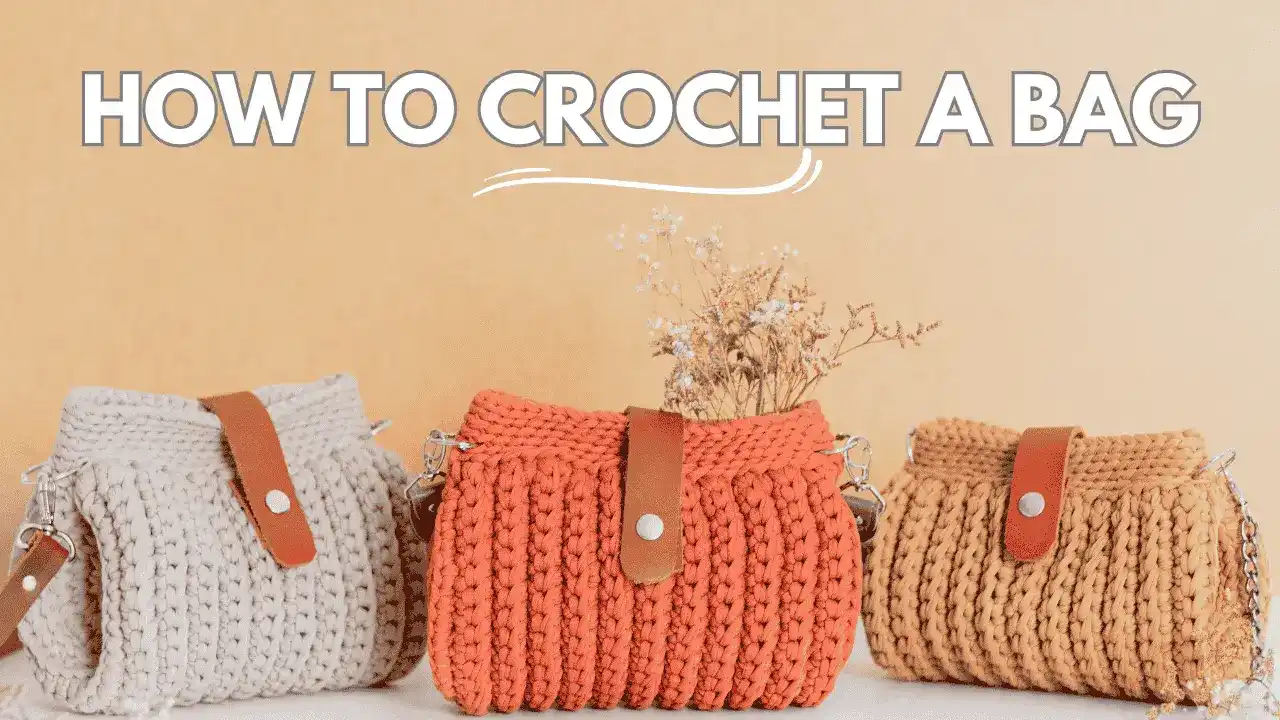
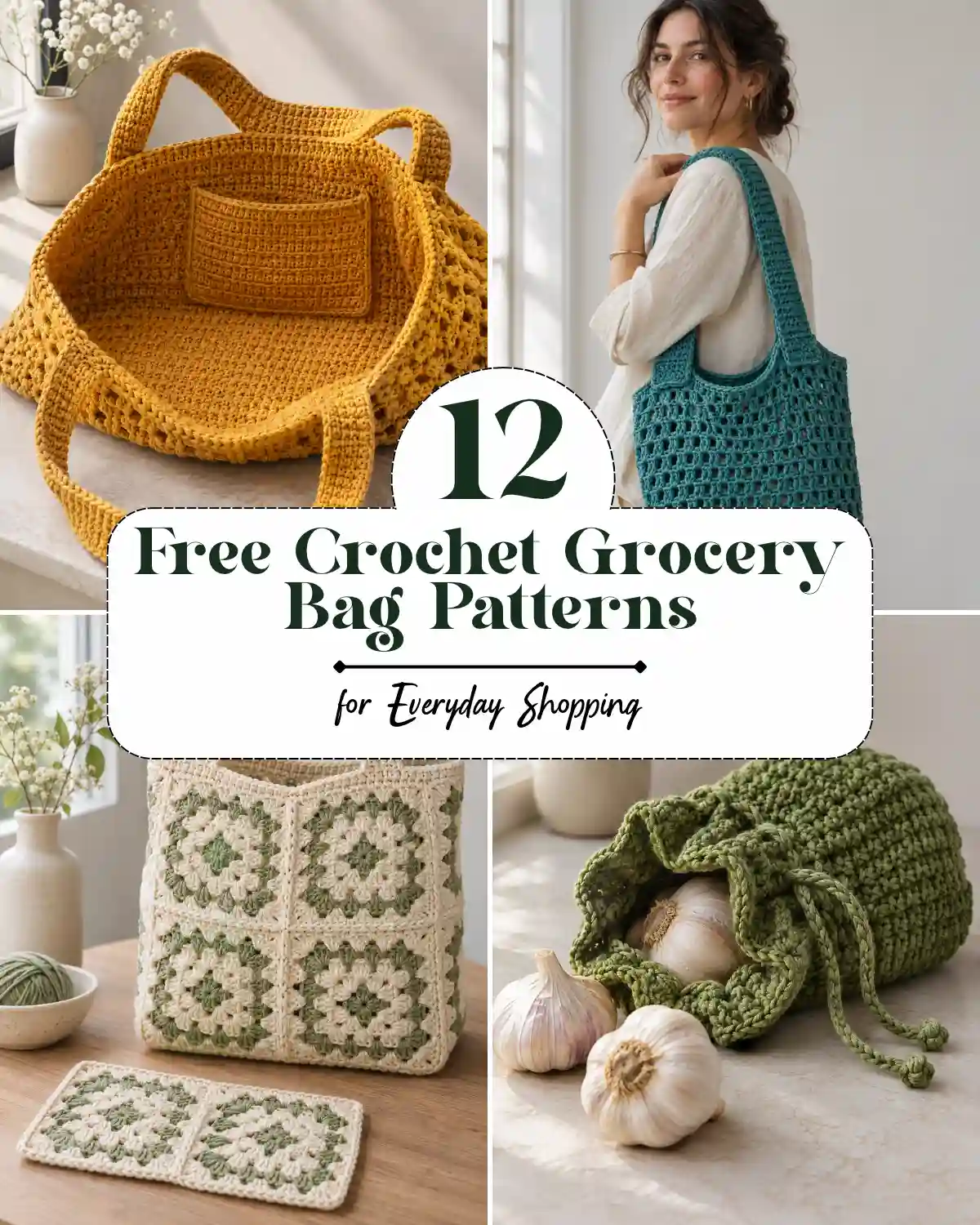
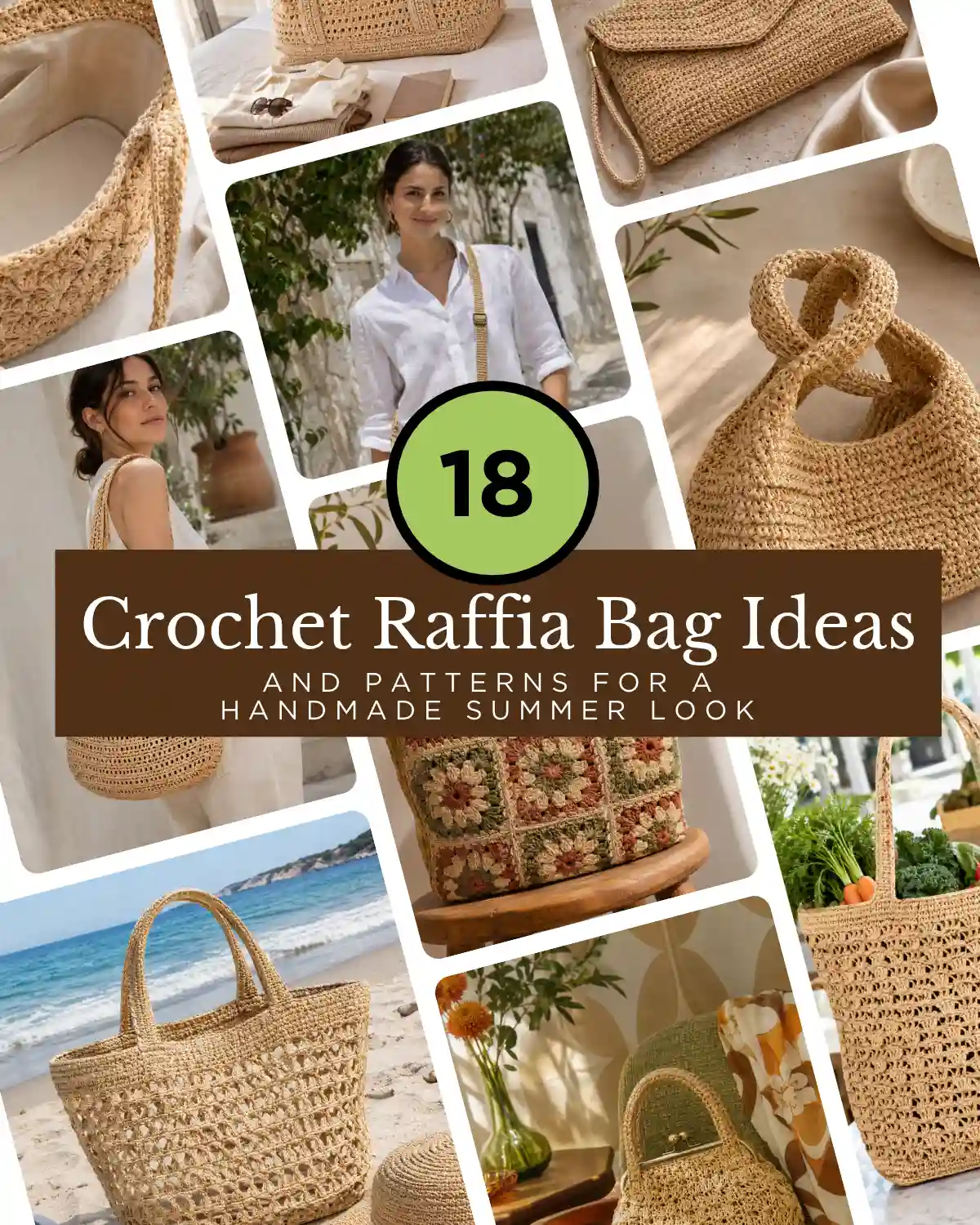
A crochet grocery bag might be a mesh tote for vegetables, a flat-bottomed carrier for cartons, or a drawstring produce pouch. Here are 12 free crochet grocery bag patterns, with original instructions, yarn requirements, hook sizes, and available dimensions. Beginners can start with a mesh crochet market bag; shoppers carrying boxed staples can choose a structured tote.
There’s something satisfying about choosing a bag for the way you actually shop, rather than picking one just because it looks pretty. Compare the projects below, then open the original designer’s pattern when you’re ready to start.
Key Takeaways
- Start with mesh for a first crochet market tote.
- Choose a solid base for cartons and boxed staples.
- Use fine mesh and drawstrings for small produce.
- Check yarn yardage, hook size, and designer measurements.
- Test handles before carrying your usual grocery load.
Which Crochet Grocery Bag Should You Make First?
Match the bag to your shopping: loose mesh for bulky greens, a dense base for cartons, and small openings for loose produce.
| Your usual shopping trip | Best pattern to explore | Why it fits | Carry style |
|---|---|---|---|
| First attempt at a tote | 1. Beginner Mesh | Visible chain spaces and basic repeats | Short handles |
| Cartons, jars, or dry staples | 2. Solid-Bottom or 6. Boxy | Firmer bottom or structured gusset | Hand carry |
| Bread and leafy greens | 3. French Net or 12. Expandable | Flexible, roomy netting | Hand or shoulder carry |
| Garlic and loose vegetables | 4. Drawstring Produce | Smaller openings and a cord closure | Produce pouch |
| A spare bag in your handbag | 5. Foldaway or 7. One-Skein | Compact design | Tote handles |
| A colorful market trip | 8. Granny Stitch or 9. Granny Square | Clusters or joined motifs | Tote handles |
| Walking with hands free | 10. Long-Strap | Extended crossbody strap | Across the body |
| Reusing clean plastic bags | 11. Recycled Plarn | Crocheted plastic strips | Hand carry |
Every link leads to the designer’s free instructions. Specifications are designer-reported; CrochetMind has not sample-tested these bags.
What Materials Do You Need for a Crochet Grocery Bag?
Keep stitch markers, scissors, a yarn needle, and a tape measure beside your hook. Follow each designer’s yarn and gauge recommendations, especially for handles.
The Craft Yarn Council places DK/light worsted in category 3 and worsted/aran in category 4. Check label yardage and gauge before substituting yarn.
Stitch key: US ch = chain, sc = single crochet, dc = double crochet, and sl st = slip stitch. In UK patterns, dc means US sc, and tr means US dc; see the Craft Yarn Council chart.
12 Free Crochet Grocery Bag Patterns for Everyday Use
At a Glance
- Just starting? Explore the beginner mesh and one-skein designs.
- Shopping for produce? Compare French net, drawstring, and expandable mesh.
- Carrying packaged groceries? Consider the solid-bottom or boxy tote.
- Looking for convenience? Try a foldaway bag or longer strap.
1. Beginner Mesh Grocery Bag: Is This a Good First Crochet Tote?
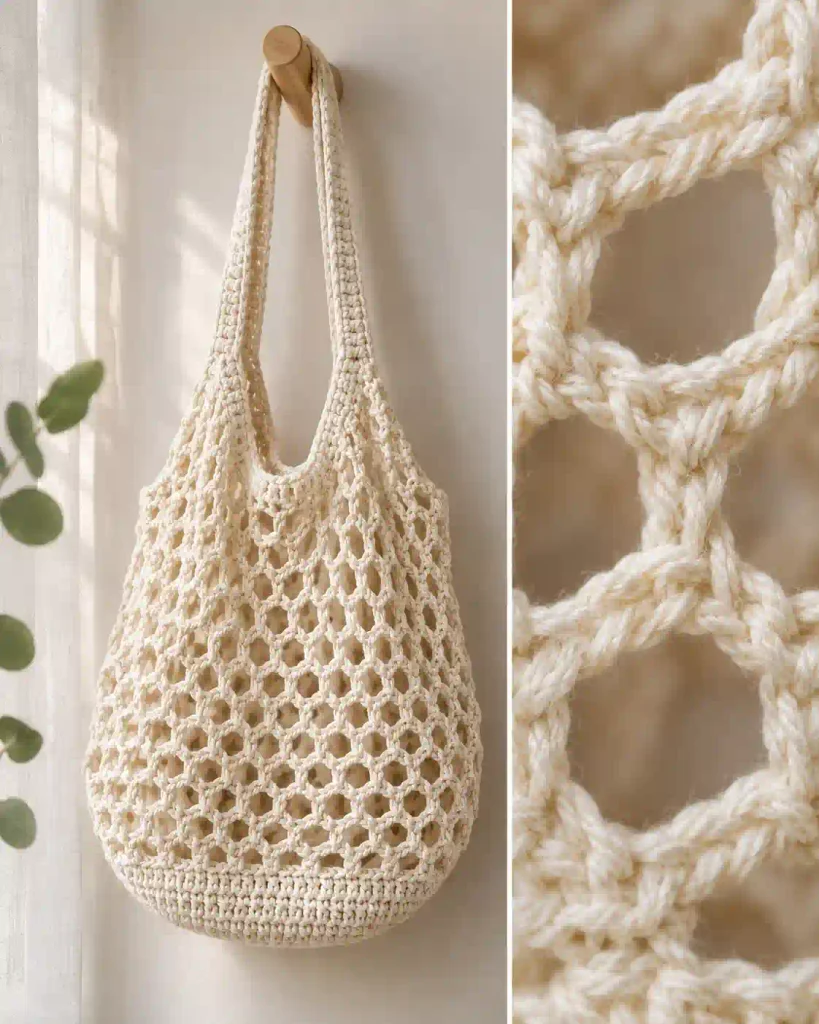
The Beginner Mesh Grocery Bag makes its airy fabric from simple, easy-to-spot spaces. Handy Finch starts with a mesh granny square and gathers it into a crochet tote bag, an approachable alternative to shaping a complicated bag bottom. Picture it on a peg by the kitchen door, ready for a couple of apples and a loaf. Beginners who want to understand where every repeat goes will appreciate the accompanying stitch chart and video.
Pattern details: Beginner-friendly; three 2.5 oz skeins of Lily Sugar’n Cream cotton, a US J or K hook (6–6.5 mm), and adjustable sizing. No fixed yardage or finished measurement is listed.
Construction note: Mark the corners as you complete the square, and follow the chart for gathering. Reinforce the foundation-single-crochet handles with edging rounds.
2. Solid-Bottom Market Tote: How Do You Keep Cartons Stable?
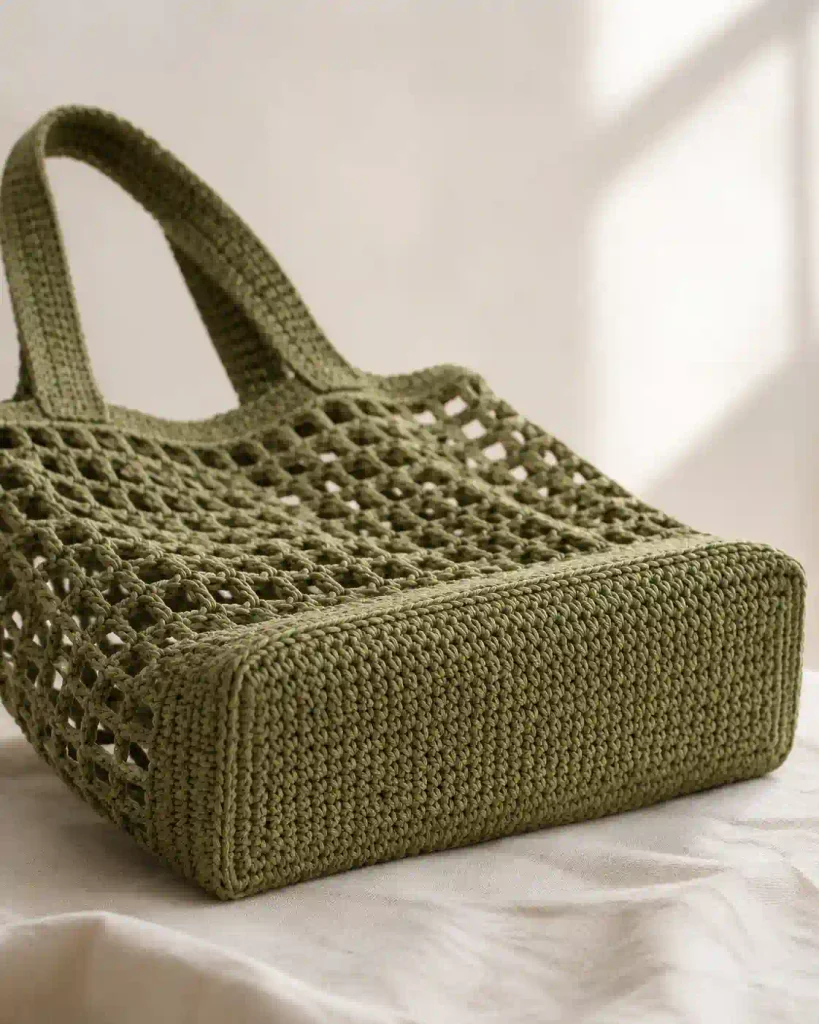
A Solid-Bottom Market Tote gives groceries somewhere flatter to land than loose netting. The dCrochet design works a dense rectangular base first, adds a solid lower band, and then opens into chain-loop mesh. I would choose this construction for a short trip involving a jar, a carton, and a few vegetables, rather than a bag of tiny loose items. It combines visibility through the sides with a more controlled bottom.
Pattern details: Confident beginner; worsted-weight cotton, 4 mm hook, proposed base about 23 × 9 cm and body about 25–30 cm high. Important: the designer identifies these dimensions as planning figures, not measured results; yarn usage, finished size, and carrying capacity have not been sample-tested.
Construction note: Pick up stitches evenly at the base corners and check strap attachments. Sample-test all provisional measurements before publication.
3. French Net Shopping Bag: Why Does It Stretch Around Groceries?
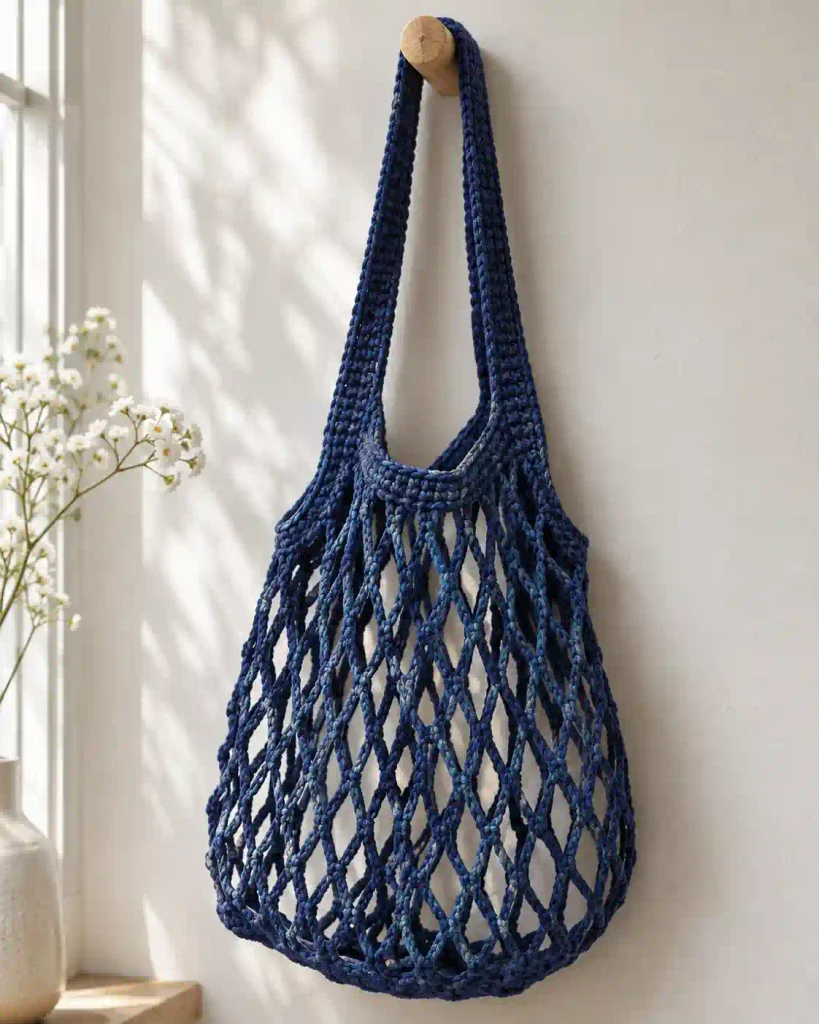
The French Net Shopping Bag has the lovely, elongated openings of a traditional string carrier. Two of Wands builds the net as a flat panel before gathering and shaping it, so the construction feels different from a bottom-up tube. Slip in a baguette and some leafy greens, and the diamond-like openings become part of the bag’s character. This one is especially appealing if you enjoy openwork and don’t mind paying attention during assembly.
Pattern details: Intermediate; approximately 558 yd/510 m of worsted-weight cotton, 4 mm hook, and a published finished size of 16 in wide by 17 in long, with 20 in straps. The designer lists a gauge of 15 stitches per 4 in in the pattern stitch.
Construction note: Gather the top edge evenly and measure the bag both empty and lightly filled to see how far the net stretches.
4. Drawstring Produce Bag: Which Crochet Mesh Holds Garlic?
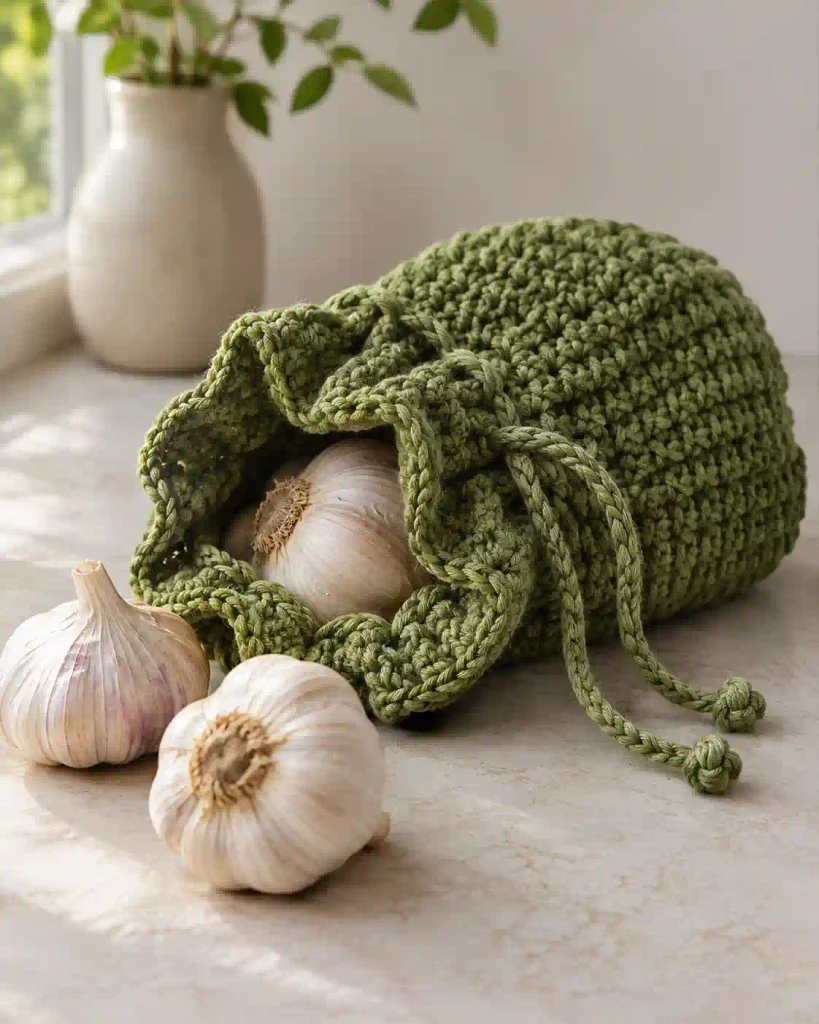
Garlic can escape an ordinary mesh tote. The Drawstring Produce Bag solves that problem with finer mesh and a cord that closes the mouth of the pouch. Yarn ‘n Me offers two lengths of this crochet drawstring bag, making it easy to organize a few different produce items inside one larger shopping bag. It’s a useful choice whenever small loose vegetables are part of your shopping routine.
Pattern details: Easy; 100–160 m of sport-weight cotton in the main color plus around 10 m for an accent, with a 3.25 mm hook. The pattern gives a 9 in width and two length choices: approximately 8.5 or 11.5 in.
Construction note: Check the holes against your smallest produce and thread the drawstring evenly. Use a washable inner pouch for tiny items.
5. Foldaway Grocery Bag: Can a Tote Pack Into Its Own Pocket?
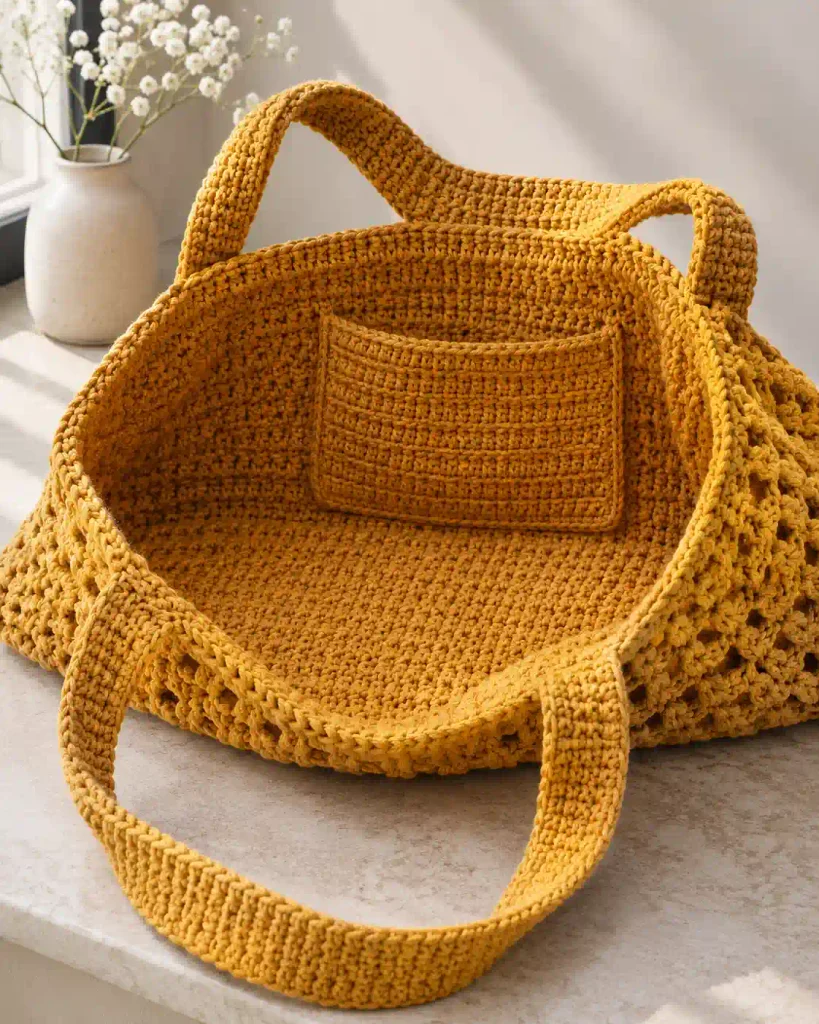
Forgot your reusable bag at the checkout again? Moogly’s Rainbow Pocket Market Bag neatly tucks into a pocket formed by its double-layered bottom, so the storage pouch never gets lost. A bright version would be easy to spot at the bottom of a backpack or in the car. Make this one when portability matters as much as how much the bag holds.
Pattern details: Intermediate beginner; around 200 yd of worsted-weight cotton, 5.5 mm hook, and an optional 3.75 mm hook for a crocheted button. Short- and long-handle variations are included; a definitive packed dimension isn’t listed.
Construction note: Leave the storage-pocket opening clear while joining the base; measure the bundle after folding the finished bag inside.
6. Boxy Grocery Tote: What Works for Boxes and Jars?
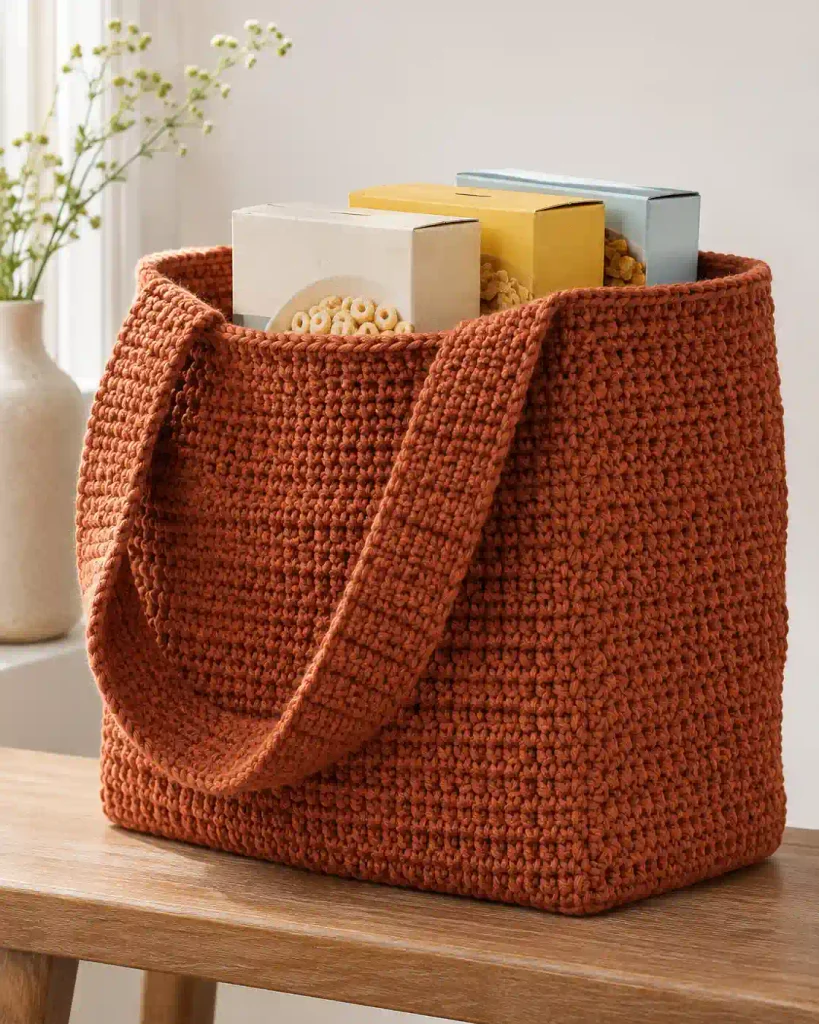
Cartons sit better in a Boxy Grocery Tote than in loose mesh. Yarnspirations’ Big Scrappy Tote uses separately made front, back, and side-gusset pieces to create a broad, rectangular shape. On a bench or countertop, that structure makes it easier to arrange dry groceries without hunting for the corners of a floppy bag. It’s a better project for someone happy to seam pieces and reinforce handles.
Pattern details: Intermediate; approximately 721 yd/660 m of super-bulky Caron Anniversary Cakes yarn and a 6 mm hook. The published dimensions are about 15 in wide × 10 in high × 4 in deep, excluding handles; the original uses acrylic rather than the cotton featured in several other designs.
Construction note: The gusset adds depth between panels. Match the corners and reinforce handles; no load rating is supplied.
7. One-Skein Cotton Shopping Bag: Can One Ball Really Be Enough?
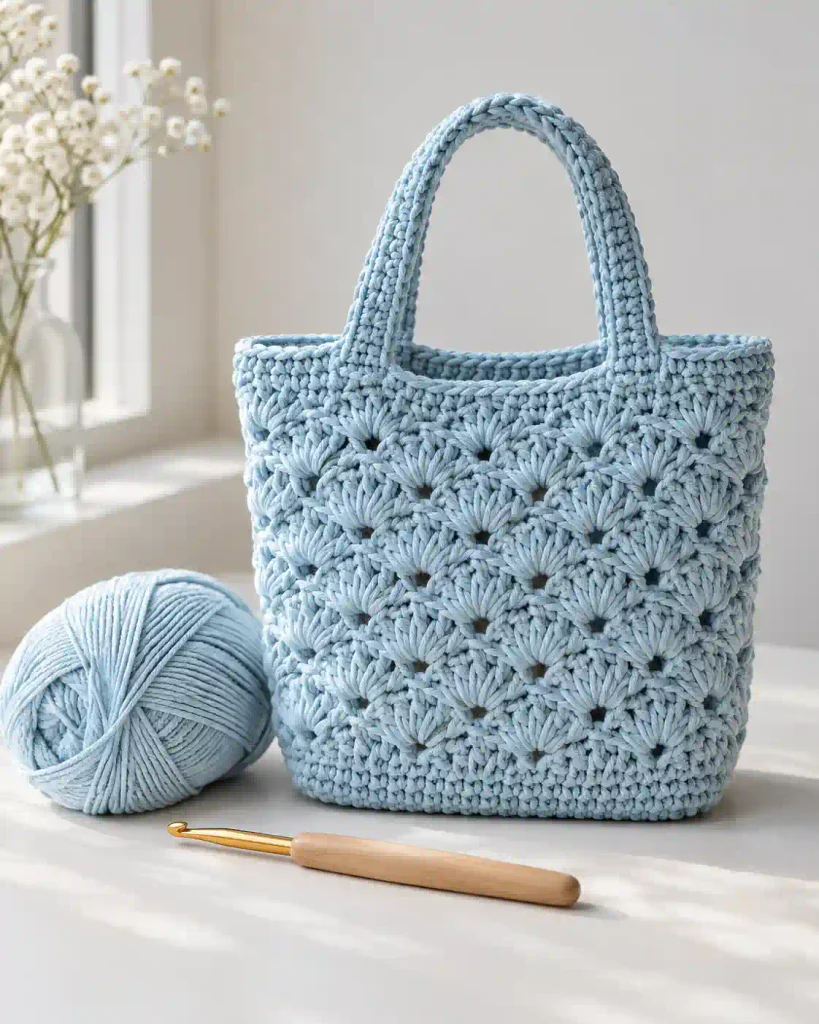
The One-Skein Cotton Shopping Bag uses surprisingly little yarn. Zeens and Roger works a compact mesh tote from a single 50 g ball, with a straightforward circular start and airy sides. It suits rolls or small gifts, not weekly shopping. For crocheters using up leftover cotton, the tiny yarn commitment is the best part.
Pattern details: Easy; one 50 g ball of DK cotton with around 155 m/170 yd, a 3 mm hook, or 2.5 mm if your tension is loose. Exact finished dimensions depend on the yarn and your gauge.
Construction note: Reserve yarn for the rim and handles. The instructions use UK crochet terms, so convert stitch names if needed.
8. Granny Stitch Market Bag: How Can You Add Color Without Joining Squares?
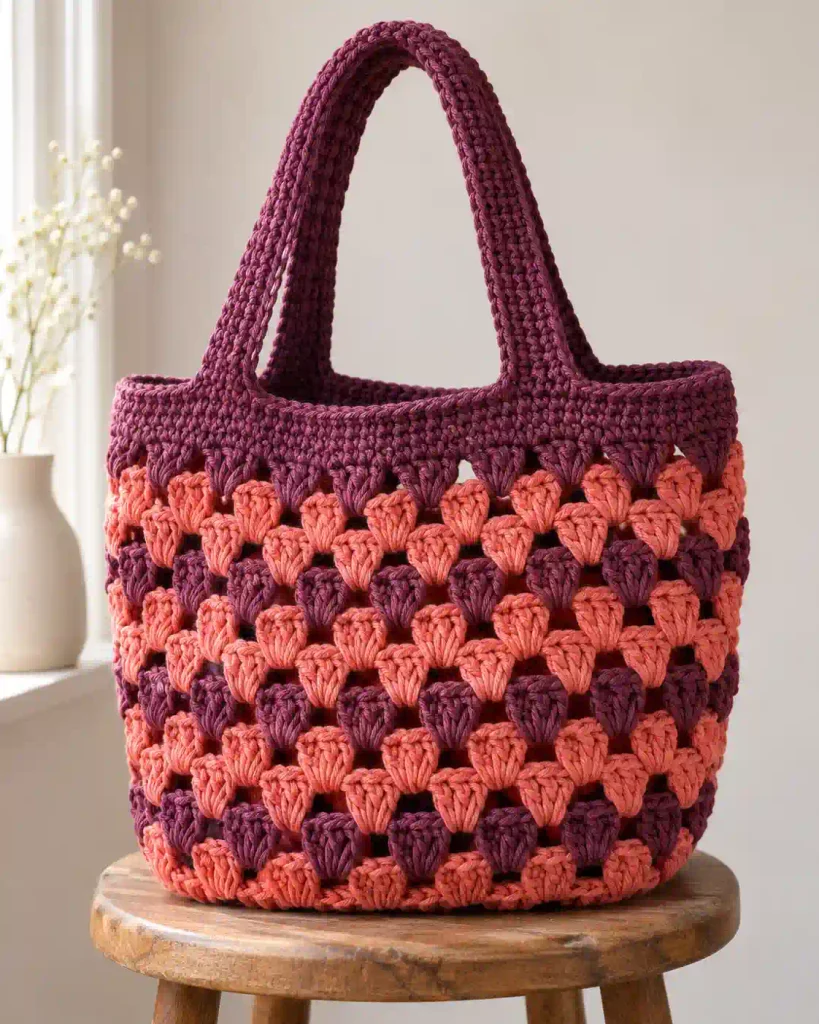
A Granny Stitch Market Bag can have bold color bands without a pile of separate motifs to sew. The Zeens and Roger design repeats familiar granny clusters around the body, then uses a firmer border to finish the opening. The plum-and-coral version I’d place beside the front door would make even a routine market run feel cheerful. Choose it for colorful, continuous crochet.
Pattern details: Intermediate beginner; six 50 g balls of Stylecraft Classique Cotton DK at 92 m/100 yd per ball, plus a 3.5 mm hook. The designer’s sample measures about 16 in across by 15 in deep.
Construction note: Change colors at the join and complete the firm rim before measuring the opening. The pattern uses UK terms.
9. Granny Square Grocery Tote: What’s the Neatest Way to Join Motifs?
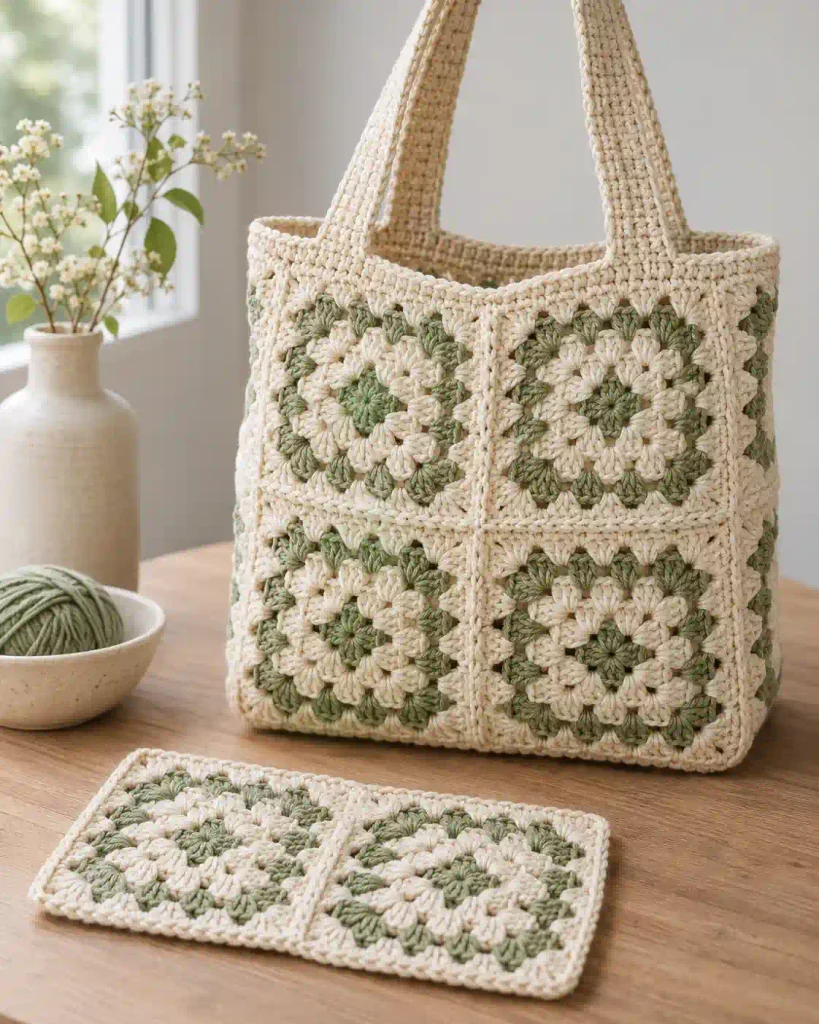
If you enjoy crochet granny square patterns, the fun starts long before the Granny Square Grocery Tote is assembled. A Crocheted Simplicity’s design combines 13 floral squares, giving you a chance to arrange colors on the table before making the seams. Unlike an all-in-one mesh tote, you can crochet a square during a short break and save joining for another day. It’s an especially satisfying option for motif lovers and gift makers.
Pattern details: Easy; approximately 420 yd of worsted-weight cotton and a 5 mm hook. Each motif is about 4.5 in square; the finished tote is approximately 12.75 in wide by 12.5 in high, without the strap.
Construction note: Gauge-check one square, match the remaining motifs, and plan their layout before seaming. Line the tote for loose items.
10. Long-Strap Market Tote: Is a Crossbody Crochet Bag Practical?
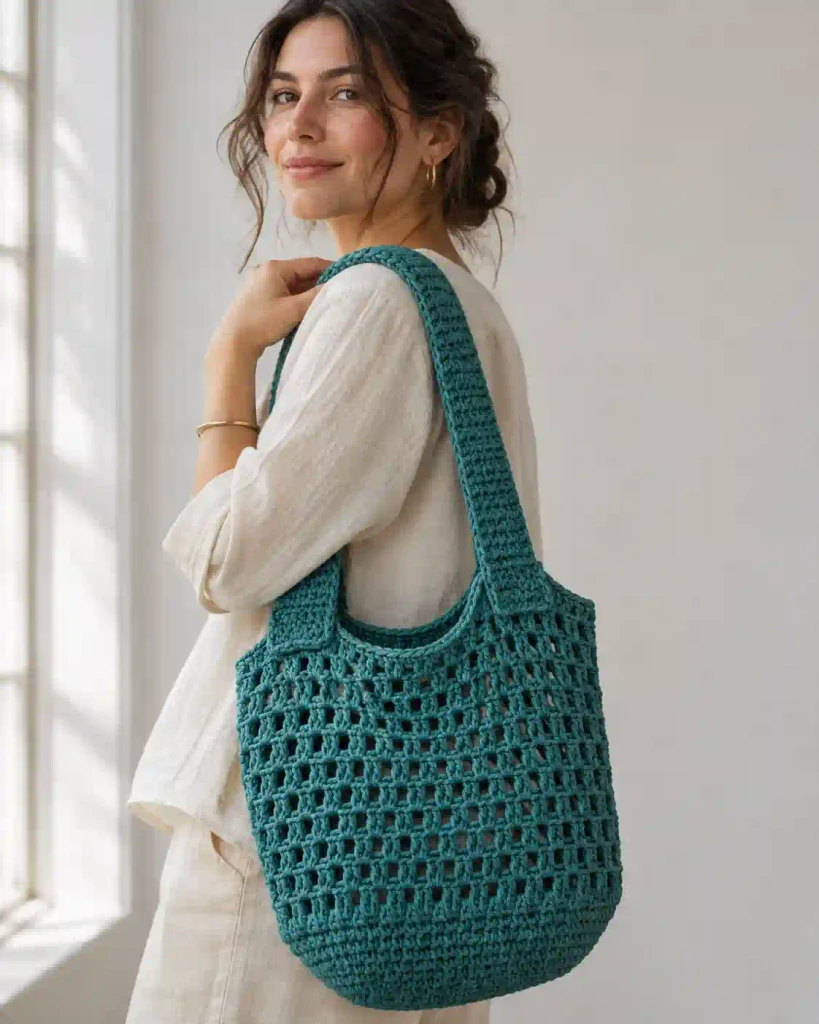
A Long-Strap Market Tote leaves your hands free for a coffee, a shopping list, or the next market stall. ChristaCoDesign’s Mercato Crossbody Bag combines a round bottom, textured sides, and one extended strap rather than two short handles. I would use this style for light errands on foot, not for carrying a week’s heavy groceries on one shoulder. The extended strap makes this crochet crossbody bag a clever alternative when easy carrying is your priority.
Pattern details: Easy; approximately 270 yd of worsted-weight yarn and a 5.5 mm hook; cotton is suggested, though the designer allows acrylic. The body measures roughly 12 in wide by 13 in tall, and the designer gives an overall length including the strap.
Construction note: Secure both strap attachments and check the loaded drop; an empty bag doesn’t reveal how low the strap will hang.
11. Recycled Plarn Grocery Bag: Can You Crochet Old Plastic Bags?
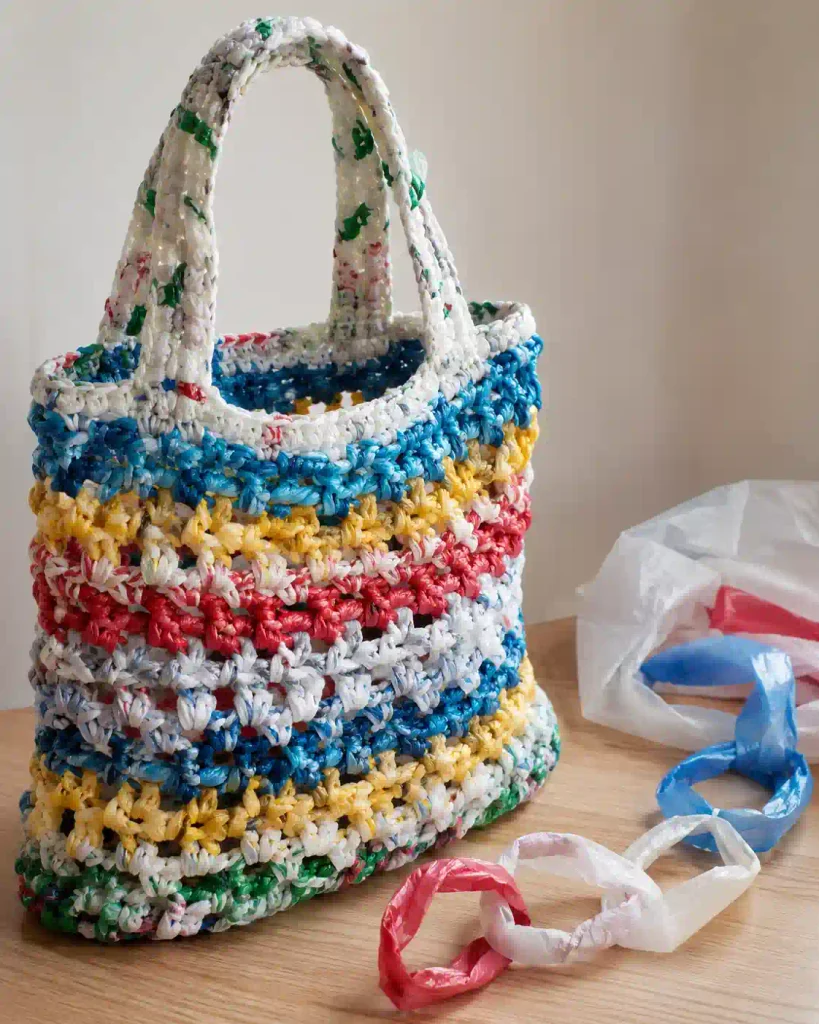
Clean saved plastic bags can become yarn. Amanda Steves’ Recycled Plarn Grocery Bag uses plarn, linked strips cut from plastic bags, in place of cotton yarn. The resulting fabric has its own texture and makes a useful dry-goods carrier, especially when you’re trying to use materials already at home. It’s a practical upcycling project without needing to claim an unmeasured environmental saving.
Pattern details: Easy; plarn from approximately 20–25 large, clean plastic grocery bags, a 9 mm hook, and one adjustable size. The free downloadable pattern includes instructions for making plarn and does not specify a fixed gauge.
Construction note: Cut even strips, link them without pulling tight, and swatch first. Keep plarn away from heat.
12. Expandable Market Tote: Which Mesh Bag Fits a Bigger Shop?
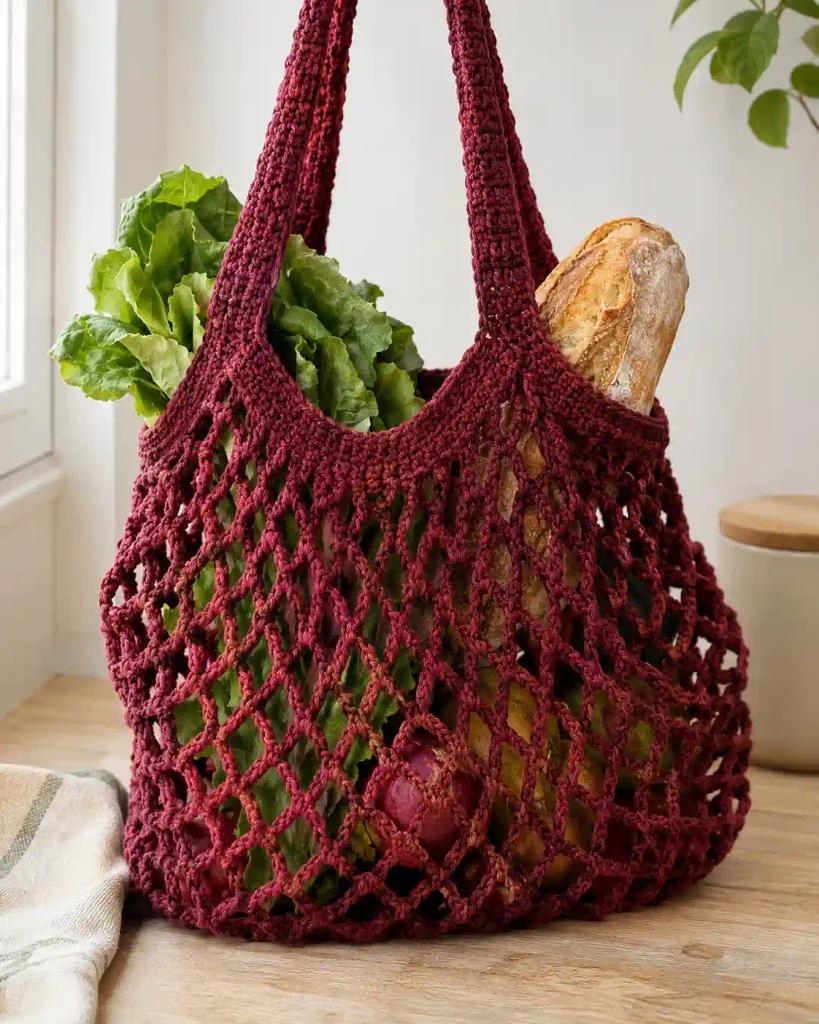
At the farmers market, the shopping list can grow faster than expected. The Expandable Market Tote by Make & Do Crew uses Solomon’s Knot, a loose, lacy stitch that opens around a loaf and leafy vegetables. A more compact top edge and stitched handles balance the generous mesh body. For bulky but fairly light groceries, this is the bag I’d reach for before a smaller everyday tote.
Pattern details: Intermediate; three 186 yd skeins of worsted-weight cotton (about 558 yd total) and a 5 mm hook. The designer lists mesh dimensions of approximately 33 in wide by 15 in deep when laid out, with an empty handle drop near 10 in; the body is designed to expand.
Construction note: Practice Solomon’s Knot, maintain an even top edge, and reserve heavy or sharp items for a denser tote.
How Do You Make a Crochet Grocery Bag Last Longer?
Protect the base and handle joins, test the bag with your usual groceries, and clean reusable bags according to their fiber-care instructions.
Check the base, rim, and handle joins. Dense attachment stitches and a test carry at home help reveal stretching before a grocery run.
Keep food safety in the plan too. The CDC’s food-safety guidance emphasizes keeping potentially contaminated foods separate from ready-to-eat items. For crochet totes, that means dedicating clean bags to produce and avoiding direct contact with leaking raw-meat packaging.
Frequently Asked Questions About Crochet Grocery Bags
What yarn is best for a reusable crochet grocery bag?
Firmly worked cotton is a useful starting point for many everyday designs, while plarn suits the recycled option in this collection. Match the original pattern’s fiber, weight, and gauge before experimenting with a substitute.
How much yarn do I need to crochet a market tote?
The amount depends on the size and stitch pattern. These linked designs range from a 50 g, 155 m one-skein cotton bag to larger options that use roughly 558 yd or more; always allow yarn for the rim and handles.
How do I stop crochet bag handles from stretching?
For a sturdy crochet bag strap, use compact stitches, make the attachments wide enough to distribute pressure, and reinforce or seam them securely. Test the finished handle drop with the items you normally carry, rather than measuring an empty bag alone.
Can I make a crochet grocery bag bigger?
Usually you can add complete stitch repeats or more body rounds, provided you preserve the designer’s shaping logic. Recheck your yarn supply, top opening, strap placement, and loaded length after resizing.
How should I wash a reusable crochet shopping bag?
Follow the yarn label and dry the bag fully before storing it. Health Canada advises washing reusable cloth grocery bags frequently, particularly after carrying produce or animal products, and keeping bags for raw meat separate from those for produce.
Where can I find free instructions for a crochet grocery bag?
Use the linked designers’ free pattern pages for directions, and check each project’s yarn and hook requirements before starting. If you search for “crochet grocery bag pattern free,” open the original pattern page and confirm whether a separate PDF download is optional or paid.
Final Thoughts
The best crochet grocery bag is one that fits the way you shop. Whether you prefer a lightweight mesh tote for fresh produce, a sturdy flat-bottom bag for everyday groceries, or a foldaway design that fits in your purse, these 12 free crochet grocery bag patterns offer something for every skill level and shopping routine.
Start with a simple pattern if you’re a beginner, and explore more textured or structured designs as your confidence grows. Choose the right yarn, reinforce the handles, and consider how much weight your finished bag needs to carry. With a little planning, you can crochet a reusable shopping bag that’s practical, comfortable to carry, and uniquely yours.