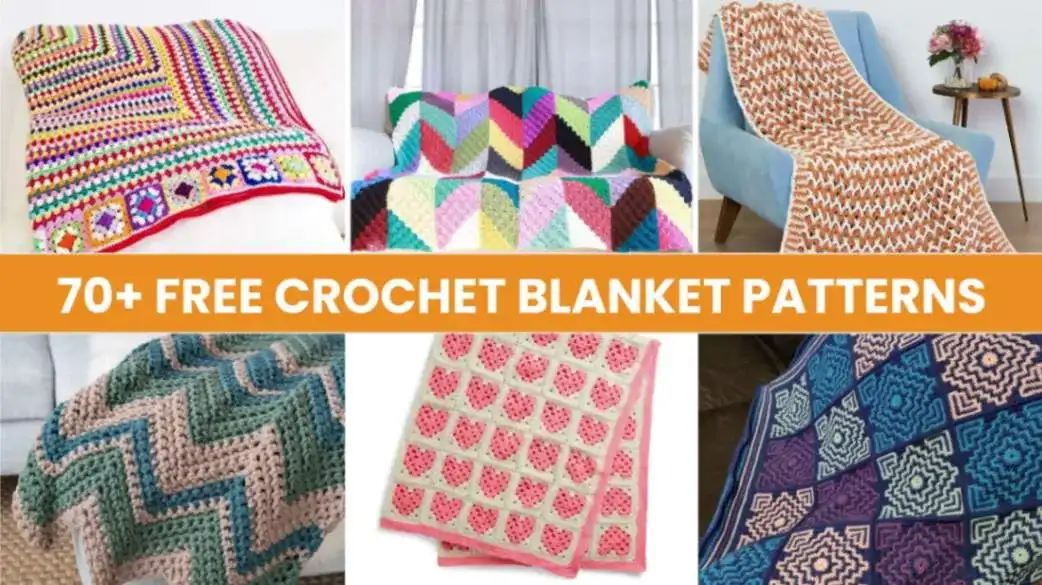
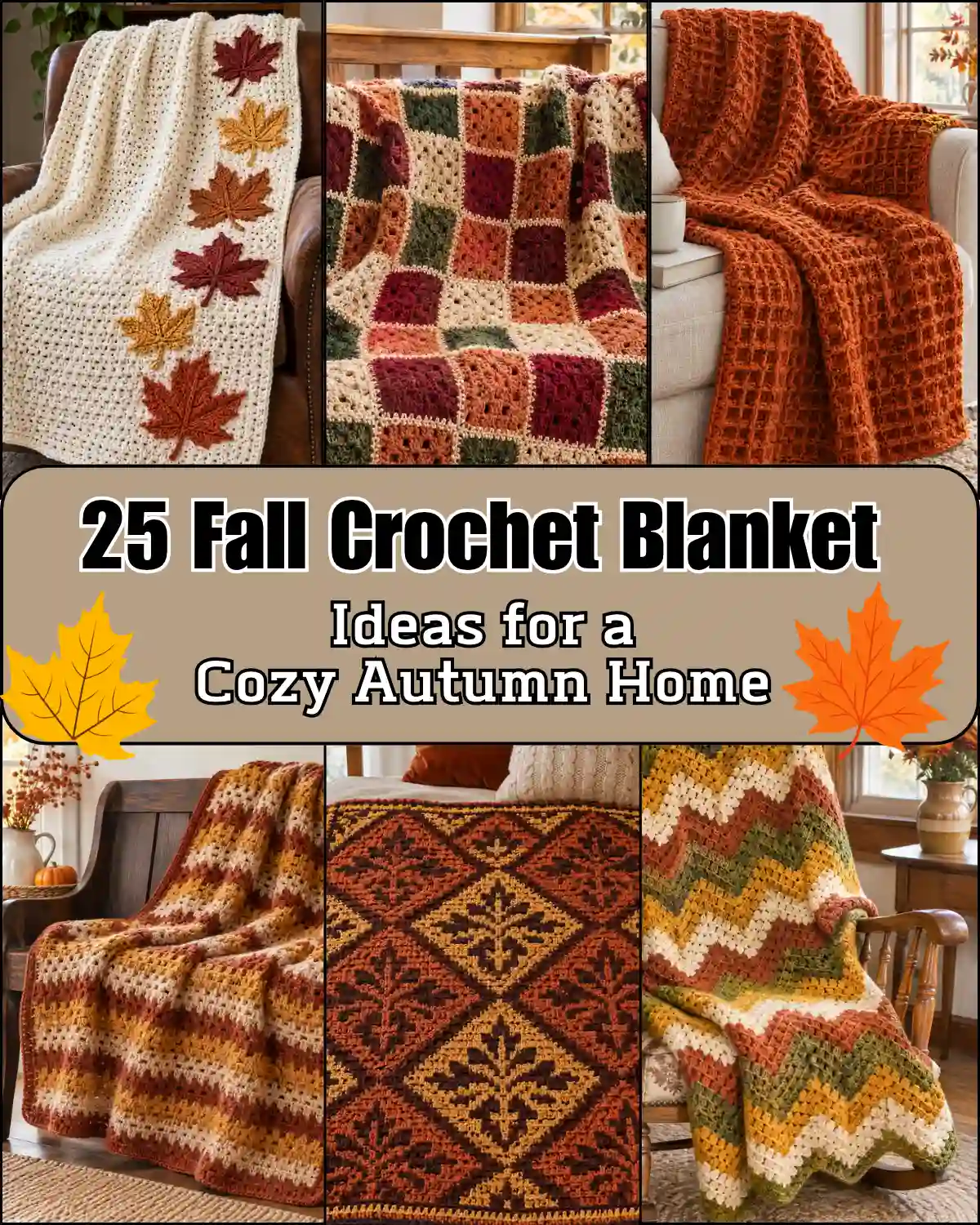
A fall crochet blanket can be as simple as a striped beginner throw or as detailed as a pumpkin granny-square design. These 25 ideas cover autumn colors, textured stitches, decorative motifs, and practical blankets for sofas, laps, and gifts. Choose the look you love, then use a complete crochet blanket pattern or a tested gauge swatch to plan the size and yarn before you begin.
There is something inviting about a handmade throw when the evenings turn cool. But fall crochet doesn’t have to mean orange pumpkins on every square. You can keep things subtle with oatmeal and olive, add a nostalgic ripple, or make the entire blanket a celebration of harvest colors.
This roundup is a design guide, not 25 complete written patterns. Where a genuinely free pattern is available from another designer, you will find verified examples later in the article.
Key Takeaways
- Choose a stitch that matches your experience.
- Swatch before estimating yarn or finished dimensions.
- Combine autumn shades with a neutral base.
- Verify fall crochet blanket patterns free before buying a PDF.
- Keep loose blankets out of infant sleep spaces.
- Follow yarn labels for washing and storage.
Which Fall Crochet Blanket Should You Make?
The best fall crochet blanket is the one whose stitch complexity, yarn weight, and finished size match your skill level and how you plan to use it.
At a Glance:
- Pick granny stripes or color blocks for a first blanket.
- Choose bulky yarn for a thicker throw.
- Use joined motifs for portable, modular pieces.
- Check pattern gauge before buying yarn.
Start with the technique that fits your experience and the blanket’s job. A small lap throw is usually more manageable than a full-size couch blanket, while joined motifs give you portable pieces to work on one at a time.Before choosing your yarn, consult a crochet hook size chart alongside the pattern’s recommended hook size and gauge. Its typical hook ranges are 5.5–6.5 mm for category 4 and 6.5–9 mm for category 5; the pattern, yarn label, and your swatch should m
| If you want… | Try this idea | Suggested yarn | Approximate skill level |
|---|---|---|---|
| An easy first blanket | Granny stripe afghan (#5) | Medium/worsted (#4) | Beginner |
| A plush, cozy throw | Chunky moss stitch (#3) | Bulky (#5) | Beginner |
| Seasonal motifs | Pumpkin granny squares (#1) | Medium/worsted (#4) | Confident beginner–intermediate |
| Strong modern color | Terracotta-to-olive blocks (#10) | Medium/worsted (#4) | Beginner |
| Detailed colorwork | Autumn mosaic blanket (#12) | DK/light (#3) or worsted (#4) | Intermediate |
| A thoughtful baby gift | Soft harvest-color blanket (#20) | Smooth, washable yarn | Beginner |
ake the final choice.
25 Fall Crochet Blanket Ideas Worth Making
These 25 designs range from simple stripes and color blocks to seasonal motifs, textured stitches, and chart-based blankets.
At a Glance:
- Try pumpkin, maple leaf, sunflower, or woodland motifs.
- Use moss, waffle, basketweave, or cable textures.
- Explore plaid, chevron, mosaic, and color-block layouts.
- Consider lap, sofa, and baby-gift uses.
1. Pumpkin Granny Square Blanket: How Can You Make the Motif Stand Out?
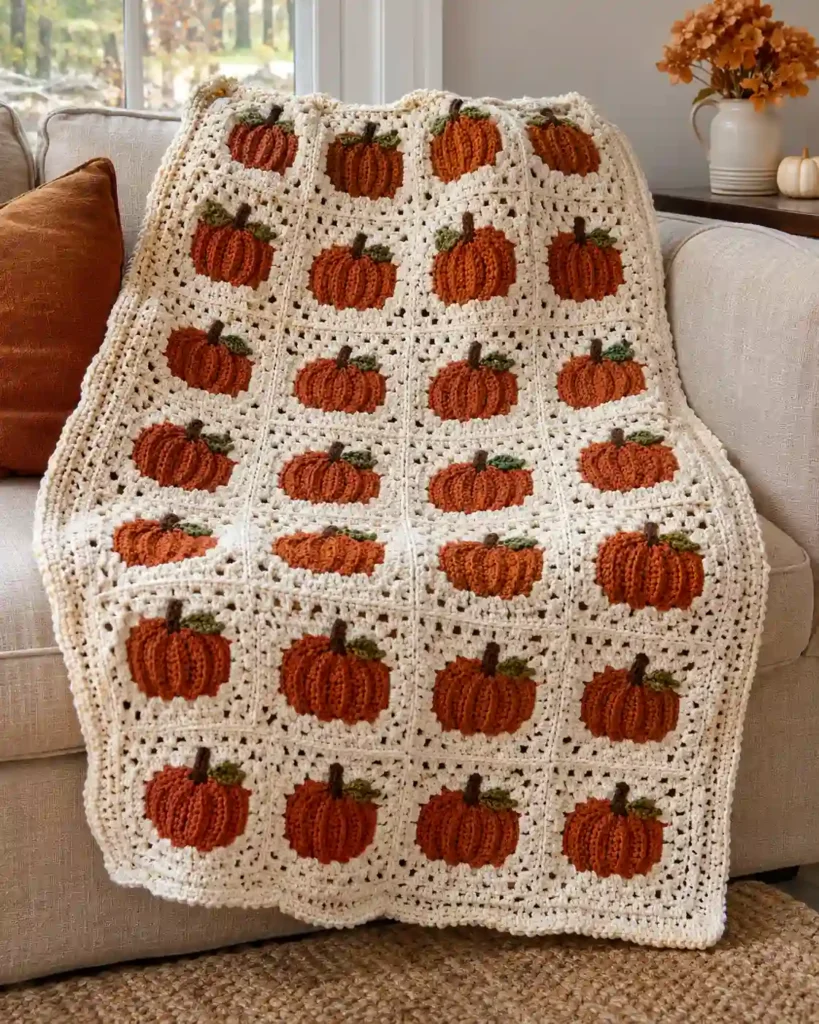
A pumpkin granny square blanket brings the harvest theme straight into your living room without requiring one giant piece of colorwork. Instead of covering every inch in orange, let rust-colored pumpkins sit inside cream or sage squares, then join the motifs with a quiet neutral. Picture it folded over the arm of a linen sofa, where even a small patch of squares becomes a seasonal accent. Choose this style if you enjoy portable motifs and want a blanket that feels unmistakably autumnal.
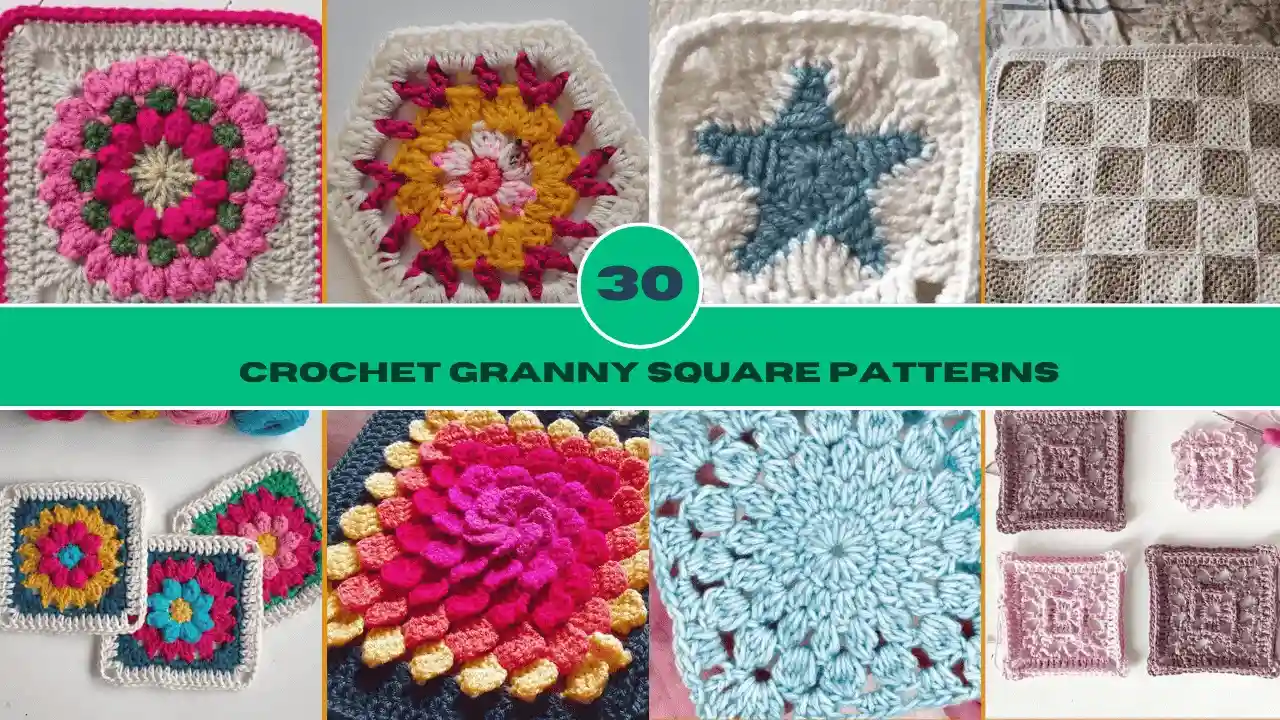
Keep your squares the same finished size before joining them; explore different crochet granny square patterns to find motifs that work well together. Try this palette: pumpkin rust, sage, oatmeal, and soft brown. A real free pumpkin-square pattern is linked in the free-pattern section below.
2. Autumn Maple Leaf Appliqué Throw
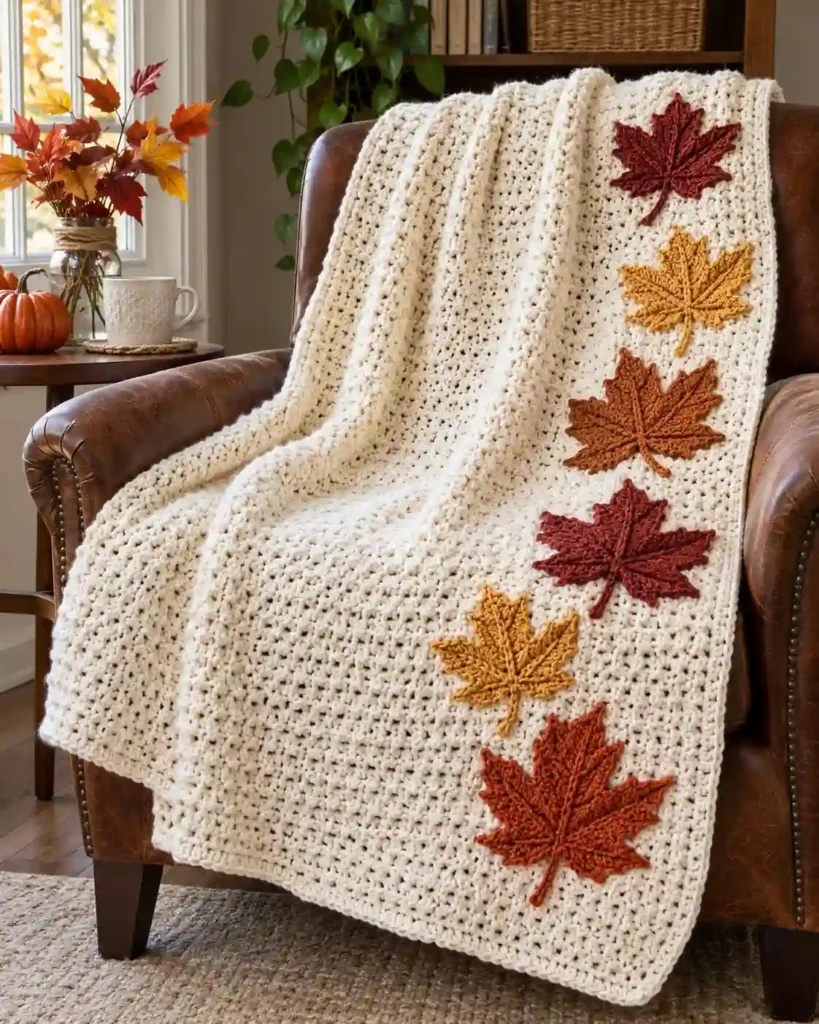
Sometimes a few leaves say more than an entire woodland scene. An autumn maple leaf appliqué throw starts with a simple cream blanket, then adds flat crocheted leaves in copper, gold, and russet along one edge. That restrained placement looks lovely on a favorite reading chair and doesn’t make the blanket feel too busy for everyday use. It’s a good choice for someone who likes botanical fall décor but wants to keep the base blanket simple.
Make the leaves separately, arrange them before attaching, and sew down edges securely so they don’t curl during use. A smooth background stitch shows the shapes best. Skill level: intermediate, especially for shaping and neatly attaching the leaves.
3. Rust-and-Mustard Chunky Moss-Stitch Blanket: Want Texture Without Complicated Stitches?
The chunky moss-stitch blanket is all about touch: soft, pebbly rows in rust, mustard, and warm oat. Moss stitch creates its texture from simple stitch-and-chain repeats rather than raised cables, so the fabric can feel more relaxed than many dense chunky designs. It belongs on a sofa where someone can reach for it during a chilly movie night, not just admire it from across the room. Newer crocheters who want visible progress will appreciate the straightforward rhythm.
Use bulky yarn, but make a swatch first; a hook that is too small can make the blanket stiff. Keep the color changes broad rather than switching yarn every row. Best feature: cozy texture that doesn’t need a complicated motif.
4. Autumn Plaid Crochet Cabin Throw
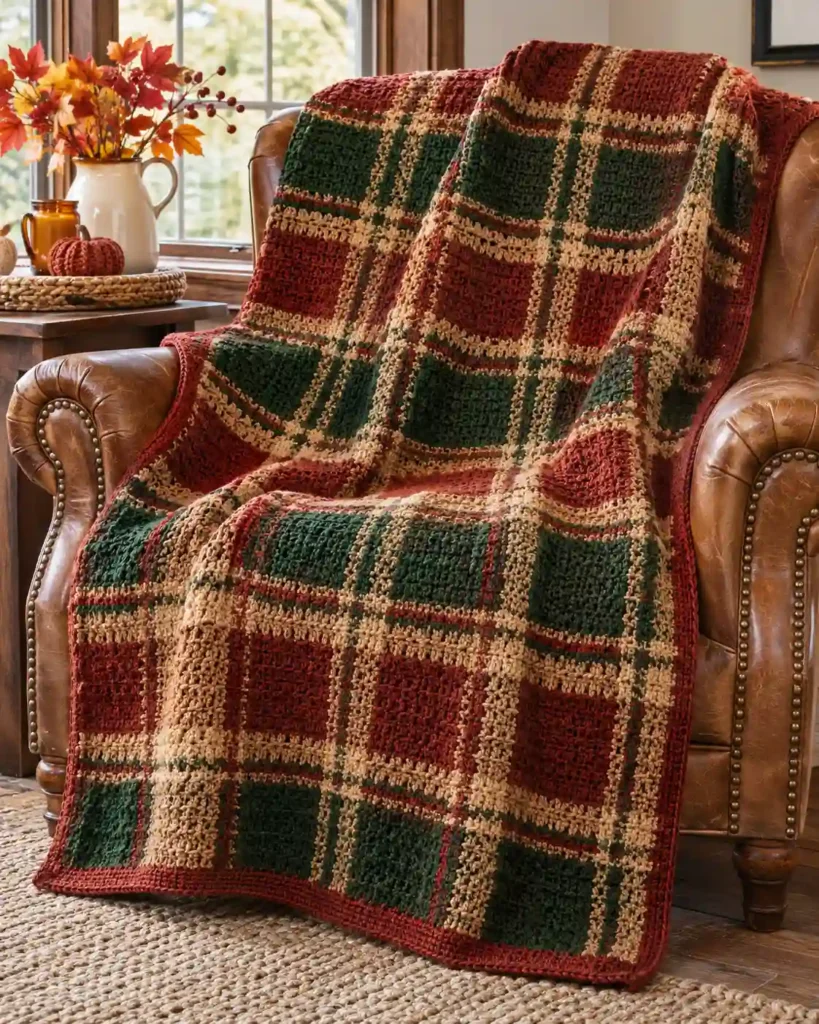
A plaid crochet cabin throw gives a room that warm, tucked-away-for-the-weekend feeling. Brick red, camel, and forest green form a grid that reads more like a woven blanket, yet the visible crochet stitches give it handmade character. Draped across a leather chair, it makes a lovely counterpoint to wood, books, and simple neutral cushions. This is one to consider when you enjoy planning color blocks as much as stitching them.
Plaid can be created with careful color changes or separately made panels. Sketch the grid before starting, count the blocks, and check that vertical and horizontal lines will line up. Skill level: intermediate because neat color management matters.
5. Easy Fall Granny Stripe Afghan: Is This the Best Beginner Project?
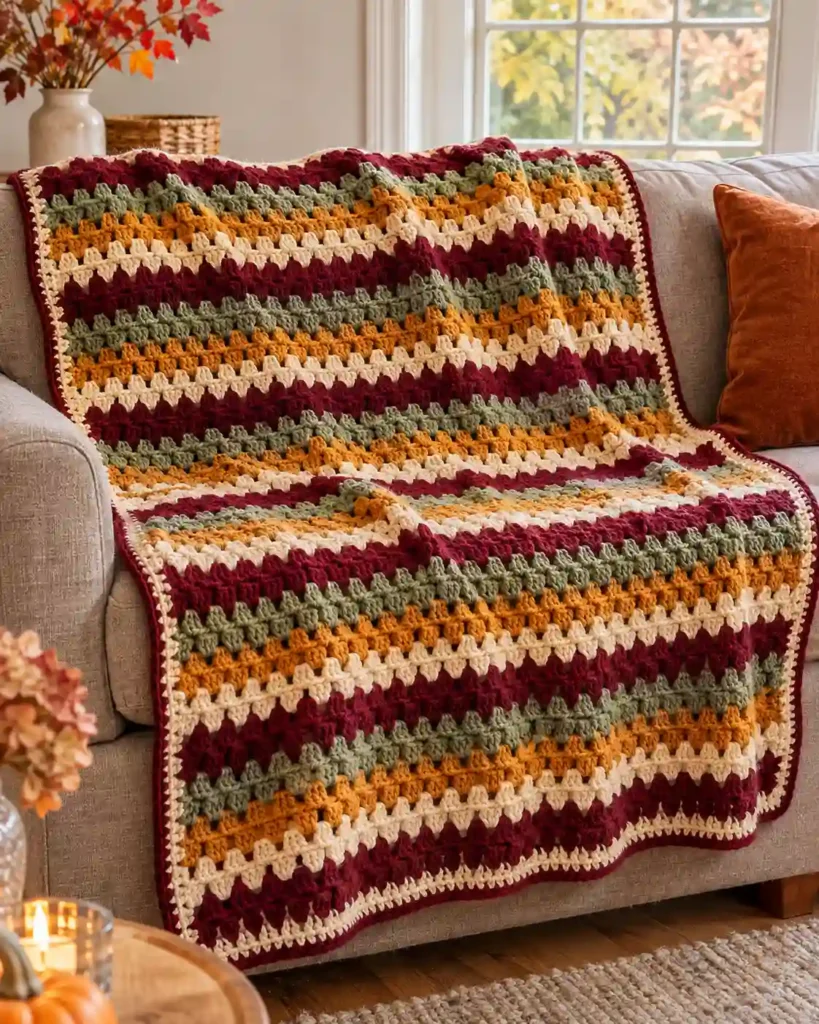
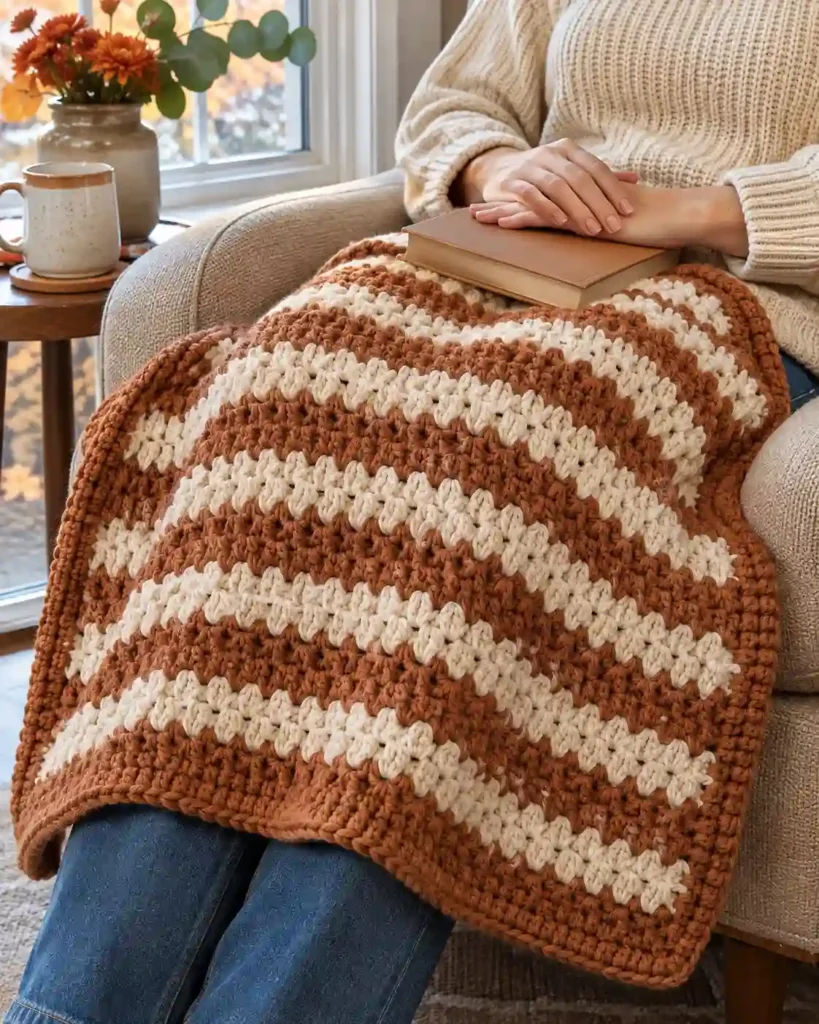
If granny squares feel like too many pieces, try a granny stripe afghan instead. Familiar clusters run in rows across the blanket, creating that classic granny texture without a pile of motifs waiting to be sewn together. Burgundy, amber, sage, and cream are enough to give it a cheerful fall look on the family couch. It’s especially appealing when you want a repeat you can settle into after learning the basic stitches.
Change color every few rows to avoid a busy effect. Count the edge stitches regularly and finish with a plain border to frame the stripes. Beginner tip: practice a small sample first to learn how the turning rows behave.
6. Burnt Orange Waffle-Stitch Blanket
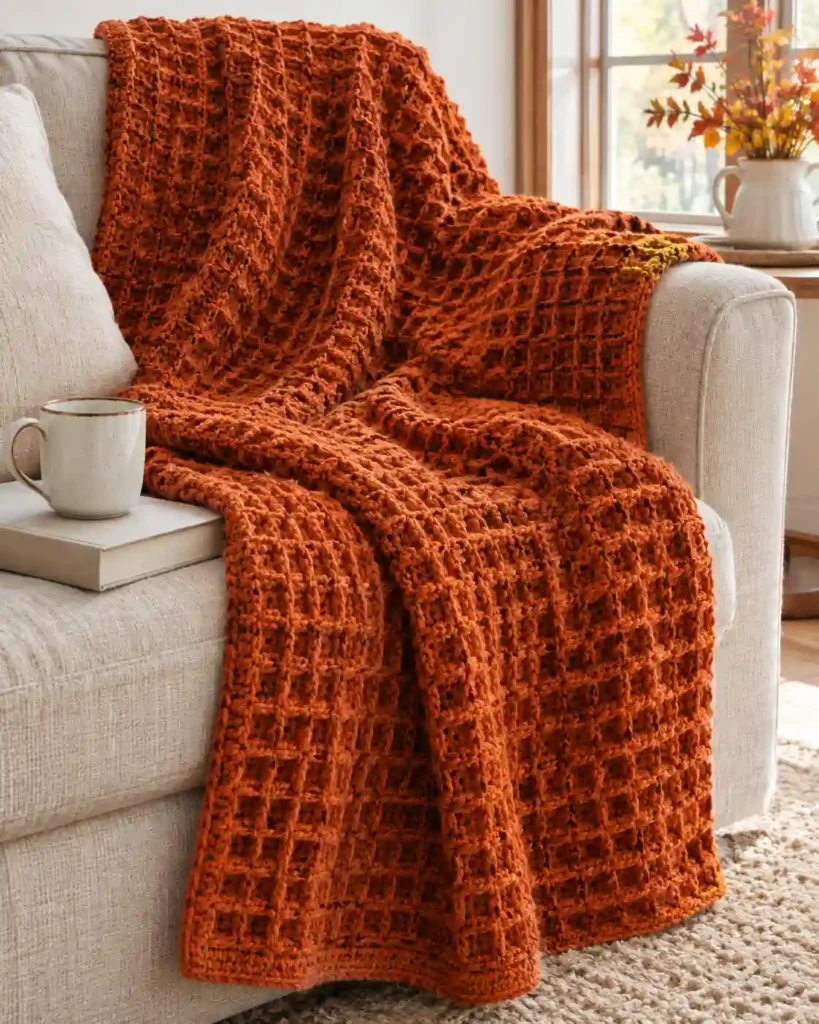
One rich color can be every bit as interesting as a multicolored autumn blanket. A burnt orange waffle-stitch throw forms a deep, square-grid texture that catches the light beautifully, especially when it is folded over a neutral sofa. The raised ridges feel substantial compared with a flat single-crochet fabric, so this design is better suited to a cozy throw than a lightweight summer cover. Pick it when texture matters more to you than changing colors.
Waffle stitch usually relies on front-post stitches, which are worked around the post of a stitch below. Because the fabric is dimensional, check yarn consumption with a sample before committing. Skill level: intermediate.
7. Sunflower Granny Square Harvest Throw: Looking for a Cheerful Fall Motif?
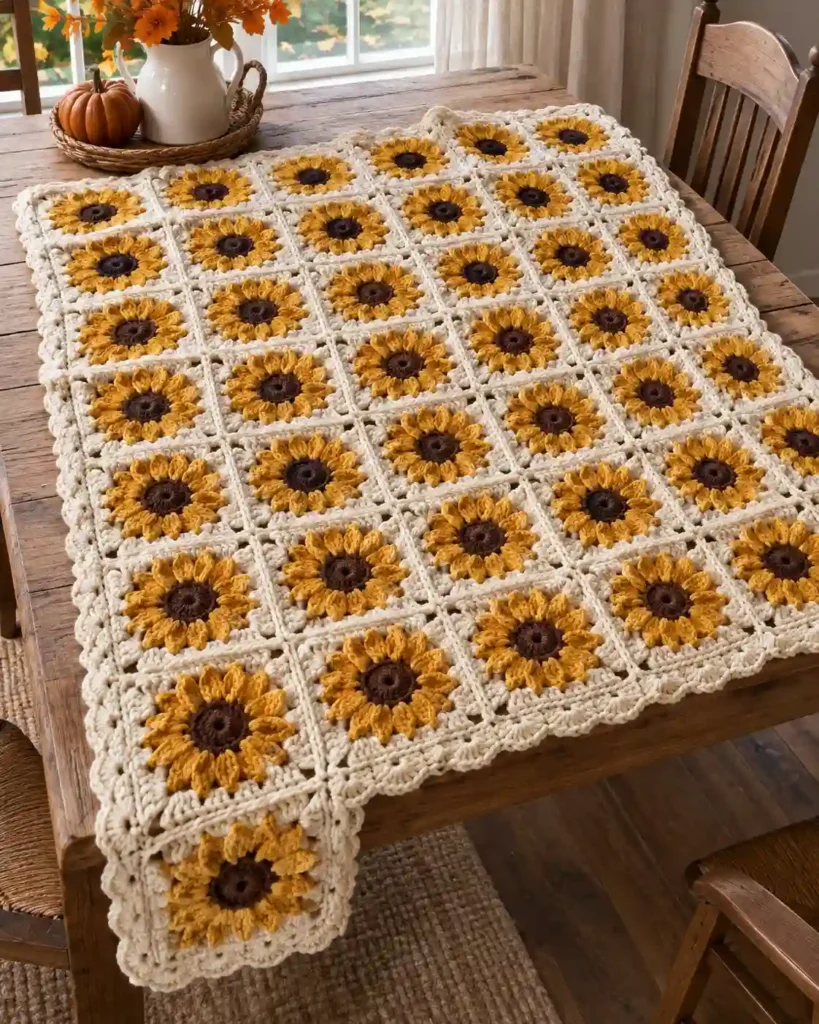
Sunflowers bring a little brightness to the harvest season, especially when their petals are muted ochre rather than sunny lemon yellow. Build a blanket from flower-centered granny squares with dark brown middles and cream borders, and the design becomes warm without shouting for attention. It would be lovely across the end of a farmhouse bed or gifted to someone who collects floral handmade pieces. For crocheters who enjoy repeating a small motif, the assembly is part of the fun.
Make one finished square, measure it, then work out how many you’ll need for your preferred size. Joining with a single neutral shade helps the flowers stay the focal point. Palette: ochre, espresso, cream, and a touch of olive.
8. Pumpkin Patch Bobble-Stitch Blanket
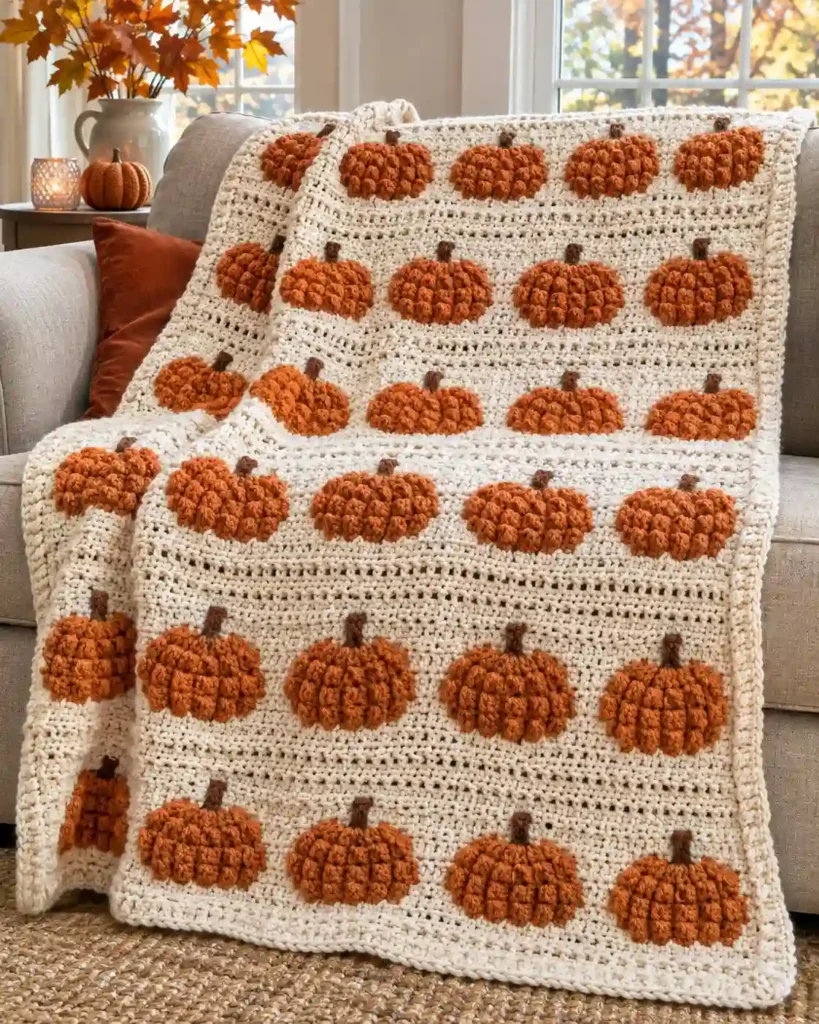
Not every pumpkin needs its own granny square. In a pumpkin patch bobble-stitch blanket, raised stitches form little pumpkins directly across a cream or rust-colored background, adding texture you can see and feel. That makes the finished blanket playful without requiring dozens of separate pieces. It works especially well as a decorative fall throw for a family room.
A bobble is a group of partially completed stitches joined to make a raised bump. Positioning those bumps into recognizable shapes usually requires a chart or carefully written pattern, so this is not the easiest improvisation project. Best for: an intermediate crocheter who enjoys following stitch placement.
9. Autumn Ripple Chevron Blanket: Want Movement in Your Stripes?
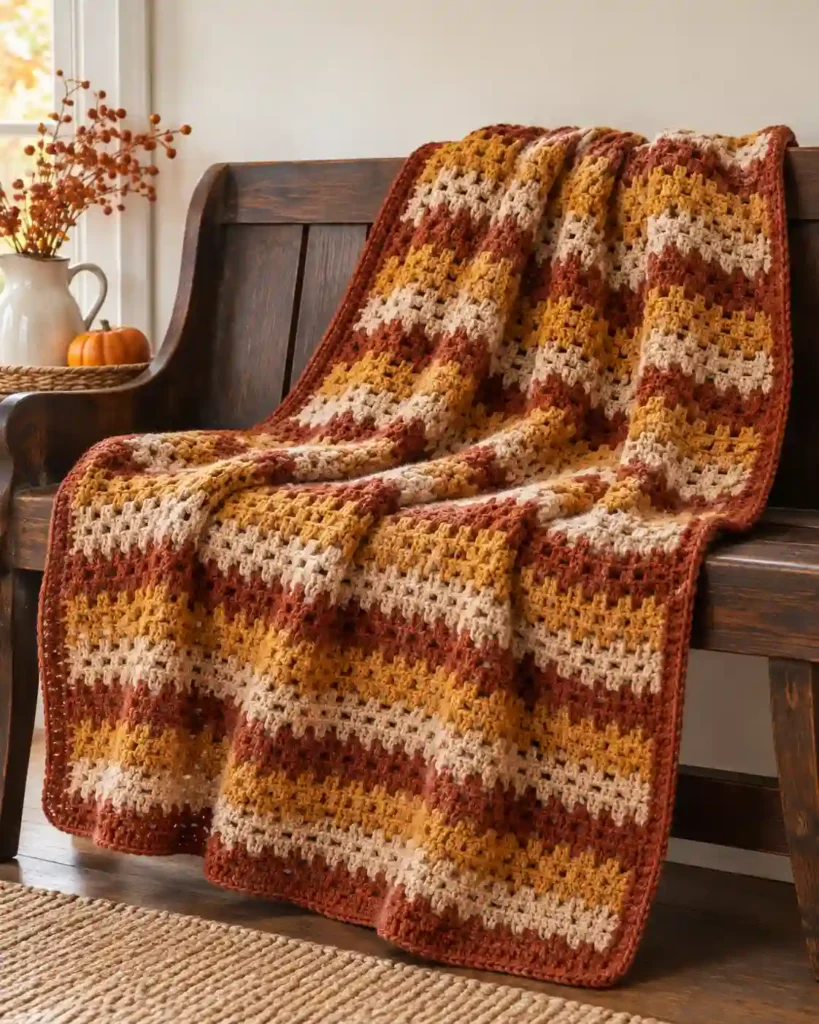
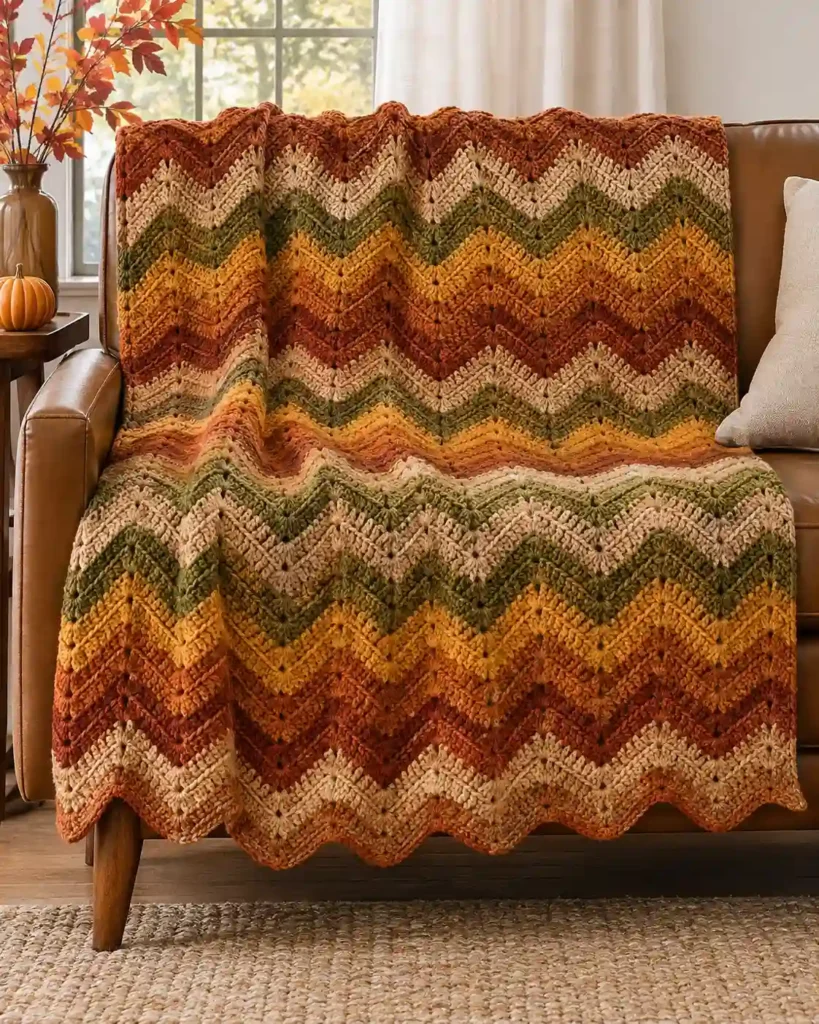
A ripple chevron blanket makes autumn colors feel lively without adding any appliqués. Terracotta, ochre, olive, and tan travel across the fabric in gentle peaks and valleys instead of flat horizontal bands. There’s something wonderfully nostalgic about a ripple folded on the back of a sofa, particularly when the colors feel soft and slightly vintage. It’s a good next step after a straight-row blanket if you’re ready to practice increases and decreases.
Mark the turning points and check your stitch count after each repeat. Broad color bands give the zigzag pattern room to show. Skill level: confident beginner with a reliable pattern.
10. Terracotta-to-Olive Color-Block Throw
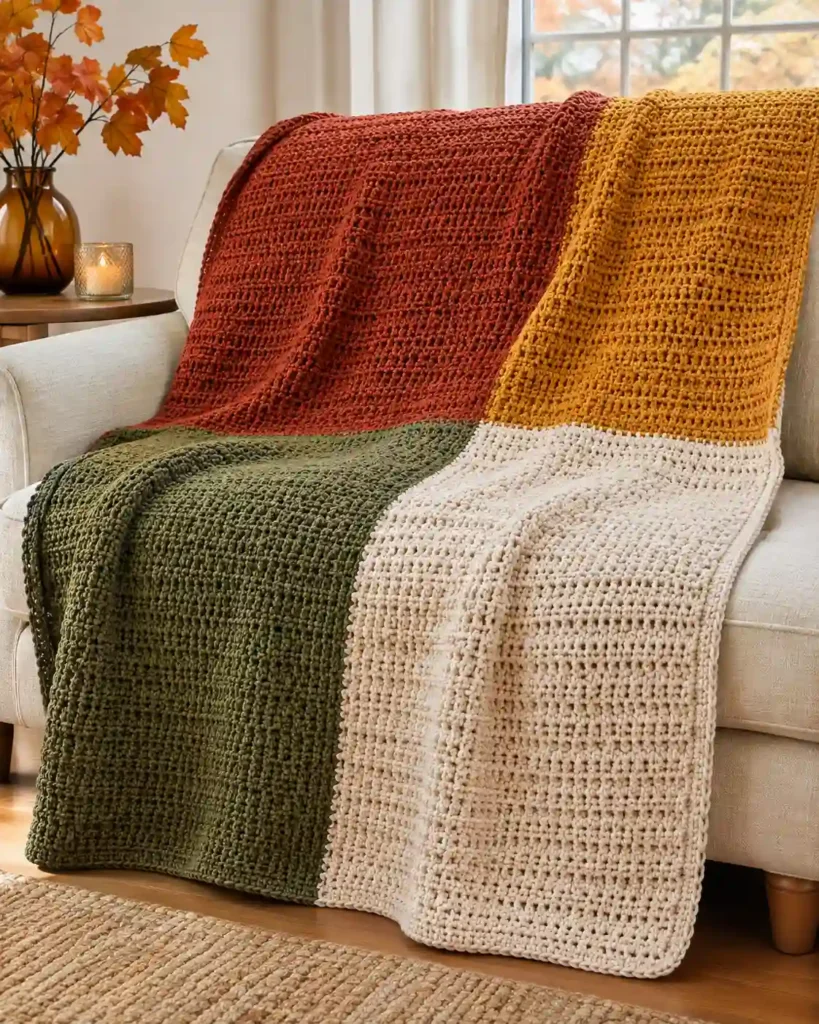
The color-block throw is proof that a fall blanket doesn’t need any seasonal motifs at all. Wide sections of terracotta, mustard, olive, and oatmeal turn a basic stitch into a modern accent that works long after Thanksgiving. Place it on a simple cream sofa and the colors do all the work, making the stitch pattern feel clean rather than plain. This is ideal for a beginner who likes choosing colors but wants to avoid complicated shaping.
Plan the width of each section before starting, and use a consistent stitch throughout. If you’re unsure about four shades, begin with terracotta and oatmeal, then add olive as the accent. Best feature: easy customization for the room.
11. Woodland Mushroom Granny Square Blanket: Prefer Cottagecore Details?
A mushroom granny-square blanket has a completely different mood from a pumpkin throw: quieter, woodsy, and a little whimsical. Imagine small burgundy mushroom caps on cream squares, joined with forest green to give the whole blanket a woodland frame. It’s the sort of piece that belongs beside a stack of well-loved books or a rustic armchair. Make it for someone who prefers cottagecore charm over traditional orange-and-gold decorations.
Keep mushroom motifs small enough that they don’t overwhelm each square. Decide early whether the mushrooms are crocheted colorwork or securely attached appliqués, since the construction changes the finishing. Skill level: intermediate.
12. Autumn Mosaic Crochet Blanket
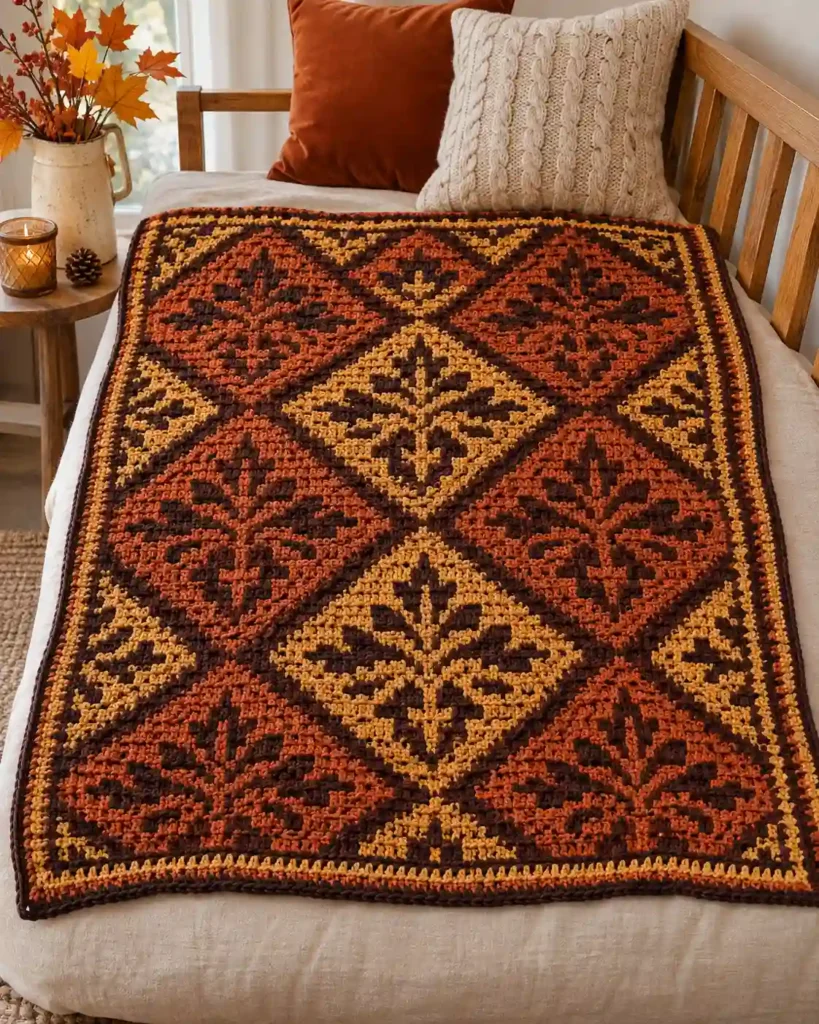
For an autumn blanket with a graphic twist, try mosaic crochet in sienna, chocolate, and muted gold. Geometric diamonds and repeating shapes create a polished surface that looks intricate from across the room. Unlike a loose granny stripe, mosaic crochet rewards careful attention to chart repeats and edge treatment. This makes a satisfying project for someone who likes following a visual plan and wants a striking throw for a modern living room.
Overlay and inset mosaic are different methods, so choose one before purchasing yarn. Sample your colors together to check that the motif remains readable. Skill level: intermediate to advanced, depending on the pattern.
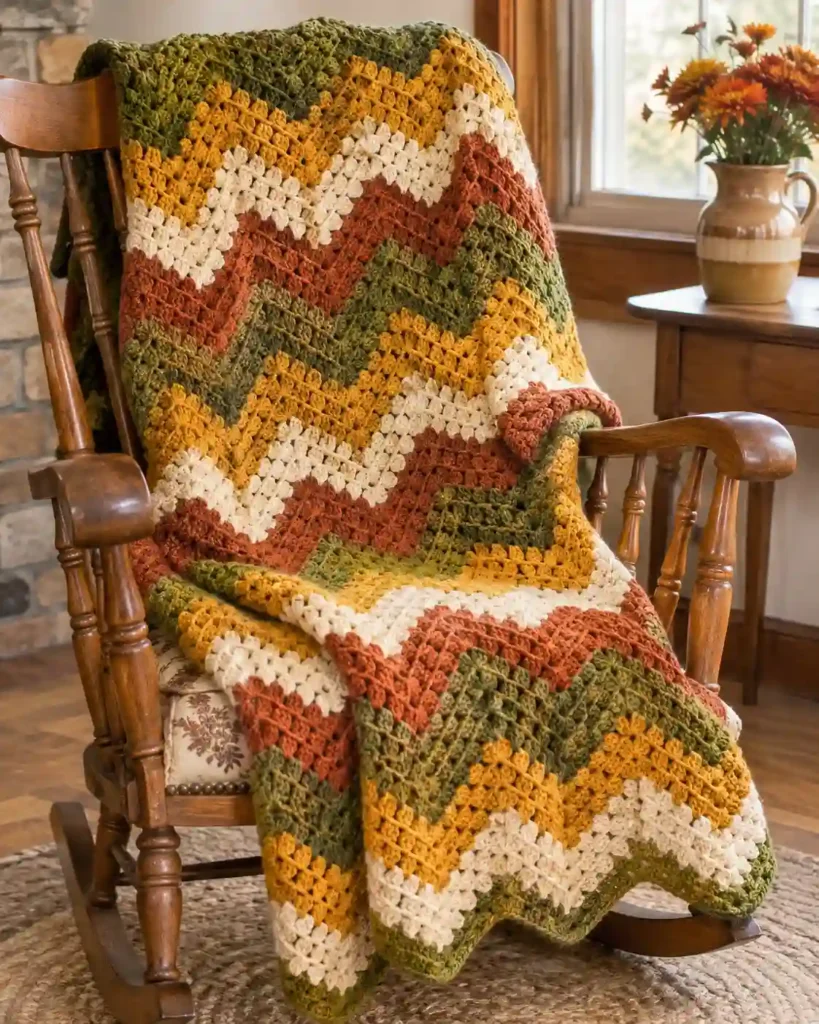
13. Vintage Granny Chevron Afghan: Love the ’70s Look?
The vintage granny chevron afghan borrows the zigzag movement of a ripple but fills it with classic granny clusters. Avocado green, amber, faded rust, and cream make it feel comfortably retro without needing a single pumpkin. On a wooden rocker or a corduroy sofa, those clustered peaks have real character. Try this one if you like traditional afghans and want something a little more textured than a standard chevron.
The cluster placement differs from solid ripple stitches, so follow a granny-chevron repeat rather than assuming a basic ripple pattern will work. Keep the stripes balanced with a repeating color sequence. Best for: confident makers who enjoy a vintage palette.
14. Two-Color Lemon-Peel Stitch Blanket
Here’s a simple option for anyone who finds multicolored blankets exhausting: forest green and cream in a lemon-peel stitch. Alternating basic stitches creates a small pebbled surface, just enough texture to make the blanket interesting without demanding lots of counting. The finished throw looks lovely folded at the foot of a guest bed and can stay out all winter. It’s an approachable choice when you want quiet texture rather than a big autumn statement.
Lemon-peel variations can use different stitch multiples, so follow the starting count in your chosen pattern. Work generous color bands and keep the edges tidy. Skill level: beginner once you know single and double crochet.
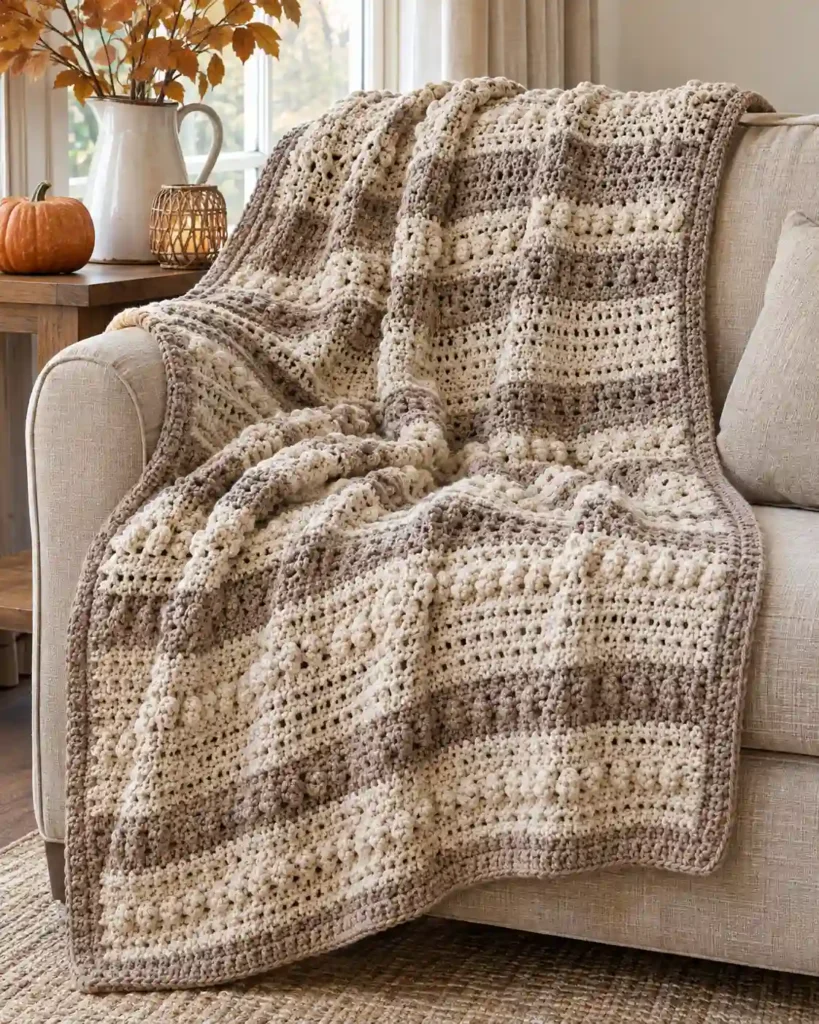
15. Neutral Farmhouse Textured Blanket: Can Fall Décor Skip Orange?
Absolutely—and an oatmeal farmhouse throw makes a strong case for it. Raised stitch bands in mushroom, cream, or taupe add warmth to a room without competing with pumpkins, wreaths, or colorful cushions nearby. Because the palette is so restrained, the fabric’s texture becomes the main feature. This is a lovely option for someone who decorates minimally or wants a handmade blanket that will be useful year-round.
Choose a washable yarn and test the stitch in natural daylight. Even subtle contrasts can disappear if the shades are too similar. Try this palette: oatmeal, mushroom taupe, and a small amount of chocolate brown.
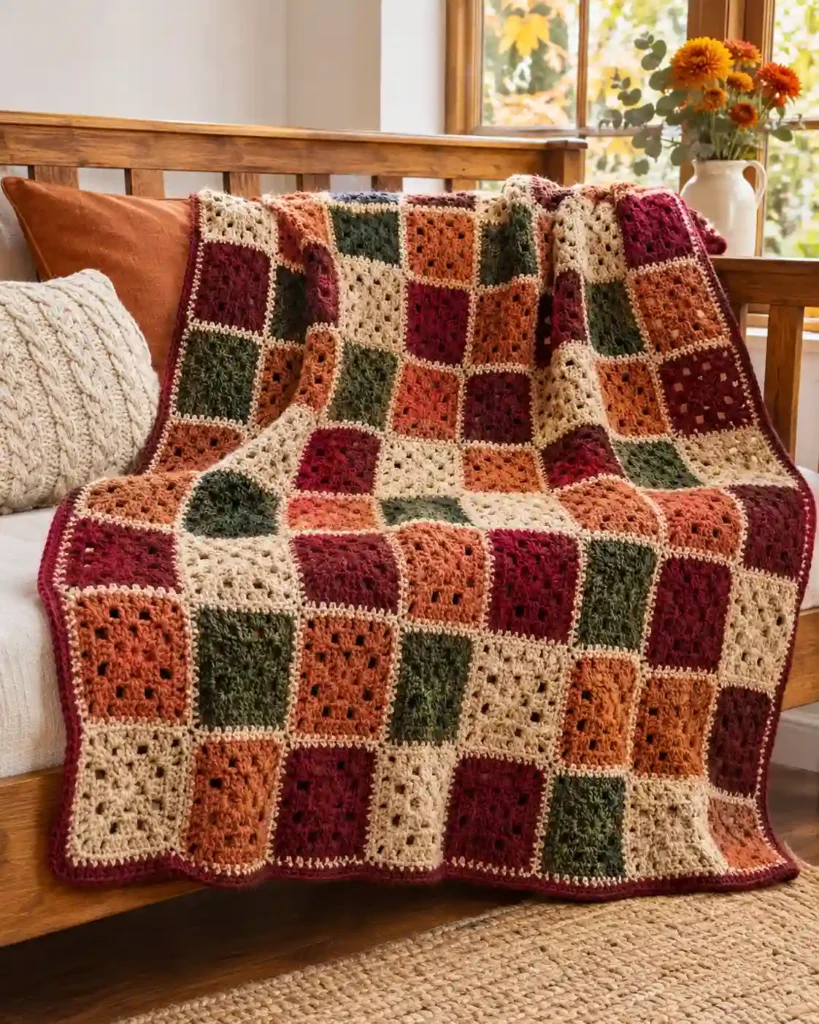
16. Cottagecore Patchwork Scrap-Yarn Afghan
A patchwork scrap-yarn afghan has a charm that perfectly matched color blocks can’t quite reproduce. Small squares in burgundy, wheat, forest green, and clay can make good use of yarn left from other projects, while one joining color pulls everything together. It looks at home in a cottage-style bedroom where a slightly mixed-and-matched feel is the point. Choose this if you’d rather work through your stash than purchase a full new palette.
Keep scraps close in yarn weight and fiber behavior to avoid uneven washing and stretching. Make a few sample squares before deciding on the final layout. Best feature: flexible color choices and less leftover yarn.
17. Pumpkin-Stripe Harvest Blanket: Need a Simple Seasonal Statement?
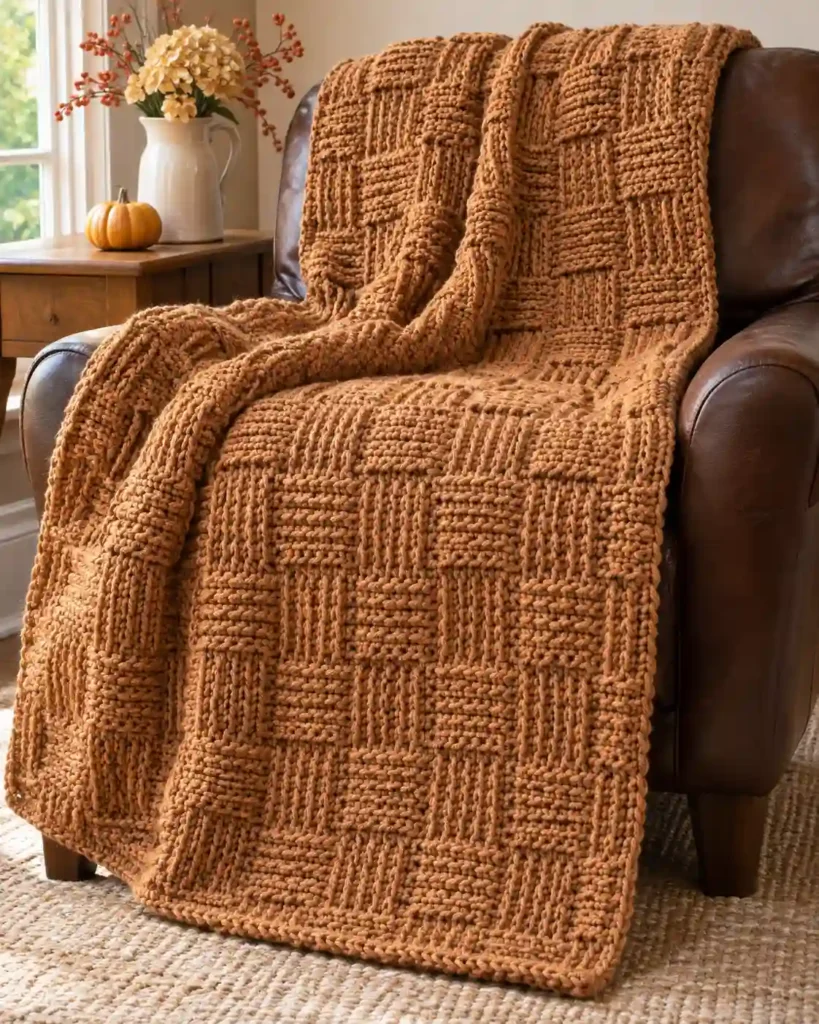
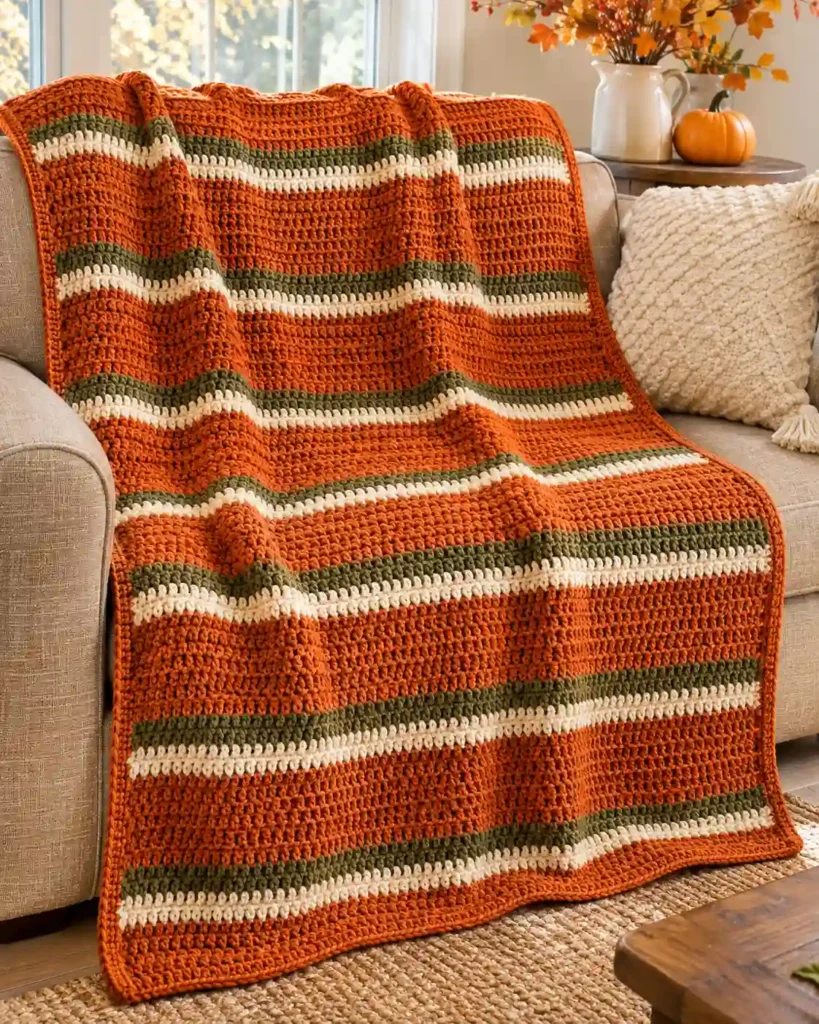
Wide pumpkin-orange bands give this harvest blanket an autumn mood without any shaped pumpkins. Add narrow olive and cream stripes and the result feels fresh, graphic, and far easier to plan than intricate colorwork. On a beige sofa, it becomes an immediate seasonal accent. It’s particularly good for newer crocheters who have mastered straight rows but want something bolder than a single-color throw.
Repeat the stripe order to make your color placement predictable. Carry yarn only where the stitch and color spacing allow it neatly; otherwise fasten off and weave in ends. Skill level: beginner.
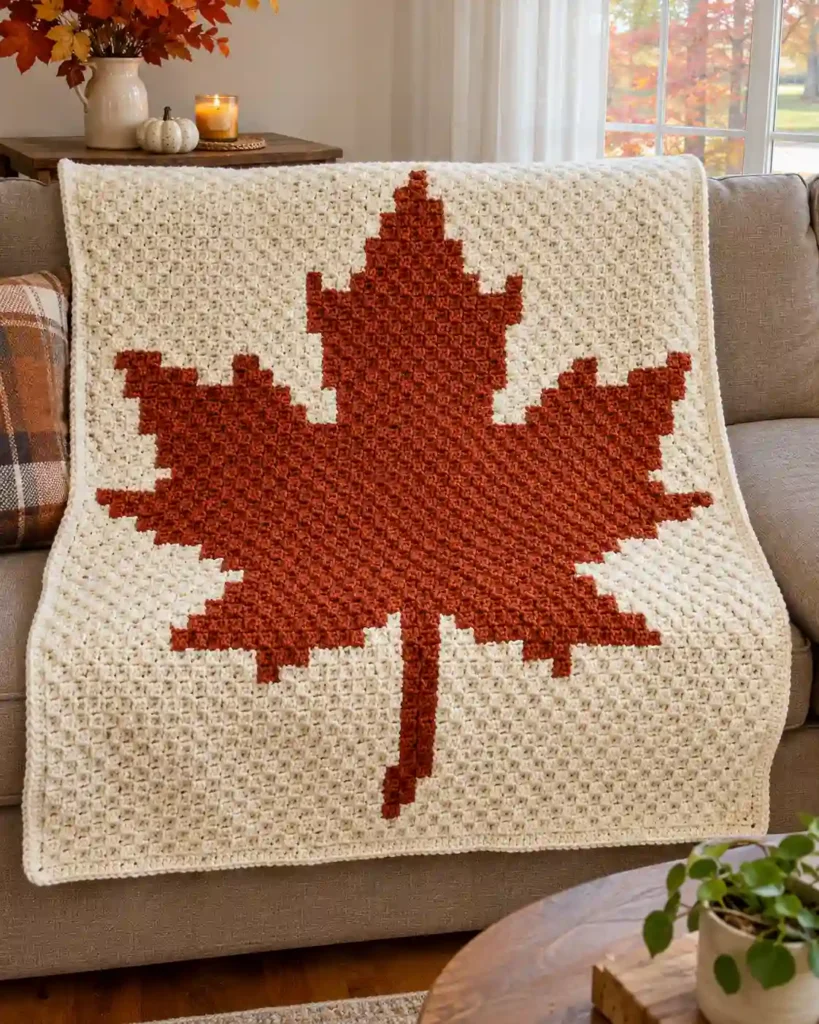
18. Corner-to-Corner Maple Leaf Graphgan
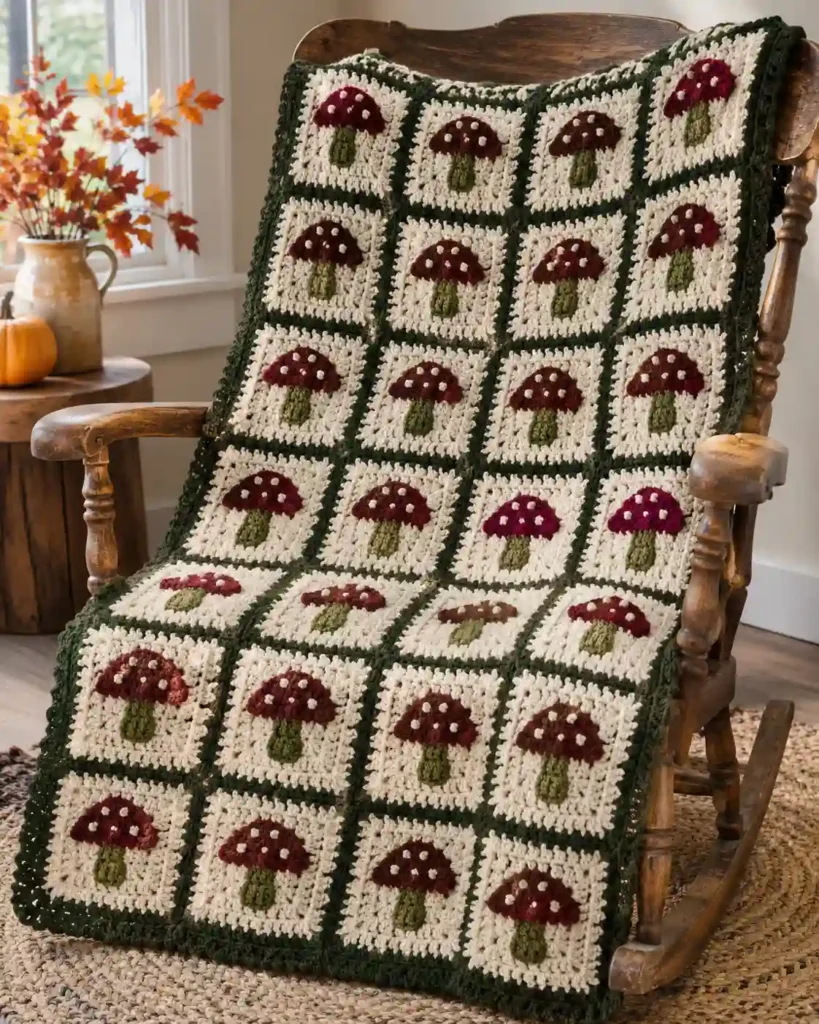
One large rust-colored maple leaf against an ivory background makes a dramatic fall blanket without dozens of tiny motifs. Corner-to-corner crochet, often called C2C, builds the fabric diagonally from small stitch blocks, so the design grows like a picture. Spread across a couch, the single leaf becomes the whole statement. This is especially rewarding if you enjoy working from a chart and seeing an image emerge row by row.
Follow a verified C2C color chart and organize your yarn into separate small balls or bobbins to limit tangles. Check the chart’s intended dimensions before starting. Skill level: intermediate, mainly because of color changes.
19. Chunky Basketweave Fall Throw: Want a Heavier Cozy Texture?
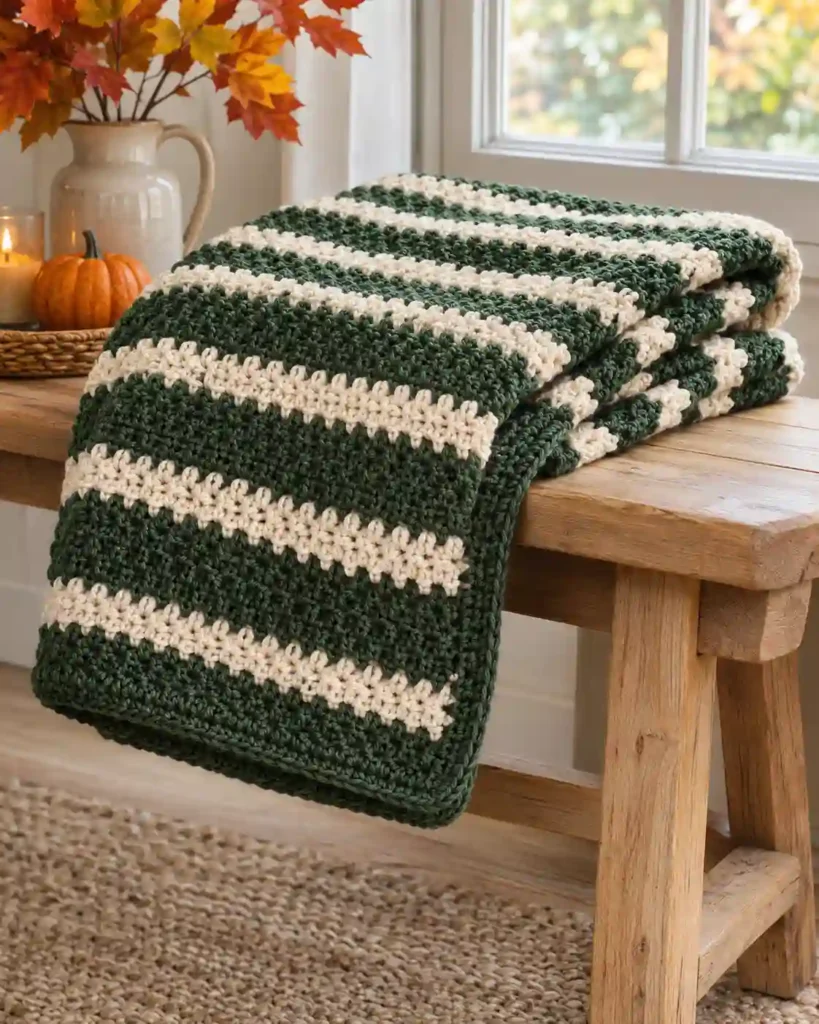
A caramel basketweave throw has the look of interlaced fabric, but its raised blocks are made entirely with crochet stitches. The texture is deeper and more structured than moss stitch, making it particularly satisfying as a lap blanket on colder evenings. Drape it over a dark chair and you can see the alternating directions of the raised blocks. Choose this if you enjoy tactile stitch patterns and don’t mind using a little extra yarn.
Basketweave usually uses front-post and back-post stitches to create the illusion of weaving. Make a sample to check weight, drape, and how much yarn the fabric uses. Skill level: intermediate.
20. Soft Harvest-Color Baby Blanket
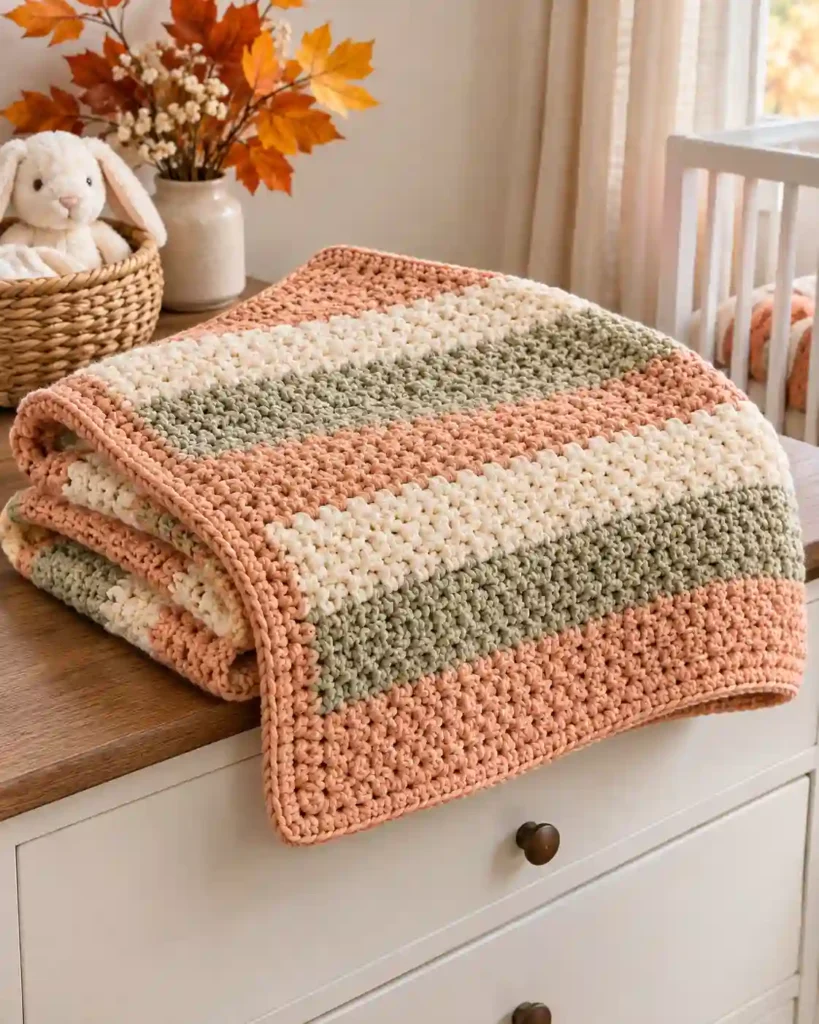
A baby blanket in dusty peach, pale sage, and warm cream feels seasonal without looking like holiday décor. Smooth, stable stitches and gentle color changes make it practical to gift, while avoiding bobbles, tassels, and loose embellishments keeps the finish simple. It looks beautiful folded on a nursery shelf beside other handmade keepsakes. Choose this version when softness, washability, and secure construction matter more than dramatic texture.
Important safety note: A handmade blanket can be a keepsake or used during supervised awake time, but it should not be placed in an infant’s sleep space. The American Academy of Pediatrics recommends keeping loose blankets and other soft items out of infant sleep areas.
21. Quick Weekend Crochet Lap Blanket: Short on Time?
A compact lap blanket is often a much friendlier project than a full sofa throw. Work a comfortable repeated stitch in cinnamon and cream, and focus on making something useful for a reading chair or TV evening rather than chasing an enormous finished size. The smaller scale lets you experiment with an autumn palette without committing to a long project. It’s a thoughtful gift idea for beginners or anyone with a limited yarn budget.
“Weekend” depends on your pace, yarn, and chosen dimensions, so don’t treat it as a fixed completion promise. Decide the finished width first and use a simple border. Best feature: manageable scope.
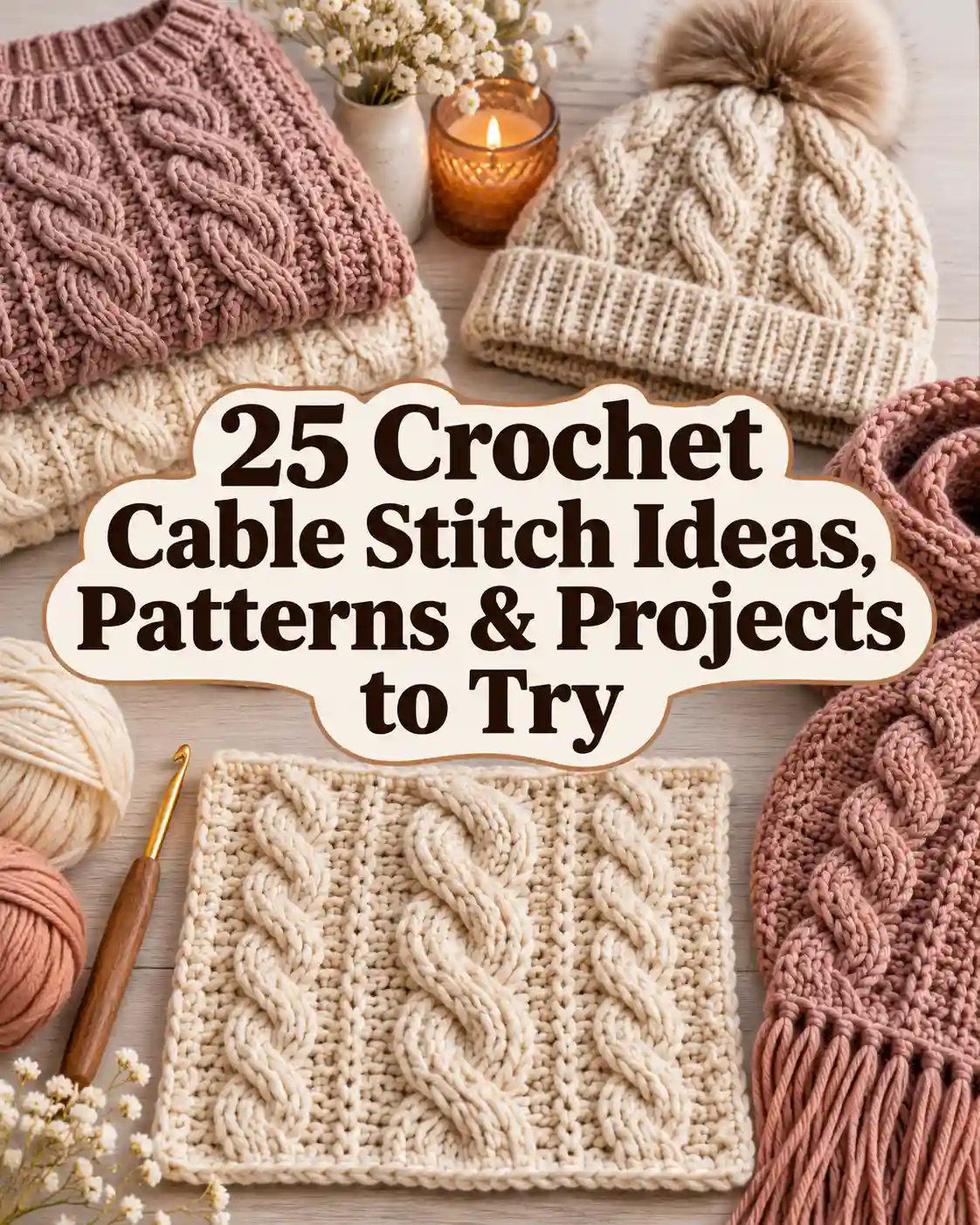
22. Braided-Look Crochet Cable Blanket
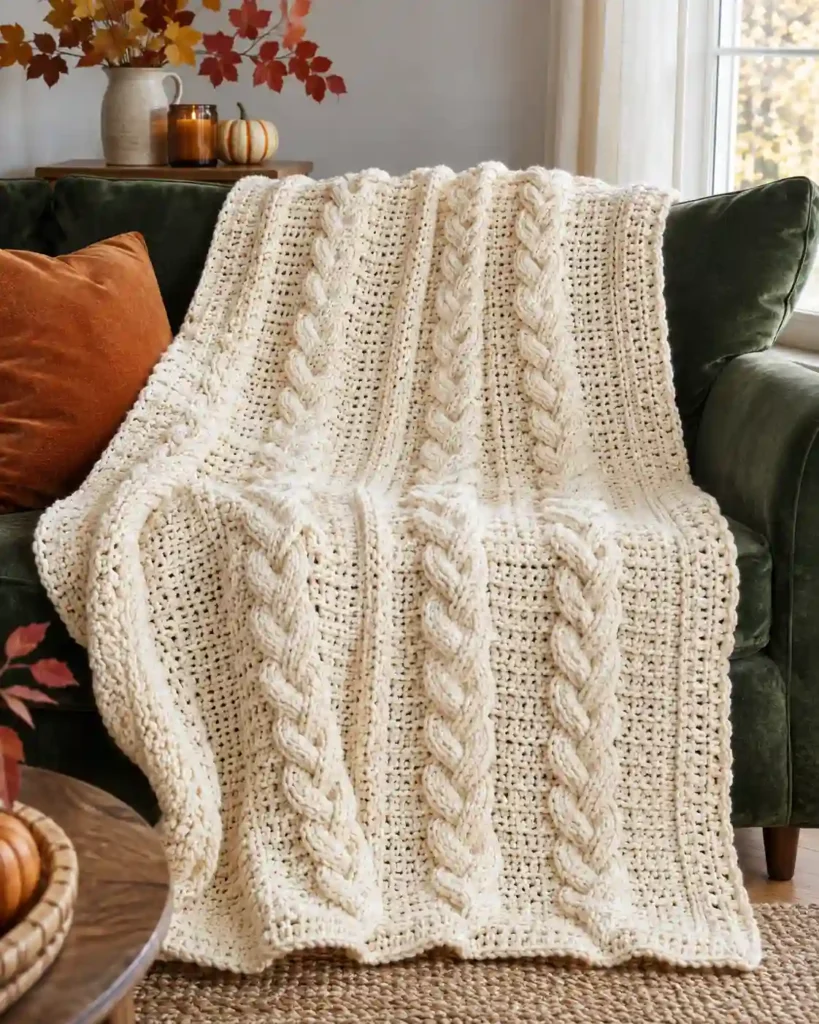
Cream crochet cables have a soft, heirloom quality that stands apart from bright fall motifs. Raised braided-looking columns add depth while a pale yarn lets each turn of the stitch catch the light. On a dark green sofa, this blanket looks rich without relying on a complicated color palette. It suits a crocheter who wants to learn more advanced post stitches and prefers a project that can remain out through winter.
Cable textures can pull the fabric inward, so gauge and stitch counts deserve extra attention. Buy yarn based on a complete pattern or carefully measured sample rather than a generic blanket estimate. Skill level: intermediate to advanced.
23. Autumn Log Cabin Granny Square Blanket: Ready for Modern Patchwork?
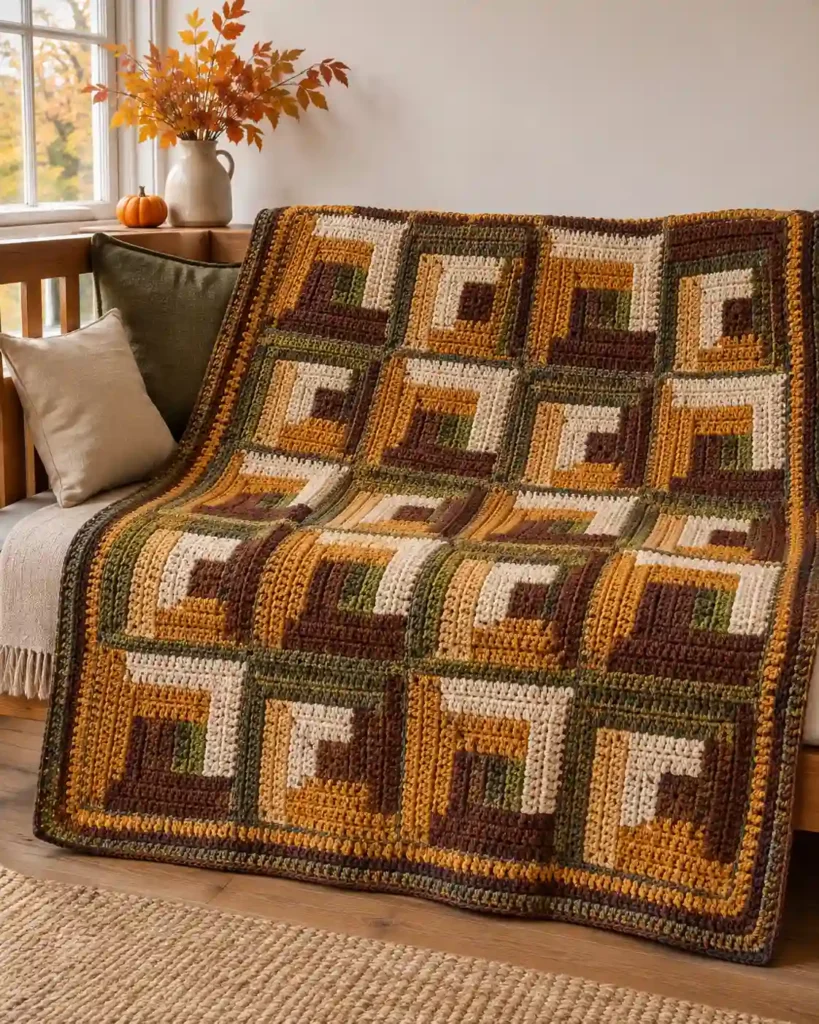
A log cabin granny-square blanket uses off-center blocks rather than identical traditional squares. Ochre, moss, chocolate, and oatmeal build around each motif in changing directions, making a geometric throw that looks wonderfully considered. Rotate the completed squares before joining and you can create different rhythms with the same pieces. This is a great fit for someone who likes planning layouts on the floor before assembling the final blanket.
Measure each block after the final round and keep the joining method consistent. You can arrange the squares in a repeating orientation or alternate them for more movement. Best feature: dramatic design variation from modular pieces.
24. Autumn Hexagon Motif Throw
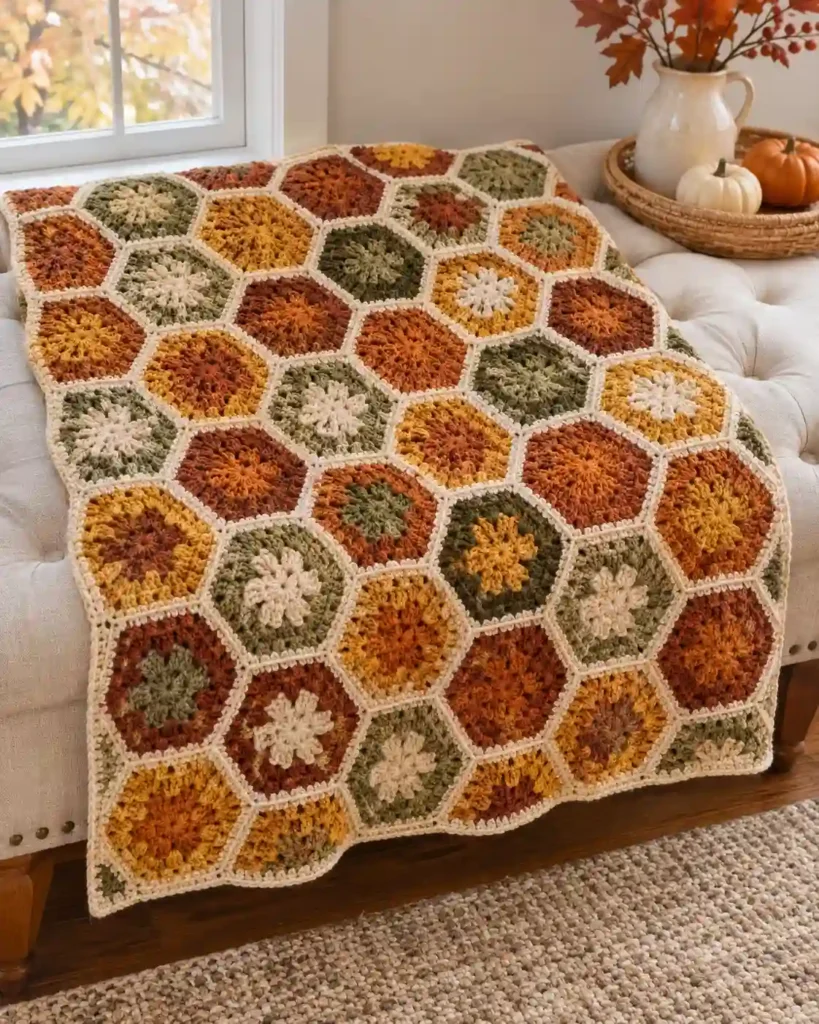
Hexagons give an autumn blanket a honeycomb rhythm that regular granny squares don’t offer. Work each motif in warm ochre, cinnamon, sage, and cream, then join them into a soft throw with visible little seams. The finished shape is especially pretty laid across a bench, where the repeating six-sided motifs can be seen clearly. Pick this if you already enjoy joining motifs and want to try a different geometry.
Unlike squares, hexagons may need half motifs or other edge treatments to create straight sides. Plan your outer shape before making the whole stack. Skill level: intermediate.
25. Cozy Halloween Skull-Motif Throw: Want Something a Little Spooky?
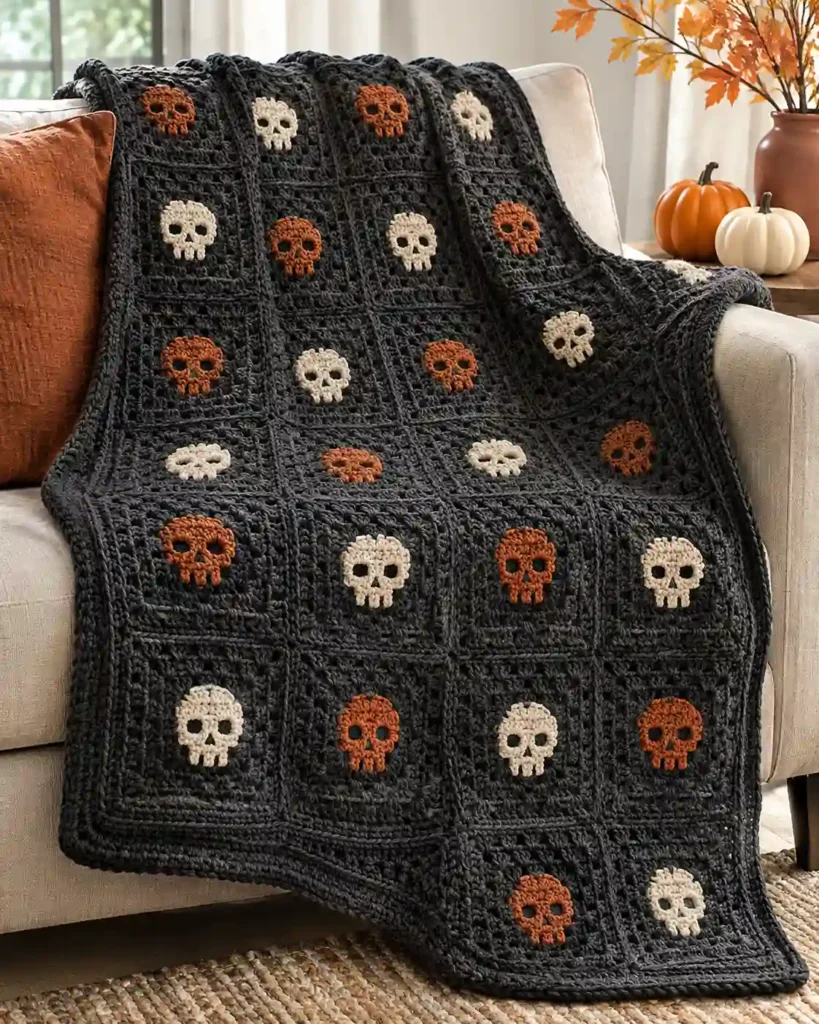
For the final autumn idea, swap harvest flowers for small skull motifs in bone white, rust, and charcoal. Keeping the skulls subtle makes the blanket more like a cozy Halloween accent than a loud novelty print. It would be fun across a plain sofa during October, especially if the rest of the room already uses dark fall colors. This is for makers who enjoy seasonal projects and want a playful twist on granny-square construction.
Select a clear motif chart or written pattern so the shapes remain recognizable at blanket scale. Secure all joins and keep the border simple. Skill level: intermediate.
How Do You Choose the Best Fall Crochet Blanket Colors?
Choose two or three autumn shades that suit the room, then add a neutral to balance the palette.
- Pair rust with cream and olive.
- Combine terracotta, oatmeal, and mustard.
- Try mushroom, chocolate, and sage for softer décor.
- Check yarn colors in natural daylight.
Start with one color you genuinely want to live with, then build a small group around it. Rust with cream and olive feels classic; terracotta with oatmeal and mustard feels brighter; mushroom with chocolate and sage is much quieter. A useful styling approach is to let one shade dominate, a second support it, and a third provide small accents—not because there is a strict crochet rule, but because it keeps a busy blanket from feeling chaotic.
Lay the yarn together in daylight before you start. And if you’re gifting the blanket, choose colors for the recipient’s space rather than automatically reaching for orange.
Where Can You Find Fall Crochet Blanket Patterns Free?
Look for designers who publish complete written instructions on their sites, and check whether charts, printable PDFs, or pattern sections require payment.
- Confirm that instructions are fully available at no cost.
- Check whether charts and diagrams are included.
- Review yarn, hook, gauge, and finished-size details.
- Verify whether a pattern is released in stages.
If you searched for fall crochet blanket patterns free, you’re probably hoping for instructions you can follow without buying a PDF. Some designers provide complete free written instructions on their websites while offering optional paid printables. Others offer only inspiration or a pattern preview, so check the actual instructions before buying yarn.
Here are three verifiable places to start:
- Crochet Pumpkin Patch Blanket — Yarnspirations: A free downloadable pumpkin-square blanket pattern designed by Sarah Zimmerman. The page lists an approximate finished size of 30 × 38 inches.
- Autumn Rhapsody Stitch Sampler — Nana’s Crafty Home: A free on-page pattern with stitch tutorials; the printable PDF is a separate paid option. The published sample is approximately 38 × 49 inches.
- Fall Into Place Mosaic Blanket — HanJan Crochet: Free written sections and video support for an autumn motif blanket; the paid PDF includes mosaic charts not supplied with the free blog version.
These are examples of actual patterns, not one-to-one instructions for all 25 ideas above. When comparing other fall crochet blanket patterns, look for finished dimensions, yarn weight, hook size, gauge, stitch definitions, and a full row-by-row or motif-by-motif guide.
What Yarn and Hook Size Work Best for an Autumn Blanket?
Medium (#4) yarn suits many everyday throws, while bulky (#5) yarn creates a thicker fabric; follow the pattern’s gauge and hook guidance.
- Match yarn weight to the pattern.
- Check the label’s hook recommendation.
- Make a gauge swatch before scaling dimensions.
- Compare care instructions when mixing yarns.
Medium-weight (#4) yarn is a versatile starting point for granny stripes, color-block blankets, and many squares. If you’re new to choosing fibers and weights, explore crochet yarn for crochet beginners for additional guidance. Bulky (#5) yarn can give a faster-growing, thicker-looking throw, while DK/light (#3) may suit finer motif or mosaic work. The Craft Yarn Council’s standard yarn-weight system provides reference hook ranges, but your chosen pattern’s gauge is more important than the general category.
A swatch is simply a small sample of the stitch you plan to use. Measure it, note how the fabric drapes, and use it to estimate yarn needs if you’re changing the finished size. A dense waffle or basketweave fabric may require a very different amount of yarn than an airy granny stripe of the same dimensions.
Is Your Favorite Design Beginner-Friendly or Intermediate?
Granny stripes and simple color bands suit many beginners, while mosaic charts, C2C pictures, and cables require more techniques.
- Start with repeated basic stitches.
- Practice color changes on a small sample.
- Try motif joining after checking square size.
- Choose chart-based work when comfortable reading charts.
The label is more useful when it reflects the work involved, not how complicated a finished blanket looks. Granny stripes, wide color bands, lemon-peel stitch, and simple lap blankets are sensible entry points. Mosaic charts, C2C picture blankets, complicated motifs, and cables add new skills in stages.
The Craft Yarn Council’s project-level guidance distinguishes basic projects from those involving more detailed patterns, colorwork, shaping, or simultaneous techniques. Try one practice motif or a few rows before committing to a whole blanket; you’ll know quickly whether the repeat feels enjoyable.
How Should You Finish, Wash, and Store a Crochet Blanket?
Finish by securing yarn ends and checking joins, then wash and store the blanket according to its yarn label.
- Weave in ends and inspect joins.
- Read the yarn label before washing.
- Test care methods on a swatch.
- Store the clean blanket fully dry.
Weave in yarn ends securely, check that motifs are joined evenly, and explore different crochet blanket edging ideas if you want to give the finished edges a decorative look. Before washing the finished piece, read the yarn label and wash a test swatch using the care method you plan to use. Keep the yarn band with a gift so the recipient has the fiber and care details.
The Craft Yarn Council’s care-symbol guide explains the common washing, drying, and other symbols found on yarn labels. Avoid assuming that every handmade blanket can be machine washed or tumble dried; store it dry and clean, following the yarn’s care instructions.
Fall Crochet Blanket FAQs
What colors work best for a fall crochet blanket?
Rust, mustard, olive, cream, terracotta, and chocolate are dependable autumn shades. Choose two or three that suit your room, then add a neutral to prevent the blanket from looking too busy.
What is the easiest fall crochet blanket for beginners?
A granny-stripe afghan, simple color-block blanket, or lemon-peel stitch throw is a practical starting point. They use repeated basic stitches and require less motif assembly than detailed pumpkin or sunflower squares. When comparing fall crochet blanket patterns, look for repeated stitches, clear turning instructions, and a simple border.
How much yarn do I need for a fall throw blanket?
There is no reliable single amount for every blanket. Yarn weight, finished dimensions, stitch density, and personal tension all change the estimate, so use a tested pattern or calculate from a gauge swatch.
Can I join granny squares without sewing each one afterward?
Yes. Join-as-you-go methods connect suitable motifs while working the final rounds, although not every square design uses the same joining technique. Follow the joining instructions for your specific motif.
Where can I find free fall crochet blanket patterns?
Start with the linked Yarnspirations, Nana’s Crafty Home, and HanJan Crochet examples above. Check whether the complete written instructions are genuinely free and whether extras such as charts or printable PDFs cost more. For fall crochet blanket patterns free, verify whether the no-cost page includes the full instructions or only part of the project.
Final Thoughts
Fall is the perfect season to slow down, get cozy, and enjoy a little handmade creativity. These 25 fall crochet blanket ideas offer plenty of inspiration, from warm autumn colors and classic granny squares to textured stitches and chunky designs. Whether you’re making your first blanket or adding another handmade piece to your home, choose a pattern that matches your skill level and favorite style. Pick up your yarn and hook, and create a cozy blanket you’ll love using throughout the season!