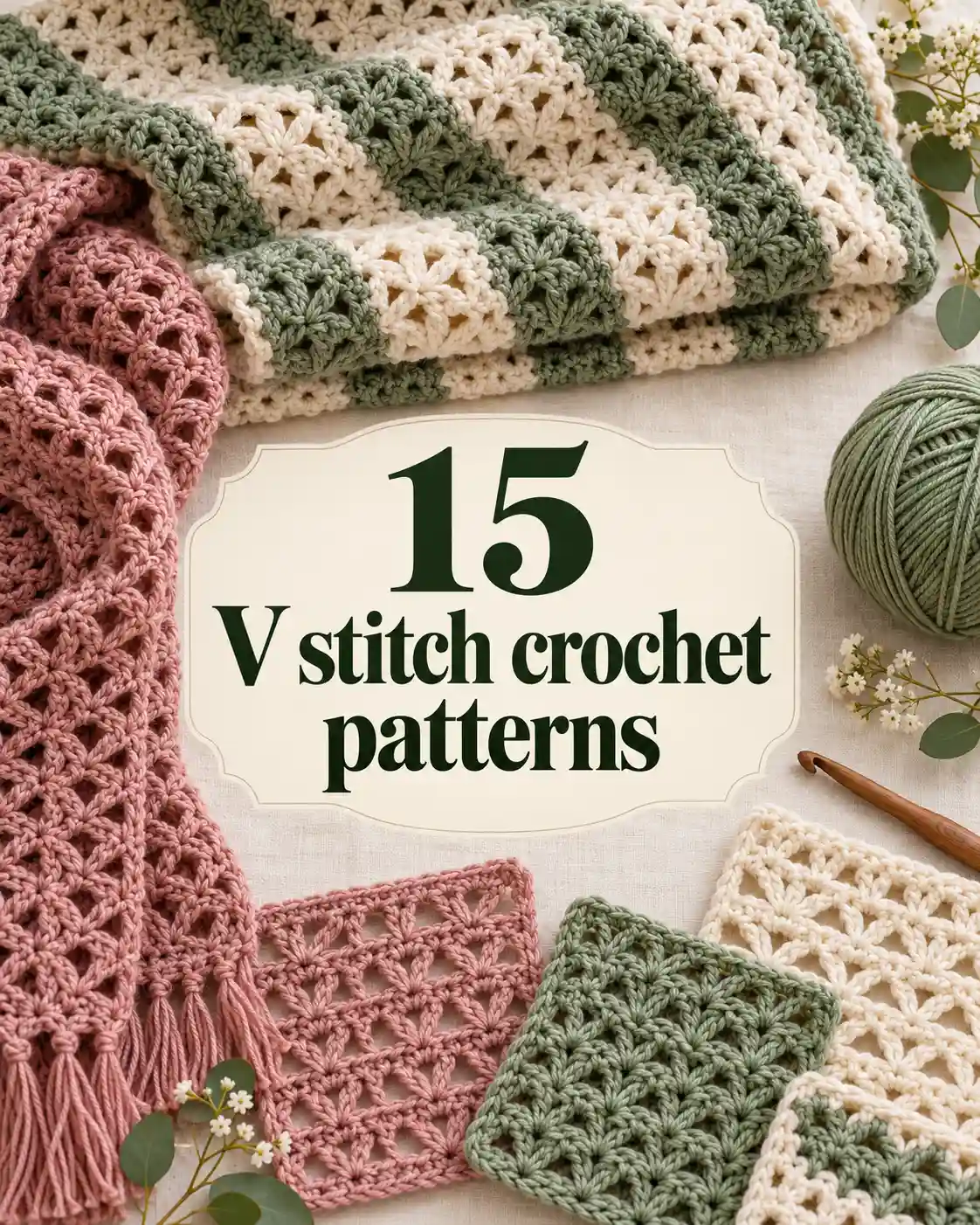
To crochet the classic V stitch, work one double crochet, chain one, and another double crochet into the same stitch or space. After the foundation row, place each new V into the chain-one space of the V below it. Learn the written repeat first, then explore these 15 stitch variations and project ideas for blankets, scarves, and clothing.
When you are learning v stitch crochet, it helps to have one small, manageable place to start rather than a whole blanket waiting on your hook. You can keep this sample beside you, find your rhythm, and choose a bigger project when the repeat feels comfortable.
Key Takeaways
- Work both double crochets into the same insertion point.
- Place new Vs into the previous row’s center spaces.
- Count five Vs across every row of this sample.
- Explore V stitch crochet patterns after mastering the basic repeat.
- Swatch for size before starting blankets or clothing.
How does V stitch crochet work?
The two double crochets form the arms of the V, while the chain creates its open center. Once you can recognize that little gap, finding the next insertion point becomes much easier.
This guide uses US crochet terms. A US double crochet is called a treble crochet in UK terminology, so check the terminology before combining instructions from different patterns.
The first seven ideas explore stitch variations; the remaining eight show ways to use them. The classic swatch below is a complete stitch tutorial, while garments and shaped projects need their own sizing and construction instructions.
| Starting point | Fabric or construction | Best next step |
|---|---|---|
| Classic double crochet V | Open, repeating columns | Practice swatch or scarf |
| Closed V | Smaller openings | Denser blanket sample |
| Half double crochet V | Shorter stitches | Compact scarf or blanket |
| Cluster or puff V | Raised texture | Small sample before a project |
| Offset or granny V | Different placement or row sequence | Follow the specific repeat |
| Blanket or scarf | Rectangular construction | Measure width and length |
| Shawl, top, or cardigan | Shaping or assembly | Use a complete project pattern |
What do you need for V stitch crochet for beginners?
Gather yarn, a suitable hook, scissors, a yarn needle, two stitch markers, and a measuring tape, and practice chains and double crochet before starting.
Start with a smooth, light-colored yarn so you can see the chain spaces. Choose a hook within the yarn label’s suggested range, then adjust if the swatch feels stiff or excessively loose.
Keep these supplies nearby:
- Yarn and a crochet hook.
- Scissors and a yarn needle for finishing.
- Two stitch markers for the row edges.
- A measuring tape for checking your sample.
You should already know how to make a chain and a double crochet. For a double crochet, yarn over, insert the hook, and draw up a loop; yarn over and pull through two loops, then repeat that last action to finish.
What are the V stitch crochet written instructions?
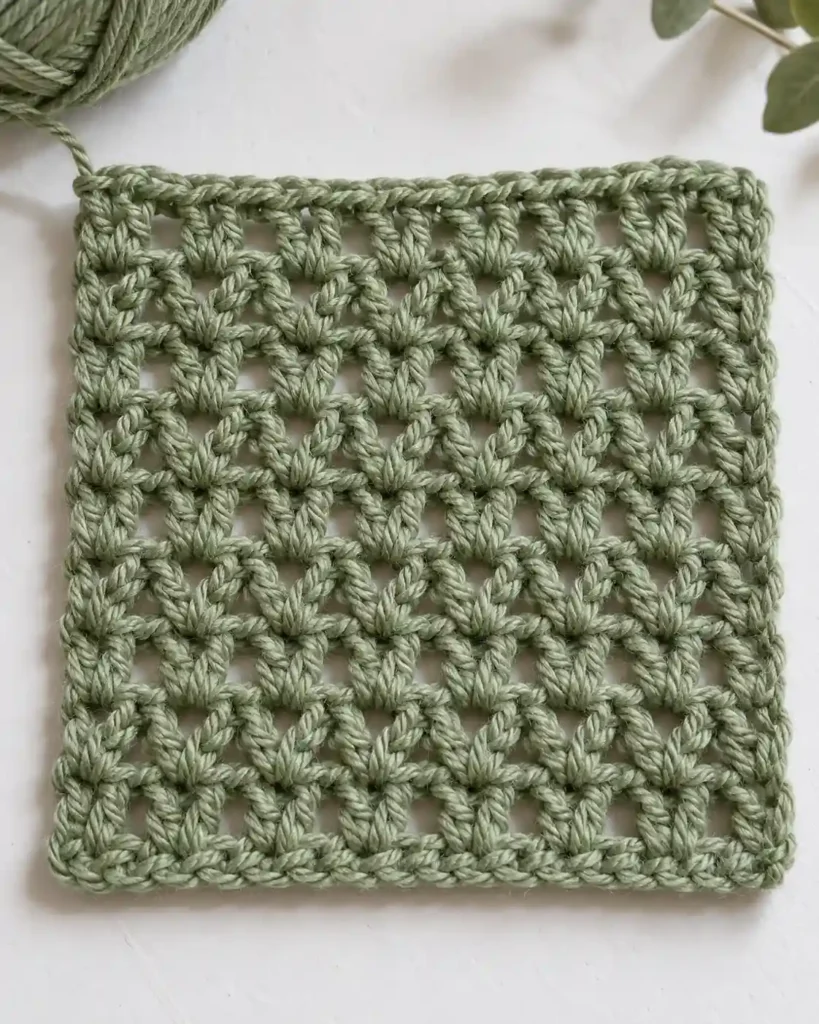
For this sample, chain 18, establish five Vs between the edges, and repeat rows with one V in each previous V’s chain-one space.
Abbreviations: ch = chain; dc = double crochet; sp = space. One V means (dc, ch 1, dc) in a single insertion point.
The following beginner sample uses the foundation and repeat documented by Hooked by Robin: a starting chain divisible by three, followed by a repeating row worked into the V centers. Other versions use different edge stitches and chain multiples, so keep one set of instructions together.
- Make the foundation: Chain 18. Do not include the loop on your hook when counting.
- Begin row 1: Place a V in the fourth chain away from the hook. The three unused starting chains form the first edge stitch.
- Continue row 1: Leave two chains unworked, then place a V in the following chain. Continue until only two foundation chains remain.
- Finish row 1: Leave one chain unworked and double crochet into the final chain. You should have five Vs between the two edges.
- Work row 2: Chain two and turn; this turning chain serves as the starting edge. Make one V in every V’s central chain-one space, then double crochet into the previous row’s turning-chain top.
- Build the sample: Repeat row 2, keeping five Vs in every row. Add no extra double crochet beside the starting turning chain.
Mark the top of each turning chain to make the final stitch easier to find. Before continuing, spread the sample flat and check that both edges stay even.
Which 15 V stitch crochet patterns and ideas should you try?
At a Glance
- Begin with the classic double crochet V stitch.
- Compare closed, shorter, textured, and staggered variations.
- Use rectangular construction for a scarf or blanket.
- Follow complete patterns for shawls, tops, and cardigans.
Choose the classic stitch first if you are still learning the repeat. For the other variations, follow a matching tutorial rather than swapping stitches into the sample without adjusting its foundation or edges.
1. Why start with the classic double crochet V stitch?
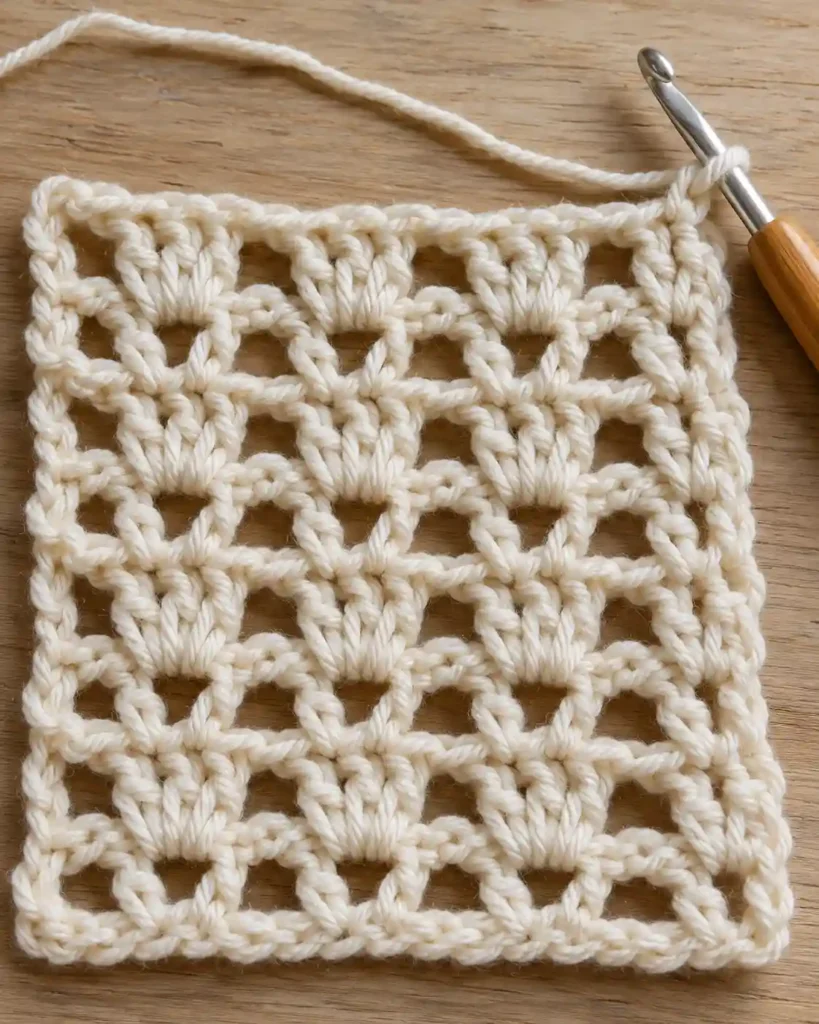
The classic double crochet V stitch gives you a clearly visible center to work into on every row. Compared with solid double crochet, its chain spaces create a more open fabric. Picture a small scarf you can pick up for ten minutes without relearning a complicated sequence. For beginners who know double crochet, the payoff is an easy repeat that makes progress easy to see.
Practice six to eight rows before changing colors. Count the Vs at the end of each row, and treat the two edge stitches separately.
2. When should you choose a closed V stitch?
For smaller openings, a closed V stitch pairs two double crochets without the central chain. That creates a denser effect than the classic open V. A lap blanket for a chilly reading chair is a useful place to explore the difference. Choose this version when you like the paired-stitch texture but want less open space.
Yarnspirations documents this as a no-space variation and works subsequent pairs between the two double crochets below. Use its matching foundation rather than the 18-chain open-V sample.
3. How does a half double crochet V stitch change the fabric?
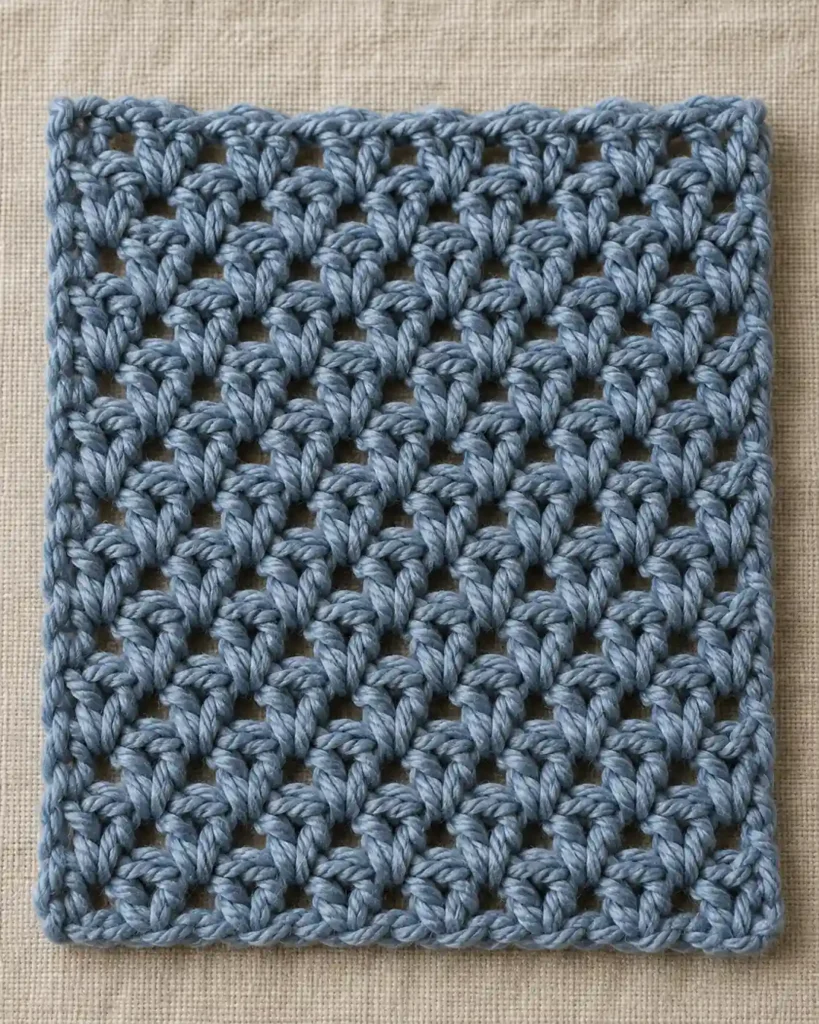
Half double crochet V stitch makes the familiar shape with shorter stitches. Its rows sit lower than double crochet rows, changing the scale of the texture. Think of a narrow scarf where you want small, tidy repeats rather than tall openings. It suits crocheters who want a compact-looking variation while keeping a recognizable V center.
The basic unit is (hdc, ch 1, hdc) in the same place. If you need to review the stitch first, see how to half double crochet before beginning this V variation.
4. What makes cluster V stitch more textured?
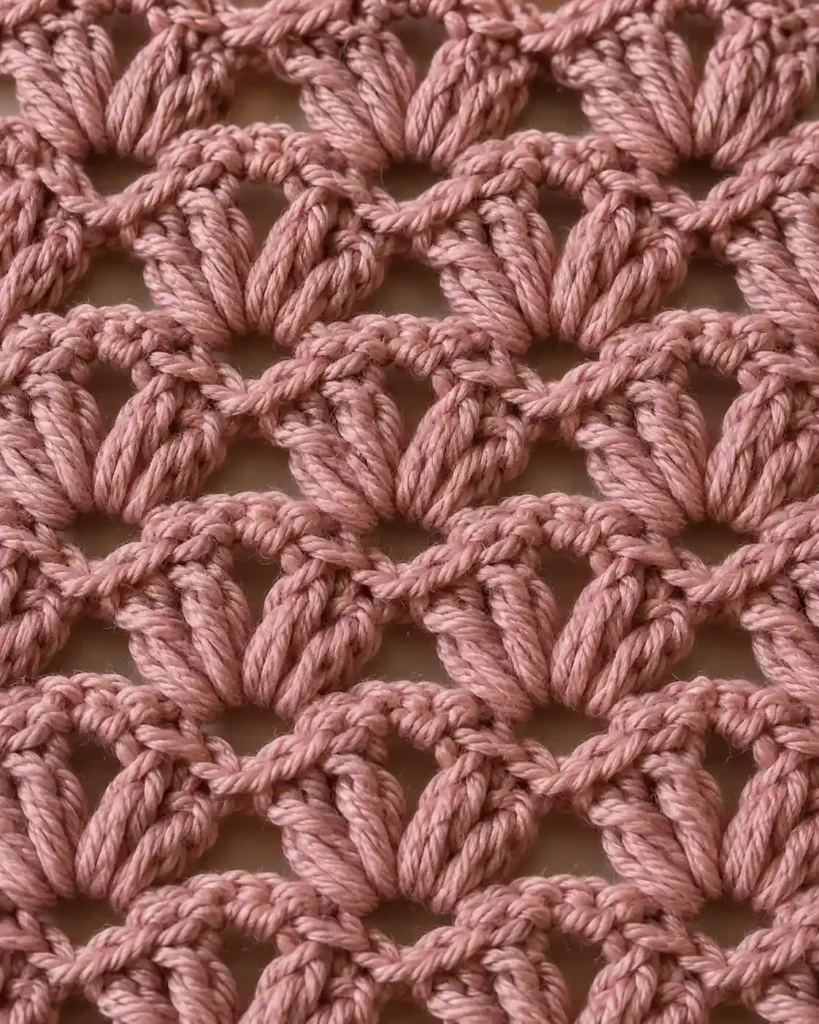
Cluster V stitch turns each arm into a group of stitches finished together. The resulting V has fuller sides than two individual double crochets. On a small cushion panel, that extra texture can make a plain color feel more interesting. Try it when you are comfortable managing several loops and want the stitches themselves to become the feature.
Nordic Hook’s version places two double-crochet clusters around a central chain. Each cluster joins two unfinished double crochets worked into one insertion point; follow the tutorial’s cluster definition and repeat.
5. Could puff V stitch suit a soft, raised pattern?
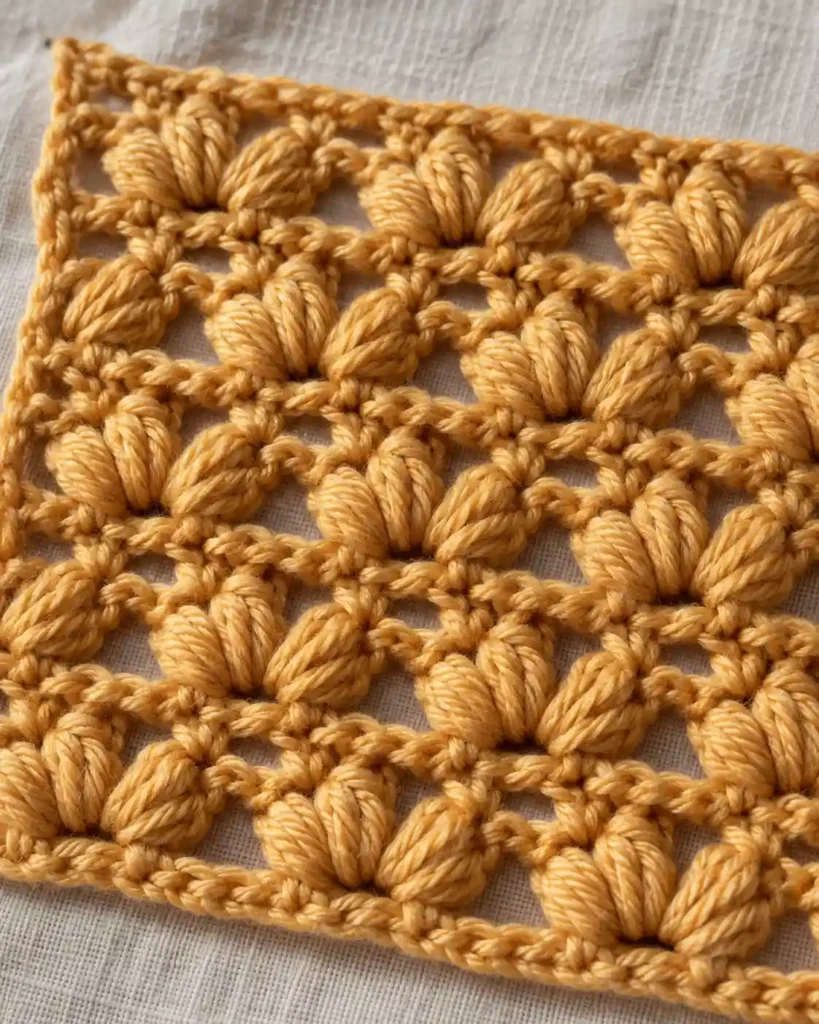
Puff V stitch brings rounded, raised arms to the V shape. It builds volume by drawing up loops, producing a different surface from ordinary double crochet. Imagine a short scarf with a few textured rows framing the ends. This variation appeals to crocheters who enjoy a more pronounced stitch and do not mind taking extra care with tension.
Puff definitions vary, including how many loops you draw up and how you close them. Follow the selected pattern exactly, and make a sample before estimating yarn needs.
6. Why try an offset V stitch?
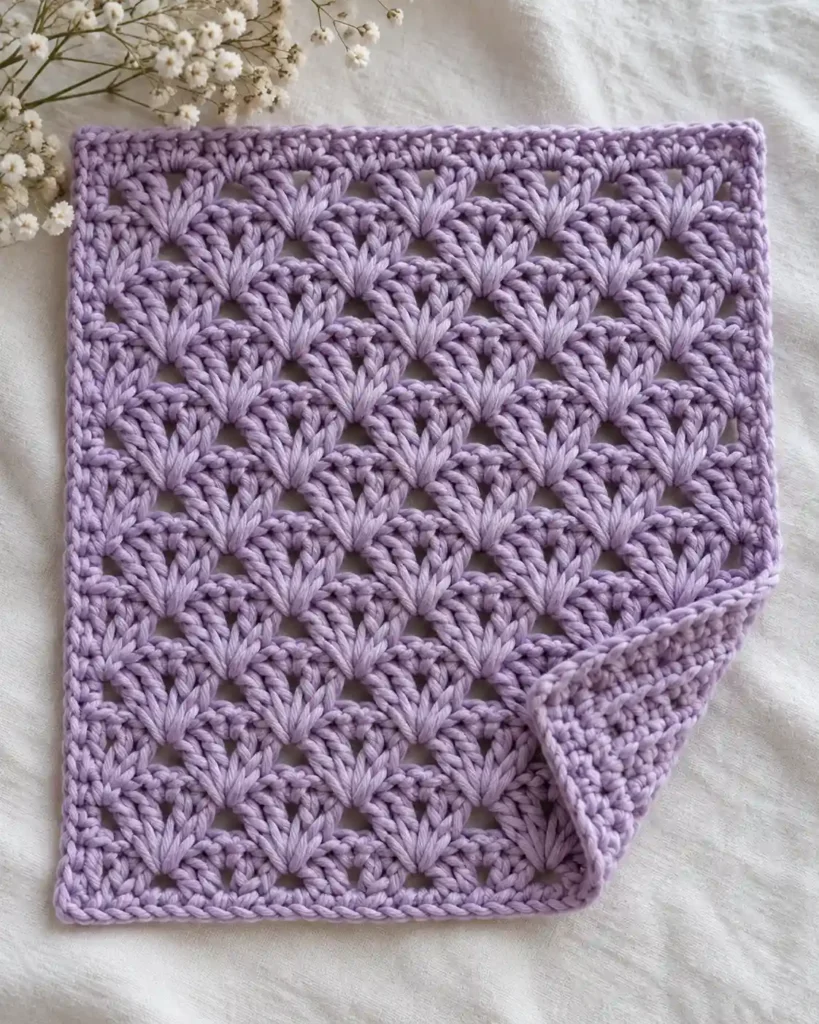
An offset V stitch changes the placement of successive Vs to create a staggered effect. The pattern looks different from the straight columns in the beginner sample. A light wrap in one color gives that shifting arrangement room to show. Pick this direction when you enjoy the classic stitch but want a different rhythm across the fabric.
Check which stitch or space receives each new V. Offset patterns can have different edge rules, so mark the first and last stitches until the repeat feels familiar.
7. What does granny V stitch add to colorful rows?
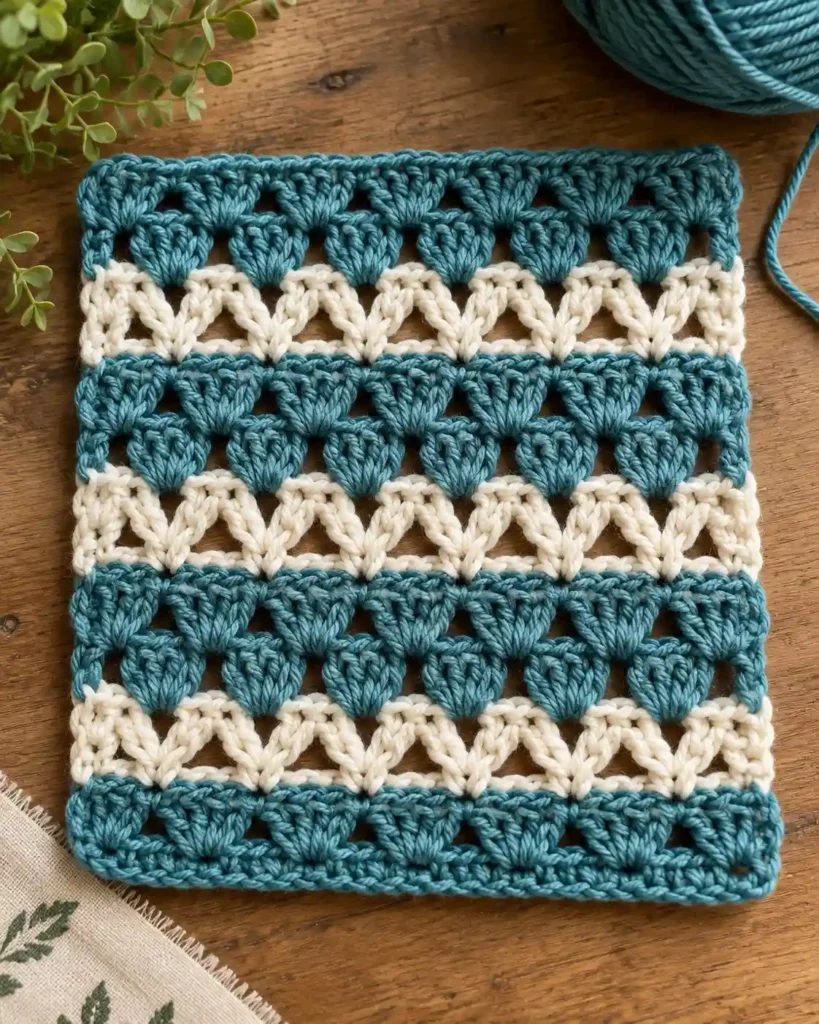
Granny V stitch combines recognizable V shapes with granny-style groups. Alternating structures gives the rows more visual variety than a single repeated stitch. It is an appealing option for a cheerful throw made with a planned palette of leftover colors. Crocheters who enjoy color changes get both texture and a clear row sequence to follow.
In Hooked by Robin’s granny V pattern, rows of three-double-crochet groups alternate with V-stitch rows. That is a two-row sequence, so do not substitute the classic one-row repeat.
8. How can you make a striped V stitch throw blanket?
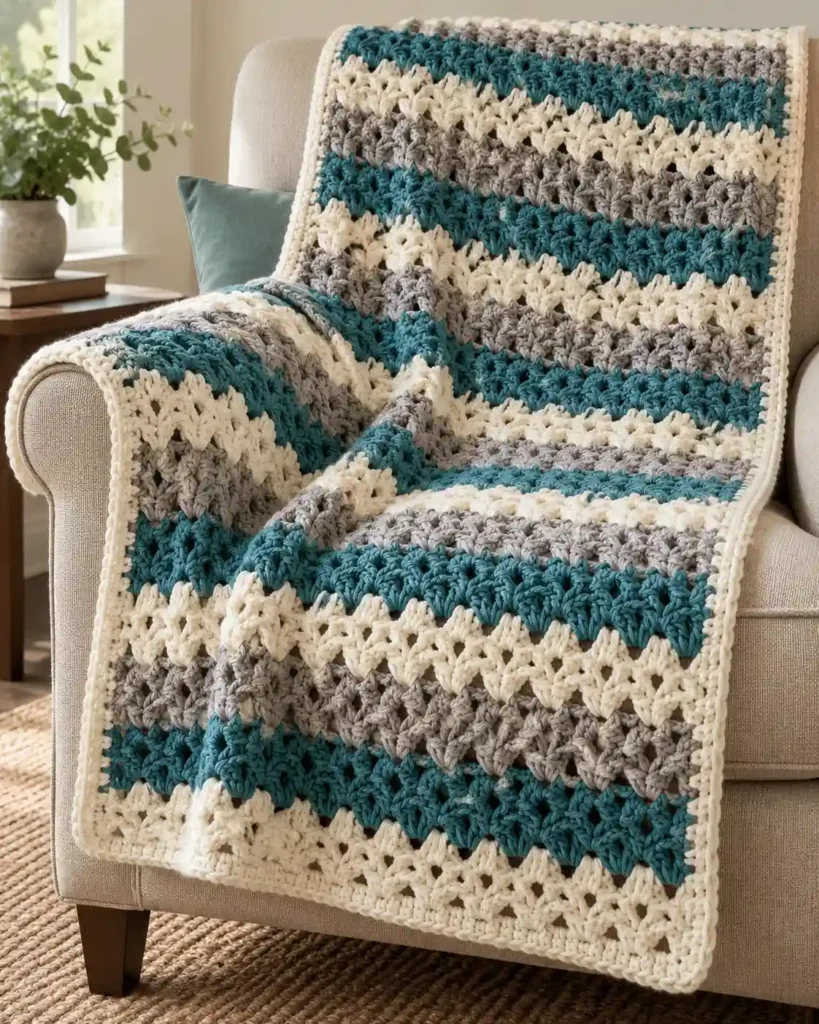
A striped V stitch throw makes color changes the main event. Compared with intricate colorwork, full-width stripes let you focus on one stitch repeat. Plan colors around the sofa where the blanket will live, or pull together shades already in your yarn basket. This project suits anyone who wants a large rectangle with plenty of opportunities to personalize it.
- Make a swatch before choosing the starting-chain length.
- Plan stripe depths in rows, such as four rows per color.
- Record the sequence so you can repeat it consistently.
Weave in tails as you go if finishing dozens of ends would spoil the fun.
9. What works well for a V stitch baby blanket with a simple border?
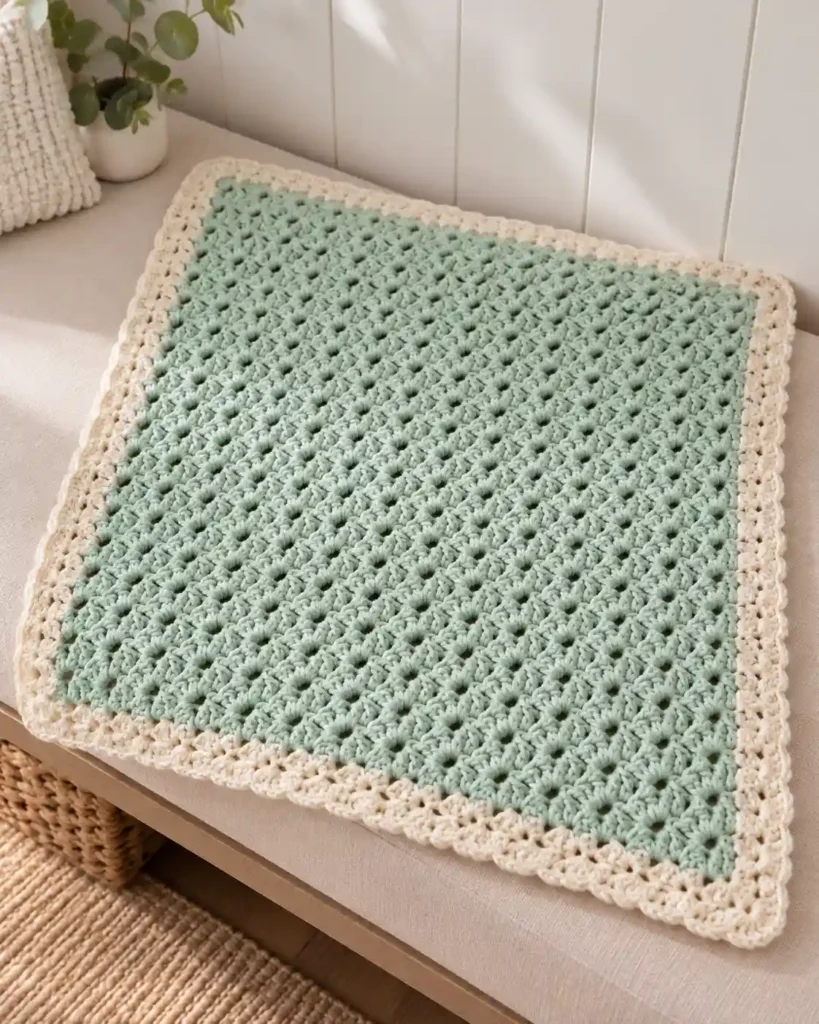
For a V stitch baby blanket, crochet blanket edging can give the open center a tidy frame. The contrast is quieter than adding another elaborate stitch pattern around all four sides. This approach is useful when you want the V texture to remain the focus.
Choose yarn with care instructions the recipient can follow. Use a simple edging without loose embellishments, and check that the border lies flat.
10. Is a chunky V stitch afghan a good next project?
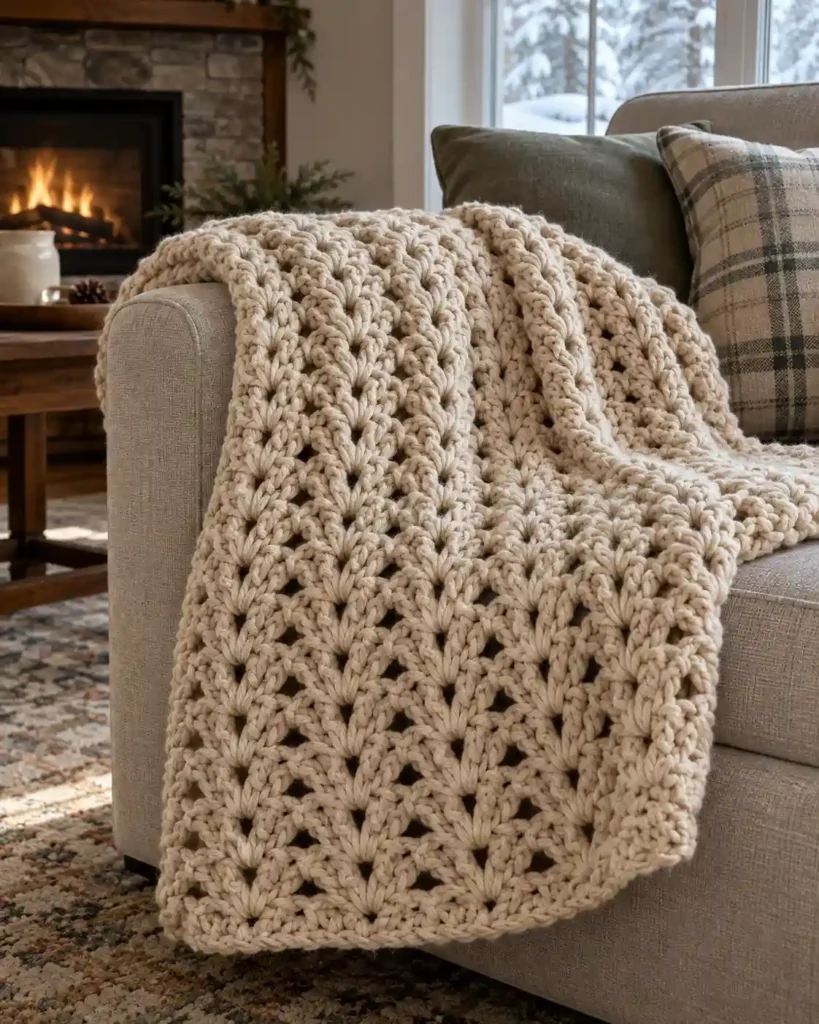
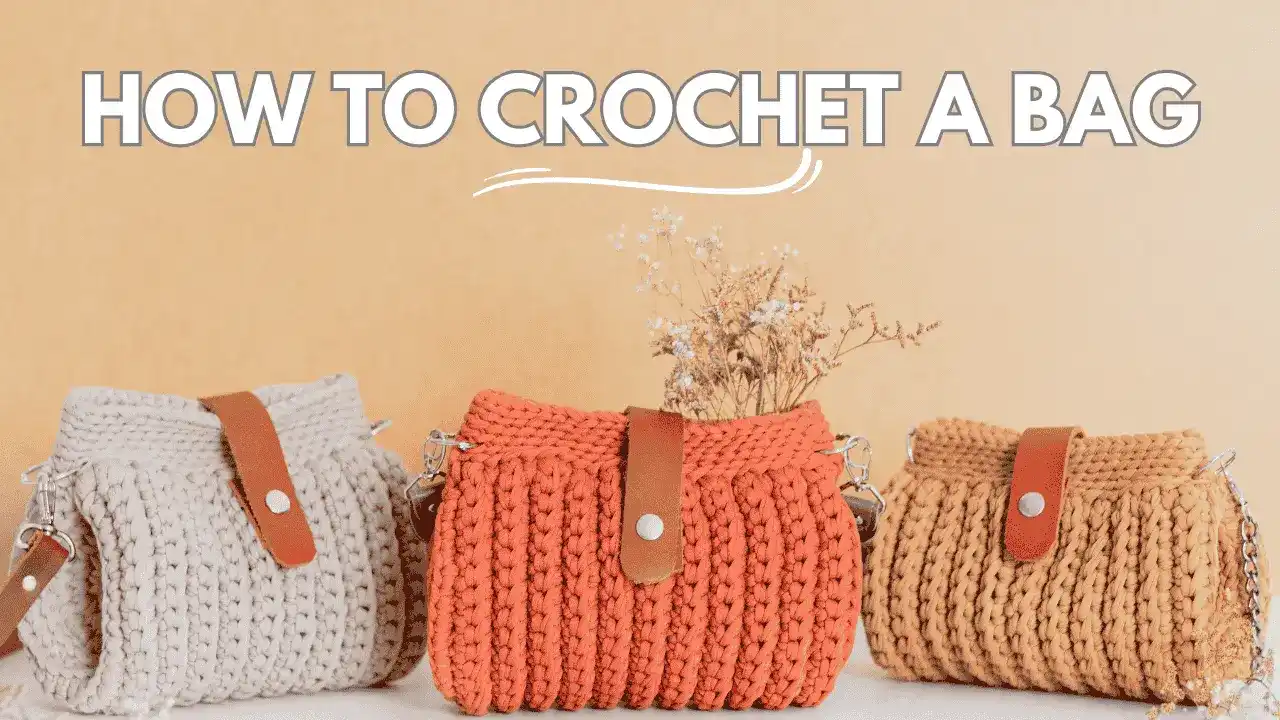
Chunky V stitch makes each repeat easier to see and gives an afghan a larger-scale texture. Larger stitches can build dimensions in fewer rows than a finer-yarn version, although yarn choice changes the result. A blanket folded at the foot of a bed is a natural setting for this bold look. Try it when you want visible texture and are comfortable handling thicker yarn.
Swatch for drape before committing. A sample that feels rigid may benefit from a larger hook, while an excessively loose sample may need a smaller one.
11. Why choose an ombre V stitch blanket?
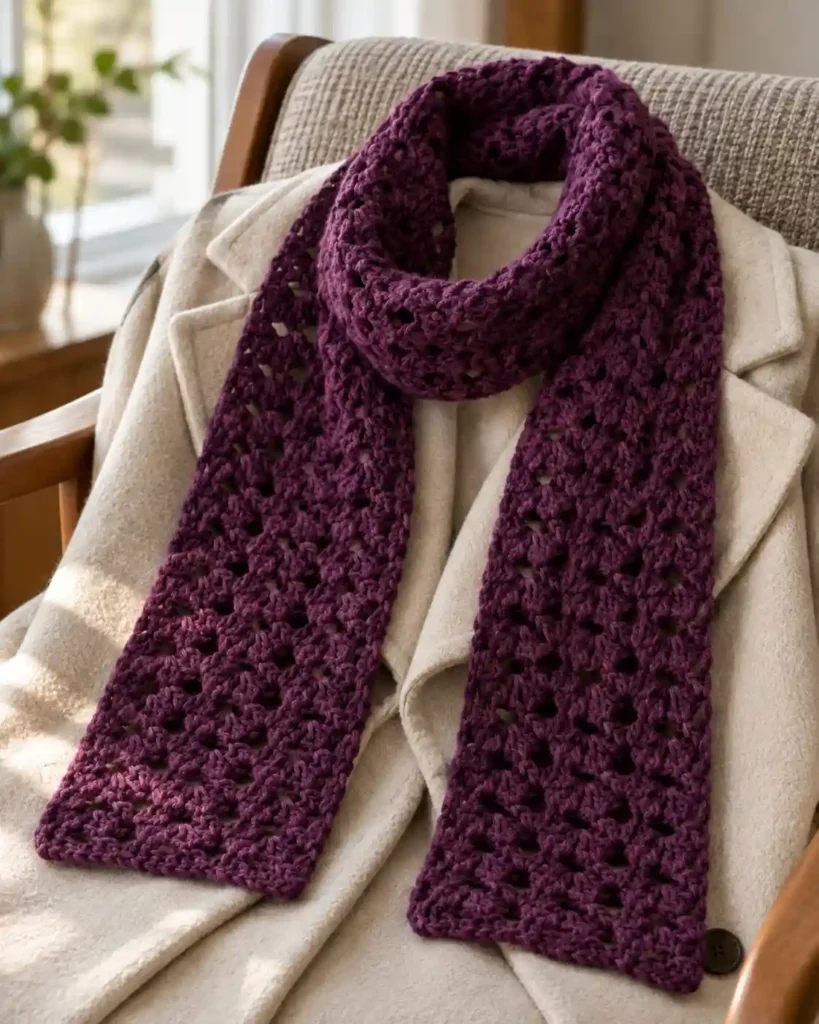
An ombre V stitch blanket lets gradual color changes travel through a simple repeat. Compared with manually switching colors for every stripe, a gradient yarn can reduce the number of joins. It fits a project you want to work on quietly while the palette develops on its own. Choose it when changing color is part of the enjoyment and exact stripe placement is not essential.
Before joining another ball, inspect where its color sequence begins. Decide whether you want a close match or are happy with a visible transition.
12. What makes an easy V stitch scarf beginner-friendly?
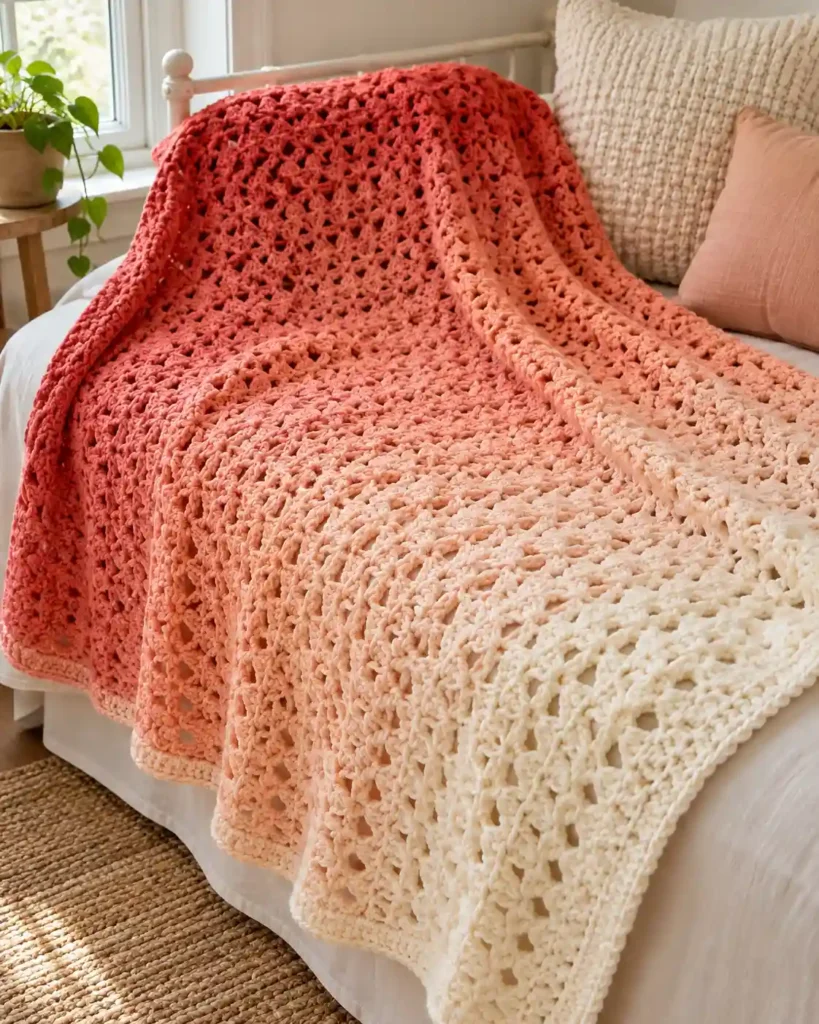
An easy V stitch scarf keeps the work narrow enough to check every row quickly. For a more beginner-focused project guide, see how to crochet a scarf for beginners. It asks for less sizing and assembly than a garment, making a small rectangle manageable to carry and resume.
Set the width from your swatch and measure the length as you work. Try the scarf around your neck before fastening off so you can judge both length and drape.
13. How is a V stitch triangle shawl different?
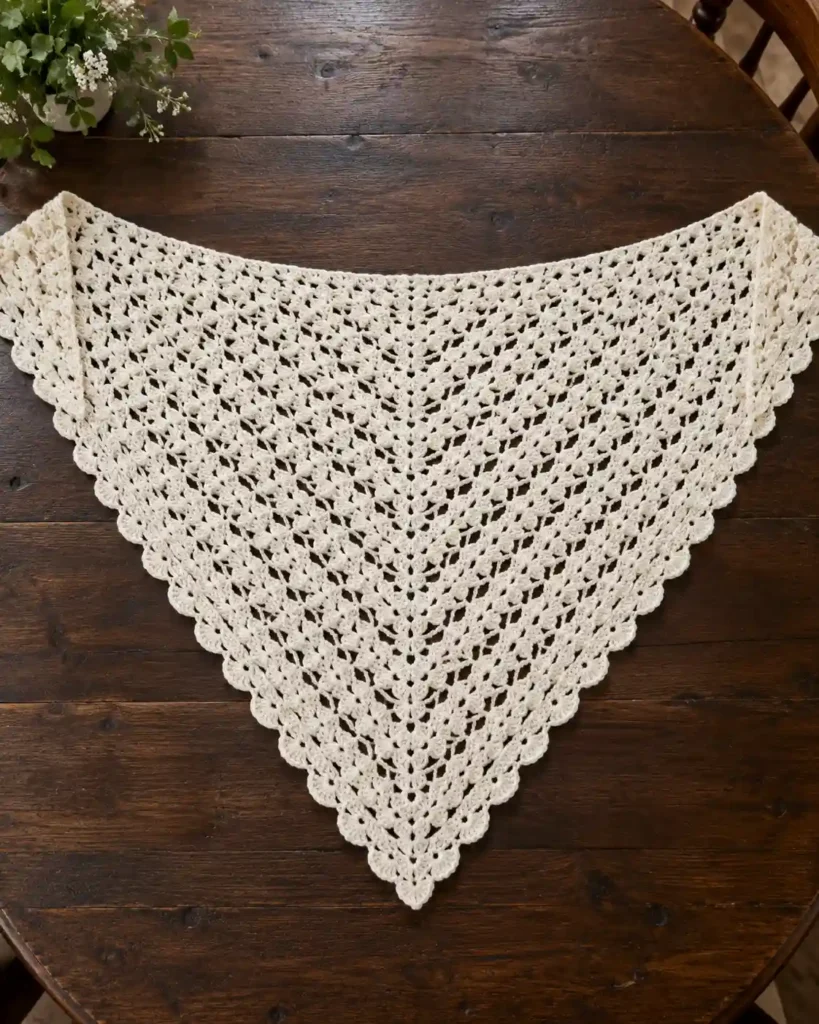
The V stitch triangle shawl adds widening edges or a central increase to an open stitch pattern. Unlike a rectangular scarf, its shape depends on planned increases. Picture a light layer over a sleeveless outfit, with the point falling down your back. It is a satisfying next step for crocheters ready to combine a familiar texture with basic shaping.
Use crochet shawl patterns that clearly identify every increase location. Keep markers at the center and edges, and check that both halves develop evenly.
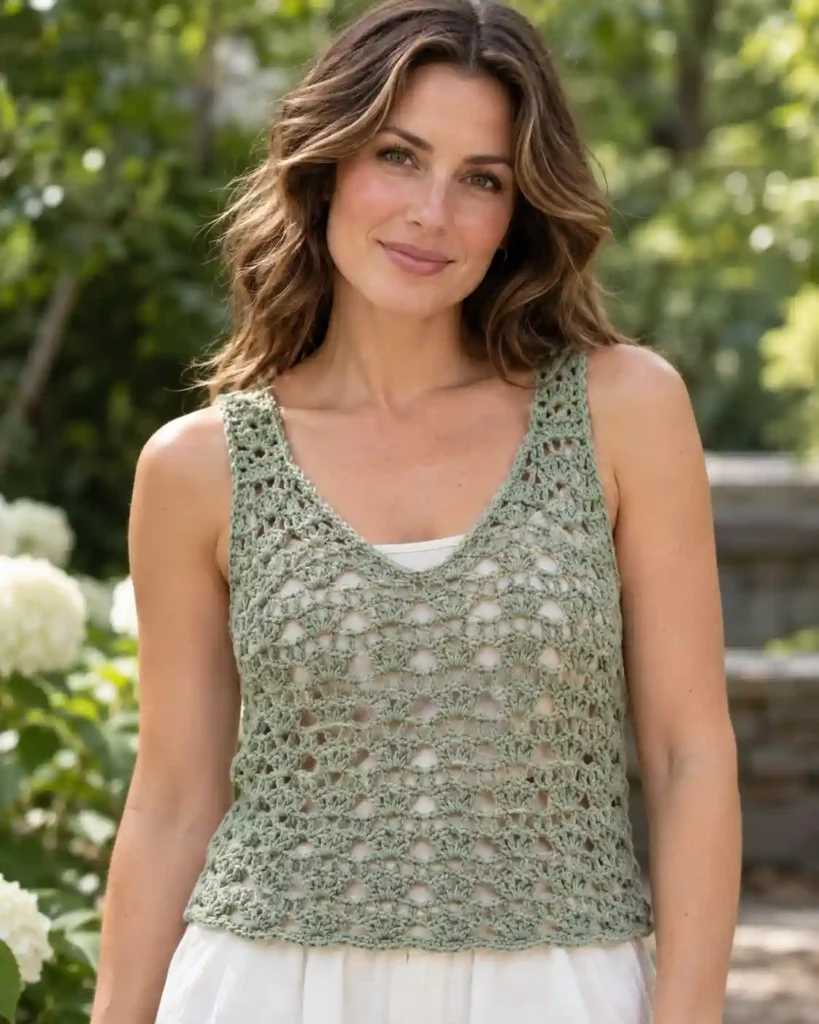
14. What should you check before making a V-stitch crochet top?
A V-stitch crochet top turns the open repeat into wearable fabric. Its chain spaces provide a different coverage level from a solid-stitch top. Think about whether you will wear it over a camisole or as a beach layer before choosing the yarn. This project suits crocheters willing to swatch for fit and follow a complete garment pattern.
Check the pattern’s finished measurements, neckline, armholes, and recommended ease—the difference between garment and body measurements. Wash and dry the sample according to the yarn’s care directions before measuring its final size.
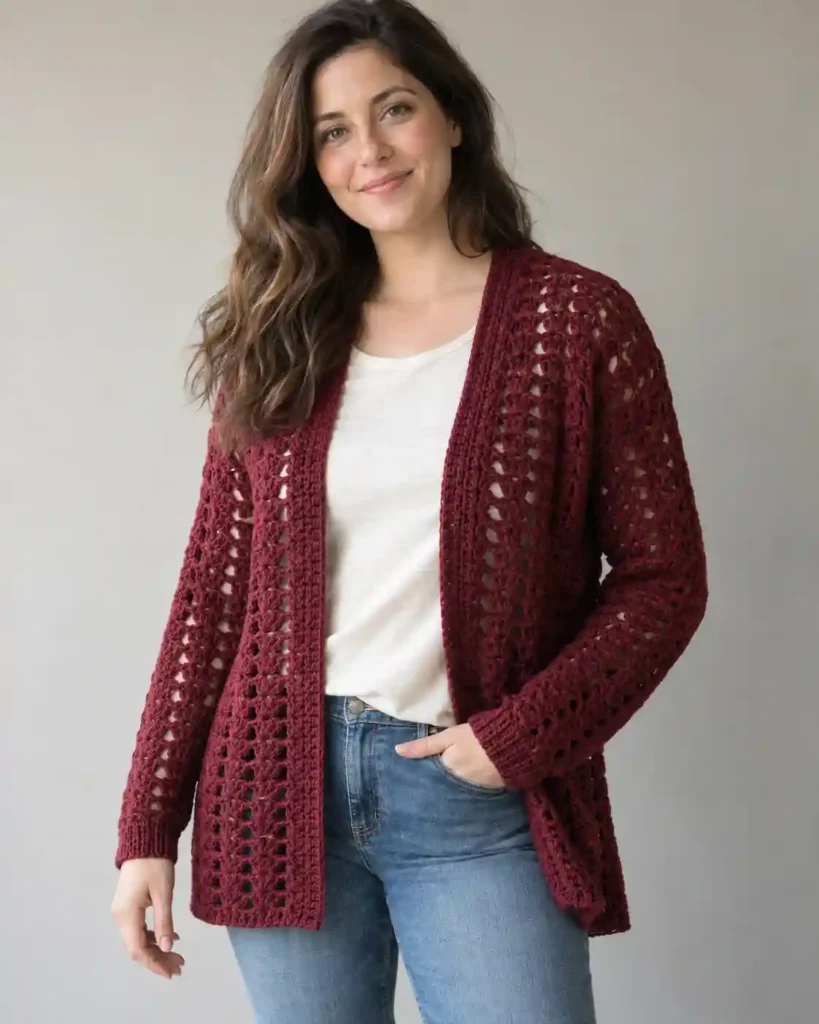
15. When are you ready for a V stitch cardigan?
For a V stitch cardigan, the familiar texture becomes part of a larger construction project. How to crochet a cardigan can help you review the construction process before moving to sleeves, joining, and bands.
Read the construction instructions before starting the first panel. Note whether the cardigan uses seams or another method, and check sleeve and body measurements throughout the work.
How do you read a V stitch crochet diagram?
A classic V stitch crochet diagram groups two double-crochet symbols at a shared base, with a chain symbol between them. That shared base tells you to work both stitches into the same location.
The Craft Yarn Council publishes standardized crochet chart symbols and advises checking each pattern’s key for additional definitions. Read the key first, identify the row start, and compare one chart repeat with the written instructions before continuing.
How do you size your project and fix uneven edges?
Measure a swatch to plan the width, match the specified gauge for clothing, and check the V count and edge stitches whenever the fabric changes shape.
At a Glance
- Measure a sample made in your chosen stitch pattern.
- Include edge stitches when planning the finished width.
- Recheck gauge after changing hook size.
- Count Vs and mark turning chains to track the edges.
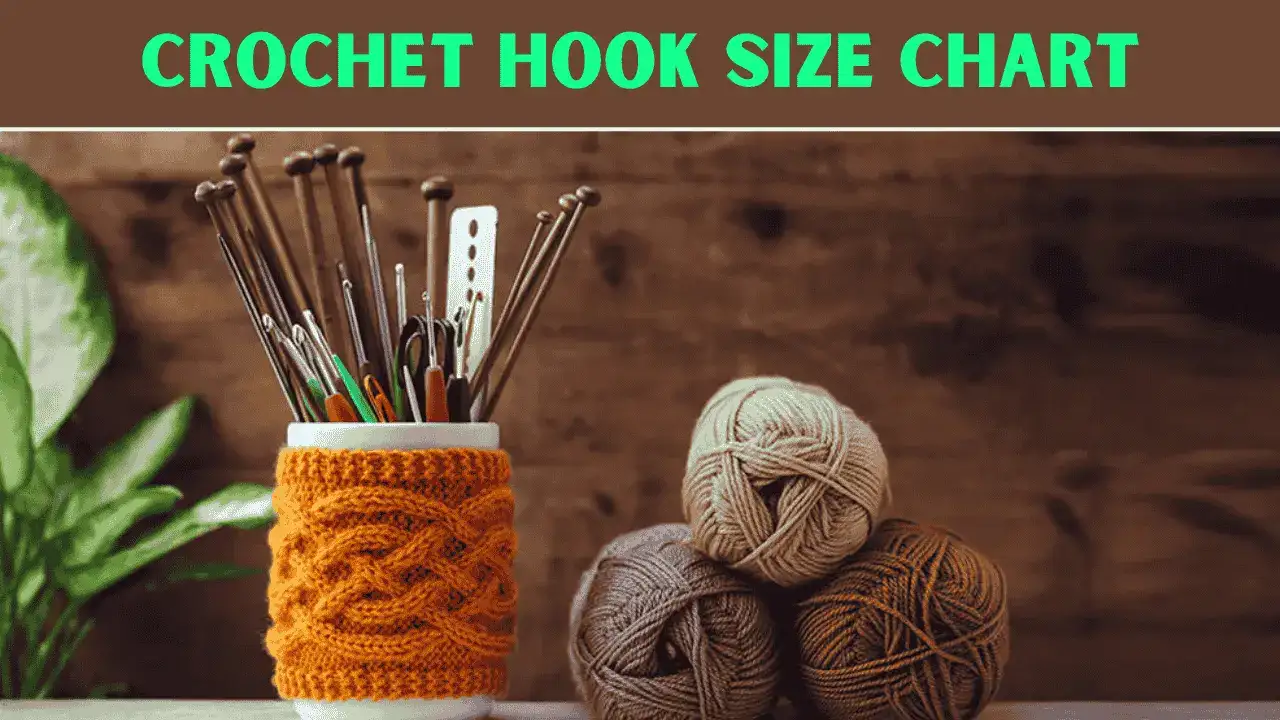
Gauge means the number of stitches and rows within a measured area. A crochet hook size chart can also help you compare hook sizing when choosing or changing a hook. For a blanket, measure the finished width of your sample and calculate how many repeats you need, including the edges; for clothing, match the pattern’s specified gauge.
The Craft Yarn Council’s gauge guide explains that too many stitches per inch call for a larger hook, while too few call for a smaller hook. Make another sample after changing hooks, because both width and row height affect fit.
Check these common problems:
- A widening piece: Look for extra Vs or an additional stitch beside the turning chain.
- A narrowing piece: Check whether you missed the final edge stitch or a V center.
- A tight foundation: Remake the chain more loosely, or test a larger hook for the chain only.
- A rippling border: Adjust the spacing of edging stitches instead of forcing a fixed number into every row end.
Weave tails securely through the fabric, then finish according to the yarn’s care instructions. Check the piece flat before deciding whether blocking is needed, and follow the care symbols provided for the yarn.
FAQs about V stitch crochet?
Is V stitch crochet easy for beginners?
Yes, the classic version is approachable once you know chains and double crochet. Start with a small sample so you can practice finding the center spaces and keeping both edges even.
A small sample keeps V stitch crochet for beginners manageable while you learn the row edges.
How many starting chains do you need?
For the tutorial above, use a multiple of three, such as 18 or 24. Other V stitch patterns use different multiples because their edges and spacing differ.
Always use the starting-chain rule supplied with your chosen V stitch crochet patterns.
Do you work into the stitch or the space?
After the foundation row in the classic tutorial, work into each V’s central chain-one space. Closed, offset, and textured versions may specify a different insertion point.
Follow the V stitch crochet written instructions for that specific version.
Can you use V stitch for a blanket and a top?
Yes, but the construction requirements differ. A blanket can use a measured rectangle, while a top needs a pattern with gauge, finished measurements, and garment instructions.
For a V-stitch crochet top, check the finished measurements and coverage before committing to the full project.
How do you change colors in V stitch crochet?
Change colors at a row boundary and continue the same stitch repeat in the new color. Keep the turning chains and V placements consistent with your chosen pattern, and weave in the yarn tails securely.
Final Thoughts
V stitch crochet gives you plenty of room to explore, from a simple scarf to a colorful blanket or a wearable summer top. Start with the classic repeat, practice keeping your edges even, and choose a variation that suits the fabric you want to create.
You don’t need to try all 15 ideas at once. Pick one that catches your eye, make a small swatch, and enjoy watching those little Vs come together. Keep this crochetmind.com guide handy whenever you’re ready for your next project.
![The Best 30+ Free Crochet Cat Patterns [Beginner-Friendly Guide]](https://crochetmind.com/wp-content/uploads/2025/04/1-The-Best-30-Free-Crochet-Cat-Patterns-Beginner-Friendly-Guide.webp)