

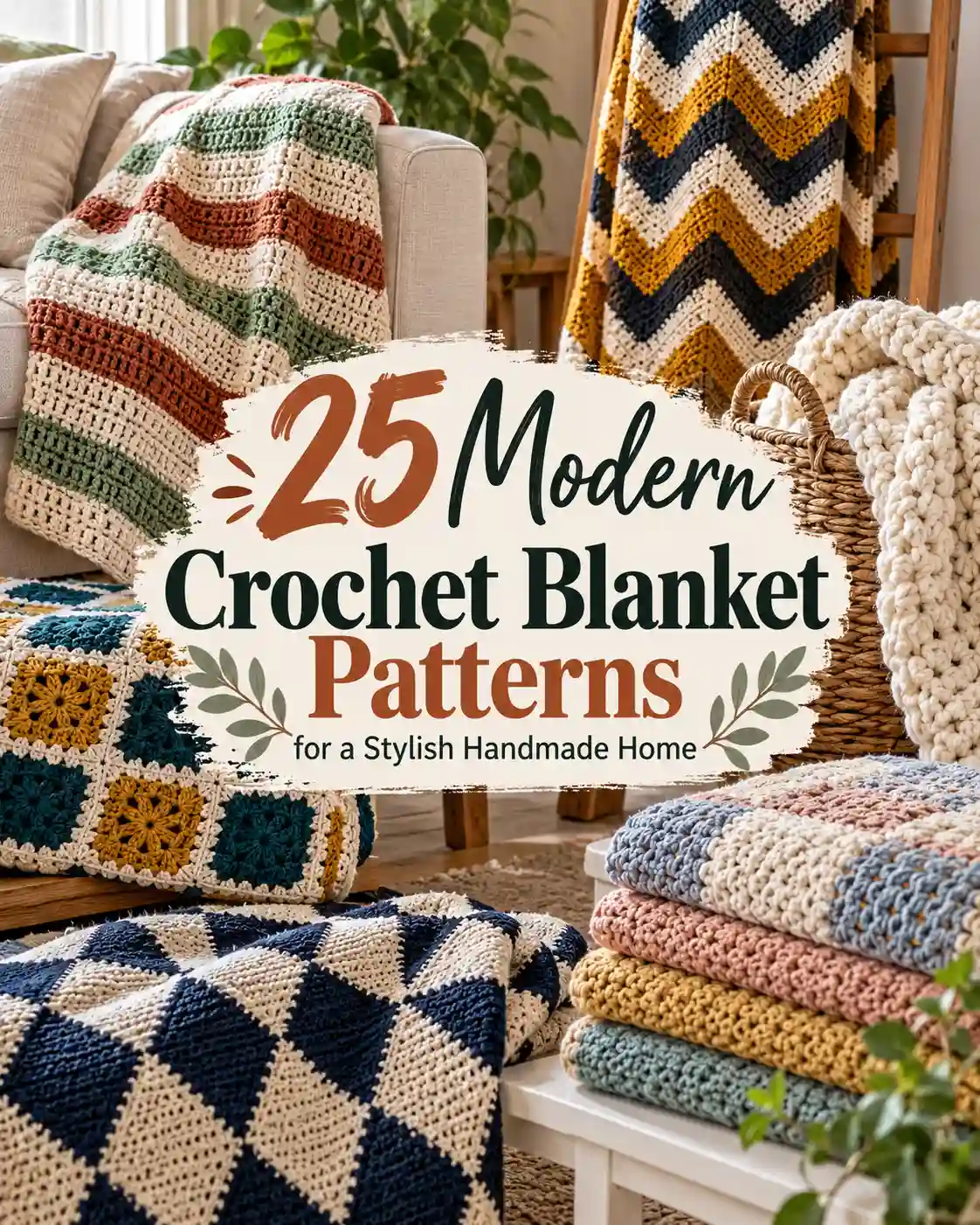
A farmhouse crochet blanket works best when it combines visible texture, a calm color palette, and a practical size you will actually use. The strongest options range from easy moss-stitch throws and chunky weekend blankets to gingham, lace, granny-square, cable, and oversized bed designs.
If you are comparing Farmhouse crochet blanket patterns free online or choosing a paid pattern, focus first on yarn weight, finished size, stitch repeat, and finishing details. Those four choices usually matter more than adding lots of colors or complicated motifs.
Key Takeaways
- Choose texture before adding extra colors.
- Match yarn weight to warmth, drape, and project speed.
- Try Farmhouse crochet blanket for beginners ideas first.
- Measure furniture before choosing your finished blanket size.
- Use simple borders to keep farmhouse textures visually clean.
- Verify whether free links include complete pattern instructions.
Which farmhouse crochet blanket style should you make first?
Start with a neutral, textured throw for the most flexible farmhouse look; choose gingham, lace, granny squares, or chunky yarn when you want a more distinctive style.
At a Glance:
- Beginners: moss, linen, or one-row repeats
- Fast projects: bulky or super-bulky throws
- Traditional style: gingham, plaid, and patchwork
- Modern style: one-color beige or greige
- Deep texture: basket weave, waffle, or cables
For a classic farmhouse look, start with cream, oatmeal, taupe, greige, charcoal, muted sage, or dusty blue. Texture does most of the visual work, so even a one-color blanket can look rich when the stitch has enough depth.
The Craft Yarn Council classifies yarn from weight 0 through 7. For blankets, medium #4, bulky #5, and super bulky #6 are especially useful because they balance stitch definition, warmth, and project speed; its guideline lists roughly 5.5–6.5 mm hooks for medium yarn, 6.5–9 mm for bulky yarn, and 9–15 mm for super bulky yarn.
| Pattern direction | Best for | Typical look | Useful reference |
|---|---|---|---|
| Even moss / one-row repeat | Beginners and relaxed crocheting | Woven, softly ribbed texture | The Turtle Trunk’s farmhouse blanket uses an even moss repeat, medium-weight yarn, and a 36 x 48-inch lapghan size. |
| Super-bulky ribbed throw | Fast projects | Chunky, modern farmhouse | Annie’s lists a confident-beginner throw at about 44 x 50 inches using super-bulky yarn and a 15.75 mm hook. |
| Bulky rustic throw | Cozy living-room use | Thick and simple | A Ravelry farmhouse blanket example uses bulky yarn, a 7 mm hook, and a finished size of about 40 x 44 inches. |
| Textured holiday farmhouse blanket | Intermediate makers | Plaid, puffs, ribbing | Crochet.com lists its Farmhouse Holiday Blanket as intermediate, worsted-weight, with a 5.5 mm hook. |
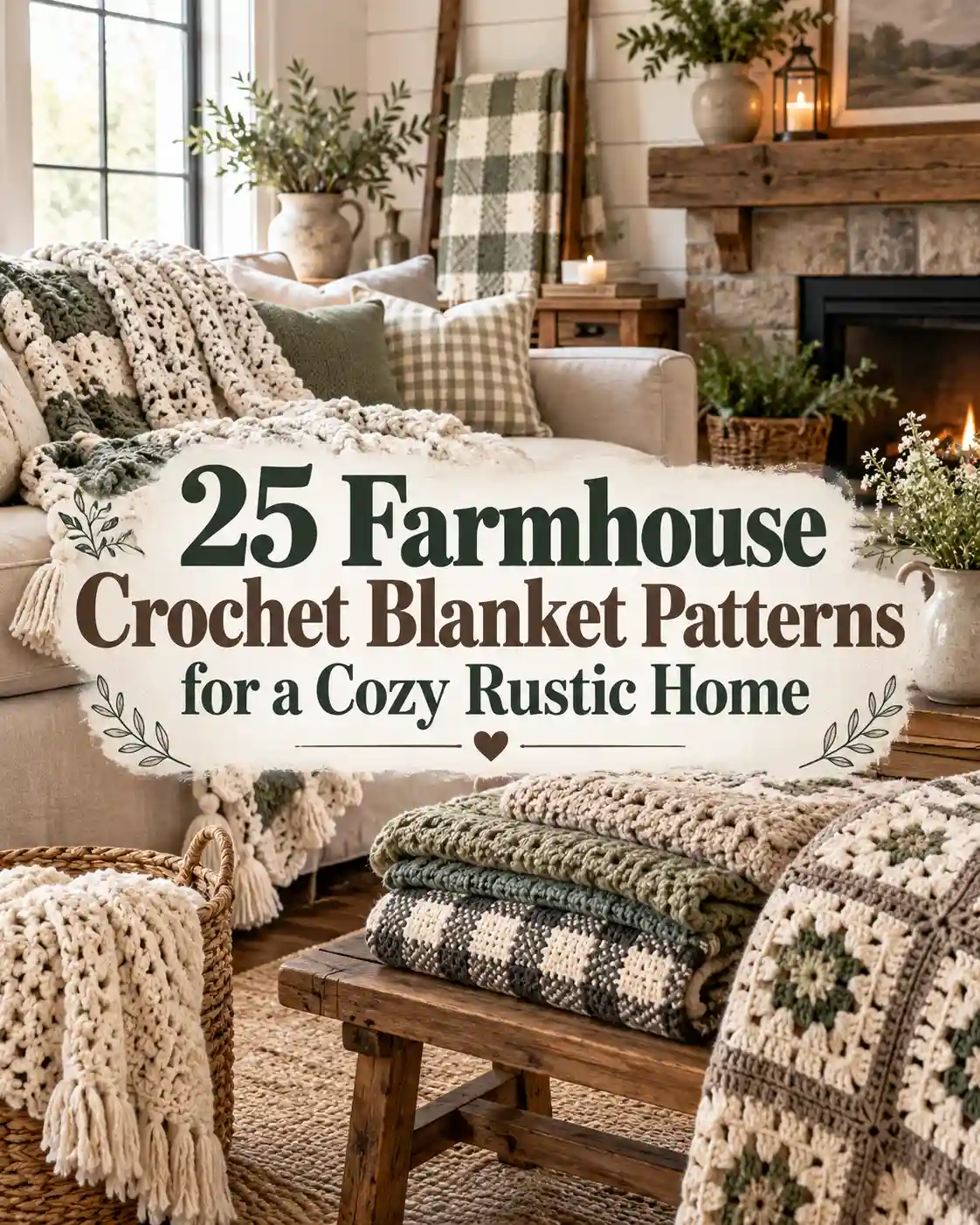
25 Farmhouse Crochet Blanket Patterns for a Cozy Rustic Home
1. Why does a Classic Cream Textured Farmhouse Throw always work?
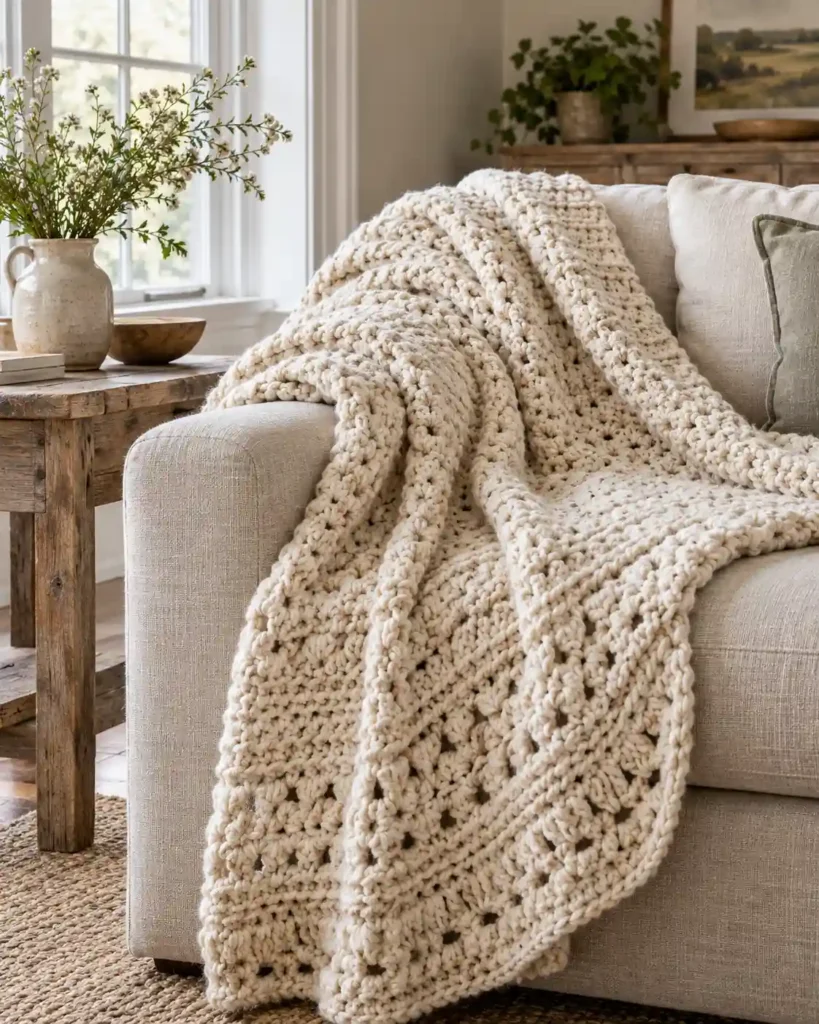
A classic cream textured throw is the safest place to begin because the neutral color lets every ridge, bobble, or woven-looking stitch show clearly. It feels calmer than a heavily striped blanket, yet it still has enough detail to keep a sofa or bed from looking flat. This direction works especially well in a room with linen, light wood, black metal, or simple vintage pieces because the blanket adds softness without competing with the decor. Choose it when you want one Farmhouse crochet blanket pattern that can stay in the room through every season.
Use a warm cream or oatmeal rather than a bright optic white if you want a softer rustic effect. Finish with a narrow single-crochet or ribbed border so the texture remains the main feature.
2. When is a Chunky Super-Bulky Farmhouse Blanket the better choice?
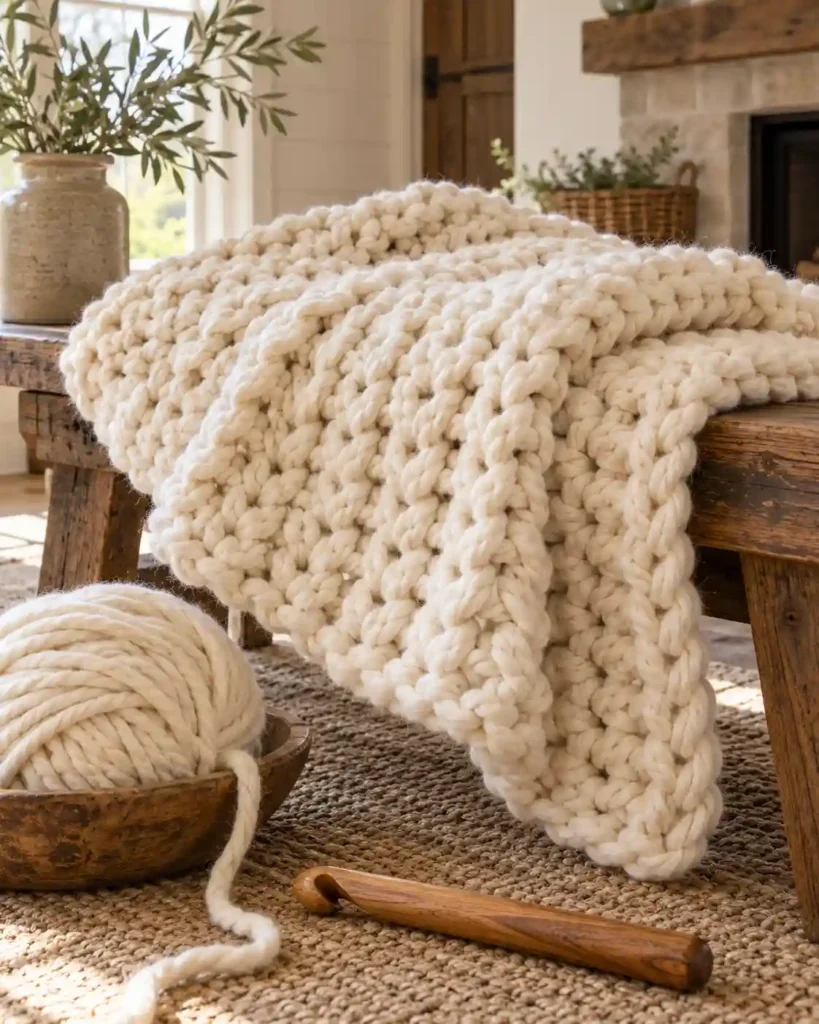
A chunky super-bulky blanket is the project to pick when you want the dramatic texture common to chunky crochet blanket patterns without spending weeks on tiny stitches. Compared with a worsted-weight afghan, the fabric grows much faster and the oversized loops immediately create that thick, cozy farmhouse look. It is especially satisfying for a reading chair, winter sofa, or guest-room bench where the blanket can stay casually folded instead of perfectly arranged. This is the best fit for makers who care more about speed and softness than delicate stitch detail.
Super-bulky yarn can become heavy, so keep the stitch pattern simple and check the finished drape as you work. The Craft Yarn Council recommends using millimeter sizing when comparing hooks because letter and number labels can vary by manufacturer.
3. How can a Black-and-White Gingham Farmhouse Blanket feel cozy instead of busy?
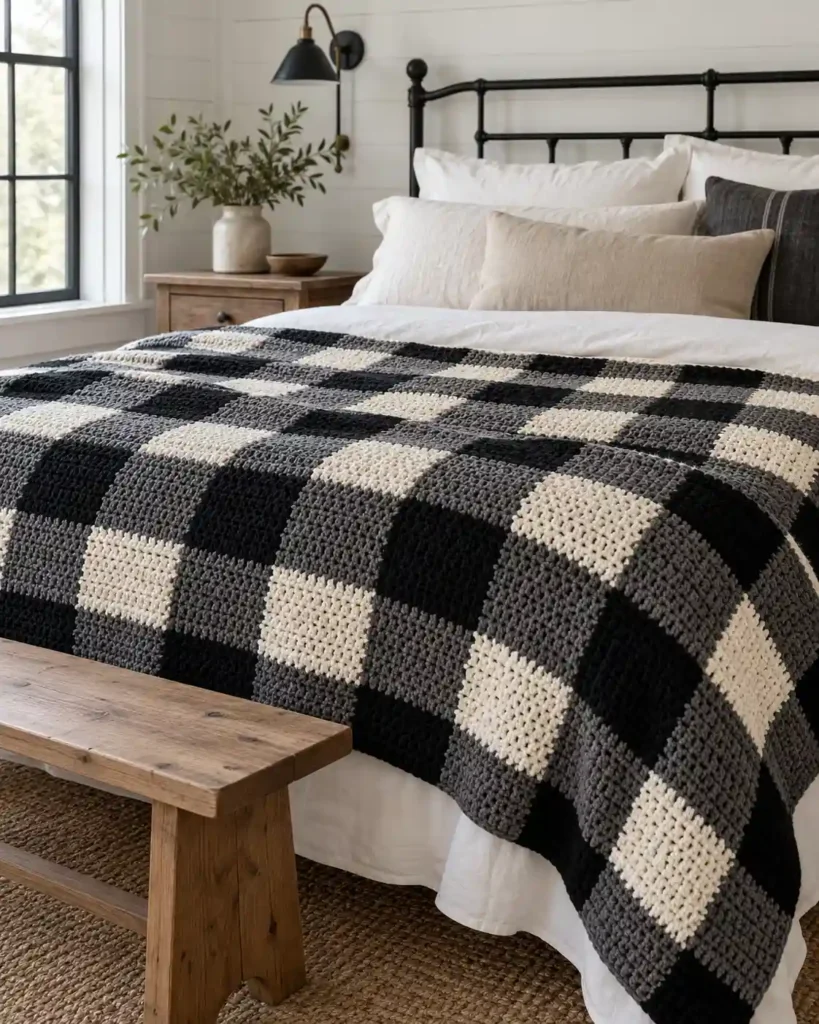
A black-and-white gingham blanket brings stronger contrast than most farmhouse throws, but the checked layout still feels classic when the blocks are large and clean. The trick is to use three related values, such as cream, gray, and charcoal, instead of harsh unrelated colors. On a white bed or simple slipcovered sofa, that pattern becomes the focal point without needing extra decoration around it. Pick this style if you love traditional farmhouse checks but want a crochet version with more handmade character.
Plan the color blocks on paper before starting so each section stays consistent. A simple border in the lightest or darkest shade can make the entire grid look more finished.
4. Why choose a Neutral Plaid Farmhouse Throw over bold tartan?
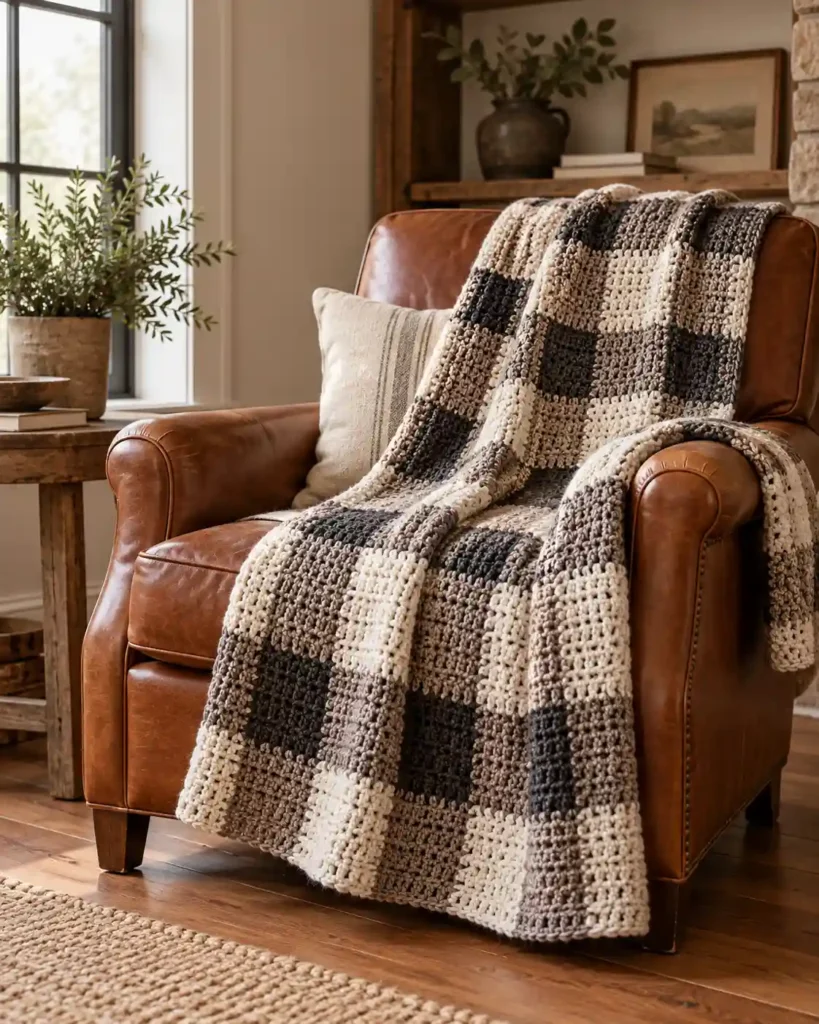
A neutral plaid throw gives you the structure of tartan without making the room feel seasonal or overly themed. Taupe, cream, charcoal, and muted brown blend more easily with wood furniture and natural textiles than bright red or green checks. This design works beautifully over a leather chair, at the end of a bed, or in a den where you want pattern but not visual noise. It is a smart choice if you enjoy colorwork and want a crochet farmhouse plaid throw blanket that still feels relaxed.
You can create the effect with planned color changes, surface crochet, or carefully placed stripes. Keep fringe modest so the plaid remains the feature.
5. What makes a Vintage-Inspired Farmhouse Lace Throw practical?
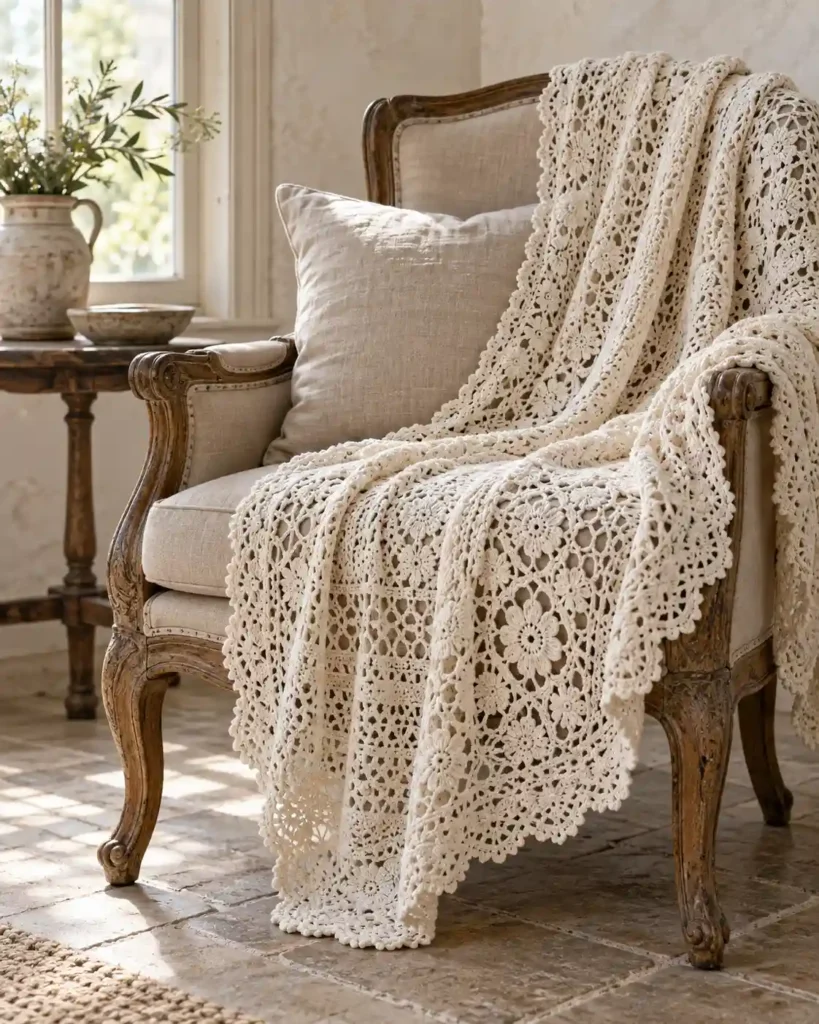
A farmhouse lace crochet throw blanket gives a room an older, softer character without the weight of a dense winter afghan. Unlike chunky stitches, openwork lets the background fabric or furniture show through, which makes the blanket feel lighter and more decorative. It works particularly well on an antique-style chair, guest bed, or layered over a solid coverlet where the lace can be seen rather than crushed. It suits makers who enjoy repeats and blocking and want a vintage farmhouse result that still looks fresh.
Choose yarn with clean stitch definition so the holes and motifs stay crisp. Since lace is more open, think of it as a decorative or mild-weather layer rather than your warmest blanket.
6. How do you make a Modern Beige and Greige Farmhouse Blanket look intentional?
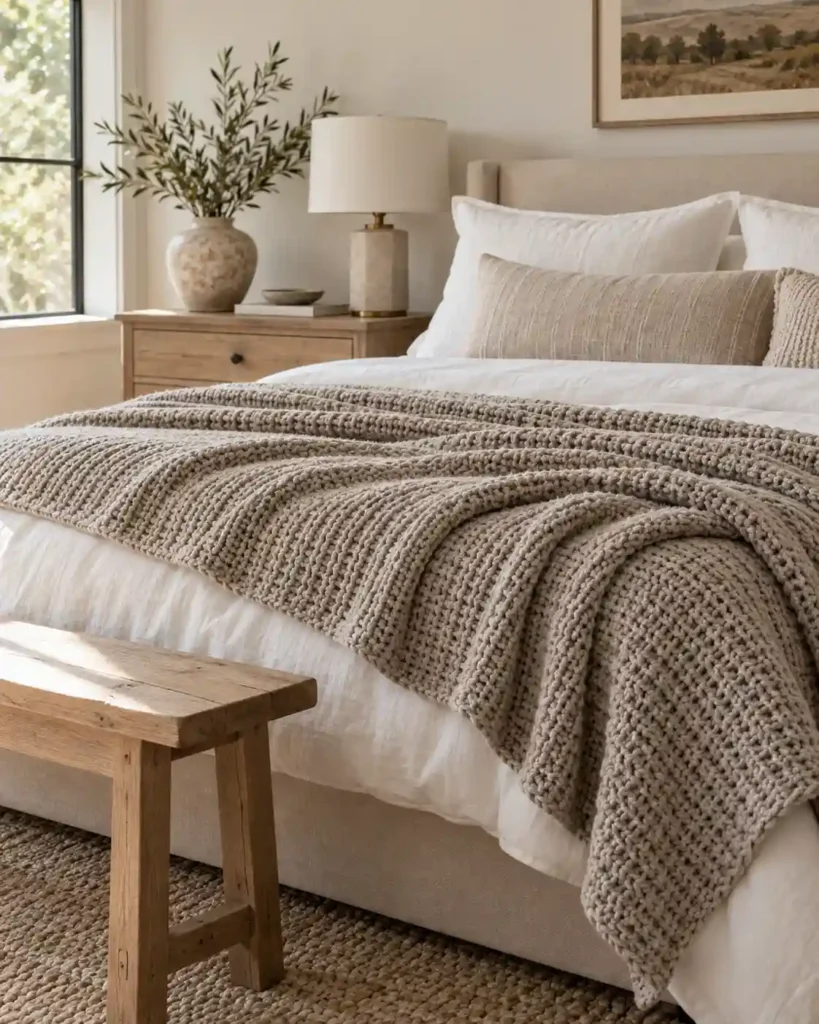
Modern farmhouse crochet works best when the palette is quiet and the stitch pattern is disciplined. Beige, greige, stone, and warm white can look more sophisticated than multicolor stripes because the texture becomes the design. In a bedroom with pale oak, white bedding, and black accents, a clean linear stitch or subtle geometric repeat adds warmth without making the space feel rustic in an old-fashioned way. Choose this style when you want a modern farmhouse crochet blanket that blends into the room but still looks handmade.
Use a crisp border and avoid too many decorative finishes. One strong stitch texture is usually enough.
7. Why is a Moss Stitch Farmhouse Blanket so beginner-friendly?
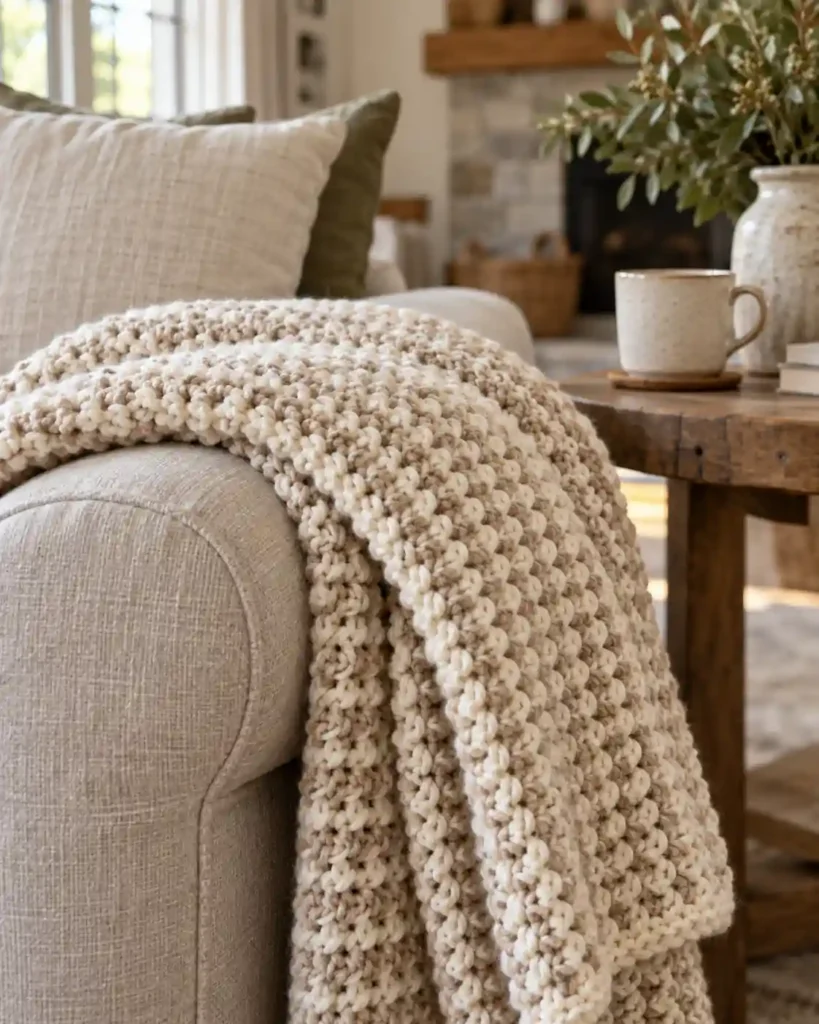
Moss stitch gives a farmhouse throw a woven appearance while keeping the repeat simple and forgiving. It is less bulky than basket weave and less complicated than cables, so beginners can settle into a rhythm without losing the textured look that makes farmhouse blankets appealing. It works especially well in cream, oatmeal, soft stripes, or low-contrast neutrals on a sofa that gets daily use. For beginners, moss stitch crochet is one of the easiest ways to get a polished farmhouse result.
The Craft Yarn Council’s project-level guidance describes basic and easy projects as those using basic stitches, simple stitch patterns, straightforward colorwork, or limited shaping, qualities worth looking for in a first blanket.
8. When should you use Bobble Stitch on a Farmhouse Throw?
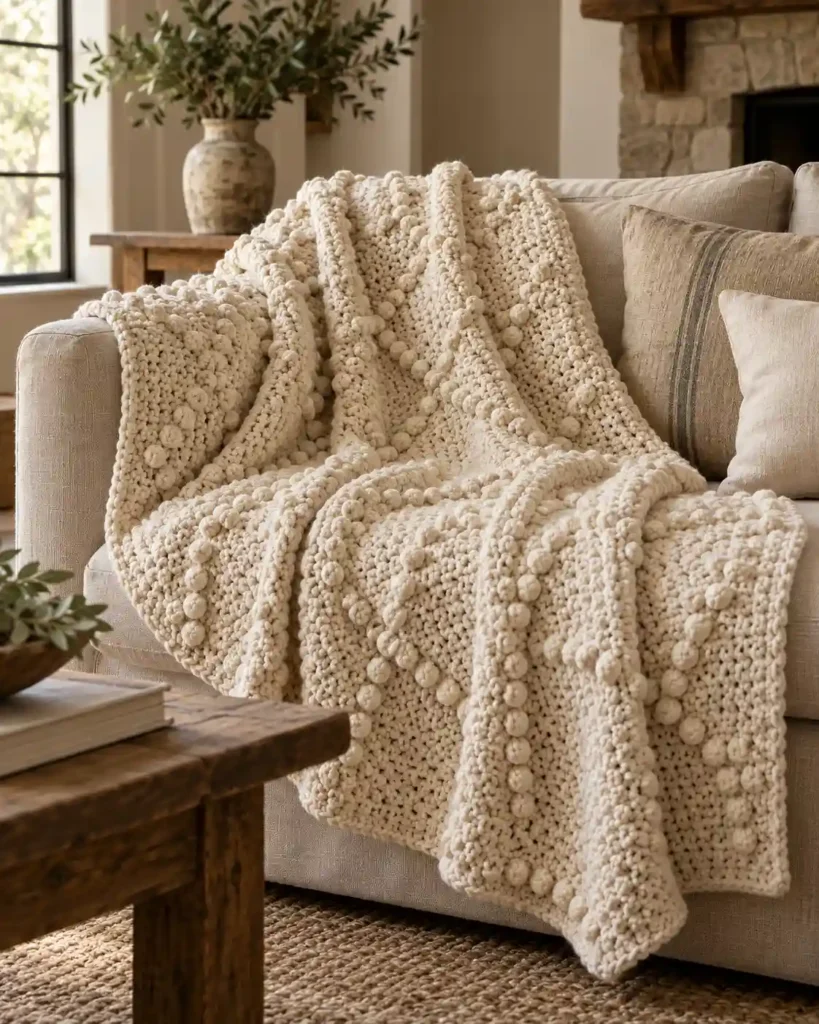
Bobble stitch is perfect when you want the blanket to look tactile from across the room. A whole blanket of dense bobbles can become heavy and visually crowded, so farmhouse versions usually look better when the raised stitches form rows, diamonds, or spaced motifs. On a neutral sofa, sunlight can create small shadows across the raised texture and make the design more noticeable without adding extra color. Choose it if you want a statement blanket but still prefer a one-color or low-color palette.
Balance bobble sections with flatter stitches so the fabric folds naturally. A medium or bulky yarn usually gives the bumps enough definition without making them enormous.
9. Why does Basket Weave make a Farmhouse Blanket feel like an heirloom?
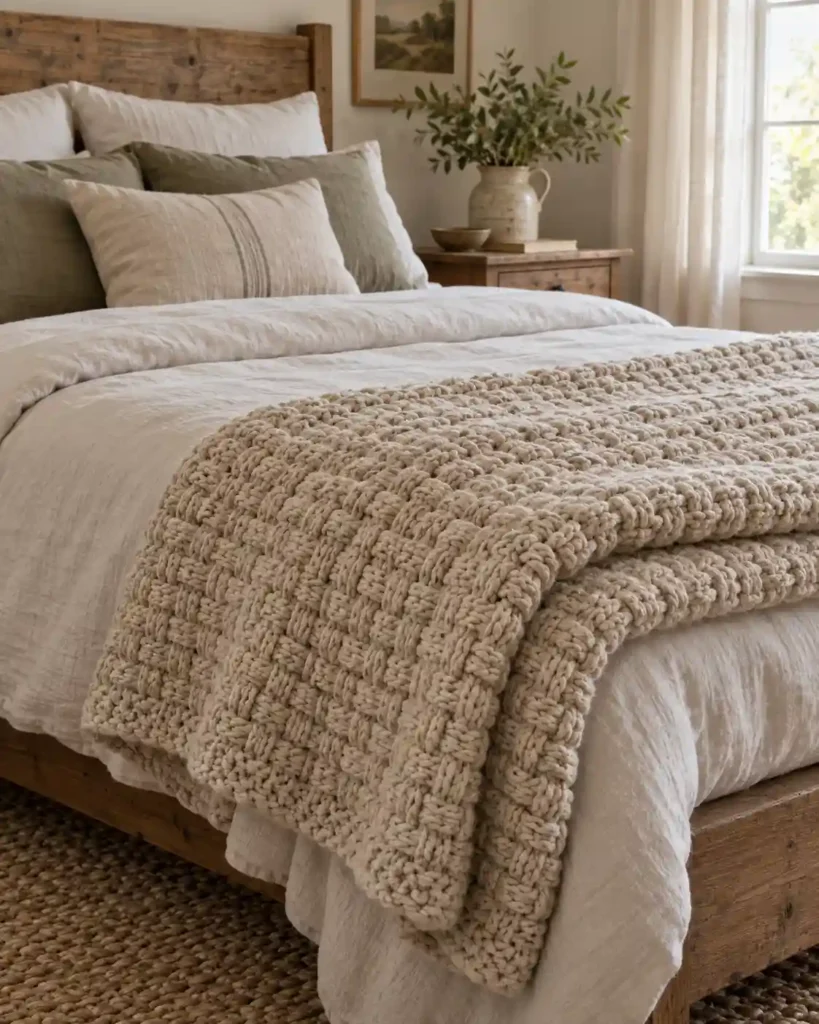
Basket weave crochet has a deep interlocking surface that looks substantial even in a single solid color. It stands apart from simple rows because front-post and back-post work creates a woven effect that feels closer to a heavy heritage textile. Fold one at the foot of a bed or keep it on a large sofa and it immediately adds weight and visual warmth. This is for crocheters who want a crochet farmhouse blanket with an heirloom feel rather than a quick, lightweight throw.
Basket-weave stitches can use more yarn than flatter patterns, so buy with extra margin. Keep the border plain to avoid competing with the woven center.
10. Which Farmhouse Crochet Blanket Pattern suits Alpine Stitch best?
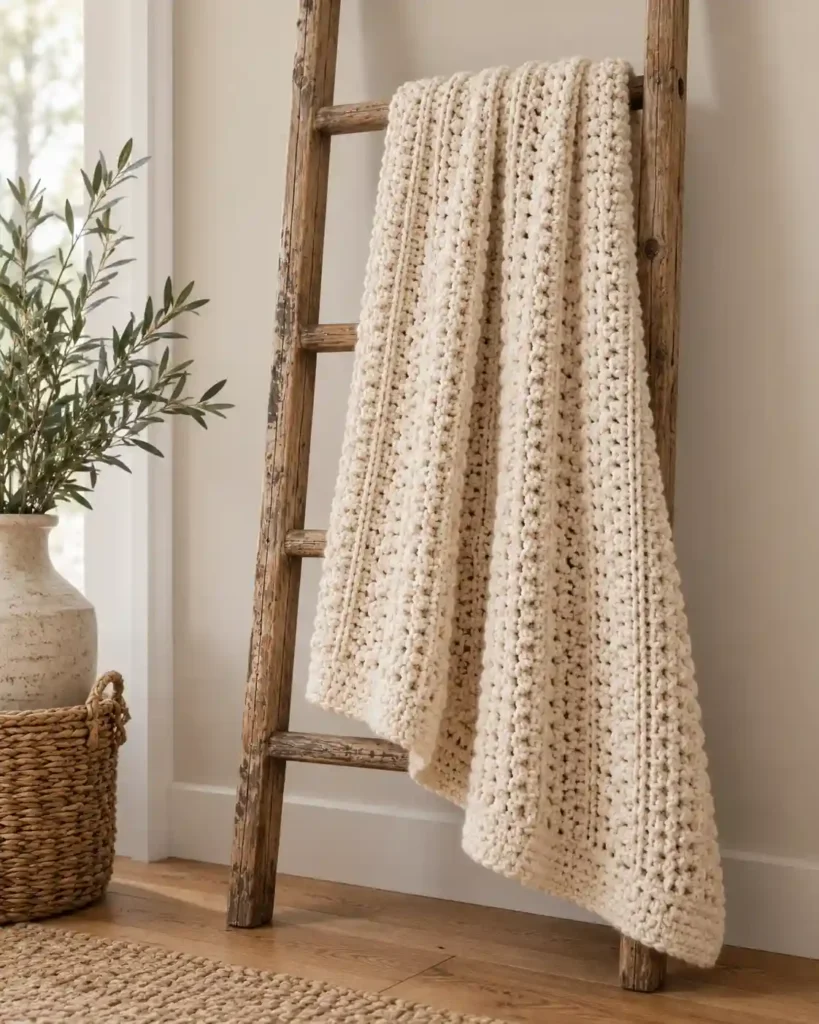
An alpine stitch crochet pattern is ideal when you want vertical texture with a slightly more architectural look. It feels more structured than moss stitch and more restrained than bobbles, so it works well in both rustic and modern farmhouse rooms. Warm cream or camel yarn looks especially good on a wooden blanket ladder, sofa arm, or neutral bed where the raised columns can catch side light. Pick this stitch if you enjoy repetitive texture but want something that looks more advanced than it feels.
Gauge matters because dense raised stitches can change both width and drape. Make a swatch first and adjust your hook before committing to a full-size blanket.
11. Why is Waffle Stitch ideal for a warm winter farmhouse blanket?
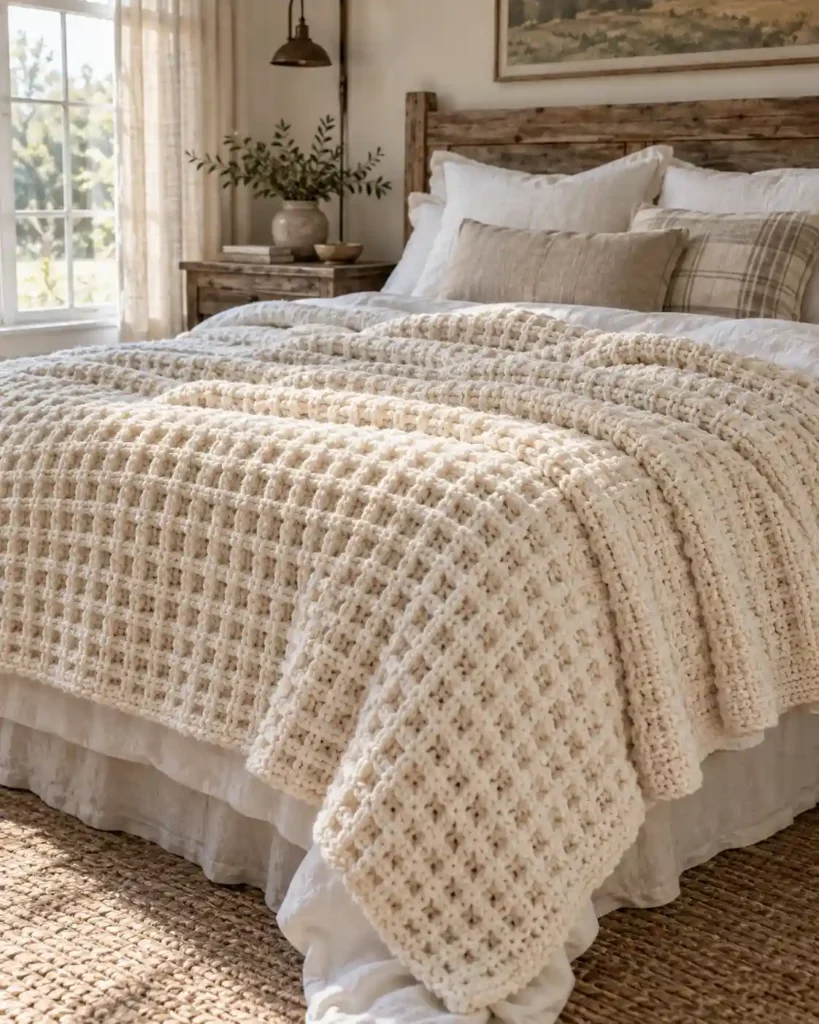
Waffle stitch crochet creates deep square pockets that naturally give the blanket a thick, cushioned look. Compared with linen or moss stitch, it feels heavier and more winter-focused, which makes it especially appealing for cold-weather sofas and bedrooms. A solid cream or oatmeal color is enough because the light and shadow inside the grid provide the pattern. Choose it when warmth and depth matter more than a lightweight drape.
Expect waffle stitch to consume more yarn than flatter stitches. A simple edge is usually all it needs.
12. When does Linen Stitch make more sense than a chunky texture?
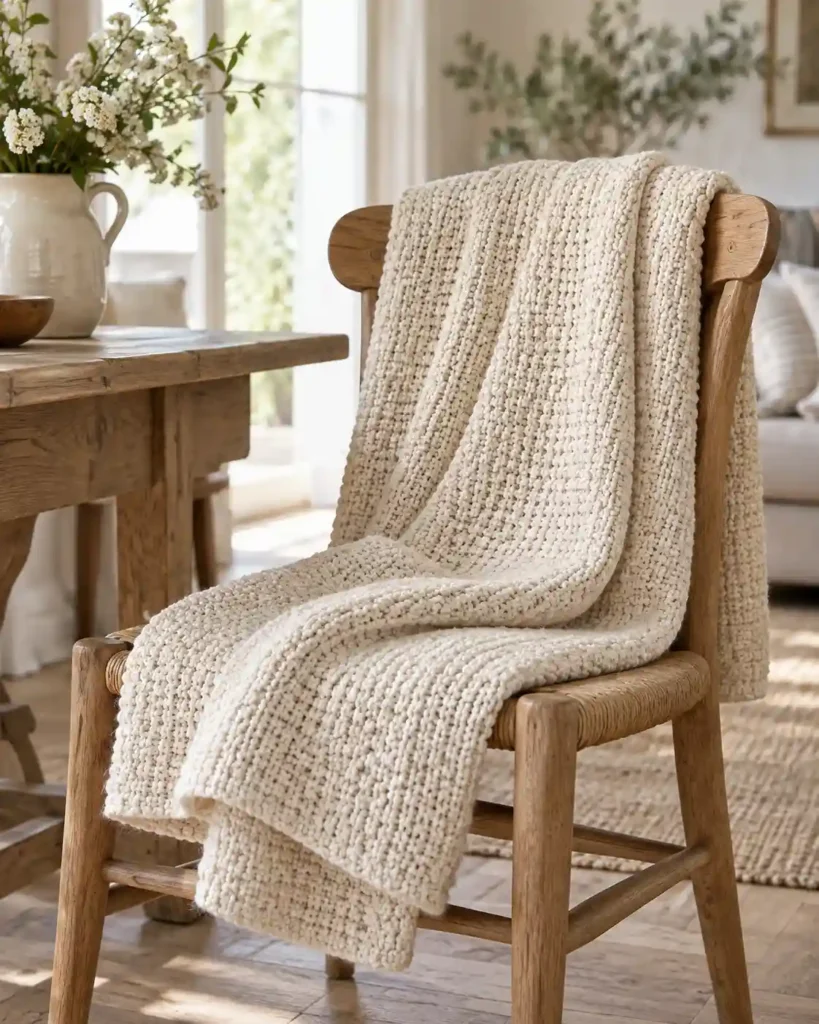
Linen stitch is the quieter option for anyone who likes farmhouse style but does not want a heavy blanket. Its tight, woven-looking surface has a flatter profile than bobbles or cables, so it drapes neatly over chairs and works well through spring and fall. In warm ivory, flax, or a subtle two-color combination, it can look almost like a handwoven textile from a distance. Choose it for an easy crochet throw blanket that feels light, practical, and easy to layer.
This stitch also handles gentle color changes beautifully. Keep your tension even so the small openings remain consistent across the fabric.
13. What makes a Farmhouse Granny Square Crochet Blanket look modern?
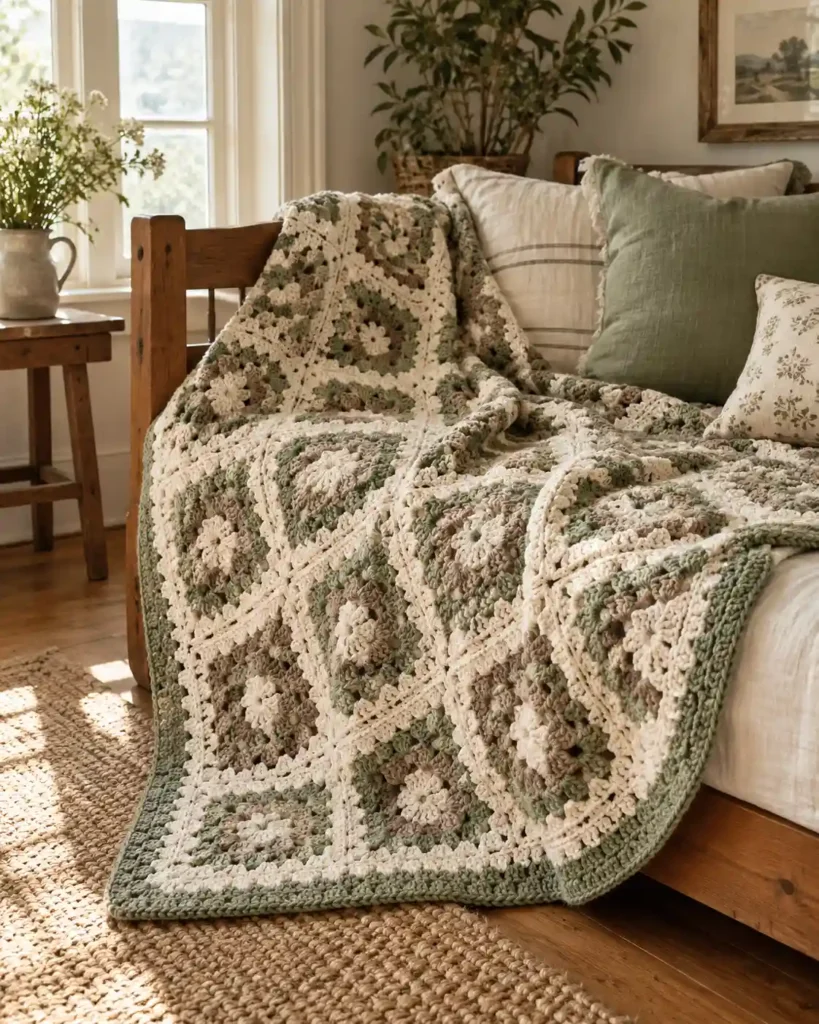
A crochet granny square blanket can feel modern when the motifs are consistent and the colors stay muted. Traditional bright scrap combinations are fun, but cream, sage, taupe, charcoal, dusty blue, or clay create a calmer patchwork that fits farmhouse interiors more naturally. This style shines on a daybed or guest-room bed because the repeated squares are easy to see at full scale. Choose it when you want a modular project that can be worked in smaller pieces instead of long rows.
Use one joining method throughout and repeat at least one color across every square. A solid outer border helps unify the patchwork.
14. Why try a Braided or Cable-Texture Farmhouse Throw?
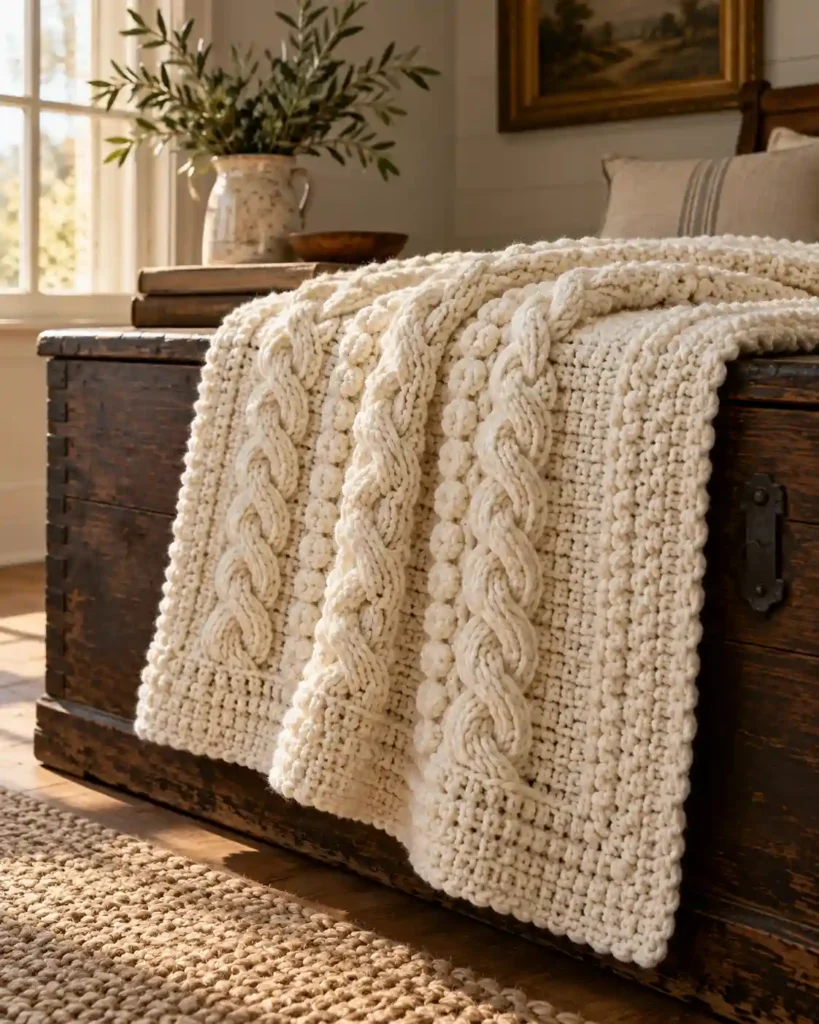
Crochet cables and braided textures make a blanket look much more intricate without requiring multiple colors. They beat busy colorwork when your goal is to make the yarn itself look luxurious and dimensional. On a dark wood chest, leather chair, or simple neutral bed, the raised braids give the piece a fisherman-knit or Aran-inspired mood that still feels comfortably farmhouse. Choose this design if you want one of the more distinctive crochet blanket patterns unique enough to become a room feature.
Use a smooth yarn so the relief stays visible. Lightly textured or fuzzy yarn can hide the cable definition you worked hard to create.
15. How can a Chevron Farmhouse Blanket stay rustic rather than retro?
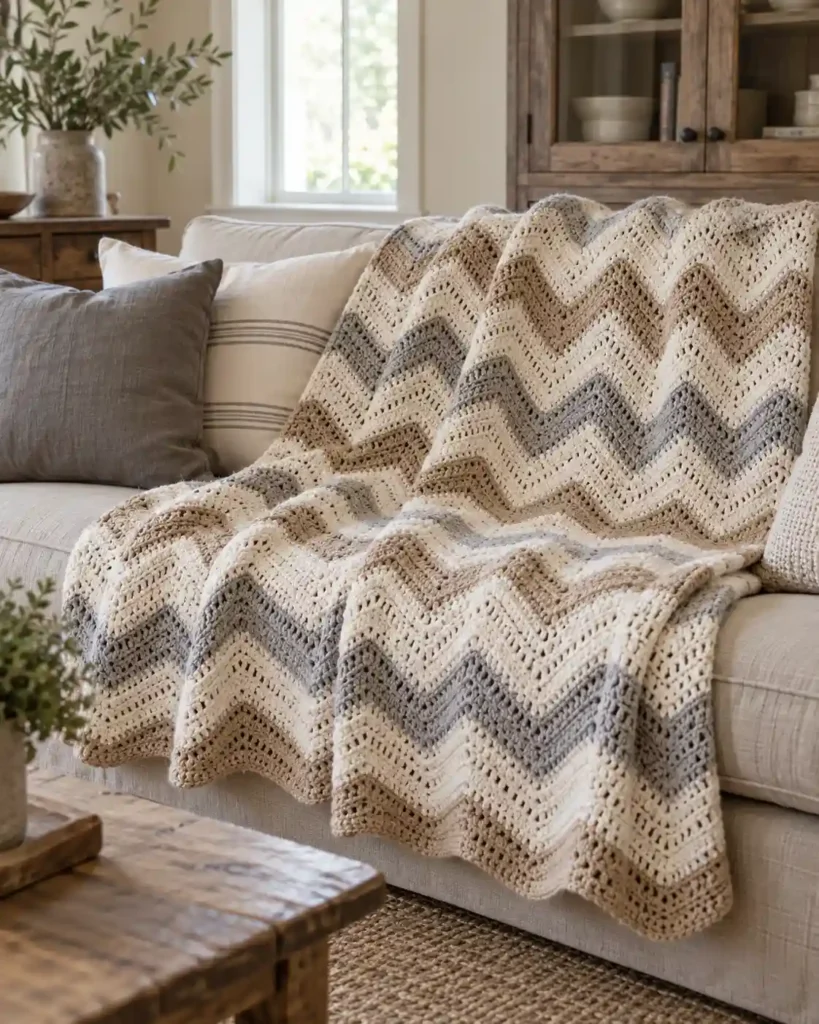
Chevron crochet can read very bold, but low-contrast colors completely change the mood. Cream, tan, greige, and muted gray soften the zigzag so it feels more like a rustic stripe than a graphic retro print. This is a good sofa blanket when you want movement in the pattern but still want the room to feel calm. It works especially well for crocheters who like repeating counts and want an afghan that looks structured without using advanced textured stitches.
Keep stripe widths consistent and use the same shaping rhythm at every peak and valley. Optional tassels can add softness without changing the main pattern.
16. Why is a One-Color Farmhouse Blanket never boring?
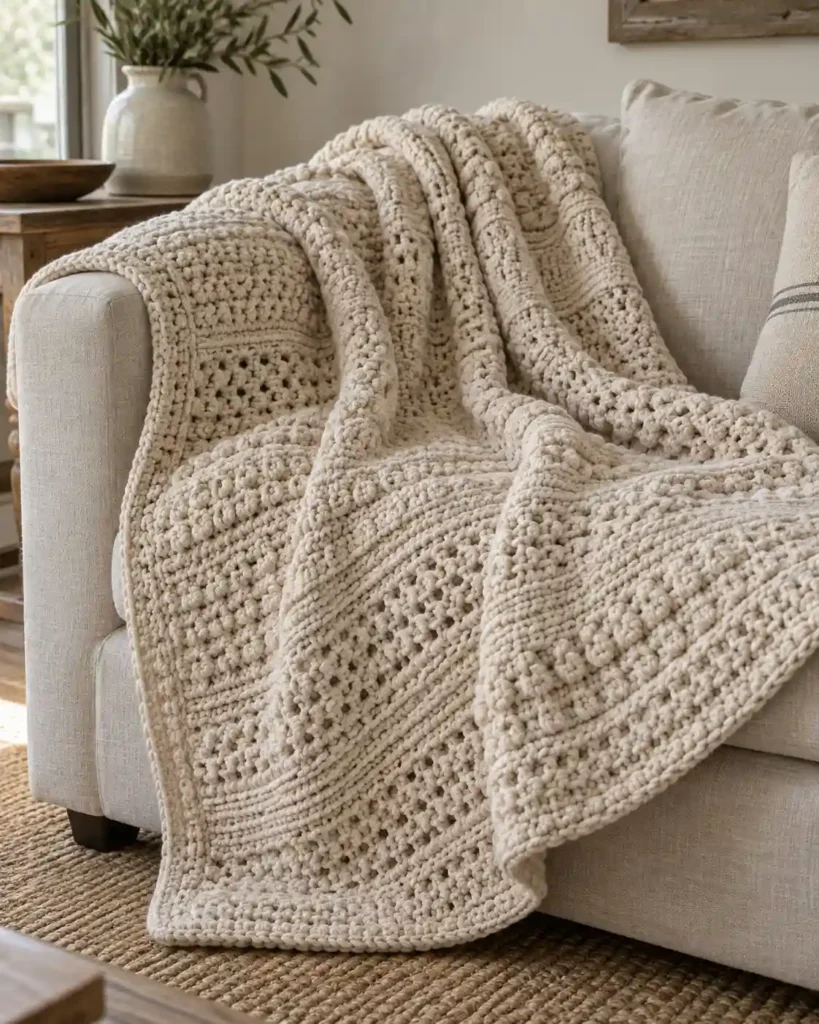
A one-color blanket forces the eye to notice stitch relief, shadows, and drape rather than color changes. That makes it perfect for modern farmhouse rooms, where too many tones can compete with wood grain, linen, metal, and other natural materials. Warm white, oatmeal, clay, greige, and charcoal all work, but the best shade is the one that contrasts slightly with the furniture underneath it. Choose one color crochet blanket patterns when you want a project that looks polished and minimizes yarn-changing work.
Mixing two or three textures within the same color can add interest. Keep the transitions orderly so the finished blanket still feels cohesive.
17. What makes a Striped Farmhouse Throw look balanced?
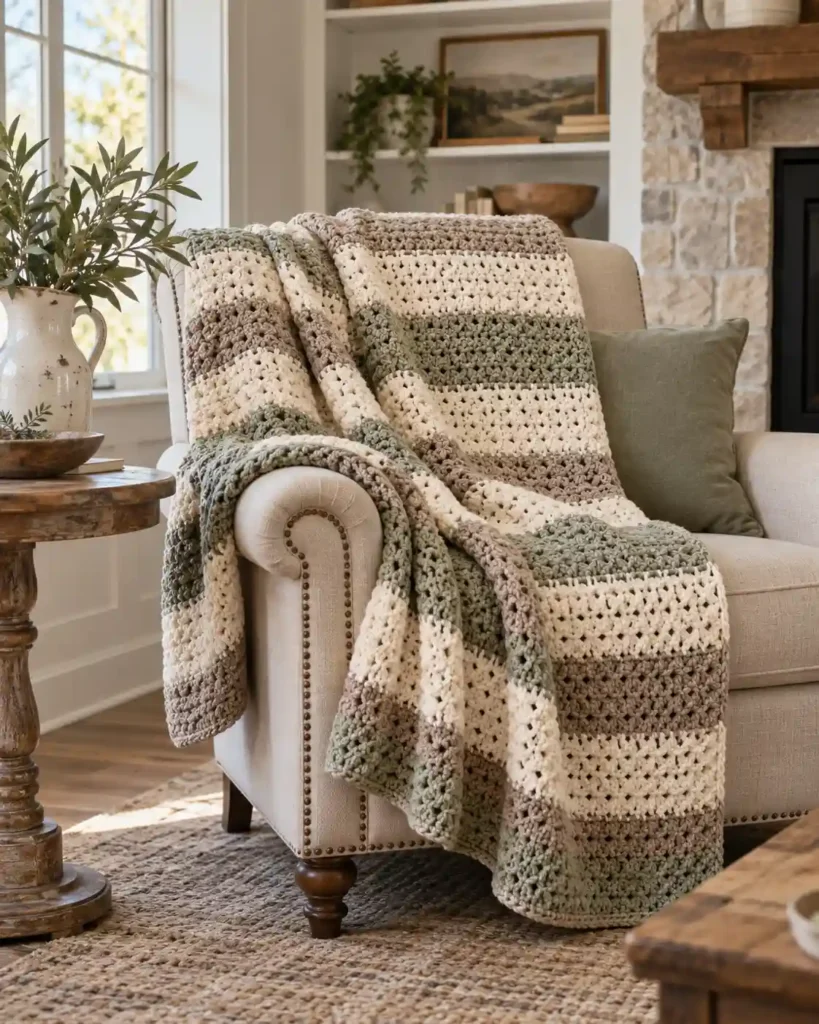
Striped blankets feel farmhouse when the colors look collected rather than loud. Cream with taupe, sage, charcoal, or dusty blue gives you variation while keeping the overall palette grounded. Wider calm stripes work particularly well on large throws because they read better from across the room and create fewer yarn ends than narrow bands. Choose this farmhouse blanket crochet idea when you want easy customization without committing to complex colorwork.
Repeat the stripe sequence before introducing a new combination. A solid border in the dominant neutral shade helps frame the design.
18. How can a Color-Block Farmhouse Blanket feel clean and contemporary?
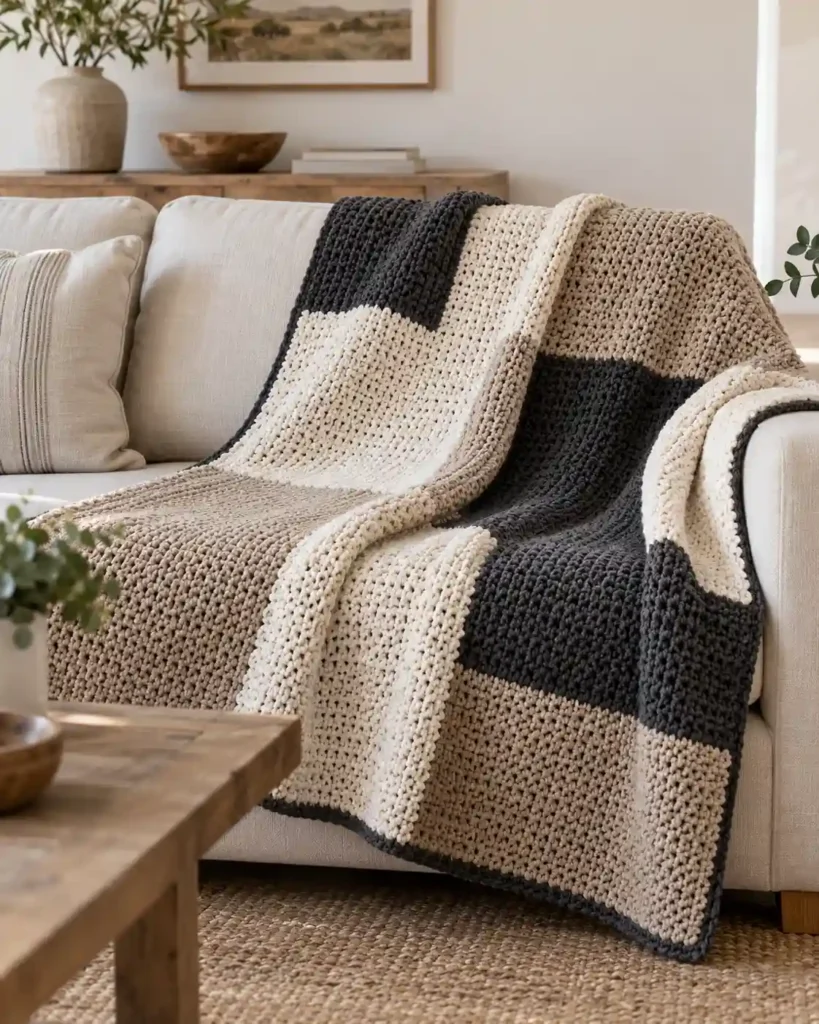
Large color blocks are one of the easiest ways to move farmhouse crochet toward a more contemporary look. Instead of tiny motifs or frequent stripes, two or three broad sections in cream, beige, charcoal, or muted clay create a stronger graphic shape. This works especially well on a simple sofa where the blanket can be folded to show different parts of the palette. Choose it if you like modern farmhouse crochet blanket styling but still want more color than a monochrome throw.
Plan block proportions before you begin. Uneven but intentional sections often look more modern than perfectly equal bands.
19. When should you add Tassels or Fringe to a Rustic Throw?
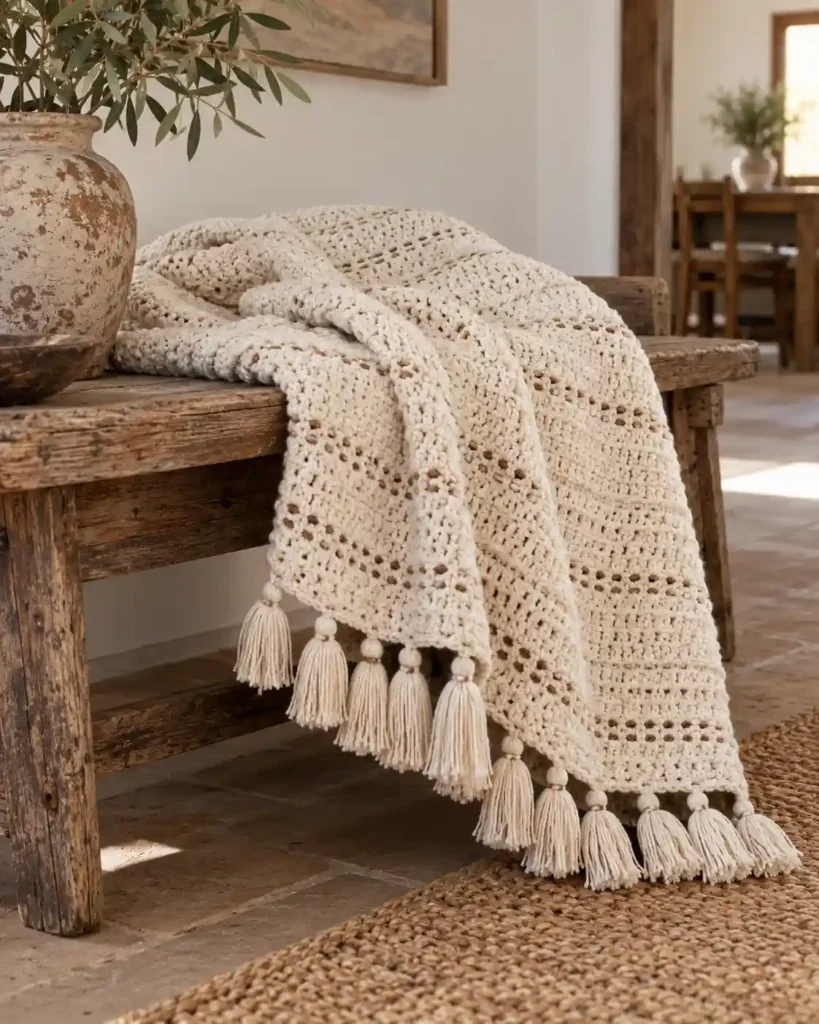
Tassels and fringe add movement and softness, but farmhouse styling works best when the finish looks deliberate rather than overly decorative. A simple cream throw with textured rows can handle generous tassels, while a busy plaid or cable pattern may only need a short fringe. This treatment works well on a bench, sofa, or reading chair where the ends can hang freely and be seen. Choose it when your blanket feels visually finished in the center but still needs a little warmth around the edges.
Match the fringe yarn to the body for a quieter look. Trim every tassel to the same length after the blanket has been washed or blocked.
20. What should you know before making an Oversized Farmhouse Bed Blanket?
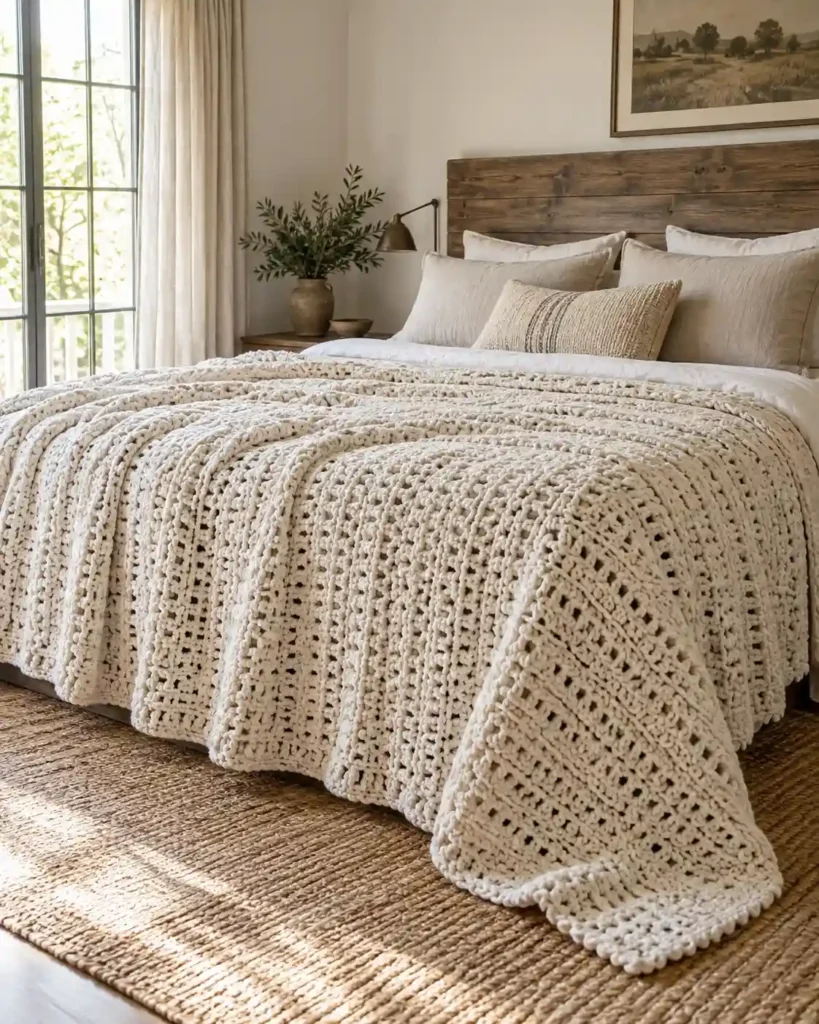
An oversized bed blanket is where planning matters most because small gauge differences become huge across queen- or king-size dimensions. It is more demanding than a sofa throw, but the payoff is a custom layer that can cover most of the bed and tie the room together. Simple repeated stitches are usually smarter than elaborate motifs because you will be working hundreds of rows or a very large number of squares. If you are searching for a Farmhouse king size blanket crochet pattern, prioritize finished measurements, yarn estimates, and a repeat you can comfortably maintain.
Do not rely on a universal yardage number. Swatch your stitch, calculate yarn use from the actual fabric you make, and buy enough from the same dye lot when possible.
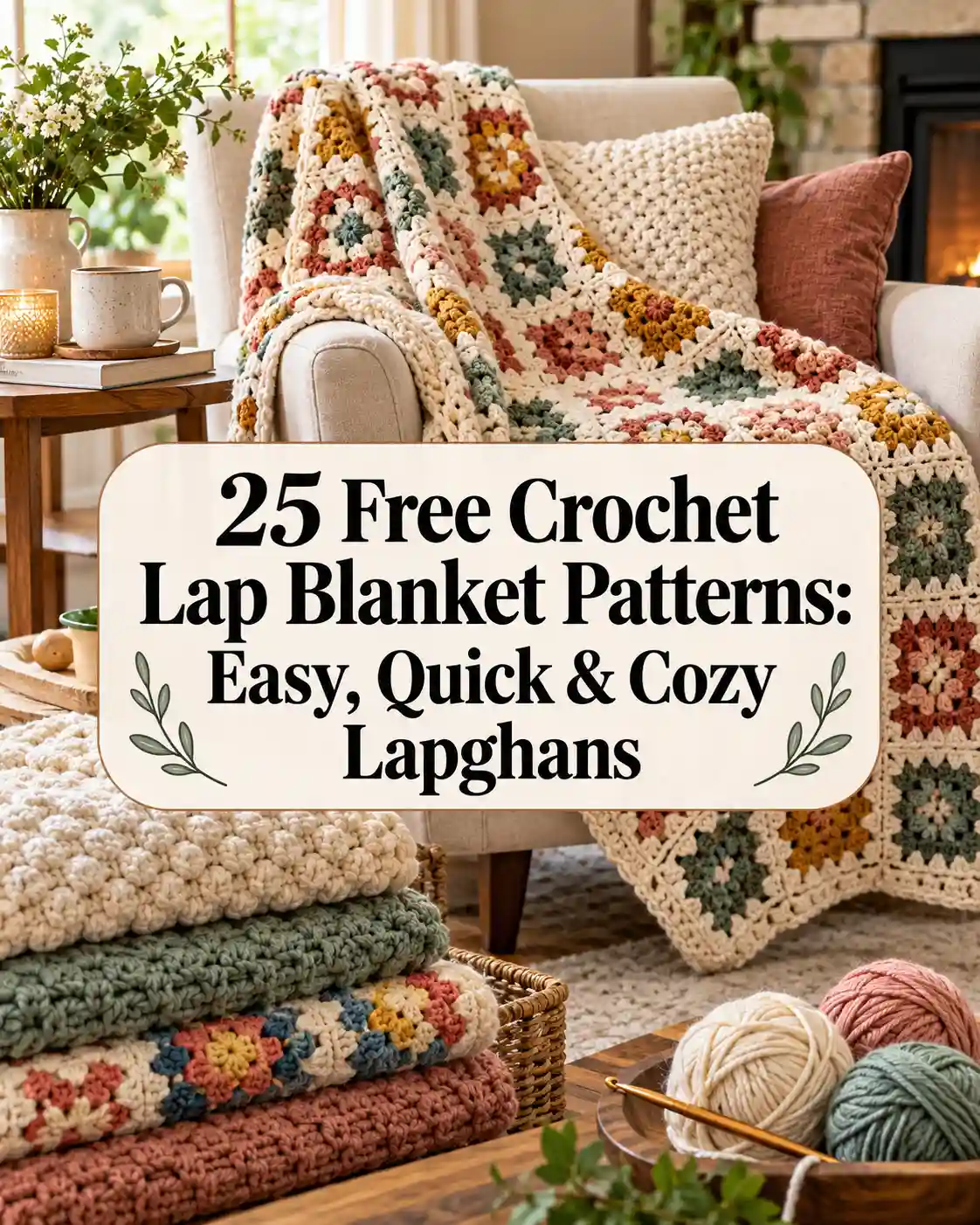
21. Why is a Farmhouse Lapghan perfect for a sofa or reading chair?
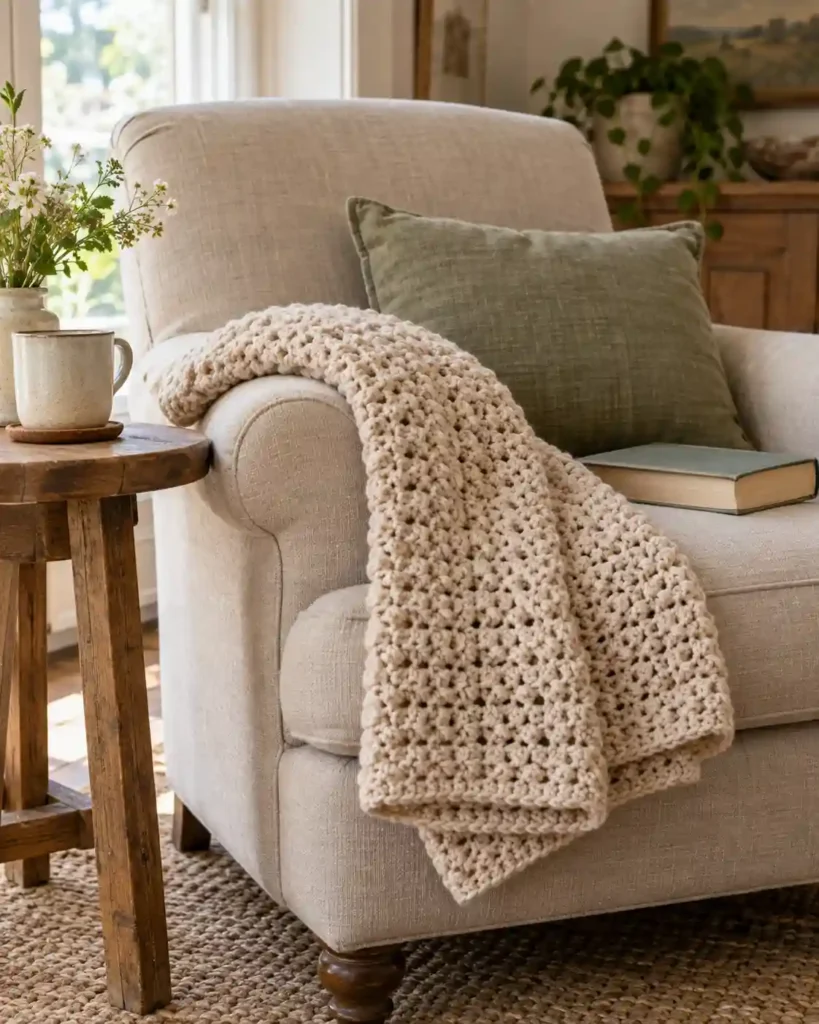
A lapghan gives you the cozy effect of a blanket without the commitment of a full bed-size project. It is easier to wash, easier to move, and much faster to finish than an oversized afghan, which makes it a practical choice for daily use. A small oatmeal or cream throw beside a favorite chair feels natural rather than staged, especially with a simple textured stitch. Choose this size if you want a useful easy crochet throw blanket that can be finished before your motivation disappears.
One published farmhouse example uses a 36 x 48-inch lapghan size, showing how compact a functional throw can be.
22. How should you design a Farmhouse Crochet Baby Blanket safely?
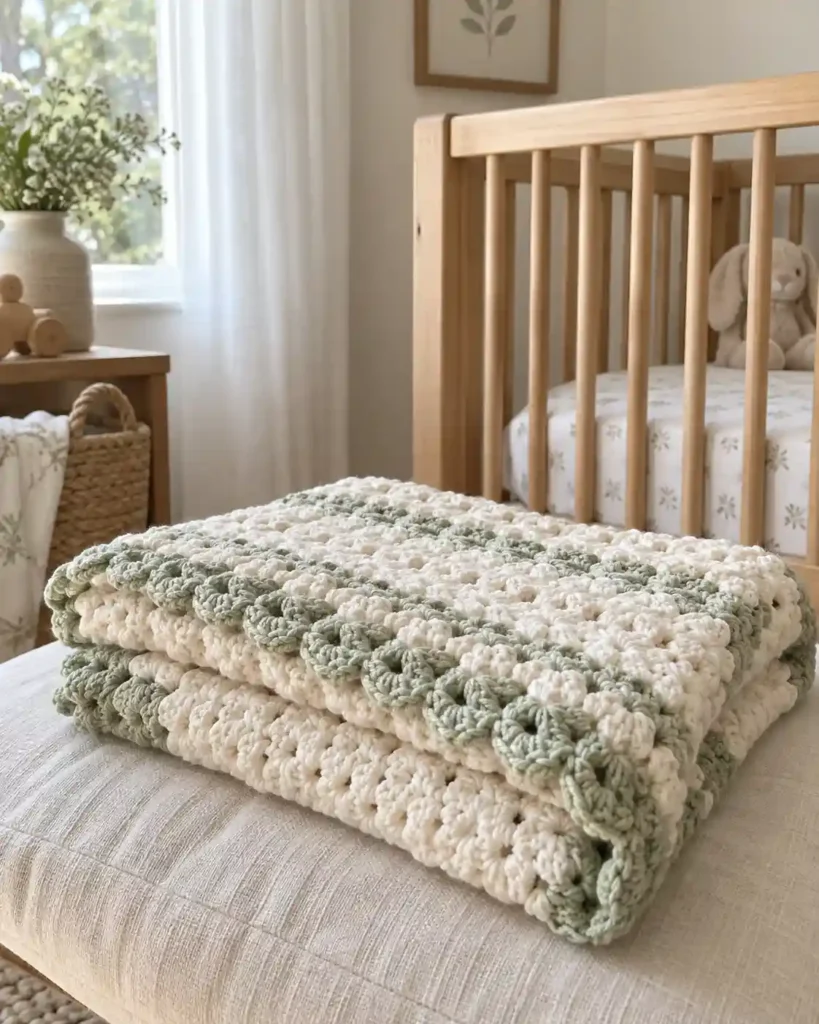
A farmhouse baby blanket looks beautiful in soft cream, sage, dusty blue, blush, or a gentle gingham palette, but the yarn and finishing need to be practical. Washable fiber, secure ends, and a flat border are more useful than long fringe or loose decorative pieces. For photos, stroller use while supervised, tummy time while awake, or gifting, a soft textured blanket can be lovely. For infant sleep, however, the U.S. Consumer Product Safety Commission says the crib or bassinet should stay bare except for a fitted sheet and specifically advises against loose blankets in the sleep space.
That means a crochet baby blanket should not be presented as a safe-sleep crib accessory. Keep the design washable and skip long tassels.
23. Why is a One-Row Repeat the best Farmhouse Crochet Blanket for Beginners?
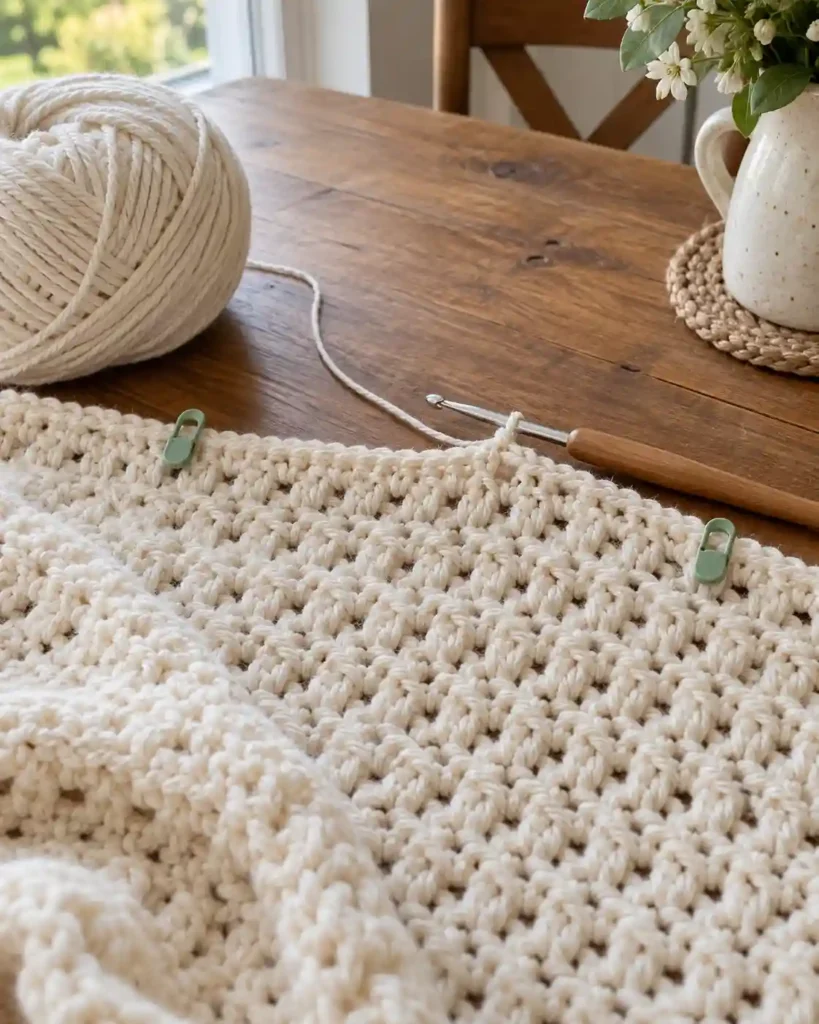
A one-row repeat removes much of the mental load that makes large blankets intimidating. Once the stitch rhythm is established, you can focus on even tension and straight edges instead of constantly checking a complicated chart. It is perfect for television crocheting, travel, or anyone who wants to build confidence while still making something substantial. For a Farmhouse crochet blanket for beginners, a one-row repeat in a neutral yarn gives the biggest visual payoff for the least pattern juggling.
The Turtle Trunk’s farmhouse blanket is a useful real-world example: it uses an even moss repeat built from slip stitch and half double crochet, with the same repeat carried through most of the blanket.
Special Tip: Place a stitch marker in the first and last stitch of each row until your edges become automatic.
24. Can you really finish a Quick Weekend Farmhouse Blanket?
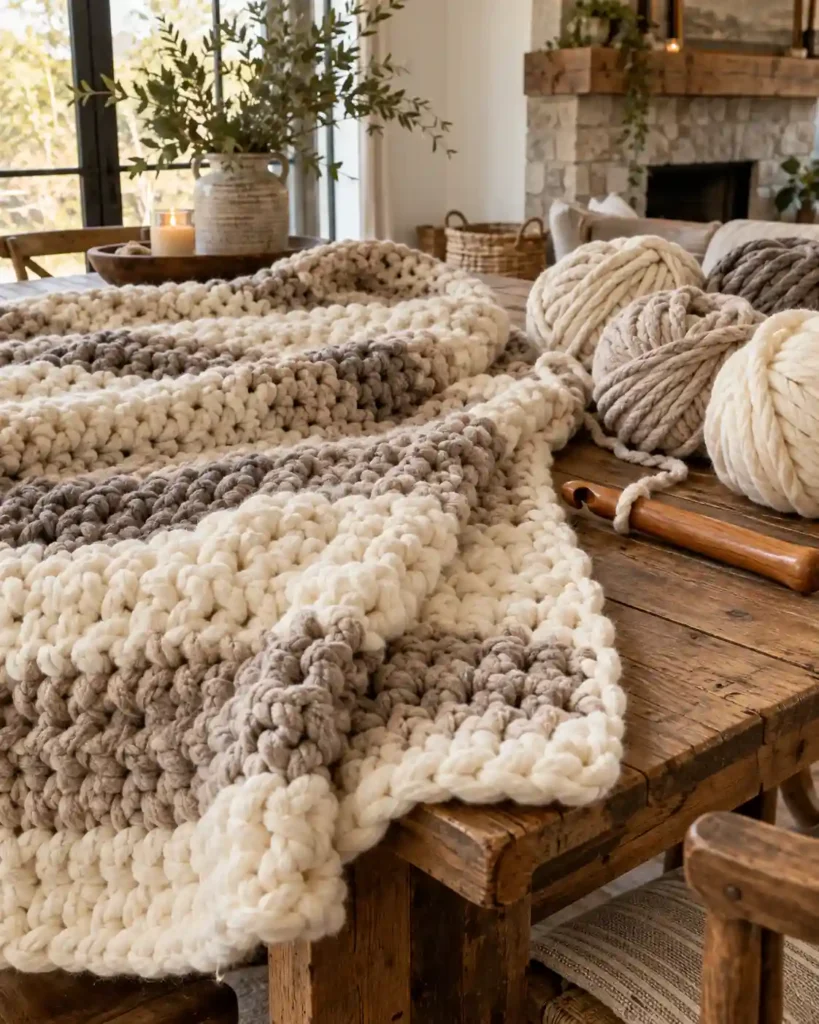
A weekend blanket is realistic only when the yarn is thick, the size is modest, and the stitch repeat is simple. Super-bulky yarn paired with a large hook can grow dramatically faster than worsted-weight crochet, but a king-size textured blanket is still not a two-day project for most people. Keep this idea to a lapghan or sofa throw and use a basic half-double, moss-style, or ribbed stitch. Choose it when you want a quick crochet blanket pattern free of complicated shaping and frequent color changes.
Annie’s modern farmhouse throw shows the scale of this approach: its pattern uses super-bulky yarn, a 15.75 mm hook, and finishes at roughly 44 x 50 inches.
25. Why does a Quilt-Block Patchwork Farmhouse Crochet Blanket feel so traditional?
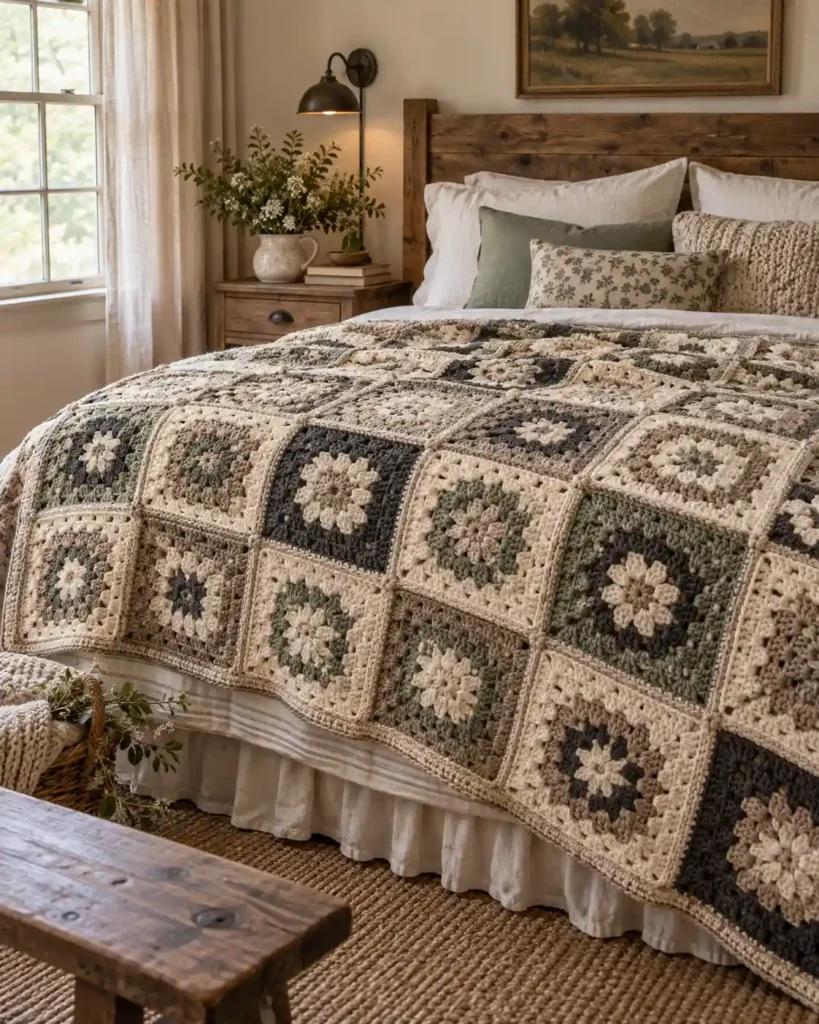
A quilt-block crochet blanket connects two handmade traditions in one project, which is why it looks immediately at home in rustic spaces. Repeated squares in cream, taupe, sage, charcoal, or dusty blue create the feeling of an old patchwork quilt without requiring fabric piecing. It is especially good for a bed because the full layout is visible and the block arrangement can become the main room pattern. Choose this one when you love modular crochet and want a blanket that looks collected, personal, and intentionally country-inspired.
Keep every block the same finished size before joining. A plain outer border is usually enough to pull the whole layout together.
How do you choose the best yarn for a farmhouse crochet blanket?
Medium #4 yarn offers a versatile balance of texture and drape, while bulky #5 and super-bulky #6 yarns create thicker fabric and usually let a simple blanket build more quickly.
At a Glance:
- Medium #4: versatile everyday blankets
- Bulky #5: thicker texture and faster progress
- Super bulky #6: oversized stitches and maximum visual weight
- Smooth yarn: clearer raised-stitch definition
Start with the way the blanket will be used. A washable medium-weight yarn is practical for everyday sofa throws and family blankets, while bulky or super-bulky yarn is better when you want more warmth and faster progress.
The Craft Yarn Council’s standard system places worsted and afghan yarn in category 4, chunky yarn in category 5, and super-bulky or roving yarn in category 6. Those categories are guidelines rather than guarantees, so always compare the yarn label with your pattern and make a gauge swatch before deciding that two yarns are interchangeable.
For CrochetMind, the easiest rule is simple: choose smoother yarn when the stitch texture is the star, and choose softer, loftier yarn when the blanket’s main appeal is warmth and squish.
What farmhouse crochet blanket colors are easiest to decorate with?
Warm neutrals are the easiest colors to coordinate, while muted greens, blues, clay tones, plaid, and gingham add character without losing the farmhouse feel.
At a Glance:
- Warm white: clean and timeless
- Oatmeal and taupe: rustic and soft
- Greige and charcoal: modern farmhouse
- Sage and dusty blue: gentle muted color
- Gingham or plaid: stronger traditional pattern
Warm white, oatmeal, beige, taupe, greige, charcoal, muted sage, dusty blue, and soft clay are the easiest farmhouse colors to mix with existing rooms. They work because they give texture room to show without forcing the blanket to become the loudest object in the space.
If you want stronger pattern, use contrast through gingham, plaid, or stripes instead of adding many unrelated colors. A Farmhouse crochet blanket pattern can feel completely different simply by switching from black-and-cream checks to sage-and-oatmeal stripes.
How should you size a crochet blanket for a chair, sofa, or bed?
Measure the intended chair, sofa, or mattress first, then choose a pattern size and swatch because stitch gauge can noticeably change the final width and length.
At a Glance:
- Lapghan: compact personal coverage
- Sofa throw: more width and length
- Bed blanket: measure mattress and desired drop
- Large sizes: swatch before estimating yarn
- King-size projects: prioritize repeat simplicity
Use the furniture and intended drape as your starting point, not a generic chart alone. A lapghan only needs to cover the person using a chair, while a sofa throw usually benefits from more length and width; a bed blanket needs enough extra fabric to cover the mattress and create the drop you want.
Published farmhouse examples show how varied blanket sizing can be. The Turtle Trunk lists a 36 x 48-inch lapghan, a 48 x 60-inch throw, and much larger bed sizes in the same stitch family, including queen and king options, while the Ravelry example cited above is about 40 x 44 inches.
Measure your actual furniture before choosing a pattern. That is especially important for a Farmhouse king size blanket crochet pattern because small changes in stitch gauge can add or remove many inches across a large width.
How do you keep crochet blanket edges straight and tension even?
Count stitches regularly, mark the first and last stitch, check the blanket width as you work, and use a gauge swatch to correct tension before the project becomes large.
At a Glance:
- Count stitches at regular intervals.
- Mark both row-edge stitches.
- Measure width during the project.
- Swatch before making a large blanket.
- Change hook size when gauge is off.
Count your stitches regularly, mark the first and last stitch of each row, and check width every few inches. If you wait until the blanket is halfway finished to notice that the sides are narrowing, correcting it becomes much harder.
The Craft Yarn Council recommends making a gauge swatch and changing to a smaller hook if the swatch is too large or a larger hook if it is too small. That simple check is useful even for blankets where exact garment fit is not an issue because it helps you predict width, drape, and yarn use.
Which borders and finishing details look most farmhouse?
Simple crochet blanket edging, including single-crochet, ribbed, or crab-stitch borders, usually suits farmhouse blankets best because it finishes the edges without competing with the central texture.
At a Glance:
- Single crochet: clean and understated
- Ribbing: structured modern finish
- Crab stitch: subtle rope-like texture
- Fringe: best for rustic throws
- Tassels: use selectively on simple blankets
A single-crochet border is the cleanest choice, while ribbing adds a slightly more structured finish. Crab stitch works well when you want a twisted rope-like edge, and a restrained fringe or tassel finish suits rustic and boho farmhouse designs.
Avoid adding every finish at once. If the blanket already has gingham, cables, bobbles, or a strong stripe pattern, a plain border usually looks more intentional.
Where can you find Farmhouse Crochet Patterns Free without confusing inspiration with a full pattern?
Look for pages that clearly provide written instructions, materials, gauge, sizing, or a downloadable pattern instead of assuming every inspiration image includes a complete free crochet pattern.
At a Glance:
- Check for complete stitch instructions.
- Confirm yarn and hook information.
- Look for finished dimensions.
- Distinguish free patterns from paid PDFs.
- Respect each designer’s distribution terms.
Look for pages that clearly provide complete stitch instructions, gauge, yarn information, size details, or a downloadable pattern rather than image-only inspiration. The Turtle Trunk publishes its farmhouse blanket instructions on the page, and the Ravelry listing for Christine Blue’s Farmhouse Blanket says the pattern is available free on the designer’s blog.
When you see the phrase Farmhouse crochet blanket patterns free, check whether “free” means the full pattern, a limited tutorial, or only a promotional excerpt. CrochetMind can use roundup ideas to help readers compare styles, but each linked designer’s usage and distribution terms should still be respected.
FAQs About Farmhouse Crochet Blanket
What yarn is best for a farmhouse crochet blanket?
Medium #4 yarn gives a good balance of stitch definition, drape, and manageable weight, while bulky #5 and super-bulky #6 yarns make thicker blankets faster. The Craft Yarn Council’s standard yarn weight system is a useful reference when comparing these categories. Choose based on the stitch, finished size, care needs, and how heavy you want the blanket to feel.
What crochet stitch looks best for farmhouse blankets?
Moss, linen, basket weave, alpine, waffle, bobble, and cable-inspired stitches all work well. The best choice is usually one with visible texture that still looks good in a restrained neutral or muted palette.
Are farmhouse crochet blankets beginner-friendly?
Yes. Simple moss stitch, linen stitch, one-row repeats, basic stripes, and chunky throws are good starting points, while cables, complex gingham, and intricate lace require more stitch or color control.
When comparing Farmhouse crochet blanket for beginners ideas, start with a short repeat and a yarn that makes individual stitches easy to see.
How much yarn do I need for a farmhouse crochet blanket?
There is no single reliable yardage because size, yarn weight, stitch density, hook size, and personal tension all change consumption. Make a gauge swatch, estimate from the actual pattern repeat, and buy a sensible extra margin for large projects.
What size should a farmhouse crochet throw be?
A practical sofa throw often falls around the 40-to-60-inch range in at least one dimension, but the best size depends on the furniture and how much coverage you want. Real farmhouse patterns vary widely, so measure the intended chair, sofa, or bed before starting.
For a Farmhouse king size blanket crochet pattern, use the mattress dimensions and desired side drop rather than enlarging a throw by guesswork.
Final Thoughts
The best farmhouse crochet blanket is not necessarily the most complicated one. A simple neutral color, a strong textured stitch, and the right finished size can create more farmhouse character than a blanket packed with too many motifs or colors.
For beginners, start with moss stitch, linen stitch, a one-row repeat, or a chunky throw. If you want more visual impact, move toward gingham, basket weave, cables, granny squares, or quilt-block patchwork, then save your favorite idea and use the matching pattern details to choose yarn, hook, and size before you begin.
![The Best 30+ Free Crochet Cat Patterns [Beginner-Friendly Guide]](https://crochetmind.com/wp-content/uploads/2025/04/1-The-Best-30-Free-Crochet-Cat-Patterns-Beginner-Friendly-Guide.webp)