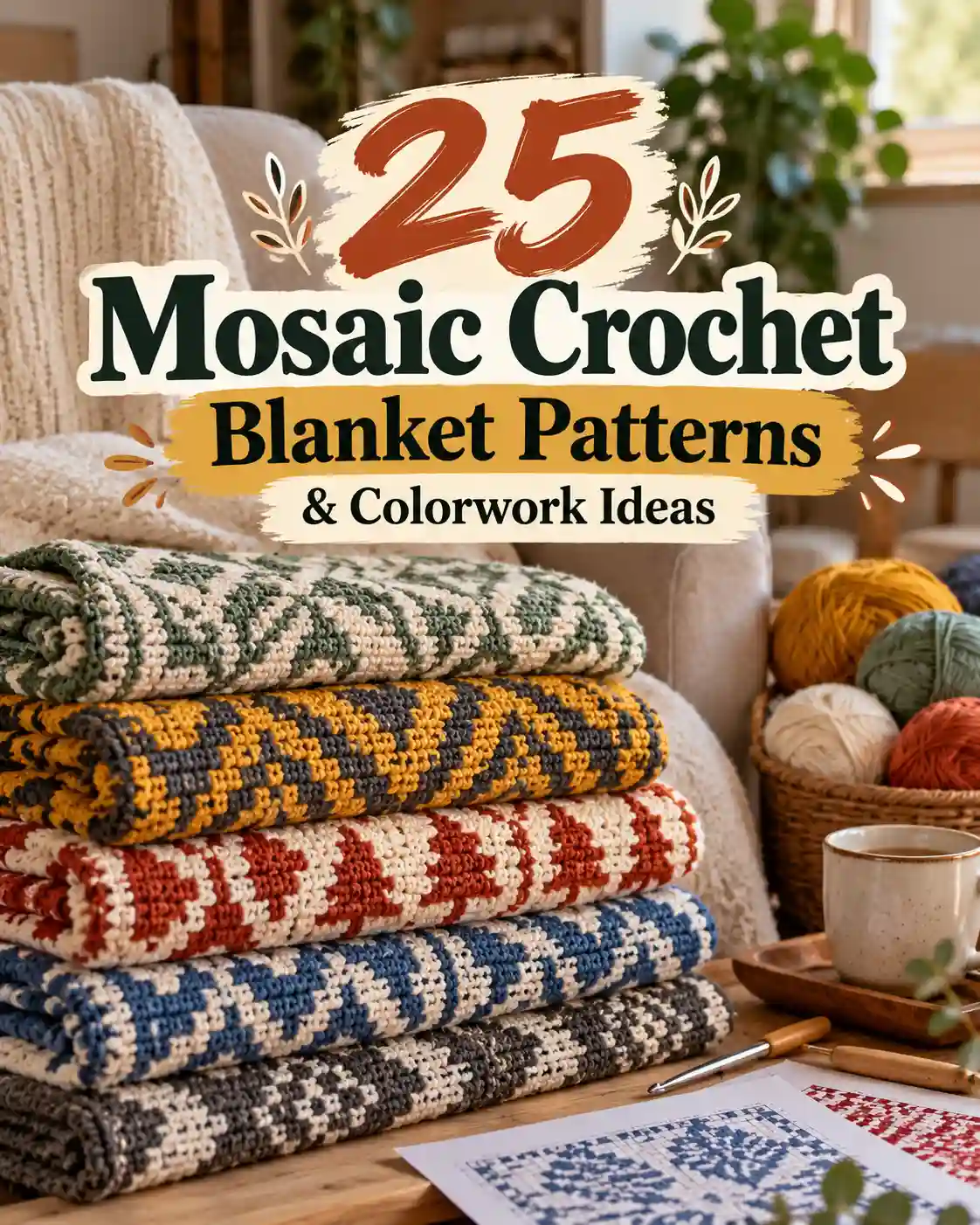
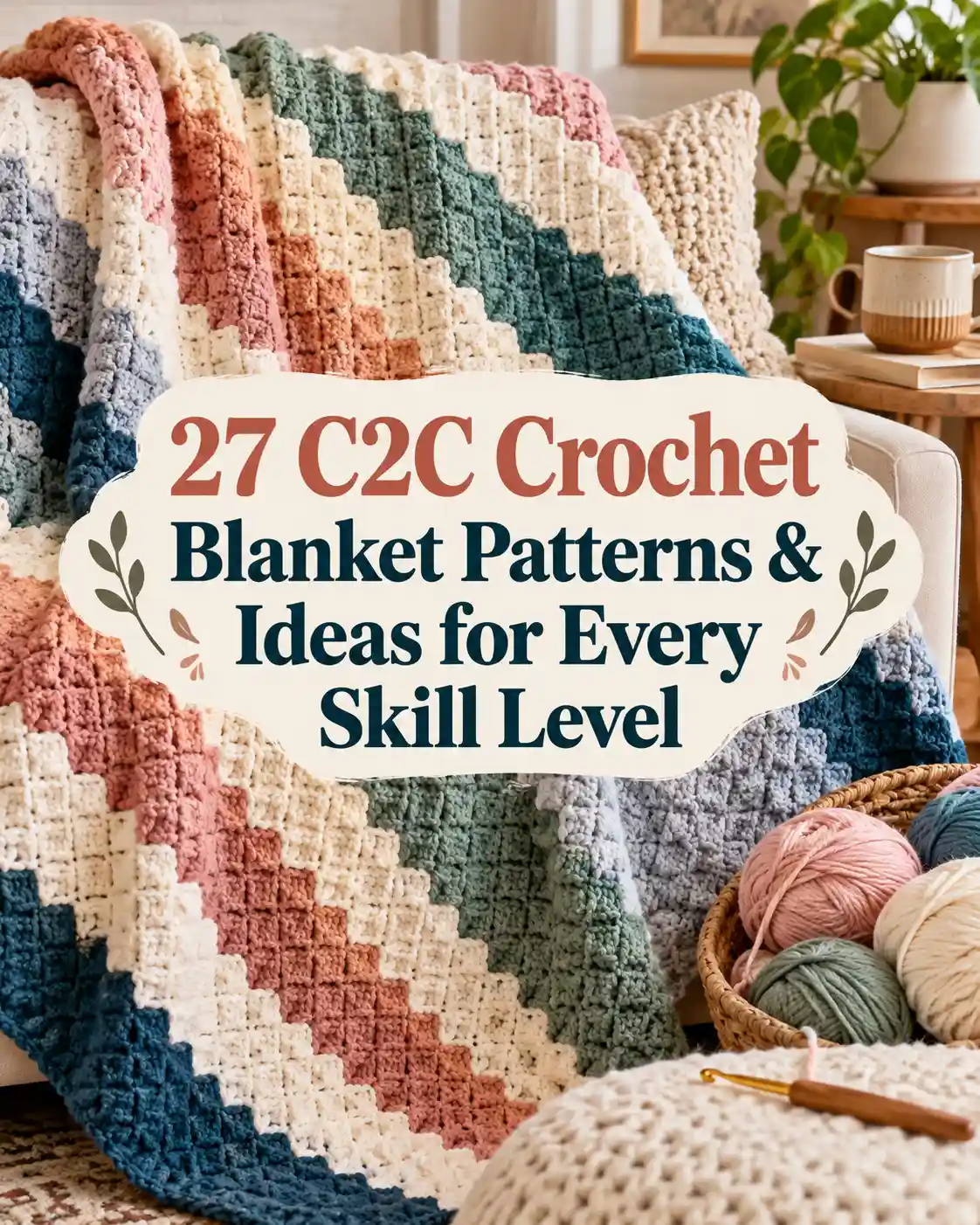
A mosaic crochet blanket is a colorwork blanket where every row uses just one yarn color, so the design comes from where you place your stitches, not from carrying strands across the back. For a first project, choose worsted-weight yarn (the Craft Yarn Council calls it Medium, category 4) and a 5.5 to 6.5 mm hook (US I-9 to K-10½), then pick a simple inset or zigzag chart. The 25 ideas below run from easy starters to overlay pictures, baby blankets, crochet-alongs, and Tunisian twists.
Mosaic looks like wizardry the first time you see a finished throw. It isn’t. You already know the stitches, and a chart does the rest. Scroll to the group that fits your skill and your calendar, and save the ones that make you want to reach for your hook.
Whether this is your first colorwork chart or your fiftieth, you’re in the right place. This guide gathers 25 mosaic crochet blanket ideas in one spot, from simple mosaic crochet blanket patterns free to try this weekend to bigger projects like baby gifts, holiday throws and year-long temperature blankets. For more inspiration, explore our crochet blanket pattern collection. Look at the beginner picks first if you want mosaic crochet blanket patterns for beginners, and save the rest for when your confidence grows. Grab your hook, choose a color pair you love, and let’s find your next blanket.
Key Takeaways
- Start with simple mosaic crochet blanket patterns free online.
- Swatch one chart repeat before buying yarn.
- Choose two colors that contrast clearly in grayscale.
- Match yarn weight and fiber for both colors.
- Pick inset for clean lines, overlay for raised pictures.
- Keep baby blankets out of the crib; use them awake.
What Is a Mosaic Crochet Blanket and How Does It Work?
A mosaic crochet blanket is a colorwork blanket worked in one yarn color per row, with the design created by where the stitches are placed.
At a Glance
- Each row uses a single yarn color
- The design comes from stitch placement, not carried strands
- Charts show one stitch or chain space per square
- Many patterns also include written rows
A mosaic crochet blanket is worked one color at a time, row by row, on a set color-change schedule. The pattern appears because some stitches are skipped, chained over or worked into earlier rows, so a contrasting color peeks through or sits on top of the fabric.
Charts do the heavy lifting. A chart is a grid where each square stands for one stitch or chain space, and you read it row by row like a map. Many free patterns also give written rows, so you can follow whichever format clicks for you. If you need help understanding pattern instructions, see our guide on how to read a crochet pattern.
Because you never juggle two colors inside a single row, the back of the fabric stays tidy and your tension stays even. That is why mosaic is often the gentlest way into colorwork. When you want step-by-step stitch guides after this list, browse our beginner colorwork tutorials on our website.
Which Type of Mosaic Crochet Blanket Is Right for You?
Choose inset mosaic for clean geometric lines, overlay mosaic for raised pictures, tapestry for more colors per row and Tunisian mosaic for a denser, textured fabric.
Pick the technique before you pick the pattern. It decides how the blanket looks, how hard it feels and which yarn you’ll need.
| Technique | How it works | Colors per row | Best for | Skill level |
|---|---|---|---|---|
| Inset mosaic | Chain spaces and stitches from earlier rows build the design into the fabric | One | Geometric throws and clean diamond motifs | Advanced beginner |
| Overlay mosaic | Stitches worked into earlier rows sit raised on top of the fabric | One | Detailed pictures worked from charts | Intermediate |
| Tapestry crochet | Unused colors are carried inside the stitches | More than one | Fine-detail motifs in many colors | Intermediate |
| Tunisian mosaic | Worked on a long Tunisian hook, with mosaic colorwork adapted | Check each pattern | Dense, textured blankets | Intermediate |
New to colorwork? Start with inset or a simple overlay chart in two high-contrast colors. Every other technique in this list builds on the same habits: reading a chart, counting carefully and keeping your edges even.
Which Mosaic Crochet Blanket Patterns for Beginners Should You Start With?
The easiest place to begin is a two-color inset or zig zag mosaic crochet blanket with a short repeat, worked in smooth worsted yarn.
If you’re hunting for simple mosaic crochet blanket patterns free of charge, these five are where I’d point a friend first. They share short, repeatable charts that teach the rhythm without punishing a miscount.
25 Mosaic Crochet Blanket Patterns & Colorwork Ideas
1. Easy Two-Color Mosaic Crochet Blanket for Beginners
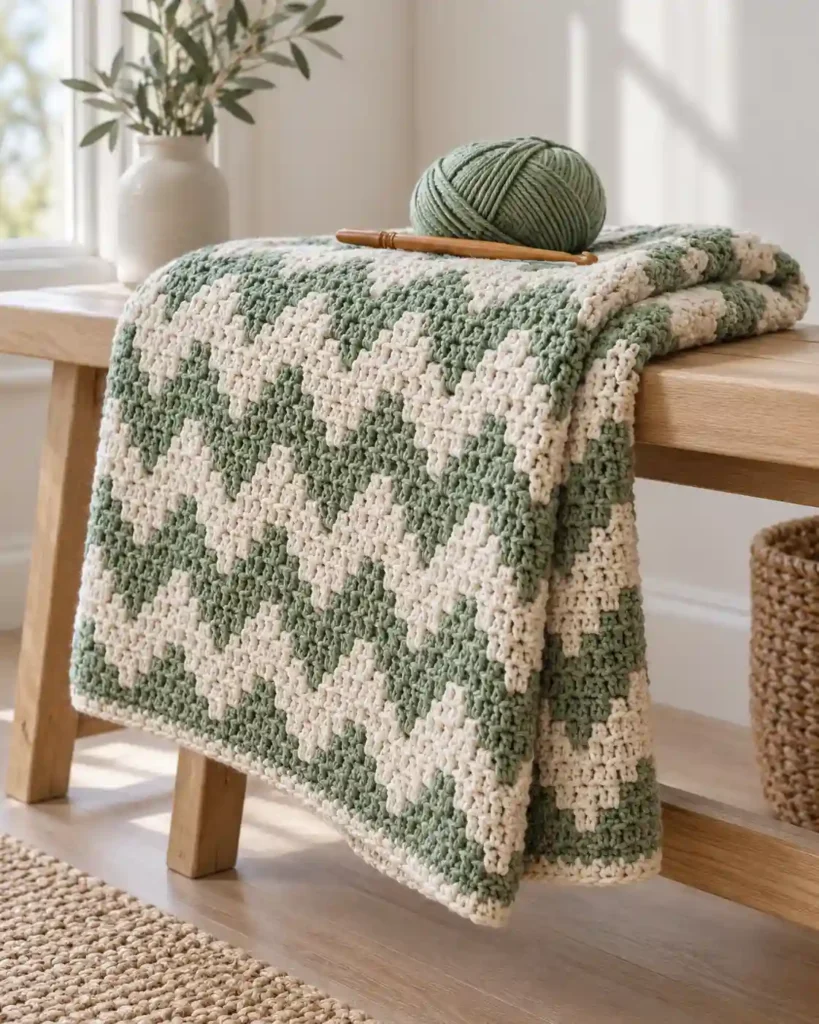
If a stranger asked which mosaic crochet blanket to try first, I’d hand them this one: two colors, one color per row and a repeat short enough to memorize by row ten. Stranded colorwork makes you carry yarn across the back, but here the fabric stays flat and your tension stays friendly. I stitch mine on the sofa with the chart propped on a cushion, glancing up between rows like it’s a recipe. Go for it if you can already single and double crochet, because the finished throw looks far more advanced than it felt.
What to look for in a starter pattern:
- A written-row version alongside the chart
- A video or photo tutorial for the first color change
- Smooth worsted yarn in two high-contrast colors
Special Tip: Swatch one full chart repeat before buying the rest of your yarn. A swatch shows whether your colors contrast enough and gives you your gauge (how many stitches fit in a set width). The Craft Yarn Council lists 11 to 14 single crochet stitches per 4 inches as typical for worsted weight, so a swatch far outside that range is your cue to change hook size.
2. Inset Mosaic Crochet Blanket
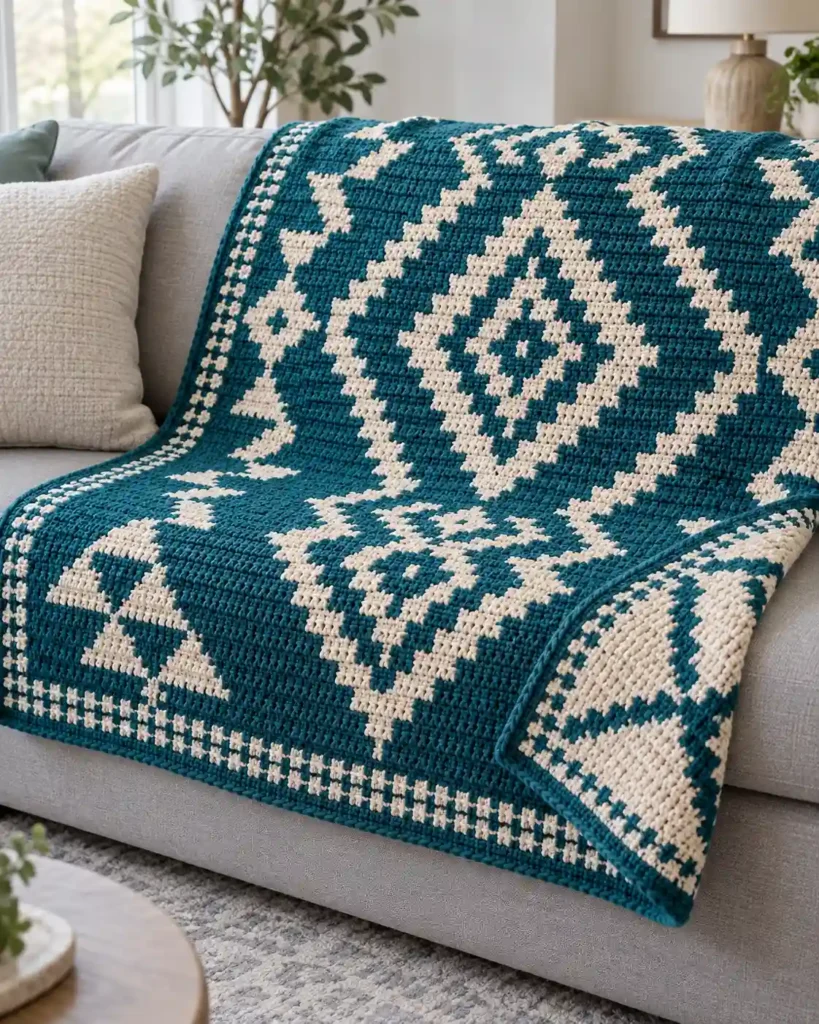
Inset mosaic is the technique that makes people ask, “Wait, that’s crochet?” Chain spaces and stitches from earlier rows carve diamonds straight into the fabric. Overlay stitches stack on the surface, but inset keeps everything flush, which gives geometric patterns crisp edges. I reach for it when a throw has to sit on the couch and look sharp without any fuss, and it suits you once you’ve finished one simple project and want cleaner lines.
Many inset patterns we looked at come with a video tutorial and both baby and throw sizes, so check the listing before you pick. If finishing is the part you dread, read the pattern notes on how color changes and ends are handled.
3. Overlay Mosaic Crochet Blanket Patterns Free (With Charts)
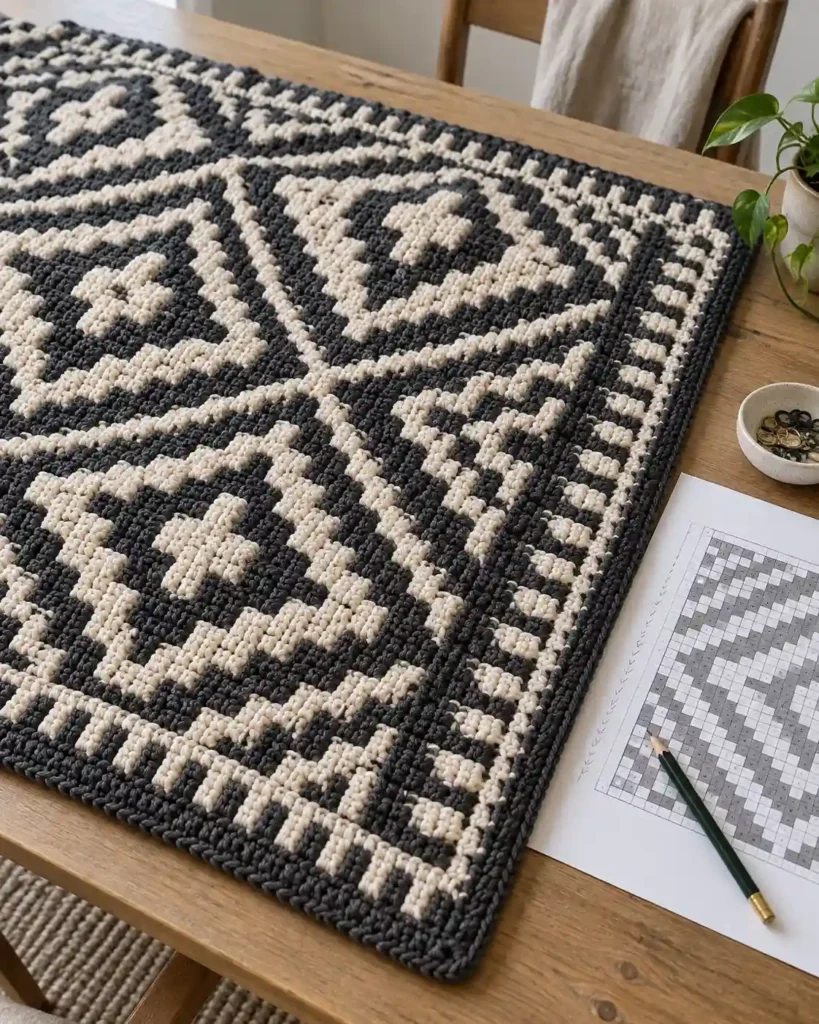
Raised, almost sculpted pictures are the reason overlay mosaic has a fan club. The design rides on top of the fabric instead of inside it, so a mountain ridge or a bold star really pops. Picture a plain cream throw over an armchair with one dark motif rising off the surface like embroidery. Choose overlay if you love charts and don’t mind a little counting, because the texture is the best part.
Searching for overlay mosaic crochet blanket patterns free? Check three things before you commit:
- Both a chart and written rows are included.
- The pattern says what you need to read it, such as a printout or a chart app.
- The designer explains the overlay stitches with photos or video.
Special Tip: Use two yarns of the same weight and fiber. Mismatched yarns make the raised stitches sit unevenly.
4. Is a Mosaic Crochet Sampler Blanket the Best Way to Learn?
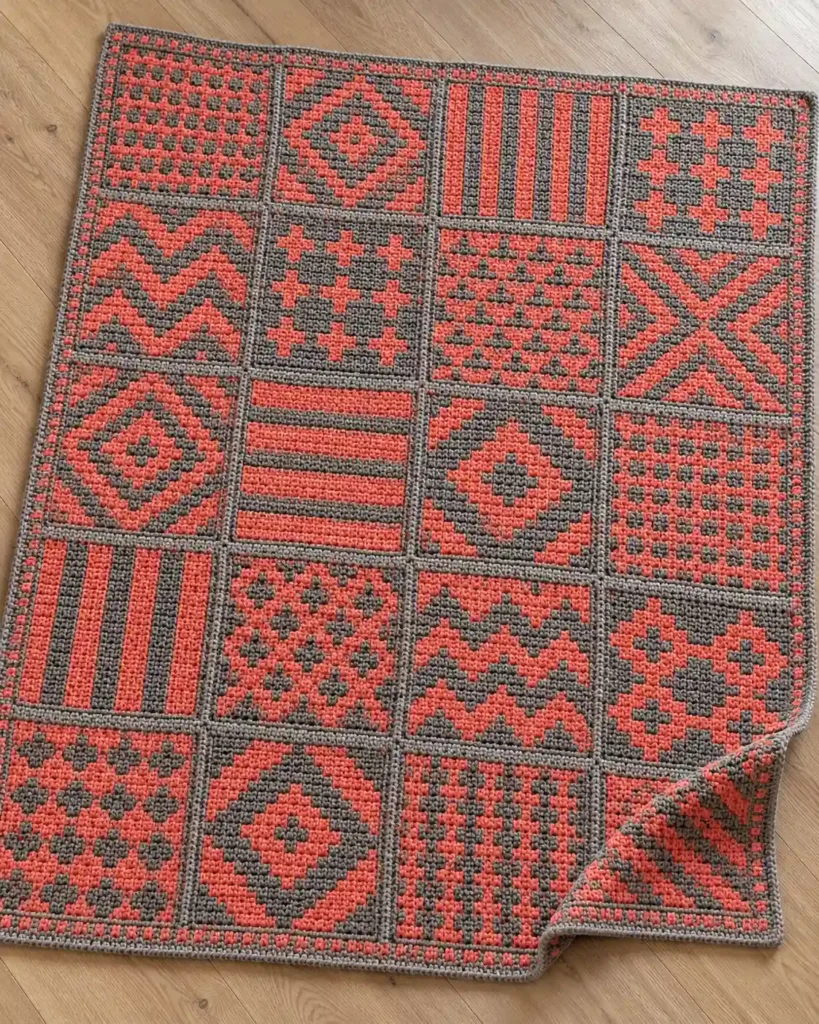
Probably, yes. A sampler is a blanket made from different mosaic blocks, so each block teaches something new: color changes, edge stitches, chart reading. Instead of repeating one motif for sixty rows, you meet a fresh challenge every few inches. Think of it as a skills class you get to keep on the bed, which works well if you learn by doing and want a finished blanket instead of a drawer of swatches.
- Start with three or four blocks to see how you like it
- Use the same yarn throughout so blocks match in size
- Decide on a joining method (sewn or crocheted) before you begin
5. Why Is a Zig Zag Mosaic Crochet Blanket So Easy to Memorize?
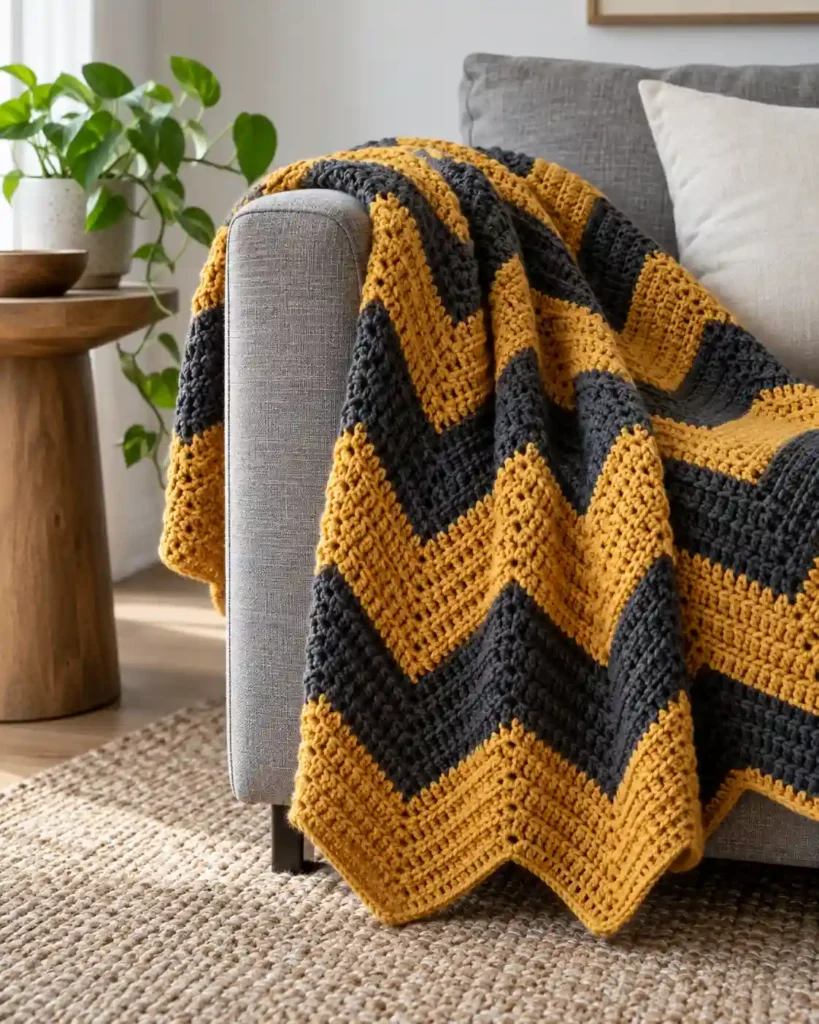
Short repeats. That’s the secret: a zig zag or chevron mosaic needs only a handful of stitches per repeat, so by row twelve your hands know the pattern without the chart. There’s less to count than in a picture blanket and less to rip out when you lose your place. It’s my pick for travel bags and waiting rooms, and for anyone who wants a modern throw that leads the eye in clean diagonals.
It works as a throw or an afghan (a handmade, throw-sized blanket). To resize it, add or remove whole repeats across the width.
Special Tip: Put a stitch marker after every repeat. If your count is off, you’ll find the mistake within one repeat instead of at the end of the row.
What Are the Best Modern and Geometric Mosaic Crochet Patterns?
These three lean on bold shapes, tile-like repeats and color that does the talking.
6. Modern Geometric Mosaic Crochet Throw
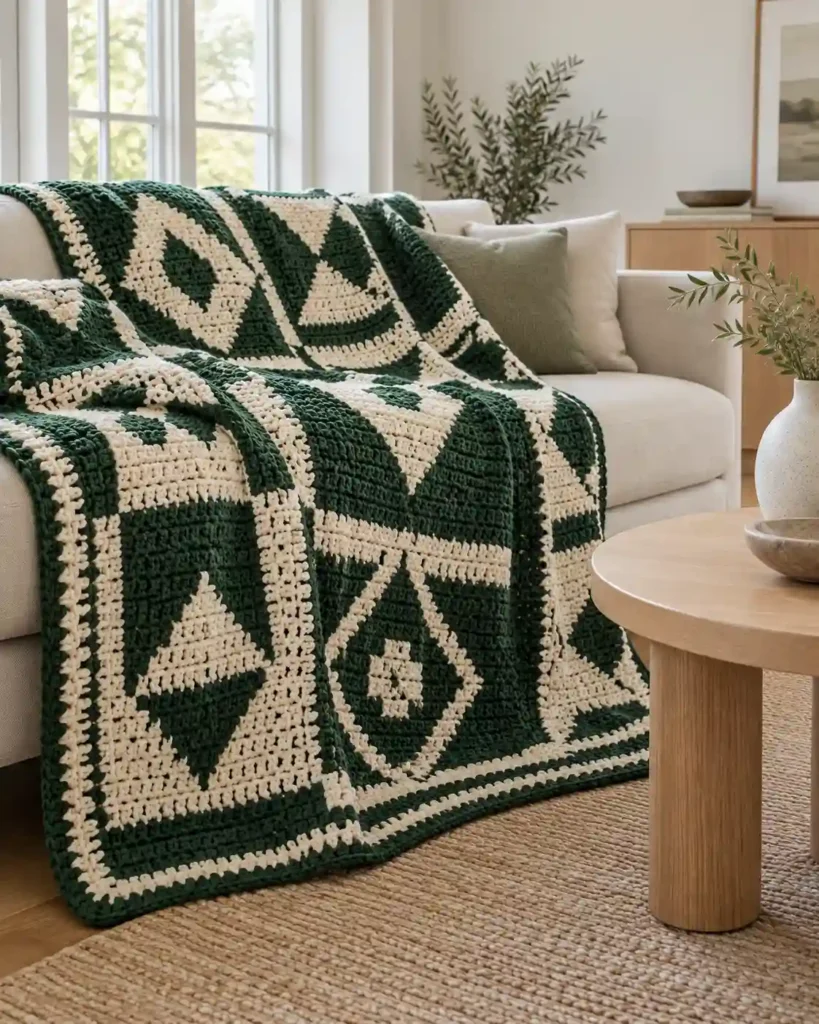
A statement throw doesn’t need a complicated pattern, just the right pair of colors. Diamonds, blocks and stripes look expensive in geometric mosaic, especially in a modern neutral plus one bold accent. Folded over the foot of a bed or draped across a sofa arm, it works like a piece of art that happens to be warm. If your living room leans Scandinavian or farmhouse, this is the one that will look like it belongs.
Throw sizes aren’t standardized, but the Sleep Foundation lists a typical throw at about 50 x 60 inches and notes that it varies by manufacturer. Several mosaic throws we reviewed finish close to 49 x 60 inches.
- Pair one neutral with a single accent color
- Choose a smooth yarn so the raised stitches show
- Pick a chart with large shapes if you want it to read from across the room
7. Mosaic Granny Square Crochet Blanket
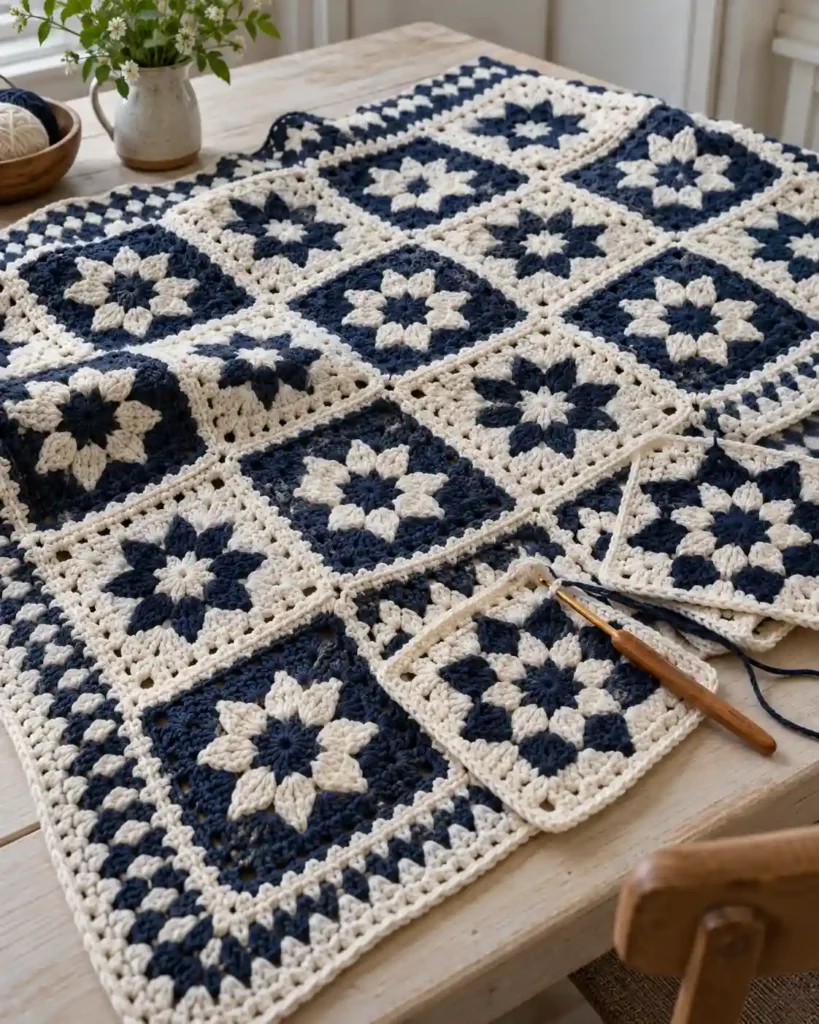
Squares are the friendliest way to take mosaic on the road. Each one is crocheted in the round, starting at the center, so a whole project lives in a tote bag and you only ever hold a hand-sized piece. Instead of a long chart you can’t see all at once, you finish one tidy tile at a time. It suits intermediate crocheters who like watching progress pile up, and the patchwork it makes looks like ceramic tile.
Square size depends on your yarn and hook, so swatch one square before you decide how many to make. You’ll need at least two colors, and baby and full-size versions both exist. Some popular square-based afghans are paid patterns, so confirm the price before you fall in love.
Special Tip: Buy all the yarn for every square at once. Dye lots (batches dyed together) can differ slightly between purchases, and a mismatch shows more in a tiled layout.
8. Why Do Makers Keep Searching for the Nya Infinity Mosaic Blanket?
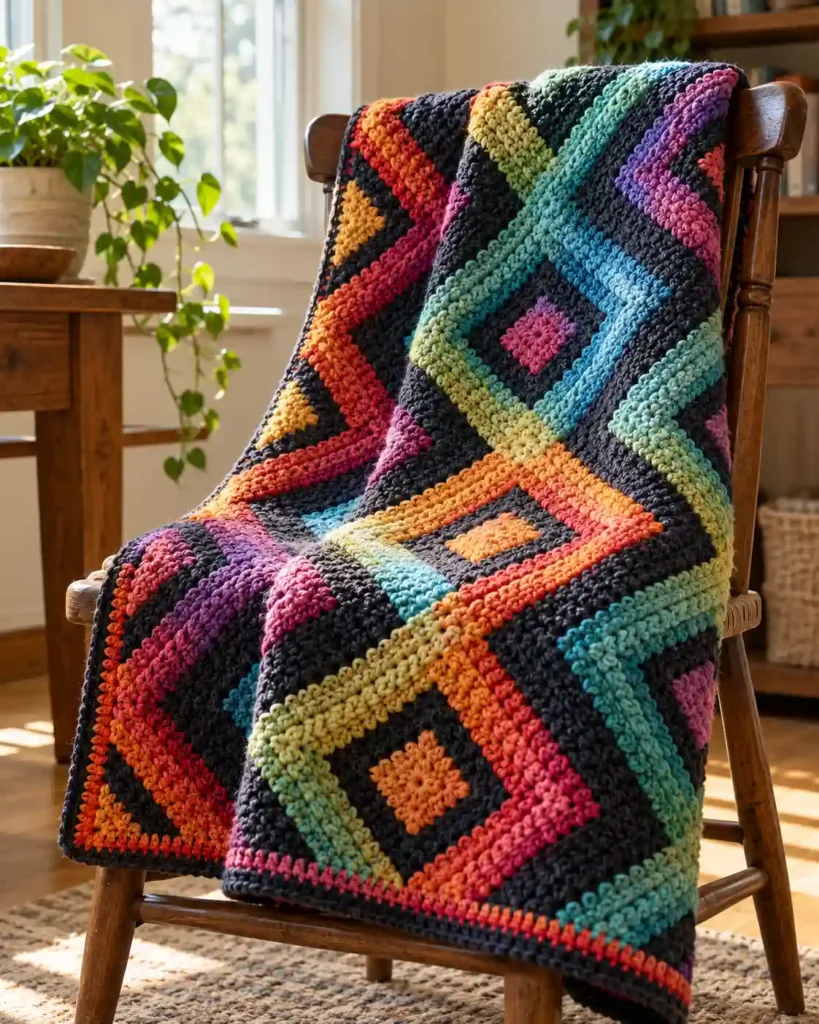
Some patterns turn into shorthand, and the Nya Infinity Mosaic Blanket is one of them. People search for it by name because it’s colorful, geometric and happy to eat up scrap or ombre yarn. Some patterns stay with two quiet colors, but this one is made for color. Try it if you’re a confident beginner who wants a bright, cheerful project and doesn’t mind a longer one.
You’ll see related names in the same family, such as Indiana and Good Mood, so browse them side by side before choosing a palette. Always download from the designer’s own page and confirm it’s still free, since patterns can move behind a paywall without notice.
Which Mosaic Crochet Blanket Is Best for Babies, Kids and Color Lovers?
Small sizes finish fast, and bright palettes keep you motivated. Start here when the blanket is a gift or a playroom upgrade.
9. Is a Mosaic Crochet Baby Blanket Safe for a Crib?
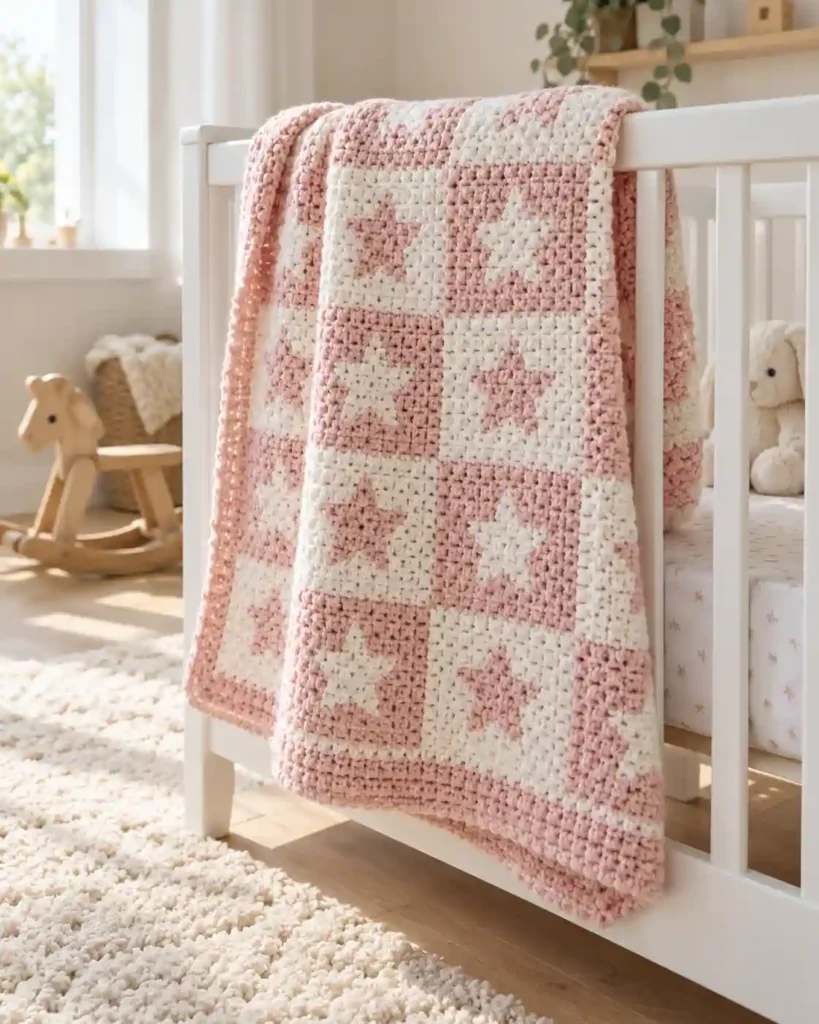
Not for sleeping, and that is worth knowing before you stitch a single row. The American Academy of Pediatrics advises keeping soft objects and loose bedding, blankets included, out of a baby’s sleep area because they can raise the risk of entrapment, suffocation or strangulation. What a mosaic baby blanket does beautifully is everything else: stroller walks, tummy time, glider cuddles and photos. Make one for a baby shower if you want a gift that feels like a keepsake, and tell the parents it’s an awake-time blanket.
For warmth at bedtime, the AAP suggests layers or a wearable blanket and says to dress a baby in one layer more than you’re wearing. Safe Sleep Missouri, which summarizes the AAP’s guidance, puts it simply: the crib should be bare.
- Sizes in the baby patterns we reviewed run from about 19 x 24 inches up to about 33 x 45 inches. If you’re planning another baby project, our crochet a baby blanket guide offers more ideas to explore.
- Choose soft yarn labeled machine washable, and follow the label’s care instructions
- Stars, moons and small hearts read clearly even at a tiny scale
10. Rainbow & Multi-Color Mosaic Crochet Blanket
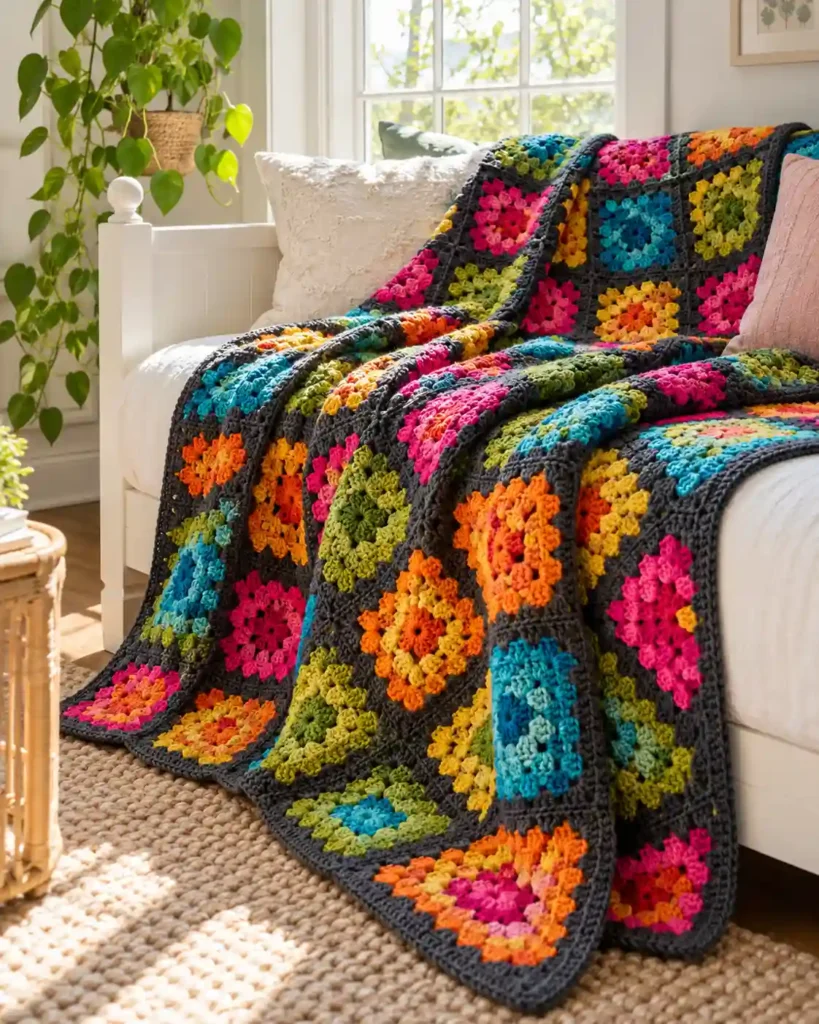
Color play is where mosaic really gets to show off. Keep one calm background color and let bright rows rotate through it, and the rainbow reads instantly with no muddy blending. Two-color charts look crisp, but three-color mosaic patterns add variety without changing the basic one-color-per-row rhythm. I’d put this one in a playroom or kid’s bedroom, and it’s the best excuse I know for using up a basket of odd skeins.
Check whether the pattern has you cut the yarn at each change or carry it up the side, since that decides how many ends you’ll weave in later. Ombre and scrap yarns both work if the background stays consistent.
Special Tip: Line up your skeins and photograph them in black and white. If two colors look the same in grayscale, they won’t contrast enough on the blanket.
What Seasonal Mosaic Crochet Blankets and CALs Are Worth Starting Early?
A full-size colorwork blanket takes weeks of evenings, so seasonal projects reward an early cast-on.
11. Christmas Mosaic Crochet Blanket
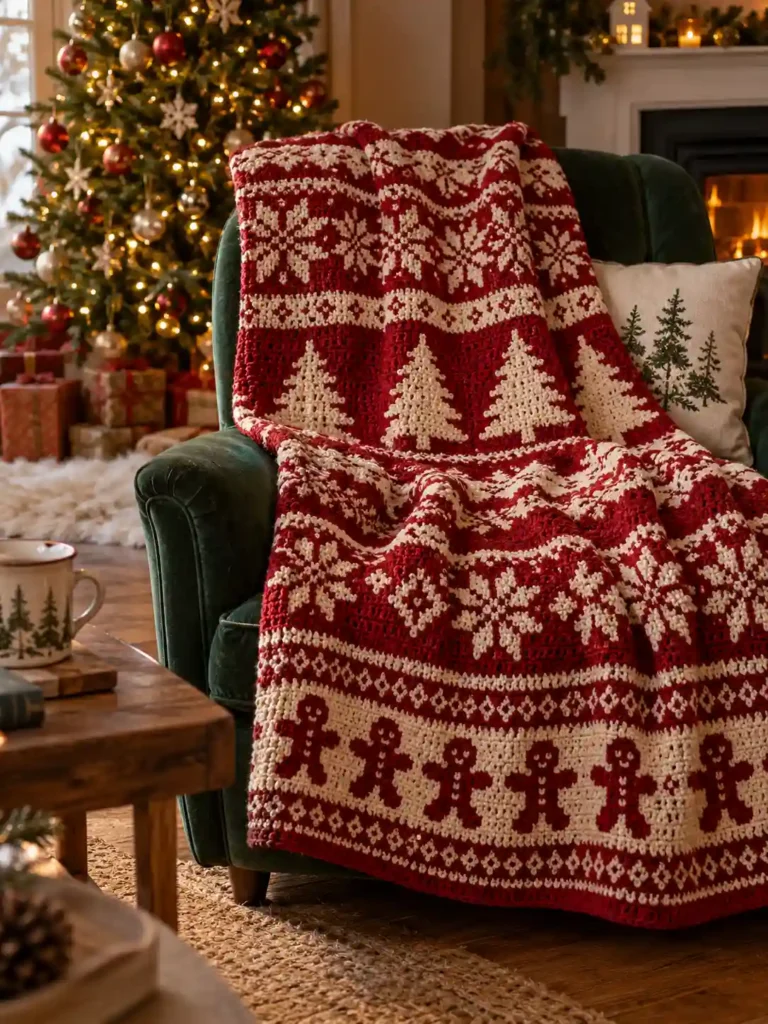
Cast on before the holiday panic starts. A Christmas mosaic crochet blanket with pine trees, gingerbread, reindeer or a tiny village is a real project, not a weekend ornament. That is exactly why it becomes the gift people keep for decades instead of one they unwrap and forget. I like red and cream draped over the back of a sofa, since it looks festive on the 24th and still cozy on January 2nd.
The holiday crochet-alongs we found included a free gingerbread CAL and a free Christmas mosaic CAL, both with video tutorials. For more seasonal inspiration, explore our Christmas crochet blanket ideas. Confirm start dates and availability before you buy yarn.
- Pine trees and gingerbread are the easiest shapes to read on a chart
- Red, green and cream is the classic palette
- Plan for a long project and set a weekly row goal
12. Winter Nordic Mosaic Crochet Afghan
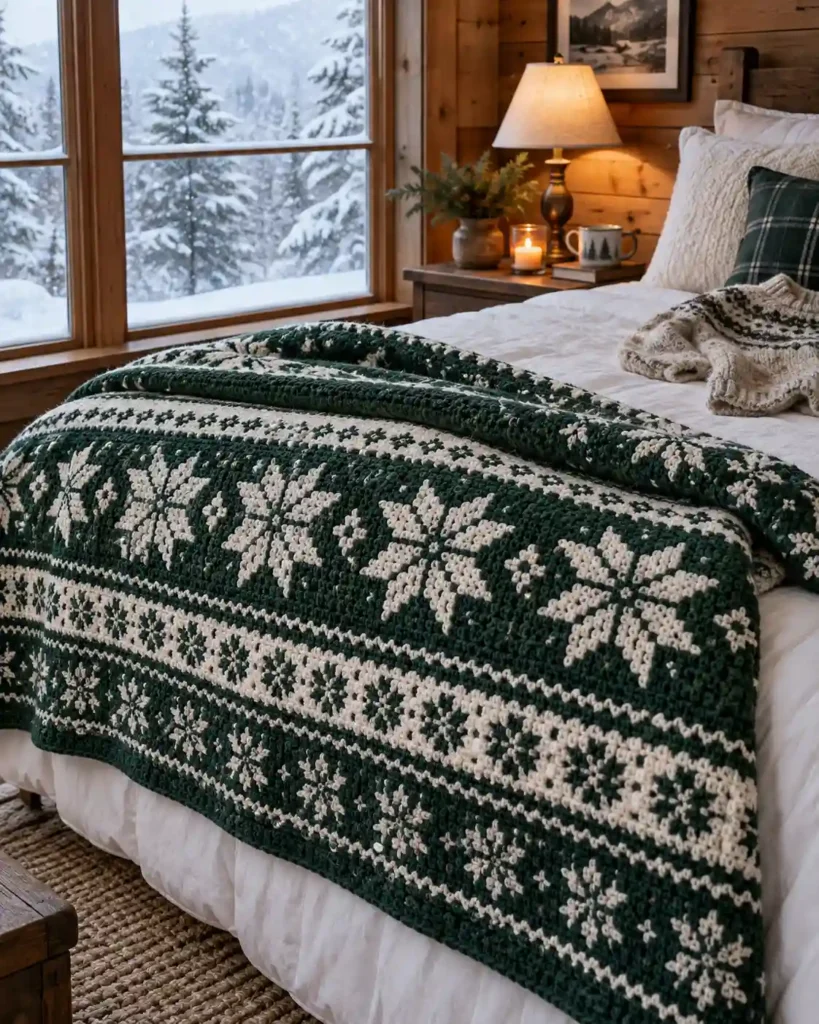
Stars and snowflakes marching across a blanket, the way they circle a Scandinavian sweater yoke: that’s the Nordic mosaic look. It borrows from Fair Isle (a traditional multicolor knitting style), but the one-color-per-row rule means you skip the stranding. Picture a deep navy and ivory afghan on a cabin bed while snow piles up outside. It’s for anyone who wants winter decor that doubles as the warmest thing in the room.
In our Pinterest research, a Nordic star CAL was the most-saved competitor pin, so this style clearly has a following. A wool-blend or soft acrylic yarn keeps the drape cozy.
| Color pair | Feels like |
|---|---|
| Navy + ivory | A cabin at night |
| Forest green + cream | A pine forest |
| Charcoal + white | Fresh snowfall |
13. How Does a Mosaic Crochet Along (CAL) Blanket Work?
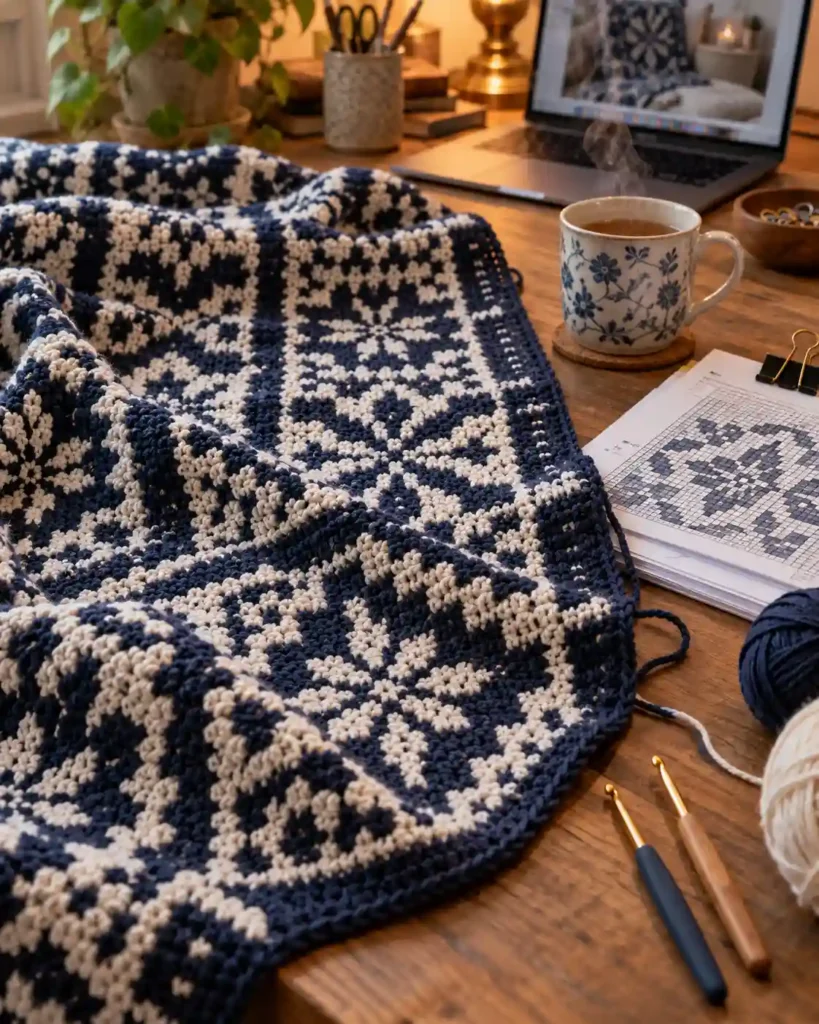
A crochet-along, or CAL, releases a pattern in parts over several weeks, so you stitch alongside a group instead of facing the whole chart alone. The schedule keeps a hundred-row project from drifting into the closet at row thirty. I like that it turns a solitary hobby into a weekly appointment, with video tutorials when a color change confuses you. If you struggle to finish long projects, this is your structure.
In the Pinterest data we reviewed, CAL pins earned the most saves per pin of any group, which tells us readers want this format. Here’s how to join one:
- Find a free CAL and note the start date.
- Buy yarn before part one drops, using the designer’s color list and yardage.
- Join the designer’s group or follow their video tutorials.
- Stitch each part within its week, and catch up later if you fall behind.
Free and paid CALs both exist, so check the price on the sign-up page before you commit.
What Scenic, Floral and Tile-Inspired Mosaic Blankets Can You Crochet?
This is the picture-making side of mosaic: landscapes, gardens, animals and tile patterns that turn a throw into decor.
14. Scenic Mountain & Landscape Mosaic Blanket
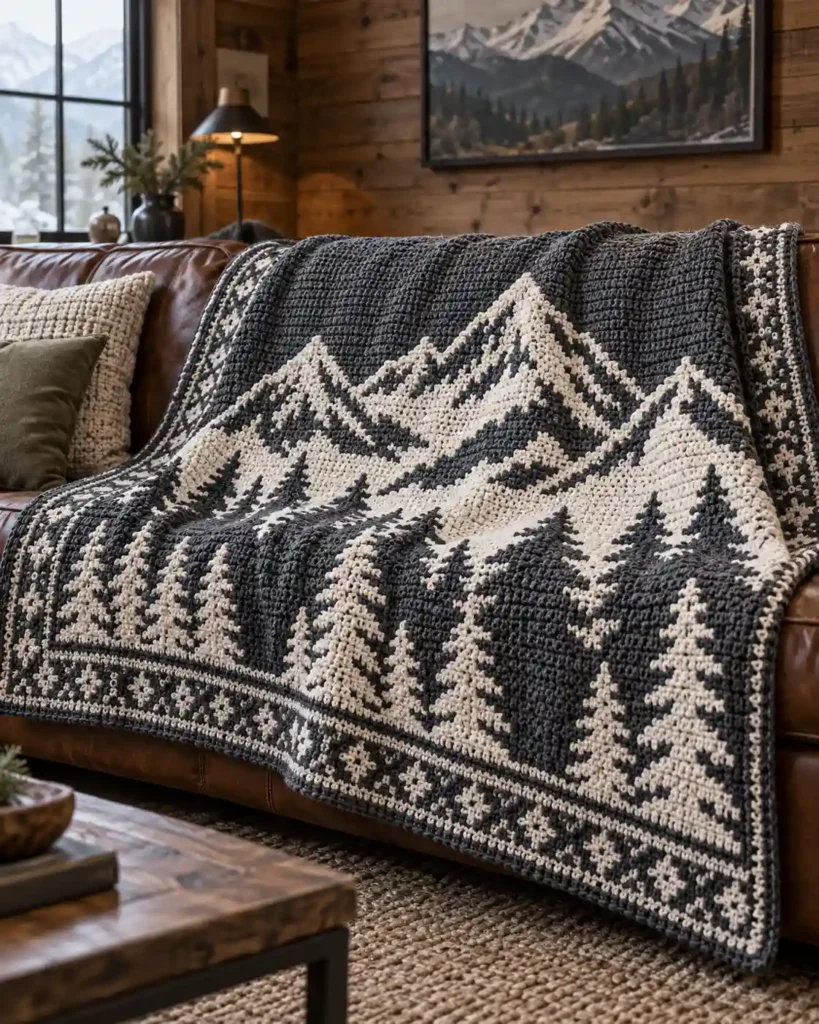
If you’ve ever wished the view from a mountain trail would follow you home, scenic mosaic is how. Ridges, pine silhouettes and a moon over a lake turn the whole blanket into one picture instead of a repeating motif. In a cabin or lodge-style room it hangs on a rail like art and still keeps your knees warm. It’s the gift for the outdoorsy person in your life, and it needs only two colors.
Many scenic overlay patterns are paid PDFs sold on marketplaces like Etsy, so look for the free ones and compare what each listing includes.
| Detail | What we saw in sampled patterns |
|---|---|
| Throw size | About 49 x 60 inches |
| Larger size | Up to about 48 x 74 inches |
| Yarn per color | About 1,900 meters (roughly 2,080 yards) for a 49 x 60 inch throw in one pattern |
Before you start, confirm the stitch count, the finished size and whether both charts and written rows are included.
15. Floral & Botanical Mosaic Crochet Blanket
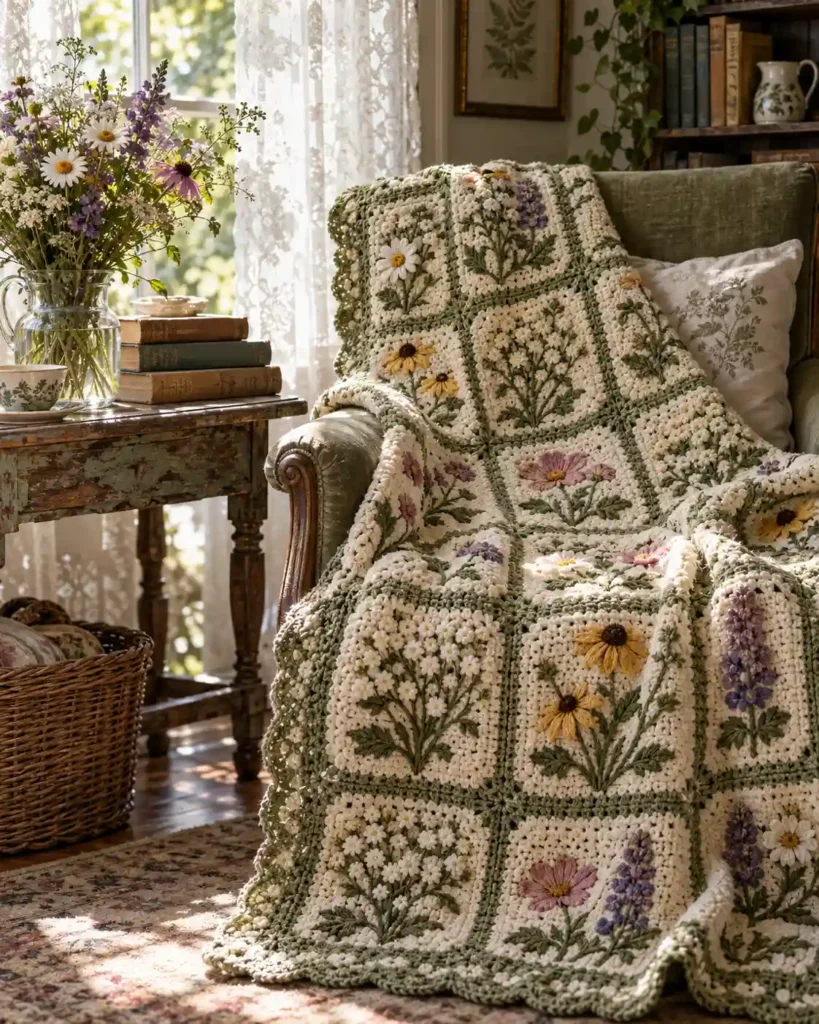
Embroidery-level detail with one color per row is the quiet surprise of a floral mosaic blanket. Bouquets, tulips, wildflowers and Morris-style repeating prints look intricate, but the stitching rhythm stays the same as in a simple chevron. I picture muted cream with sage over a cottage armchair, or navy with ivory when you want something moodier. If you garden, or love someone who does, it’s the botanical print you can actually curl up in.
A wildflower crochet-along showed up repeatedly in our research. Confirm that it’s free and still live before you plan around it.
16. Animal Mosaic Crochet Blanket (Cat, Fox, Highland Cow)
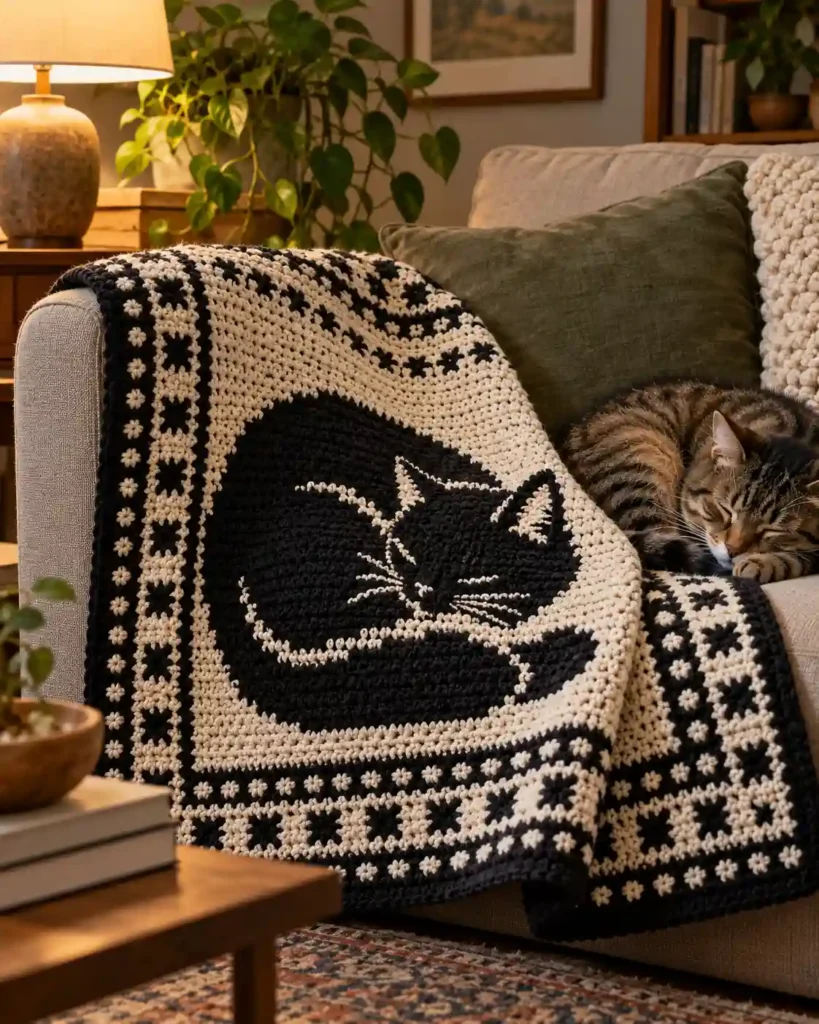
Cat people will understand: a blanket with a cat on it, spread over a sofa that a cat has already claimed. Animal mosaic turns bold silhouettes into portraits, whether you choose a fox, an owl, a bear or a shaggy Highland cow. The shapes read best in two colors, which is why this technique suits animals so well. It makes a great gift for pet lovers, a nursery or your own reading corner.
Check whether the design is a full-picture blanket, which needs very large stitch counts, or a smaller motif on a simple background. Pattern names such as Highland Hamish and a woodland bear blanket appeared in our research, so verify their prices before you link or buy.
Special Tip: Choose a design with a bold outline and little interior detail. Clear silhouettes stay readable from across the room.
17. Ocean Waves & Whale Mosaic Crochet Blanket
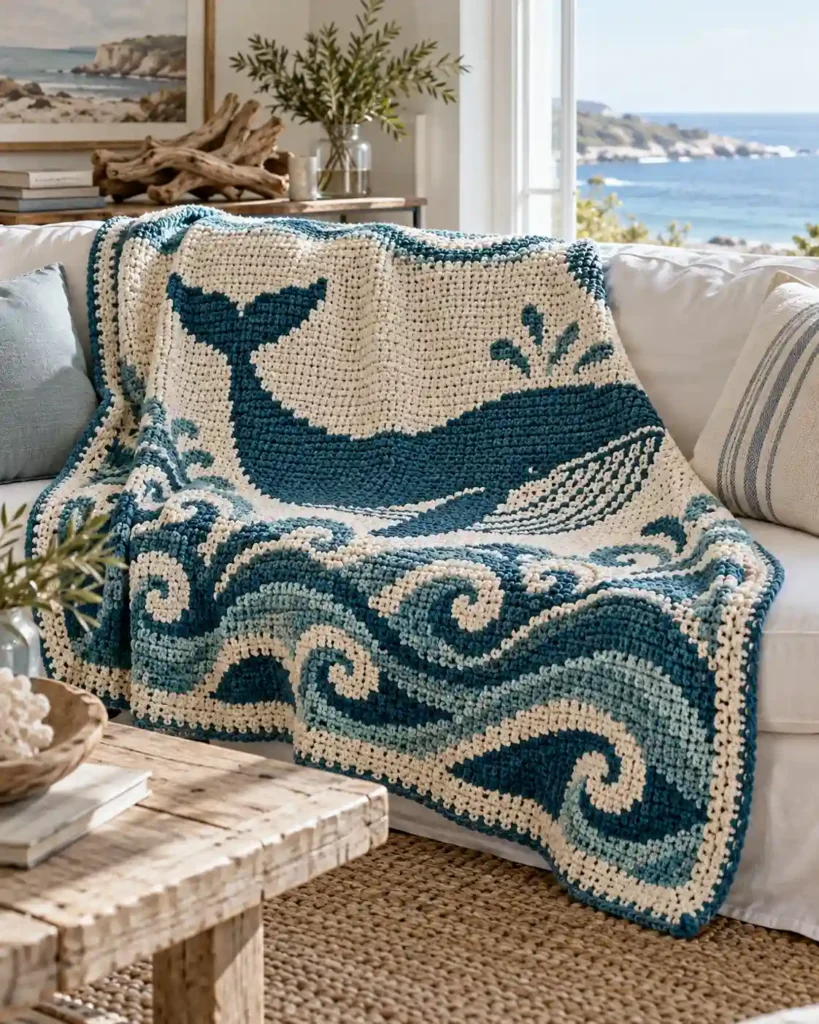
Picture a whale gliding through blue-and-white waves across a nursery blanket. The ocean is naturally made of repeating curves, so mosaic charts handle it almost effortlessly. You get a beach-house mood without a single seashell, and the bold two-color look works for baby and adult sizes alike. It’s friendly for adventurous beginners and satisfying for intermediate crocheters.
One competitor pin offered a free marine graphgan chart. A graphgan is a picture blanket worked from a chart, one square per stitch. Paid patterns are plentiful too, so compare before you buy.
- Blue and white is the classic pairing
- Waves repeat, so they’re great for longer rows
- Add a whale or a small sea creature as a focal point
18. Desert & Southwestern Mosaic Crochet Blanket
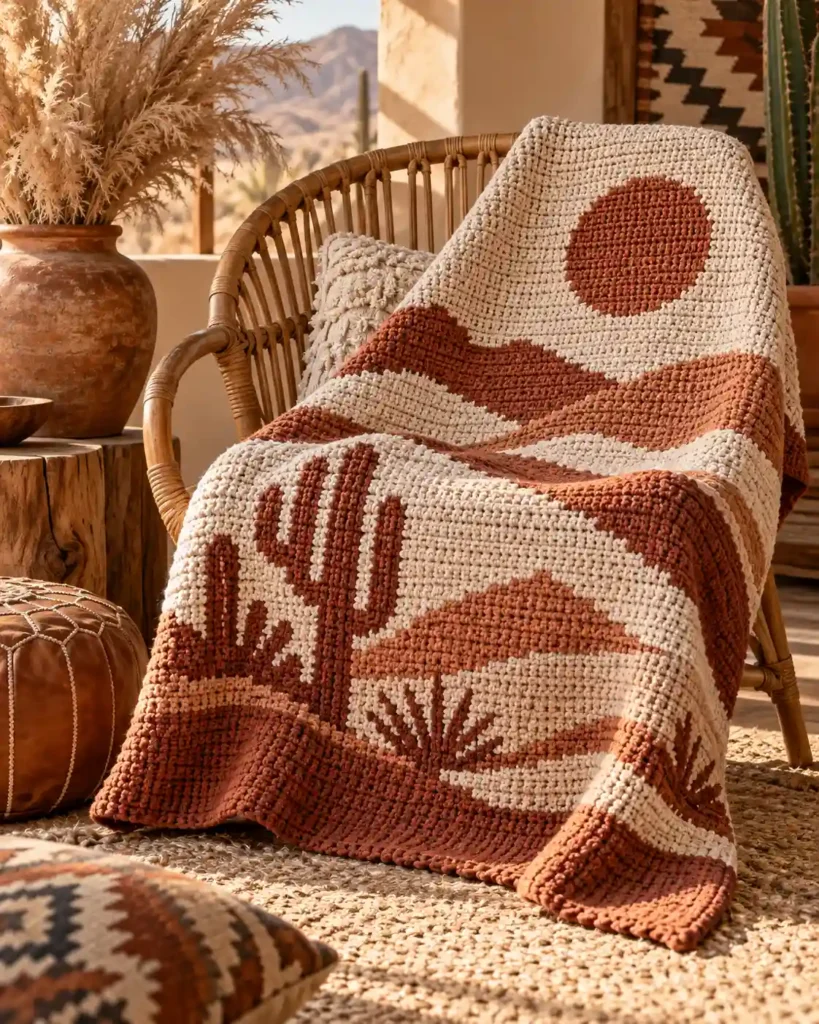
Terracotta, sand and cream do half the styling for you. Cactus, dune and sampler-style motifs bring a warm, earthy mood that cool-toned geometrics can’t match. Over a bed with natural wood furniture or a sunroom daybed, it looks collected rather than coordinated. Choose it for boho or southwest decor when you want your colorwork to feel like a place.
Free patterns in this style often include optional borders and a video. The Desert Dunes and Desert Cactus mosaic blankets both turned up in our research, so confirm they’re free and live before you plan a project around them.
19. Moorish & Moroccan Tile Mosaic Crochet Blanket
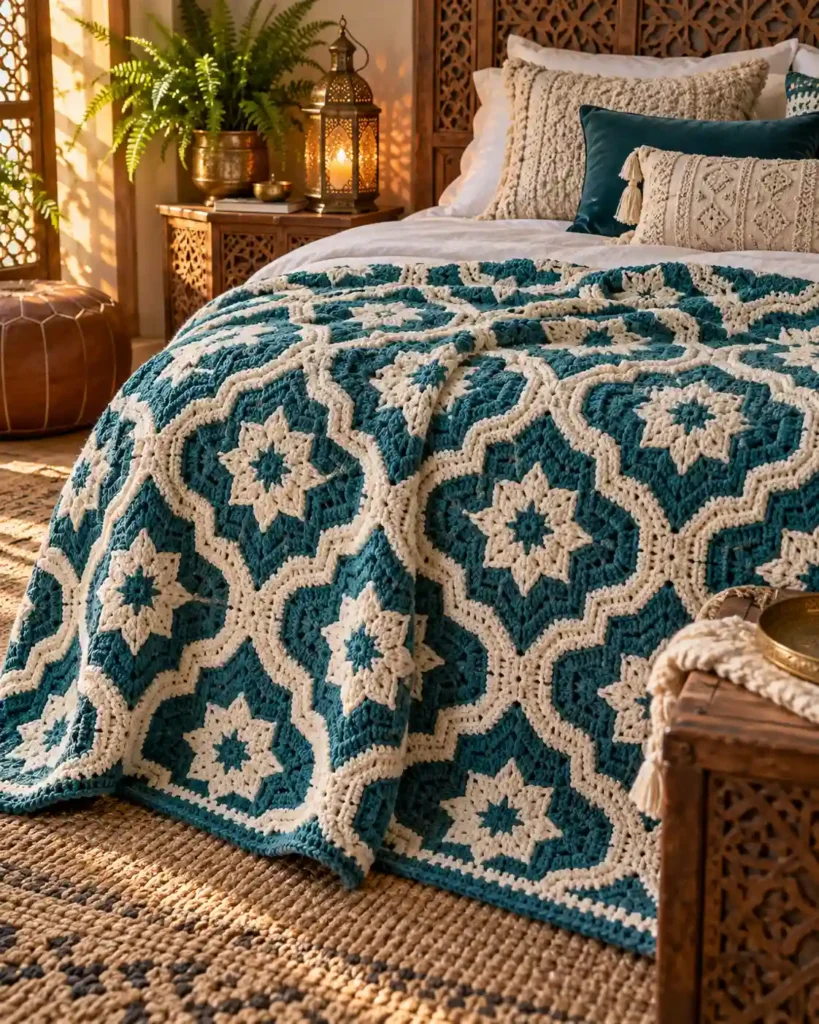
Stars, arches and interlocking tiles give this blanket its Moroccan-tilework look. Symmetrical repeats make the chart easier to follow than it appears, since you can check each half against the other. The geometric throw above is about clean shapes, while this one is about ornament and arches. Teal, white and a gold-toned accent suit a boho bedroom, and the pattern will keep you busy for a satisfying stretch of evenings.
Some of these designs are paid, so check the listing for chart quality and finished size before you purchase.
How Do Tapestry and Tunisian Crochet Compare With Classic Mosaic?
Sometimes the best answer to “which pattern?” is “which technique?” These two cousins are worth a swatch before you buy a whole blanket’s worth of yarn.
20. Is Tapestry Crochet Better Than Mosaic for a Blanket?
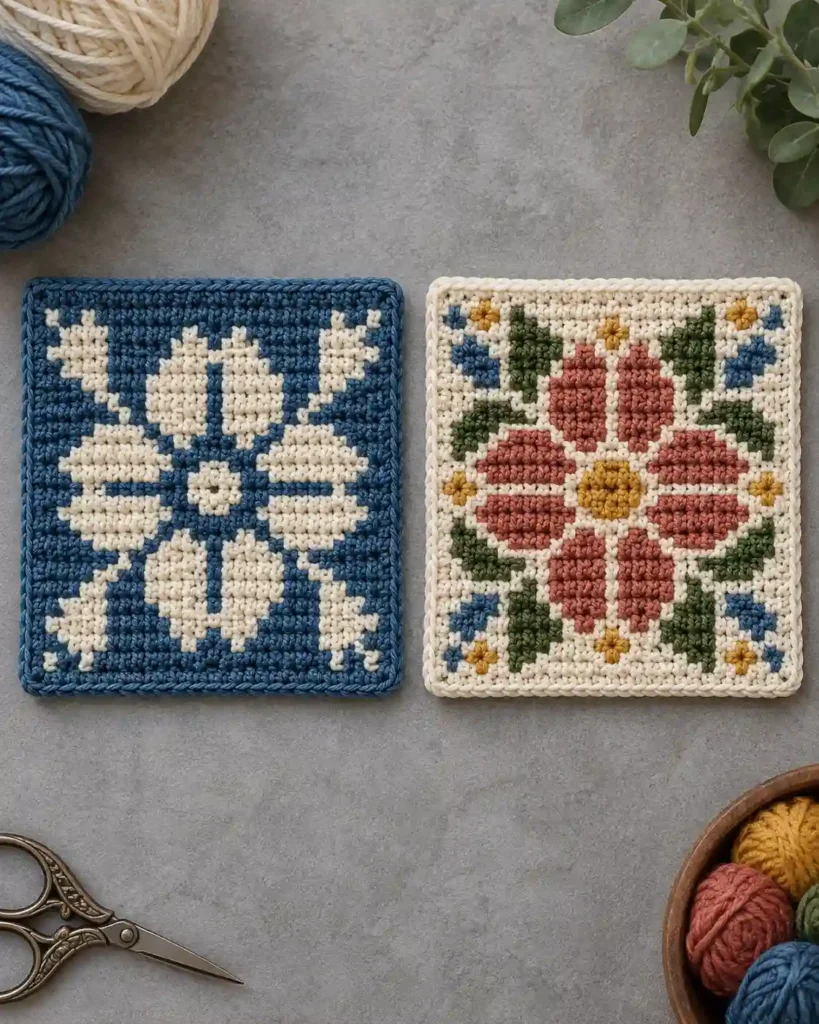
Neither wins outright, because they answer different questions. Tapestry crochet carries unused colors inside your stitches, so you can use more than one color in a row and draw finer pictures. Mosaic keeps to one color per row, which means a tidier back and a gentler learning curve. I choose tapestry when I crave detail and don’t mind managing several strands, and mosaic when I want my hands to settle into a rhythm.
- Mosaic: one color per row, charts, a calmer pace
- Tapestry: several colors per row, carried yarn, finer picture detail
Some designers publish both versions of the same picture, so you can compare before committing.
Special Tip: Swatch a few rows of each technique in your actual yarn. Your hands will tell you which one you’ll enjoy for sixty rows.
21. Can You Do Mosaic Crochet in Tunisian Style?
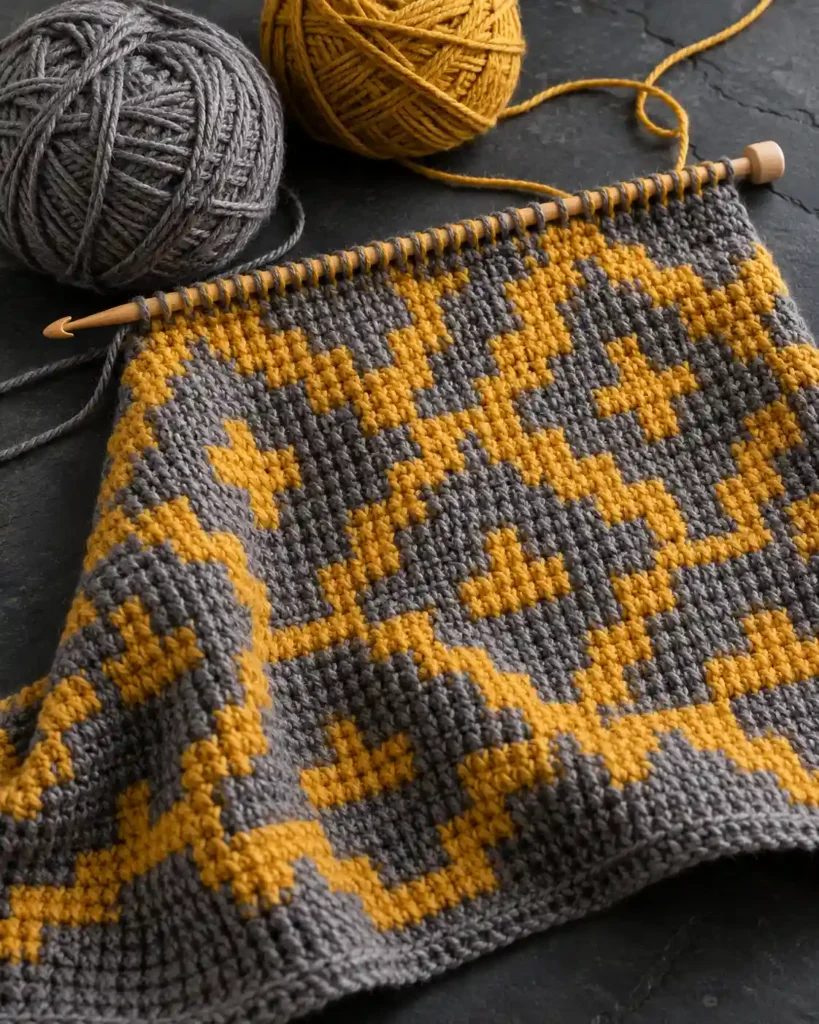
Yes, and it’s the corner of mosaic almost nobody writes about. Tunisian crochet uses a long hook: you pick up loops on a forward pass and work them off on a return pass, which typically builds a denser, more textured fabric than regular rows. Mosaic colorwork can be adapted to that structure, so a Tunisian mosaic blanket feels different in your lap even when the chart looks familiar. It’s a fun detour for intermediate crocheters who want something new from the same colors.
Mosaic knitting is a separate craft that shares the one-color-per-row idea, so check which craft a pattern is written for before you buy. In our research, strong Tunisian mosaic blanket pins were hard to find, so treat this as a style to explore rather than a guaranteed pattern.
What Else Can You Make With Mosaic Charts Besides a Throw?
The same one-color-per-row logic scales down to a lap blanket, up to a year-long record and sideways into wearables.
22. Mosaic Crochet Lapghan (Small Lap Blanket)
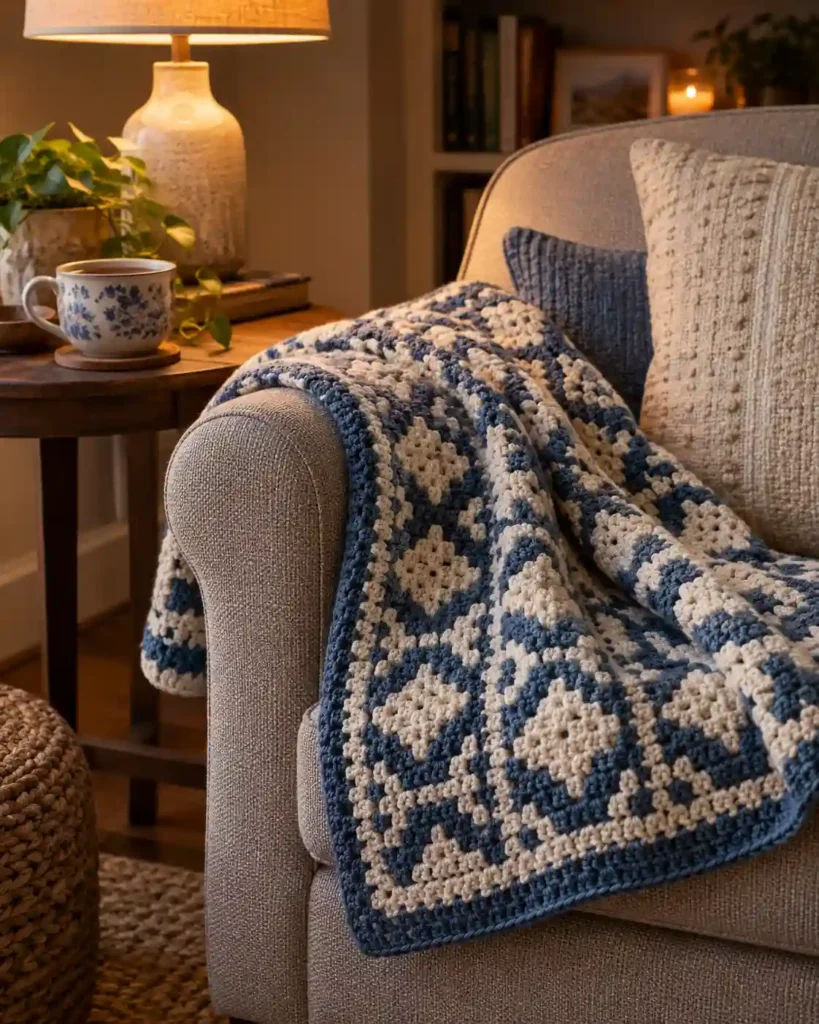
A lapghan, which is a small afghan sized for your lap, finishes before the novelty wears off. It needs far less yarn than a full throw, so it’s a low-risk way to test a technique and a quick gift that still looks thoughtful. I’d drape one over a desk chair or tuck it in a travel bag for car rides. Make it your first mosaic project if you’re nervous about a sixty-row commitment, then scale up later by adding repeats.
Compare the pattern’s finished dimensions with the roughly 50 x 60 inch throw size the Sleep Foundation lists, so you know what you’re getting. Inset mosaic lapghan patterns turned up in our research and suit beginners to intermediate crocheters.
23. Mosaic Crochet Wrap or Shawl
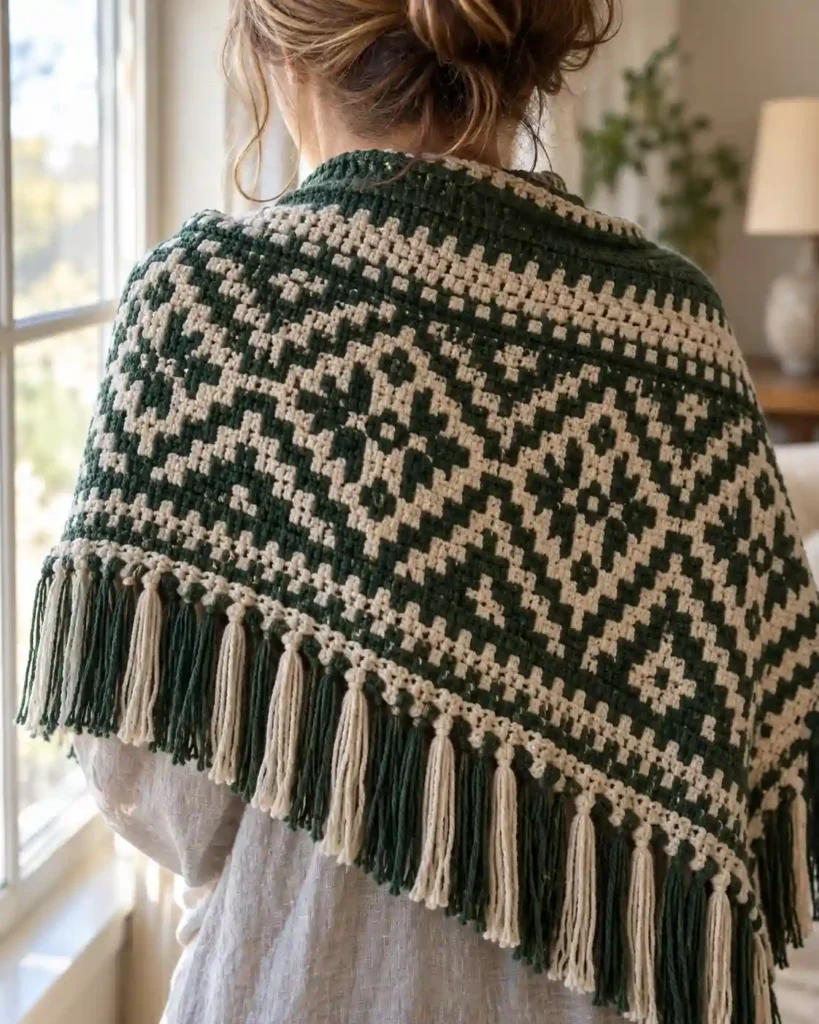
Wear it. A mosaic chart doesn’t care whether it ends up on a bed or around your shoulders, so ruanas, wraps, shawls and scarves are all fair game. A wrap needs more drape than a blanket, which means lighter yarn: the Craft Yarn Council lists Light/DK (category 3) with 4.5 to 5.5 mm hooks and a typical crochet gauge of 12 to 17 stitches per 4 inches. I think of it as a layering piece for cool offices and cold evenings. Give one to a friend and the geometric pattern turns it into a gift that doesn’t look like a blanket.
Some designs adapt to different sizes with a moss stitch mosaic base, so look for patterns that explain how to resize.
Special Tip: Wash and block your swatch before measuring. Lighter yarns can change in drape and width after washing.
24. Can You Turn a Year of Weather Into a Mosaic Crochet Temperature Blanket?
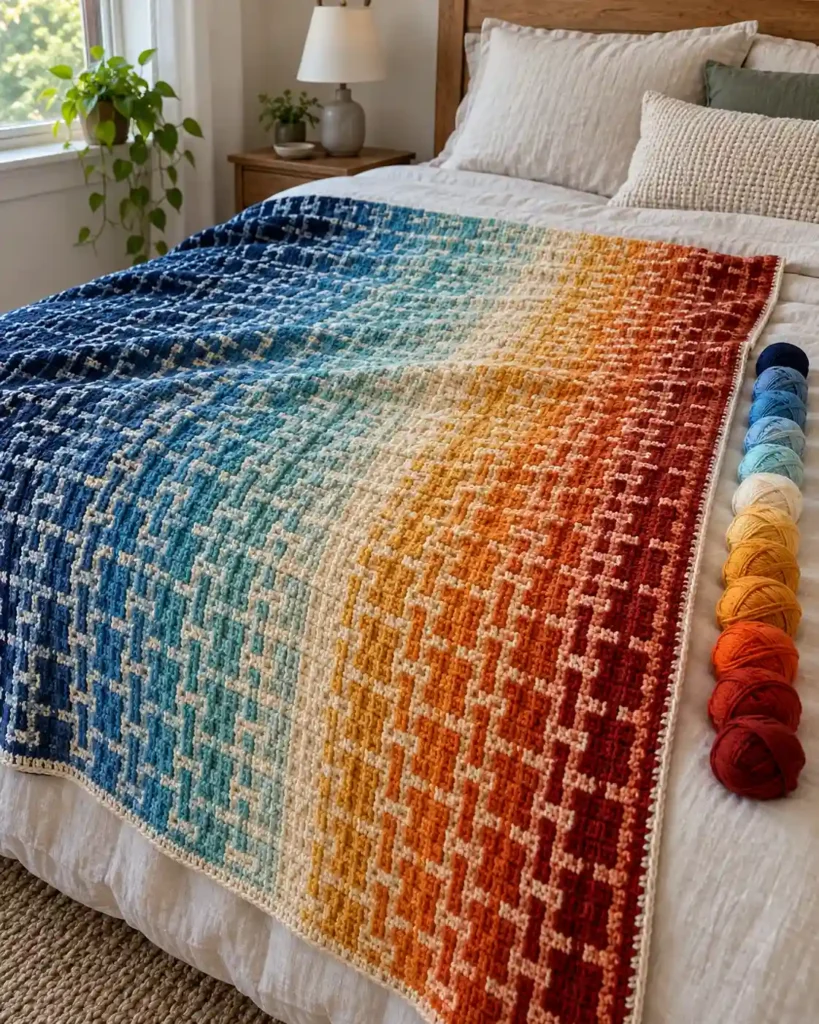
Yes: assign a color to each temperature range, then add a mosaic row for each day or week, and the year becomes a blanket. Plain temperature blankets use stripes, but mosaic adds texture and little patterns that make the finished piece feel designed. It’s perfect if you like journaling in yarn, since every color is a memory of how the week felt. Plan the palette carefully, because neighboring temperatures need colors that stand apart.
- Choose your location and decide whether to track daily highs, lows or averages.
- Group temperatures into ranges and give each range one color.
- Pick a palette where neighboring colors contrast clearly.
- Decide on a row count per day or week, then keep it consistent.
Ready-made mosaic temperature patterns are a niche, so expect to adapt a mosaic chart yourself or follow a CAL-style schedule. For another approach to tracking weather in yarn, explore our temperature blanket crochet guide.
25. Can You Make a Mosaic Crochet Blanket on a Budget With Red Heart or Bernat Yarn?
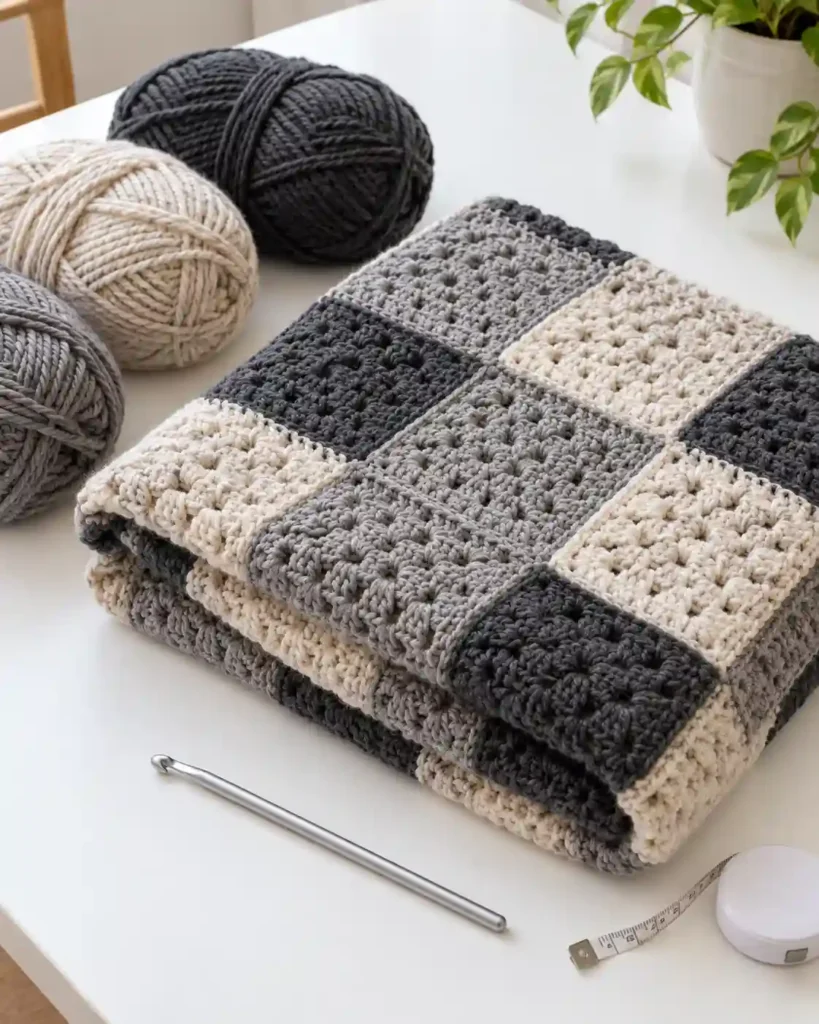
Absolutely. Worsted-weight acrylic is a common choice for mosaic patterns, and a craft-store brand such as Red Heart or Bernat keeps the cost friendly while still giving clear stitch definition. I like this route for a first big colorwork project, since a frogged row costs you time but not much money. Pick high-contrast colors and you’ll get most of the drama of a boutique yarn.
One kit we found pairs ombre acrylic yarn with a pattern and finishes around 50 x 60 inches with a US I-9 hook. That hook size is 5.5 mm, the bottom of the 5.5 to 6.5 mm range the Craft Yarn Council lists for Medium (worsted) weight.
- Calculate skeins by comparing the pattern’s yardage per color with the yardage on the label, and round up
- Wash a swatch with both colors together to check that dark dye doesn’t bleed onto the light color
- Read the care label before gifting to make sure it’s machine washable
What Yarn, Hook Size and Colors Work Best for a Mosaic Crochet Blanket?
Smooth worsted-weight yarn in two high-contrast colors, worked with a 5.5 to 6.5 mm (US I-9 to K-10½) hook, is the safest starting point.
At a Glance
- Worsted weight is Craft Yarn Council category 4 (Medium)
- Suggested hooks: 5.5 to 6.5 mm (US I-9 to K-10½)
- Typical gauge: 11 to 14 single crochet stitches per 4 inches
- Treat ranges as guidelines and follow the pattern’s gauge
Smooth, plied worsted-weight yarn in two high-contrast colors is the safest starting point. Smooth yarn shows the stitch shapes that make a mosaic chart readable, and matching weight and fiber keeps both colors the same size.
For hooks, the Craft Yarn Council lists 5.5 to 6.5 mm (US I-9 to K-10½) for Medium (worsted) weight. The council’s standard yarn weight system describes these ranges as guidelines and says the pattern’s own gauge should always win, so swatch and adjust your hook until you match.
- Choose one light and one dark color of the same yarn line.
- Lay them side by side and photograph them in grayscale to check contrast.
- Swatch a chart repeat and measure your gauge.
- Go up a hook size if the fabric feels stiff, down if it looks loose.
How Big Should a Mosaic Crochet Blanket Be?
Many mosaic throws we reviewed finish near 49 x 60 inches, close to the 50 x 60 inch throw size the Sleep Foundation lists.
Many mosaic throws we reviewed finish between roughly 49 x 60 and 50 x 60 inches, and bed sizes climb from there. These are the typical blanket dimensions the Sleep Foundation lists, which you can use to size a pattern up or down.
| Blanket size | Typical dimensions (inches) |
|---|---|
| Crib blanket | 45 x 60 |
| Throw | 50 x 60 |
| Twin | 65-66 x 90 |
| Full/Double | 80-85 x 90 |
| Queen | 90 x 90-100 |
| King | 108 x 90-100 |
The crib-blanket size is a bedding category, not a recommendation to put blankets in a crib (see item 9). Colorwork also eats yarn, because every color is carried through the whole blanket. One pattern we reviewed lists about 1,900 meters (roughly 2,080 yards) of each color for a 49 x 60 inch throw, so always check the pattern’s yardage before you shop.
What Are the Most Common Mosaic Crochet Mistakes?
Most mosaic mistakes come from a few habits that are easy to fix once you know them.
- Skipping the swatch. Your blanket will end up the wrong size. Swatch one chart repeat first.
- Choosing low-contrast colors. The motif fades into the background, so test them in grayscale.
- Losing count. Put a stitch marker after every repeat and count at the end of each row.
- Mixing yarn weights or fibers. The two colors will stitch up at different sizes and the pattern will look lumpy.
- Pulling carried yarn tight at the edges. Keep the strand relaxed so the sides don’t pucker.
How Do You Finish and Care for a Mosaic Crochet Blanket?
Weave in the ends, add a simple single crochet border in your darker color, and follow the yarn label’s care instructions.
Weave in your ends first, then frame the blanket with a simple border. A plain single crochet border in your darker color hides uneven edges and makes the design look finished. For more border ideas, browse our crochet blanket edging guide.
Block gently if the pattern or yarn label allows it, since blocking (shaping the damp fabric and letting it dry flat) evens out the stitches. Follow the yarn label’s washing instructions, and check dye stability with a swatch before you wash the whole blanket. For more finishing walkthroughs, learn more on Crochet Mind’s site.
Frequently Asked Questions About Mosaic Crochet Blankets
What is the easiest mosaic crochet blanket for a beginner?
A two-color inset or zig zag mosaic crochet blanket with a short repeat is the easiest place to start. Use smooth worsted yarn in high-contrast colors and a pattern that includes both a chart and written rows.
Where can I find mosaic crochet blanket patterns free?
Designer blogs, crochet-along pages and yarn brand sites often share free charts with written rows. Searching for mosaic crochet blanket free patterns works best when you add a technique word such as inset or overlay, and always confirm on the designer’s own page that the pattern is still free.
What is the difference between overlay and inset mosaic crochet?
Inset mosaic builds the design into the fabric with chain spaces and earlier-row stitches, while overlay mosaic puts raised stitches on top of the fabric. Both use one color per row.
How much yarn does a mosaic crochet blanket need?
It depends on size and the number of colors, so follow the pattern’s yardage for each color. One throw pattern we reviewed lists about 1,900 meters (roughly 2,080 yards) of each color for a 49 x 60 inch blanket.
What hook size should I use for a mosaic crochet blanket?
For worsted-weight yarn, the Craft Yarn Council lists 5.5 to 6.5 mm (US I-9 to K-10½) hooks. Swatch first, because the pattern’s gauge matters more than any general range.
Final Thoughts
A mosaic crochet blanket is more than just a cozy handmade project—it’s a beautiful way to turn simple stitches and contrasting colors into something truly eye-catching. Whether you love bold geometric designs, delicate floral motifs, or colorful modern patterns, there’s something here to inspire your next creation.
These 25 mosaic crochet blanket patterns offer plenty of possibilities for beginners and experienced crocheters alike. Start with an easy two-color design if you’re new to mosaic crochet, or challenge yourself with detailed overlay patterns, seasonal blankets, or creative colorwork.
So grab your favorite yarn, choose a pattern that catches your eye, and enjoy watching each row bring your design to life. After all, the beauty of mosaic crochet isn’t just in the finished blanket—it’s in the creativity and joy of making it, one stitch at a time.

![The Best 30+ Free Crochet Cat Patterns [Beginner-Friendly Guide]](https://crochetmind.com/wp-content/uploads/2025/04/1-The-Best-30-Free-Crochet-Cat-Patterns-Beginner-Friendly-Guide.webp)