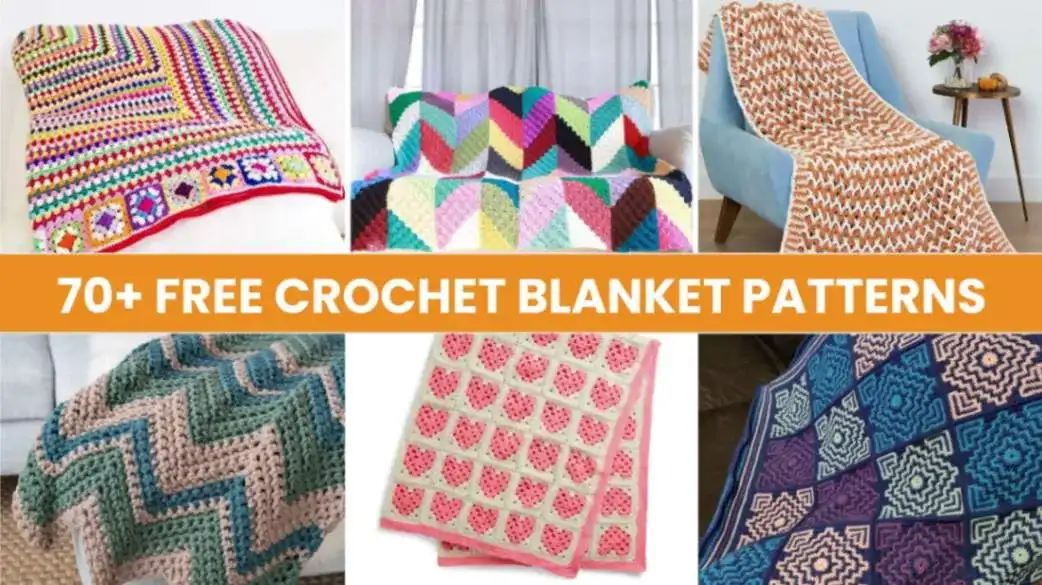
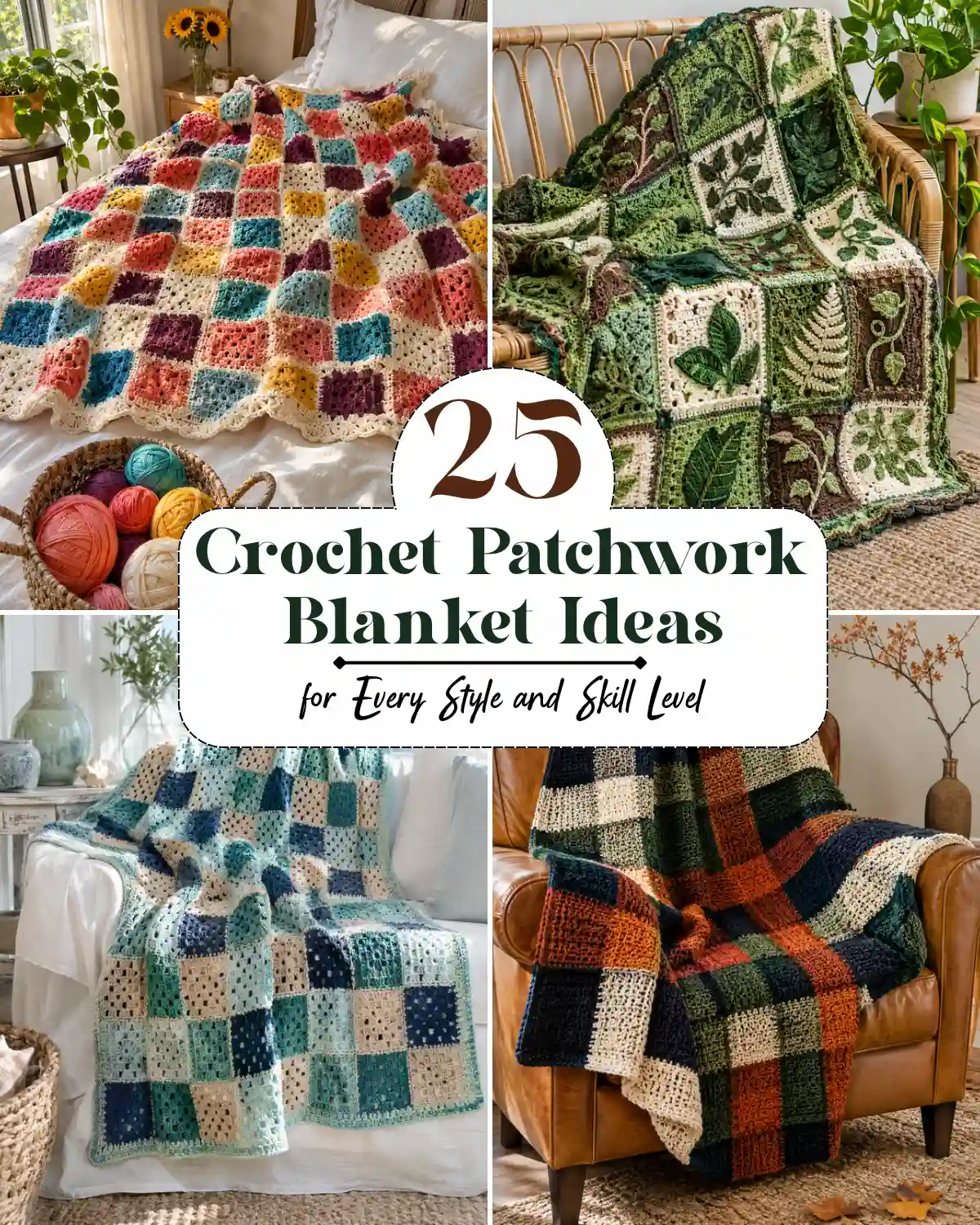

A crochet patchwork blanket is one of those projects that lets you turn individual crochet pieces into something beautiful and useful. You can experiment with colors, combine different stitches, use leftover yarn, and create a design that suits your home or makes a thoughtful handmade gift. Whether you are planning your first blanket or looking for a fresh project, there are plenty of ways to make patchwork crochet your own.
A crochet patchwork blanket is made by joining separate crochet motifs, usually squares but also hexagons or rectangles, into one larger piece. The 25 ideas below range from simple solid granny squares and scrap-yarn throws to Tunisian panels, baby blankets, and oversized bedspreads. For a neat result, choose compatible yarn, make a test motif, and plan the layout and joins before assembling the blanket.
The best part is that you can make the design as simple, colorful, or detailed as your project needs.
Key Takeaways
- Start with repeatable motifs for an easier first project.
- Match yarn weight and care instructions before combining scraps.
- Explore crochet patchwork baby blanket designs for handmade gifts.
- Plan square counts using blocked motif measurements.
- Test joining techniques before assembling the entire blanket.
- Choose colors that complement your home and personal style.
What Is a Crochet Patchwork Blanket?
A crochet patchwork blanket is created by joining individual crochet squares, rectangles, hexagons or other motifs to form one larger blanket.
At a Glance:
- Crochet separate motifs using matching or contrasting patterns.
- Arrange the pieces into a planned layout.
- Join the motifs using a suitable crochet or sewing method.
- Finish with blocking and an optional decorative border.
A patchwork blanket is built in sections rather than worked as one continuous piece. You can crochet identical squares for a regular grid, combine different motifs for a sampler effect, or use panels and rectangles to create a more modern arrangement. The pieces are joined by sewing, crocheting them together, or working a join-as-you-go method.
That modular construction makes the project easy to adapt. Make fewer motifs for a lap throw, add rows for a bed blanket, or use a planned color palette to make different stitch patterns feel connected. The key is consistency: motifs do not all need to look the same, but their finished edges must fit together.
| Patchwork style | Typical construction | Best suited to | Main planning point |
|---|---|---|---|
| Classic granny-square | Repeated squares in rows | First patchwork project | Keep square size consistent |
| Scrap-yarn sampler | Mixed colors and stitch blocks | Using suitable leftovers | Match yarn weight and care |
| Geometric or quilt-inspired | Mitered, checkerboard or half-and-half blocks | A structured, graphic look | Sketch the layout first |
| Floral or textured motifs | Flower, rose or raised-stitch squares | Decorative throws | Check motif depth and joining |
| Panel, hexagon or rectangle | Longer panels or non-square motifs | Confident beginners and intermediate makers | Plan edges and borders |
| Baby, travel or bed size | Motifs scaled to the intended use | Gifts and home projects | Calculate finished dimensions |
25 Crochet Patchwork Blanket Ideas for Every Style and Skill Level
These 25 crochet patchwork blanket ideas include beginner granny squares, colorful scrap-yarn designs, floral motifs, geometric layouts, baby blankets and oversized throws.
At a Glance:
- Choose simple granny squares for beginner-friendly projects.
- Try mixed textures and floral motifs for decorative blankets.
- Experiment with Tunisian crochet, hexagons and geometric layouts.
- Use neutral, rainbow or seasonal palettes to change the overall look.
- Adjust motif sizes to create baby blankets, throws or bedspreads.
1. Why Choose a Beginner Solid Granny Square Patchwork Blanket?
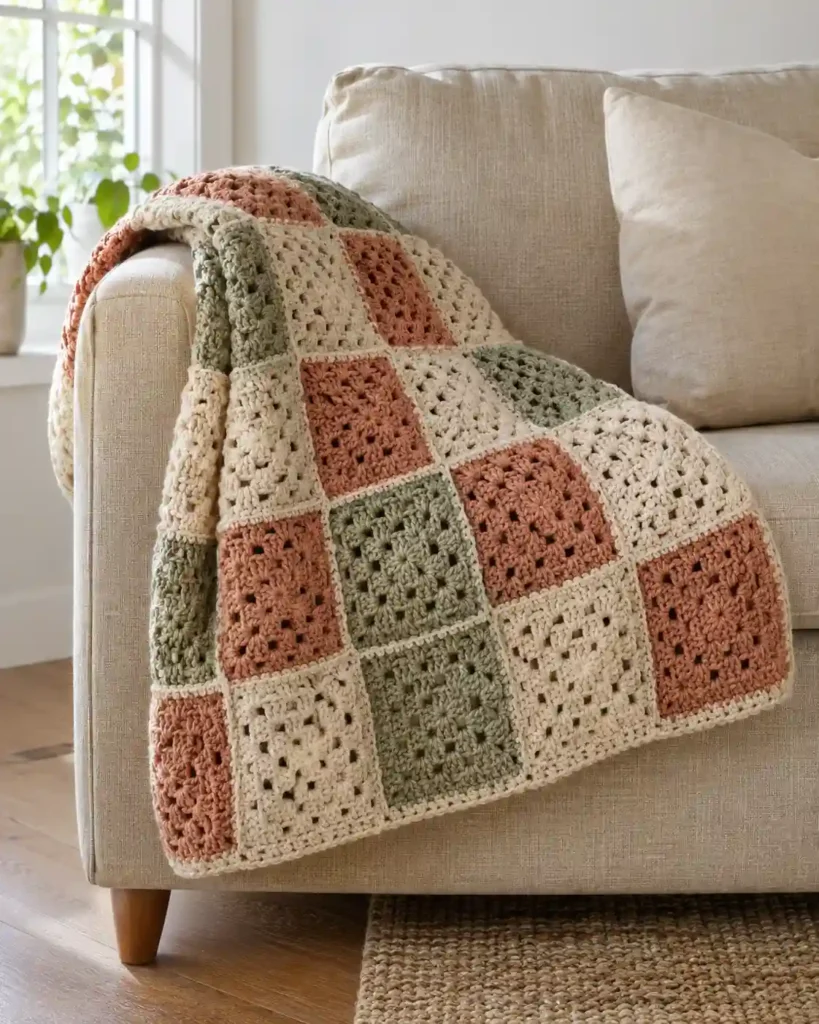
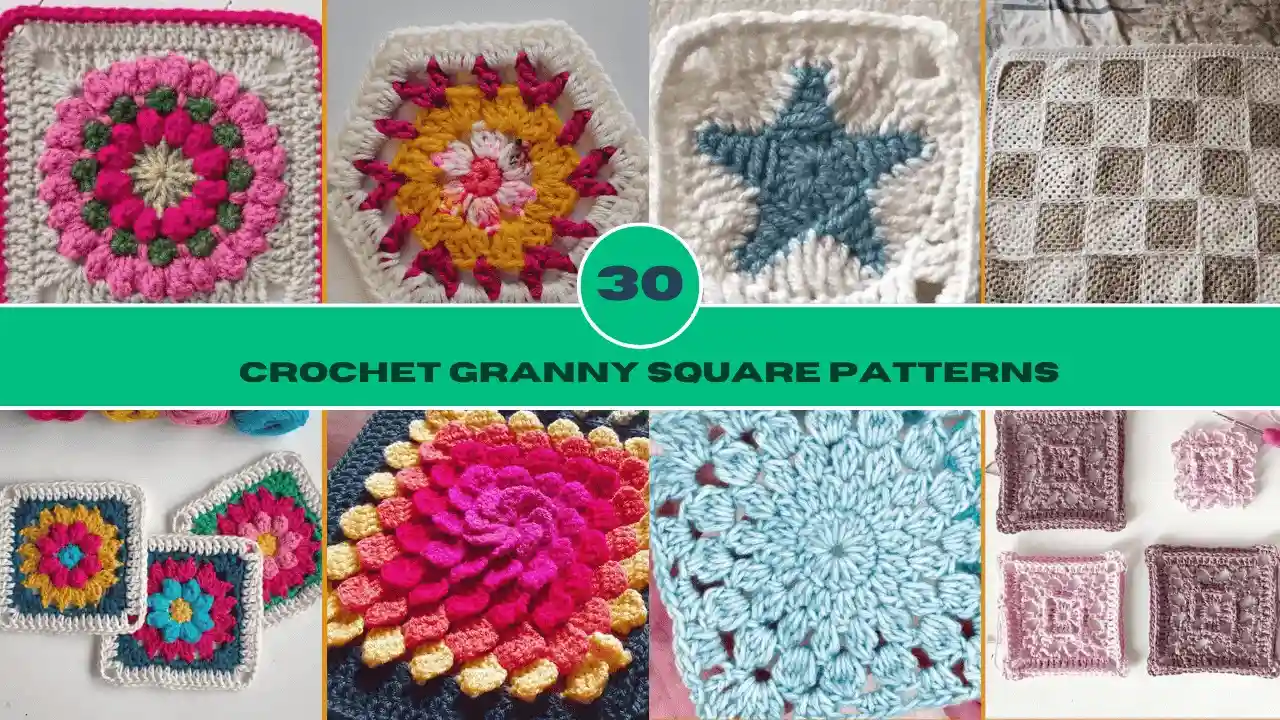
A solid granny square patchwork blanket is a practical first project because one repeatable motif teaches you the rhythm of making, measuring and joining blocks. For more motif variations, explore crochet granny square patterns. Compared with a blanket that changes stitch pattern every few rows, the repeated square keeps the process predictable. Try oatmeal, sage and dusty terracotta for a calm throw; make one test square first so you can check its finished size. Count the same number of rounds in every square and block them before joining.
2. How Can a Mixed Granny Square Layout Blanket Look Balanced?
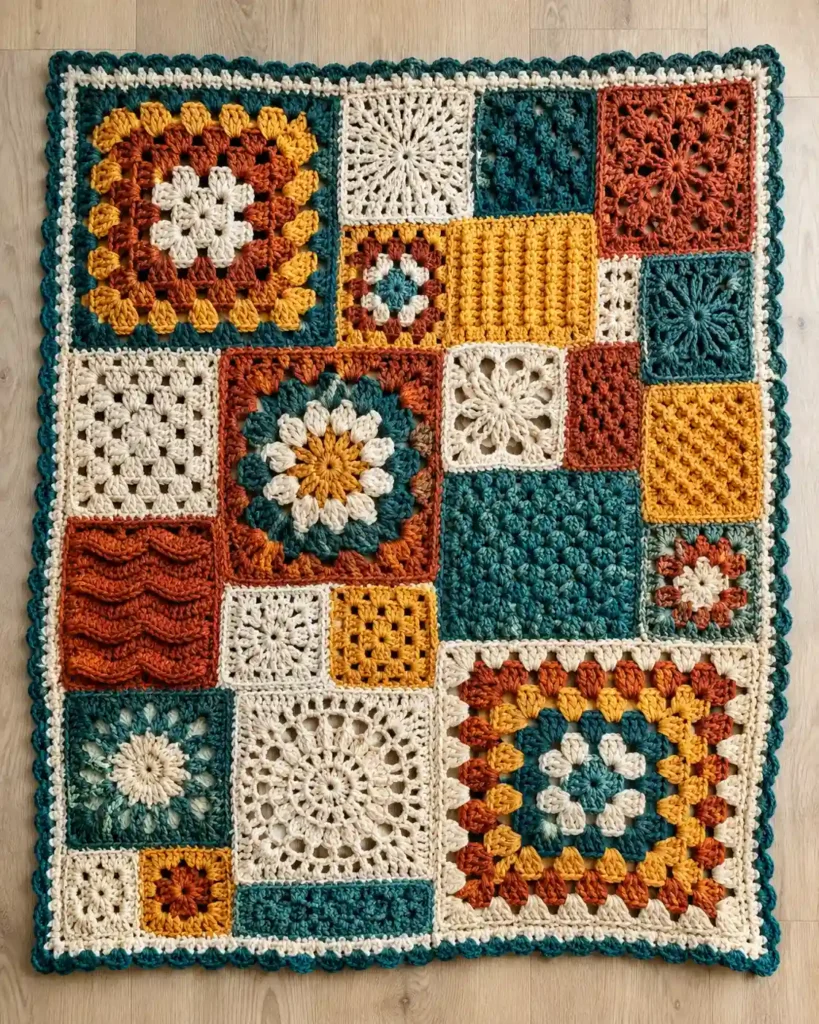
A mixed granny square blanket lets you use several motifs without making the finished piece look random. Arrange the squares in a tidy grid, place colors diagonally, or create an off-center mosaic; each approach gives the same blocks a different personality. Lay every square on the floor and photograph the arrangement before joining, especially if you are balancing bold and quiet motifs. Use a neutral or repeated border color to connect motifs that have different centers.
3. How Do You Make a Scrap-Yarn Random Color Patchwork Blanket?
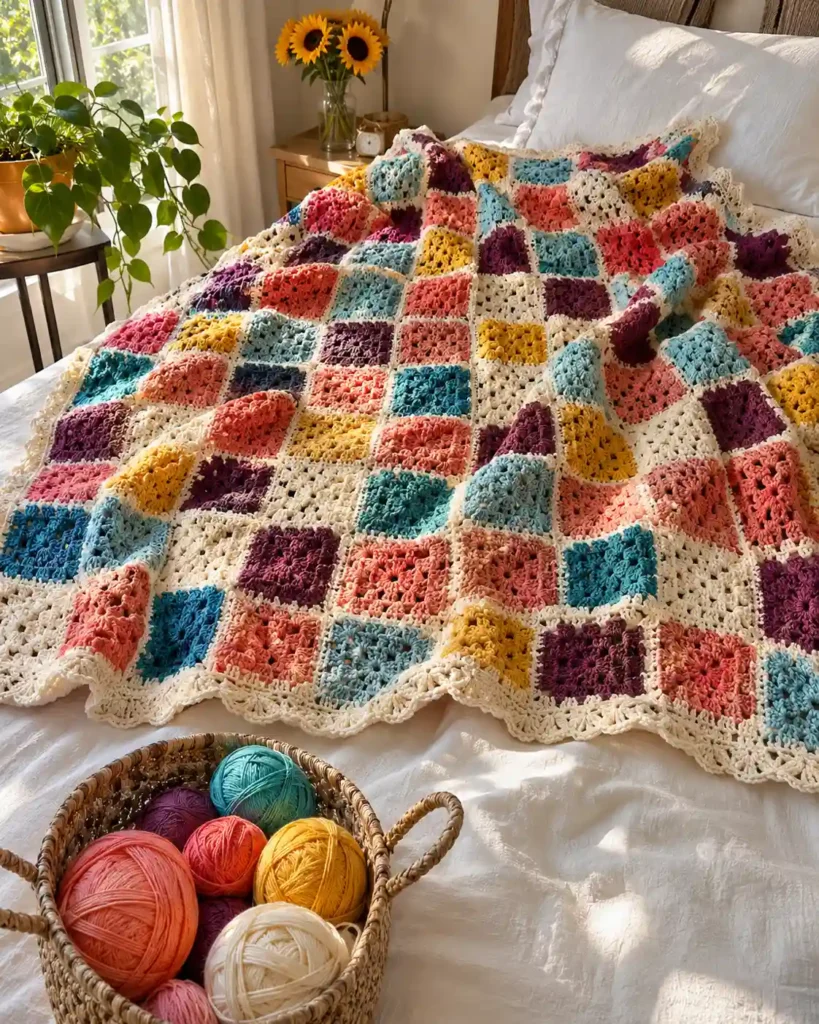
A scrap-yarn patchwork blanket turns leftover balls into a colorful project with a purpose. It looks more considered than a completely unplanned mix when you repeat two or three anchor colors throughout the design. Before combining scraps, check that their yarn weights, fiber behavior and care requirements are compatible; a handful of leftovers may not be enough for a full-size throw. Sort scraps into piles by weight first, then make a small sample to compare drape.
4. How Does a Three-Color Geometric Patchwork Throw Work?
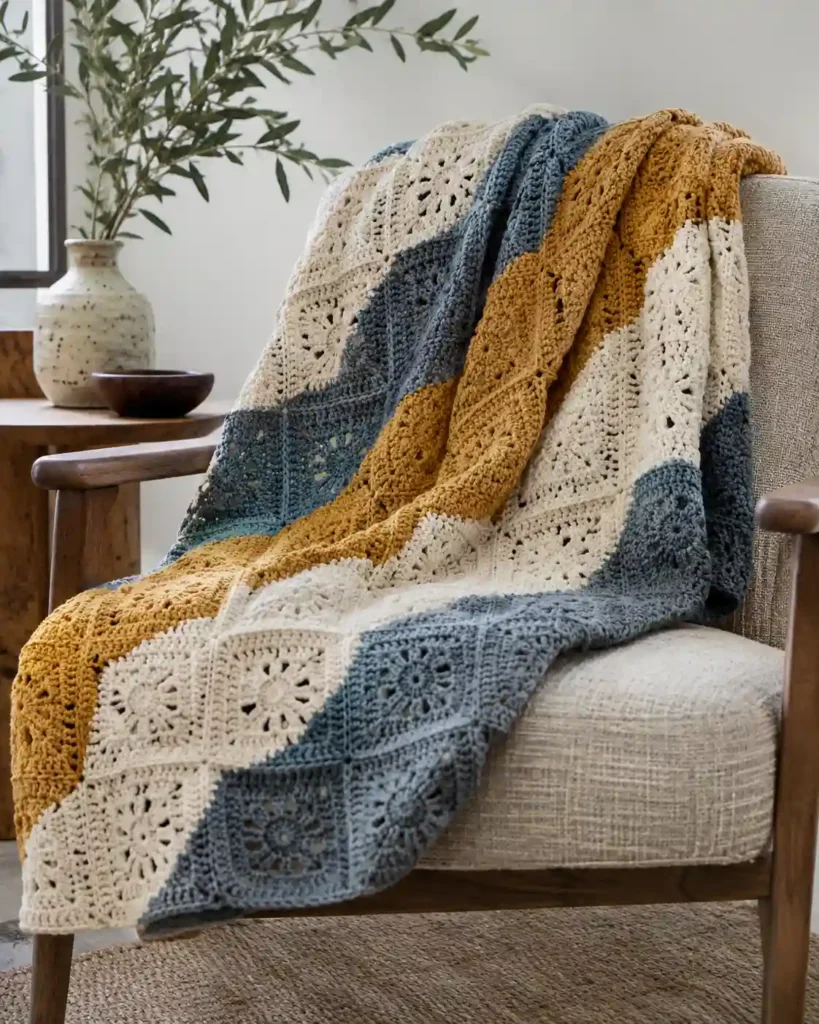
Three colors can make a patchwork throw feel modern without complicated stitch work. Use ivory as the main shade, slate blue for the larger blocks and ochre as a small accent, then arrange the squares in diagonal bands or a checkerboard. This is a good choice for a room that already has a strong color scheme and needs one handmade piece to tie it together. Draw the order on graph paper so the accent color does not collect in one corner.
5. Can You Combine Textures in a Mixed-Stitch Square Sampler Blanket?
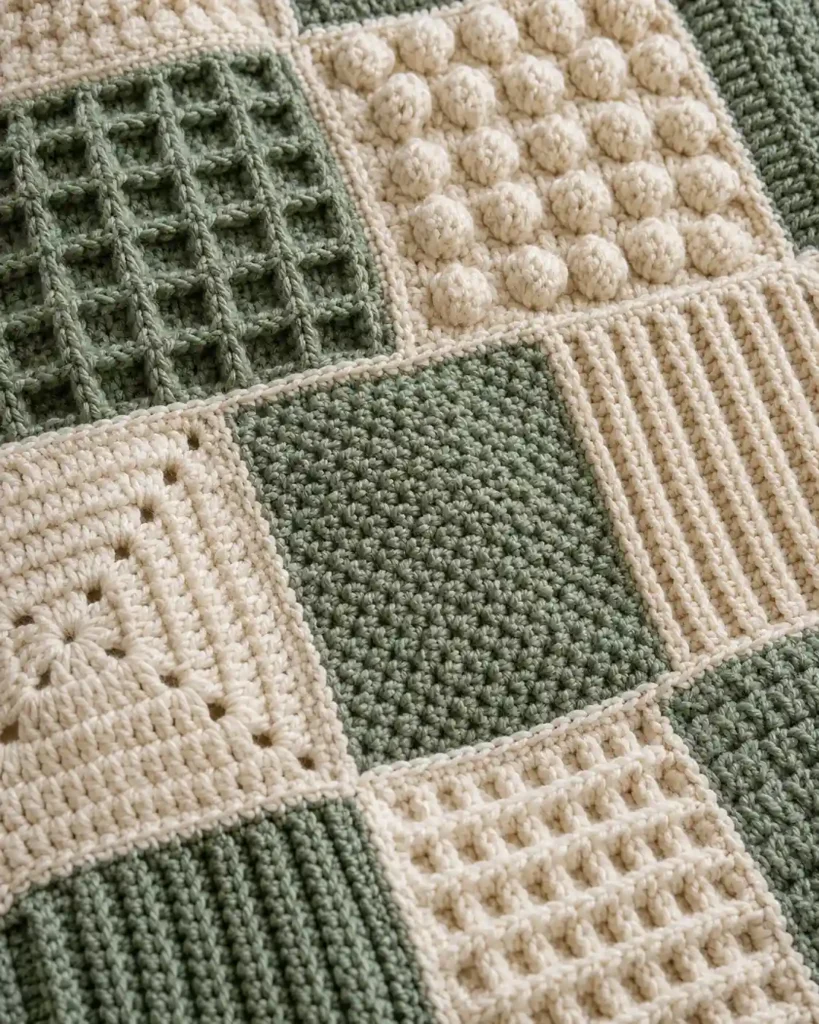
A mixed-stitch sampler blanket brings together moss stitch, bobbles, ribbing, waffle texture and simple granny squares. The contrast is more interesting than repeating one stitch, but textured blocks can finish at different sizes or thicknesses. Make a small sample of each motif, block them to matching dimensions and avoid placing very bulky squares where a smooth, lightweight finish matters. If one stitch pulls in more than others, adjust its hook or add a balancing round.
6. Is a Flat-Braid Joined Granny Square Throw Right for Your Project?
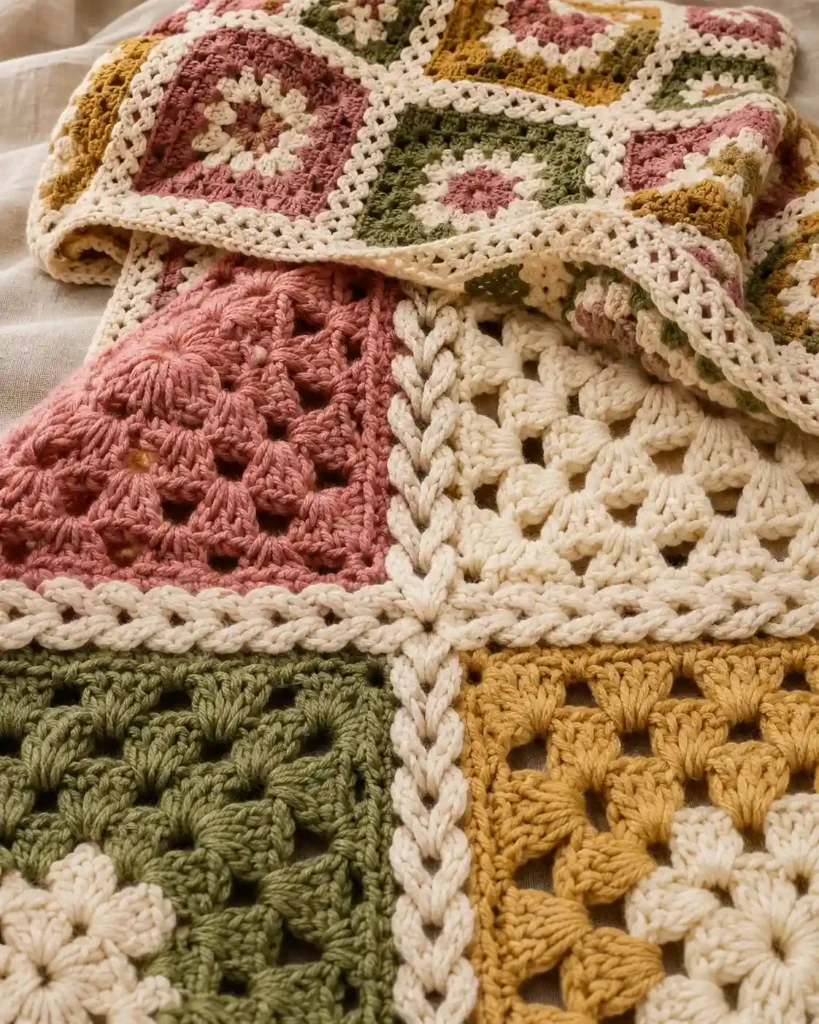
A flat-braid join turns the seams into part of the design, adding a decorative openwork line between contrasting granny squares. It creates a different finish from a nearly invisible whip stitch, so the joining method becomes a feature rather than an afterthought. Choose it when you want the joins to show, and practise the corners first to prevent puckering where four blocks meet. Use stitch markers at corners while practising the braid so the join stays even.
7. What Makes a Mitered Square Patchwork Blanket Stand Out?
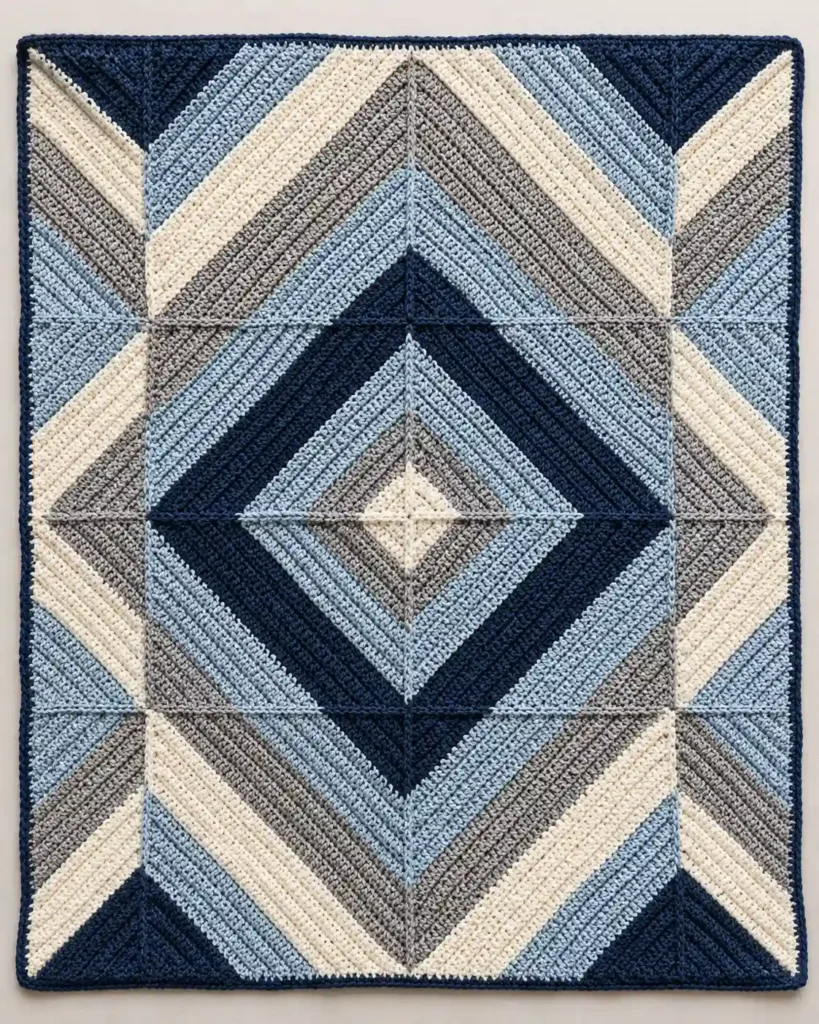
Mitered squares create strong diagonal lines that can look like diamonds or angled color blocks across the blanket. Unlike a standard centre-out granny square, the shaping gives each motif a clear direction, so orientation matters when you assemble the pieces. Navy, mist blue, gray and cream make the geometry easy to see; a simple border can frame the edges neatly. Keep the direction of each square consistent or rotate blocks intentionally to build a larger motif.
8. How Do You Arrange a Nine-Patch Checkerboard Crochet Blanket?
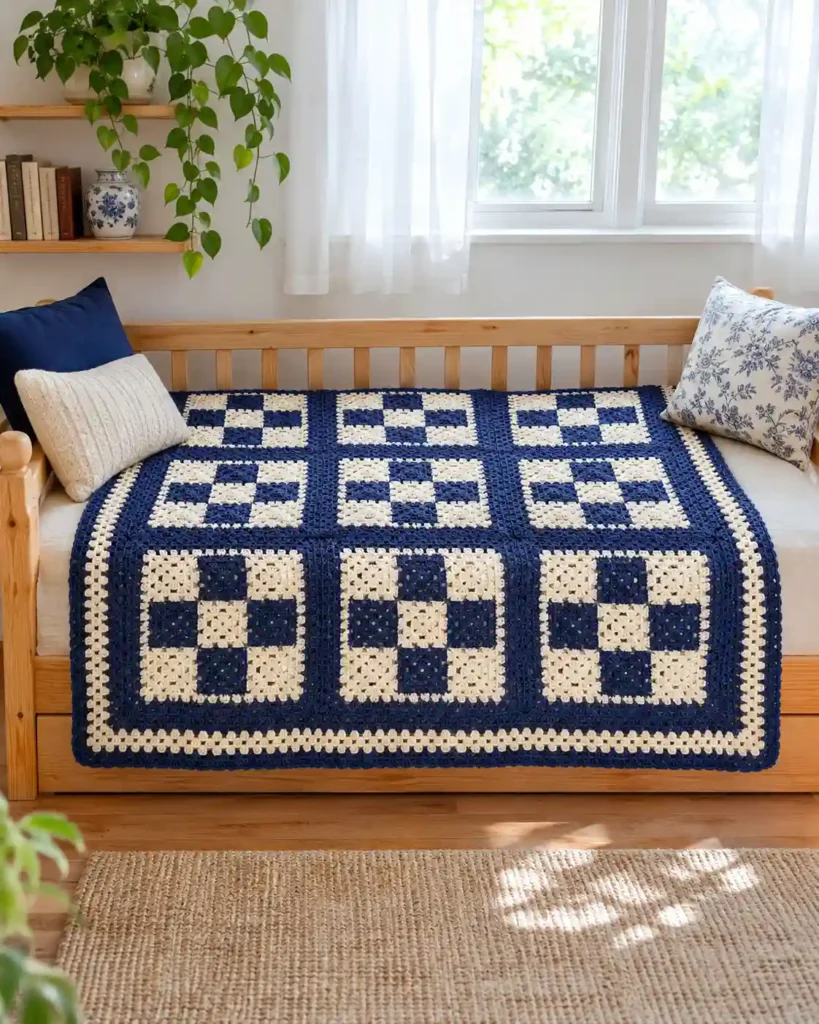
For a nine-patch checkerboard blanket, group nine small crochet squares into one larger block and repeat the arrangement across the throw. Alternating indigo and ivory makes the pattern easy to read, while two close shades create a softer effect. Count and arrange the small squares before joining each larger unit so the checkerboard stays consistent from one section to the next. Join the nine-square units separately, then connect the larger blocks to simplify assembly.
9. Can You Create a Plaid and Tartan-Inspired Patchwork Blanket?
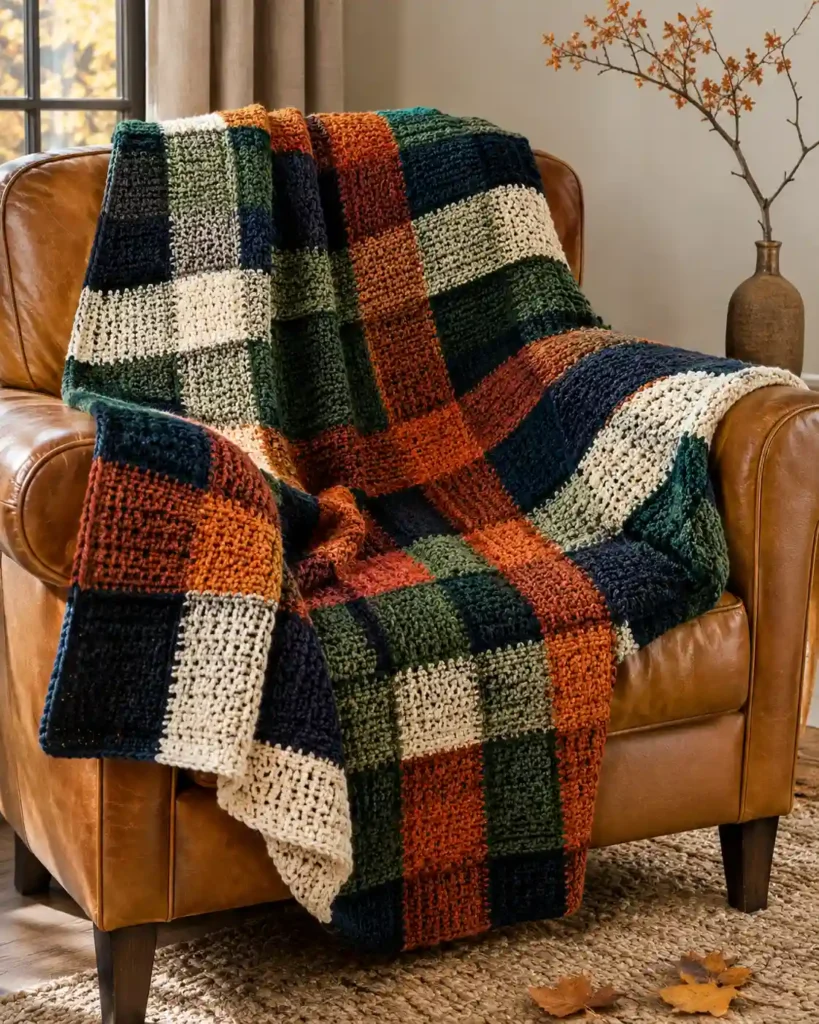
A plaid-inspired crochet blanket uses planned color bands to suggest the crossing lines of a checked fabric. Arrange rust, forest green, navy and cream blocks so vertical and horizontal bands appear to intersect, while keeping the construction visibly crocheted. It is a cozy option for an autumn chair or sofa; think of it as a crochet interpretation of plaid, not woven tartan. Map the color bands before crocheting; a repeated band width makes the plaid effect clearer.
10. How Do Tunisian Crochet Patchwork Panels Fit Together?
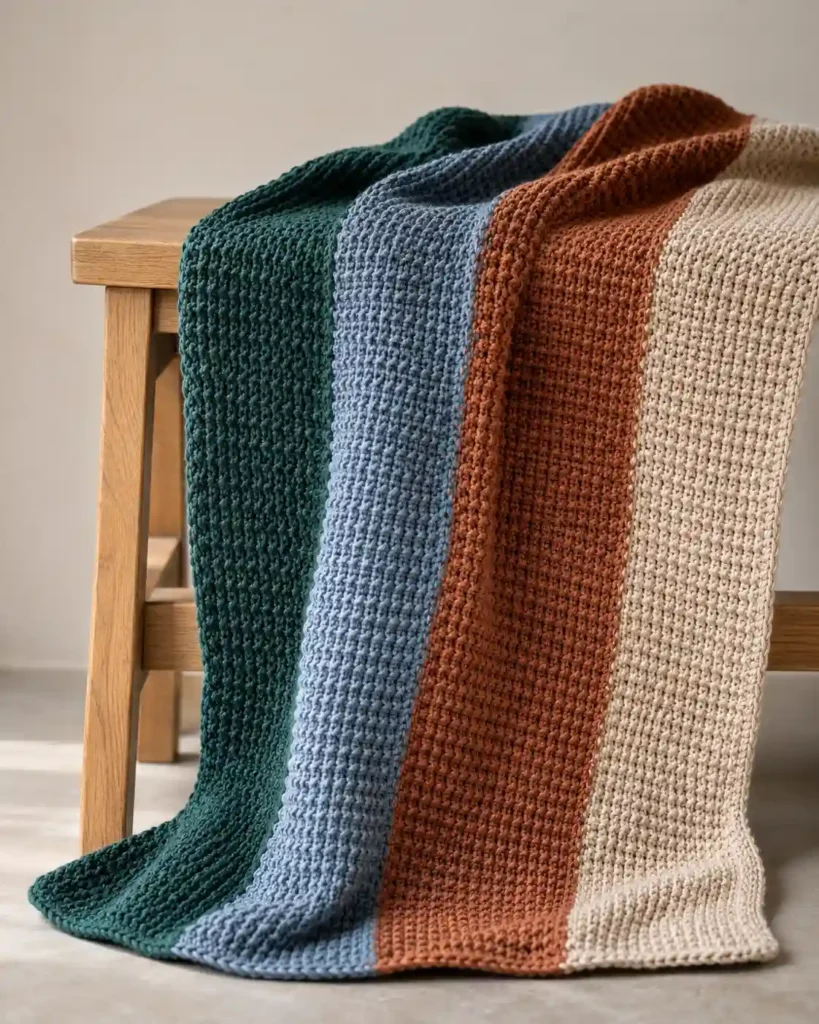
Tunisian crochet patterns offer inspiration for creating panels with a dense, woven-looking texture for a patchwork blanket. Work separate rectangles in colors such as jade, dusty blue, sienna and sand, then join them into vertical or horizontal bands. This method is better for someone comfortable with Tunisian basics because the fabric can curl at the edges; plan for suitable edging and blocking rather than relying on the seam to flatten it. Work a gauge swatch and decide the panel width before making the full set.
11. Would a Chunky Granny Square Couch Blanket Suit Your Space?
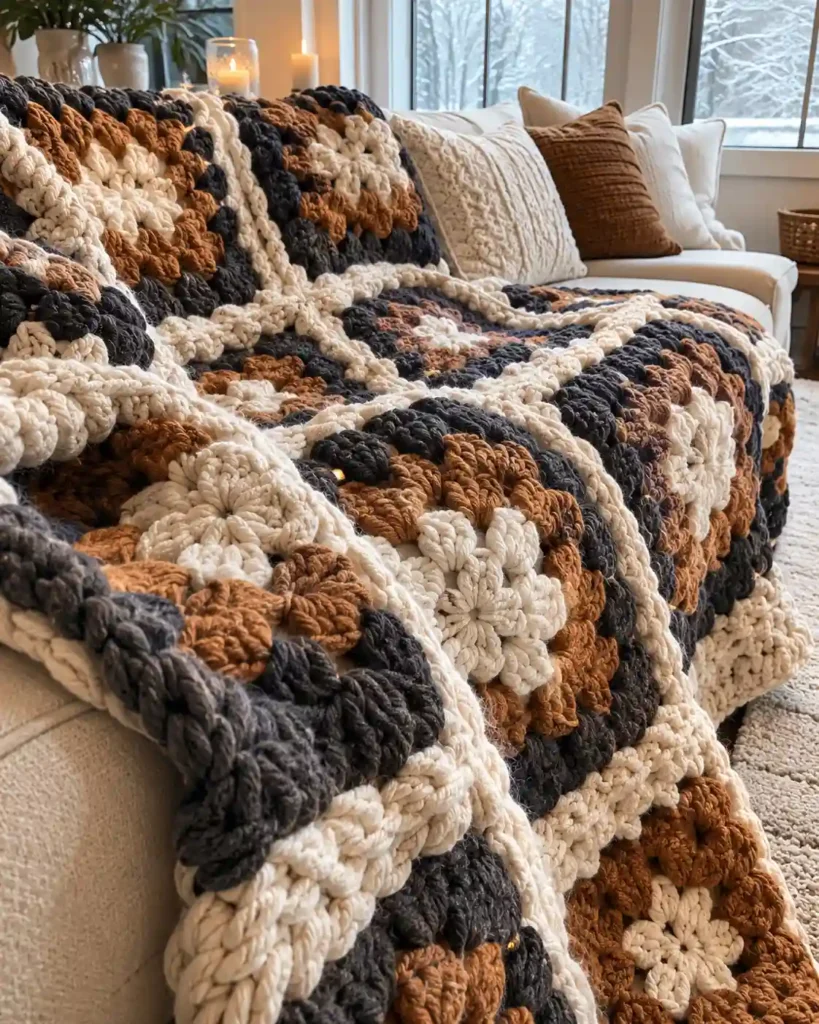
A chunky granny square blanket gives a sofa a plush, relaxed look and lets large motifs build up quickly. The trade-off is weight: bulky yarn and thick joins can make a large blanket heavier and less flexible than a lighter-weight throw. Measure a sample square and weigh it before estimating the full project, particularly if you want a blanket that is easy to fold and move. Compare the sample’s weight with a lighter yarn option before choosing the bulky version.
12. How Do You Create a Vintage Cottage-Style Granny Square Blanket?
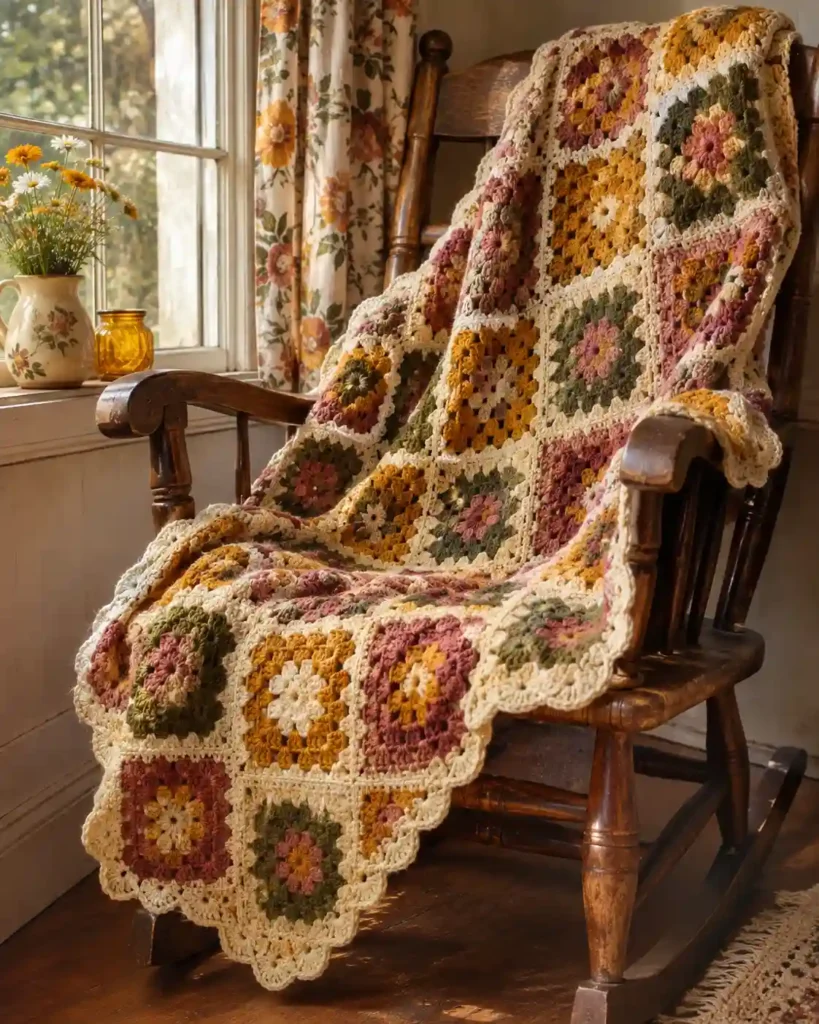
A vintage cottage-style granny square blanket gets its character from familiar motifs and a softened palette. Combine faded rose, olive, goldenrod and antique cream, then finish with a neat scalloped edge if it suits the squares. It works beautifully over a wooden rocking chair or the end of a guest bed, especially when the colors look gently collected rather than perfectly matched. A simple neutral joining color can keep the vintage palette from becoming too busy.
13. What Makes a Floral Granny Square Patchwork Blanket Special?
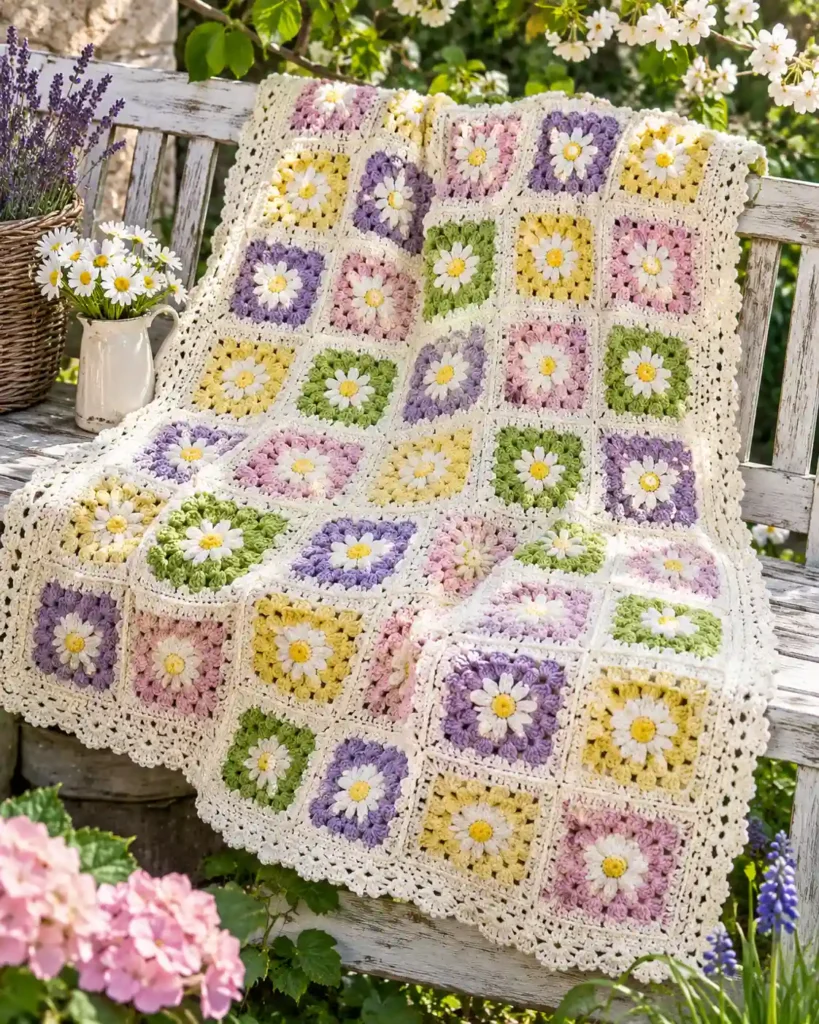
Floral granny squares place a small flower at the centre of each block, giving the blanket a spring-like feel without requiring every square to be identical. Use daisy-style centers in lavender, pale yellow, blush and fresh green, but keep the outer rounds consistent so the pieces join cleanly. This design suits a light bedroom throw or a handmade housewarming gift. Make the final round of each flower square identical, even when petal colors change.
14. Can a Crochet Rose Motif Patchwork Blanket Work as a Throw?
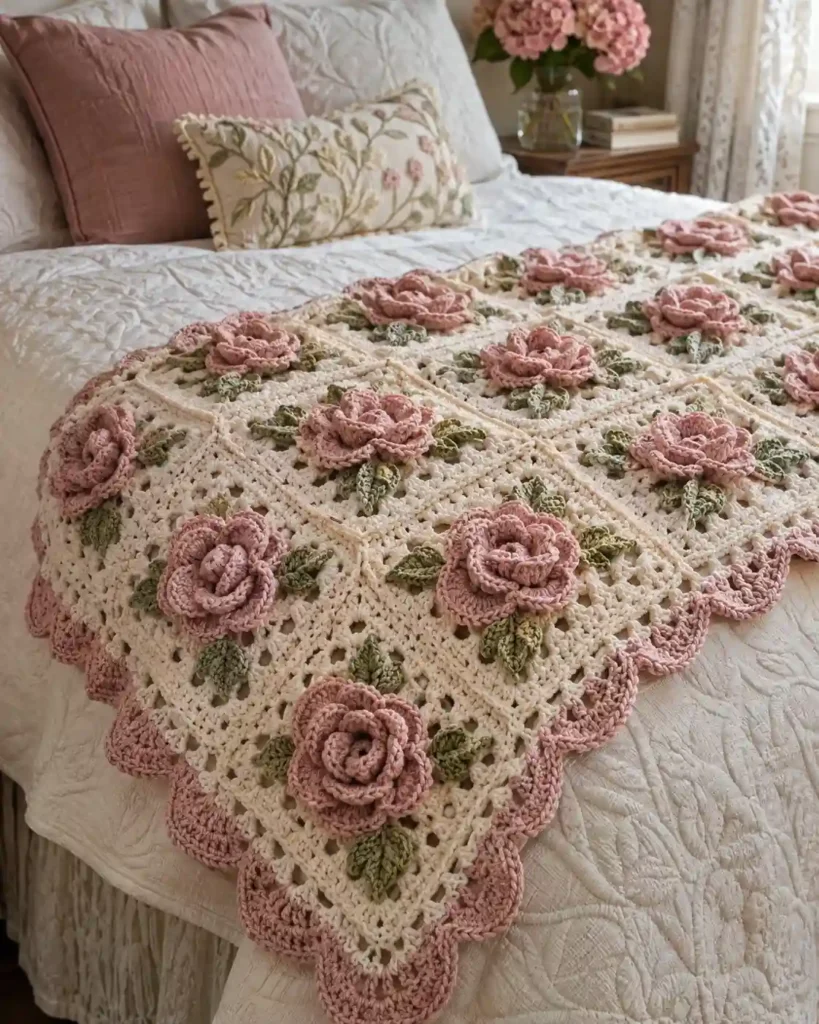
A crochet rose blanket uses raised motifs to add dimension in a way that flat flower motifs cannot. Dusty-pink roses framed by cream squares and sage leaves create a romantic decorative throw, particularly across the foot of a bed. The raised petals can catch on jewelry or other objects, so consider this texture for an adult home accessory rather than a blanket that needs a very smooth surface. Keep the raised flowers spaced out and secure all ends to reduce snagging.
15. How Can Rainforest Leaf and Botanical Squares Shape a Blanket?
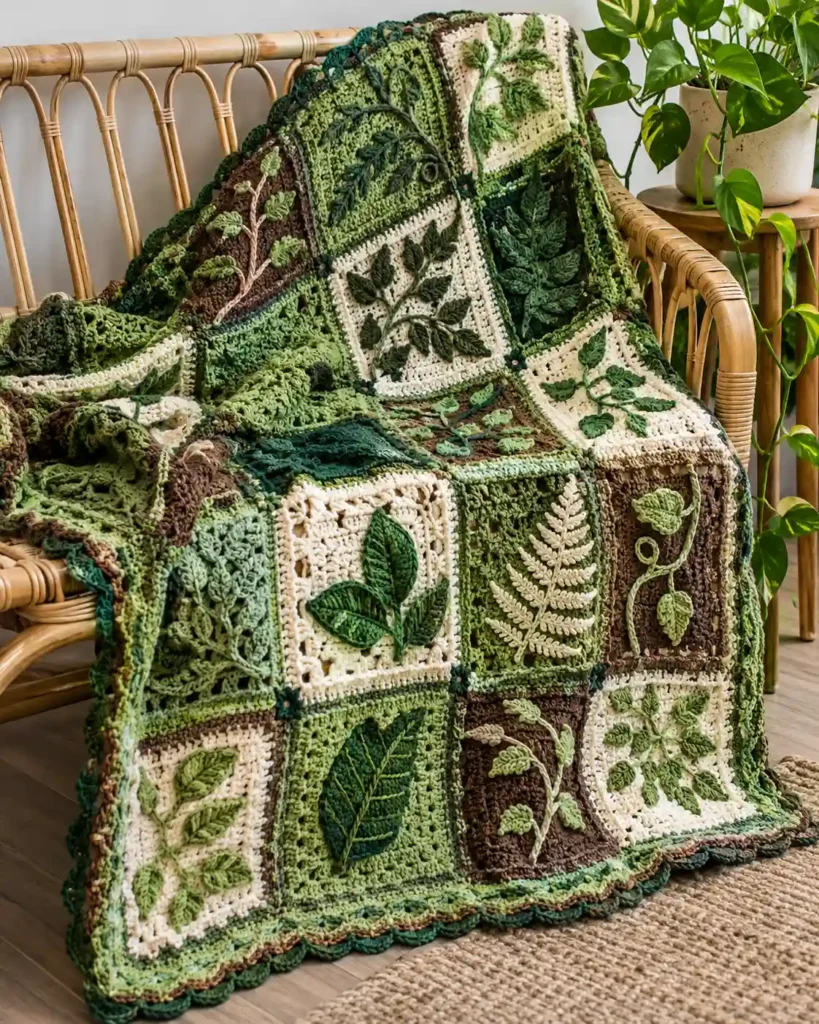
Leaf and vine motifs make a botanical patchwork blanket feel connected to nature. Build the palette around moss, fern, jade, bark brown and ivory, then repeat leaf-like shapes inside square frames to keep the overall layout orderly. A rattan bench or simple neutral sofa gives the green blocks room to stand out without competing with the stitch detail. Alternate detailed leaf blocks with simpler solid squares so the overall pattern can breathe.
16. How Do You Create a Seaside Blue-and-Sand Patchwork Throw?
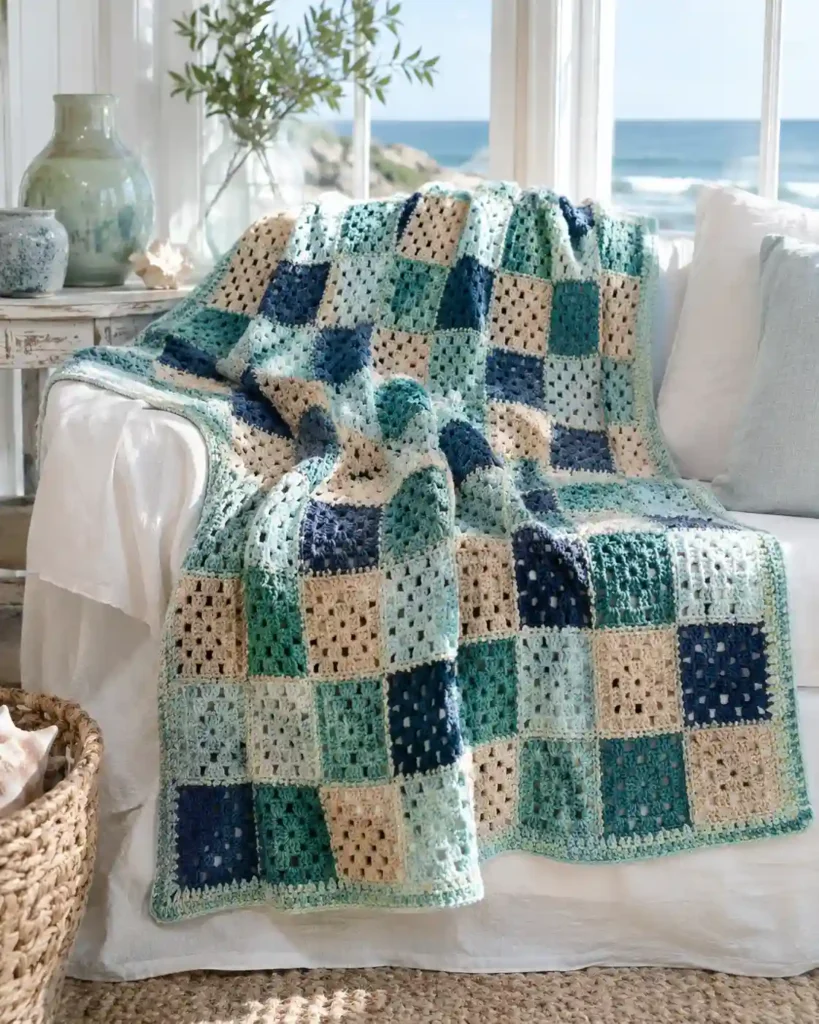
A seaside patchwork throw can suggest the coast through color alone. Combine sea-glass teal, pale aqua, indigo and warm sand in square motifs, using the darker shades sparingly to anchor the layout. It is an easy way to bring a coastal palette into a bright living room without relying on shell or wave-shaped embellishments. A cream or sand join will separate blue motifs without breaking the coastal palette.
17. What Defines a Modern Neutral Minimalist Patchwork Blanket?
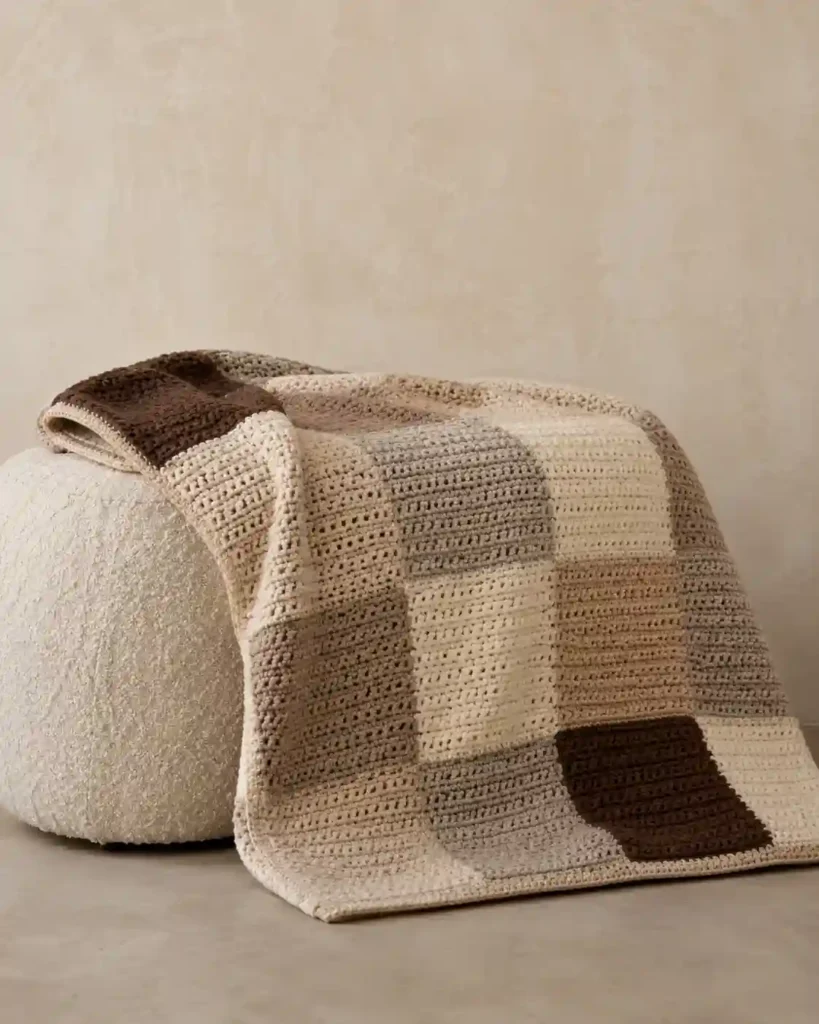
A modern neutral patchwork blanket relies on texture and proportion instead of a busy color mix. Large squares in ivory, putty, clay beige and greige can be balanced with a few espresso accents, creating a quiet look for a minimalist room. Keep the joins even and the border simple; the small details become more noticeable when the palette is restrained. Vary square texture rather than introducing too many extra shades.
18. How Do You Arrange a Bright Rainbow Patchwork Granny Square Blanket?
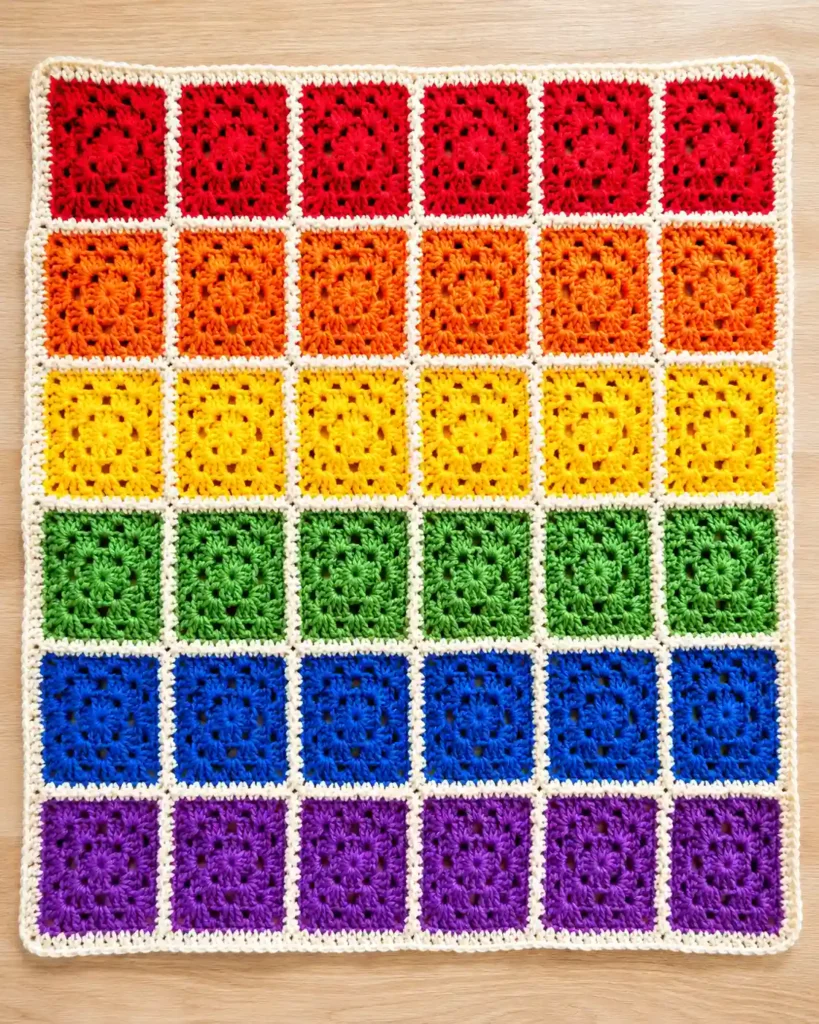
A rainbow granny square blanket can be arranged in color order, in alternating groups, or as a deliberately mixed mosaic. A narrow cream join gives the bright blocks breathing room and makes the overall grid easier to see. Repeat each color in more than one area so the blanket feels balanced rather than having all the visual weight at one end. Make a color key before starting and repeat each hue in several parts of the blanket.
19. Which Colors Suit a Farmhouse Earth-Tone Patchwork Afghan?
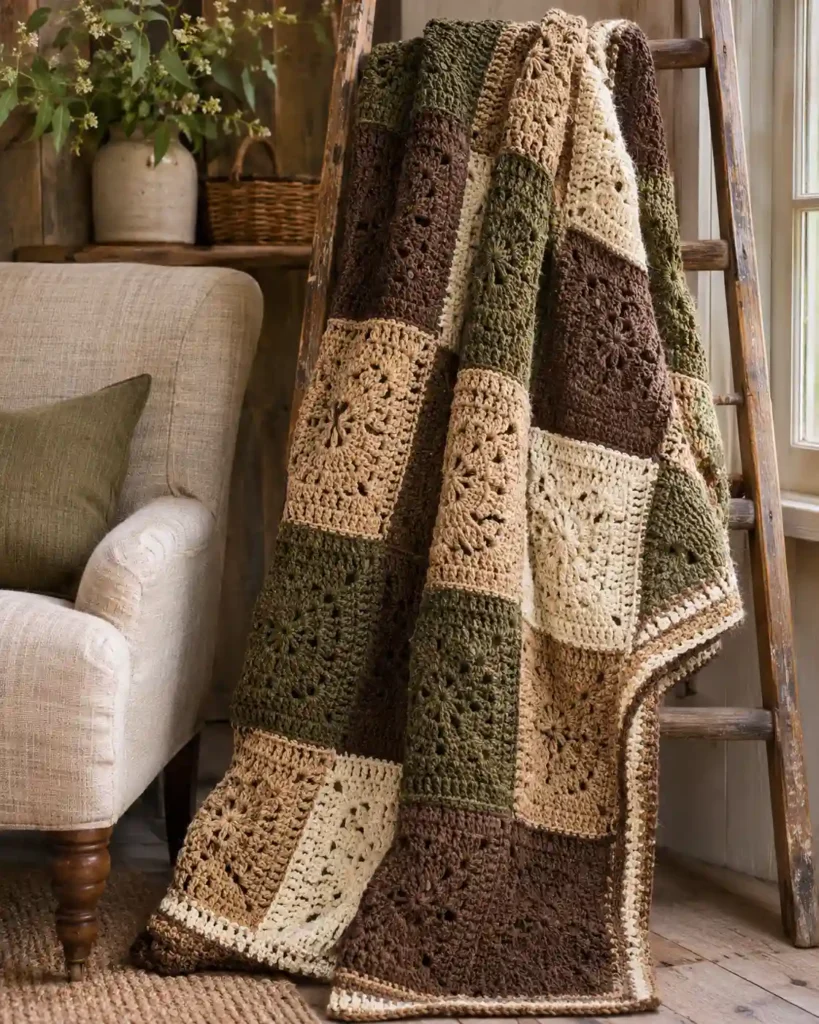
A farmhouse patchwork afghan looks grounded in walnut brown, deep olive, wheat and cream. Use a fairly dense square pattern and a practical border if the blanket will be used often in a living room. This palette suits natural wood, linen and simple upholstery, and it is forgiving when you want to combine several related shades without a sharp contrast. A border in cream or olive can frame the earth tones without introducing another color.
20. Can a Quilt-Block Inspired Crochet Patchwork Throw Work in Crochet?
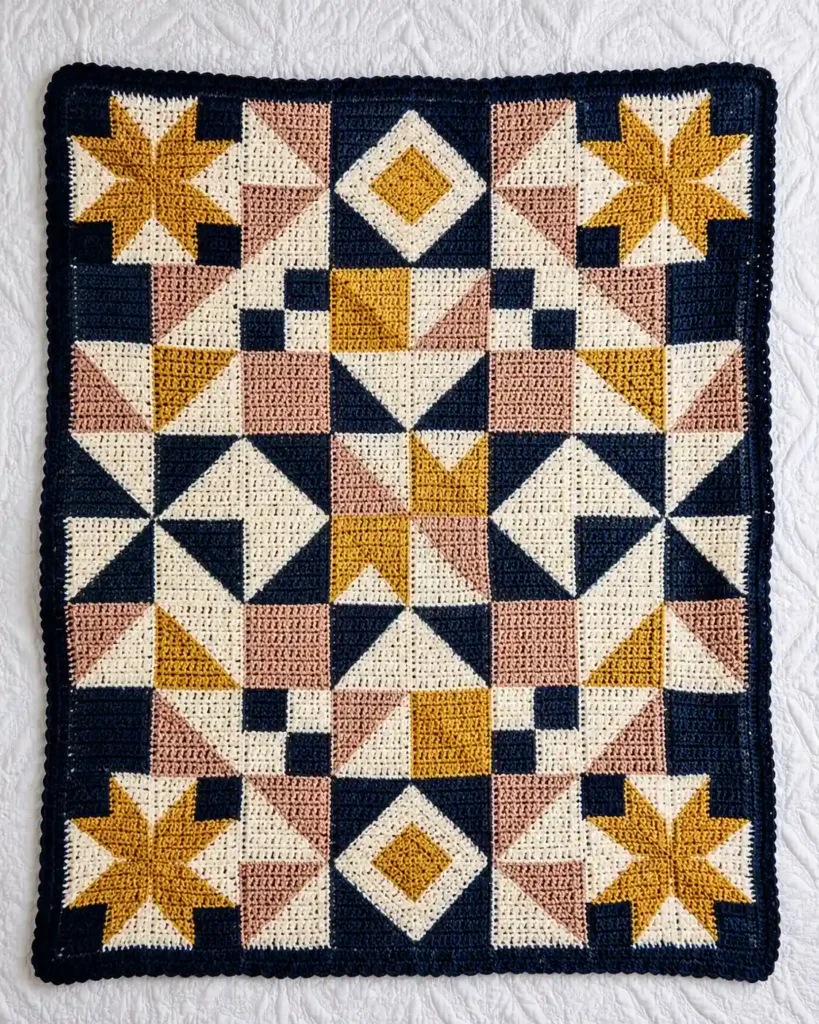
Quilt-block-inspired crochet translates familiar geometry into yarn rather than sewn fabric. Combine half-and-half squares, offset grids or framed motifs in midnight blue, muted mustard, pale clay and ivory. Sketch the block arrangement on graph paper before crocheting; it helps you see where colors meet and prevents the finished design from looking like a collection of unrelated squares. Use a simple diagram to track block orientation and prevent mirrored pieces from disrupting the design.
21. How Do You Design a Soft Pastel Crochet Patchwork Baby Blanket?
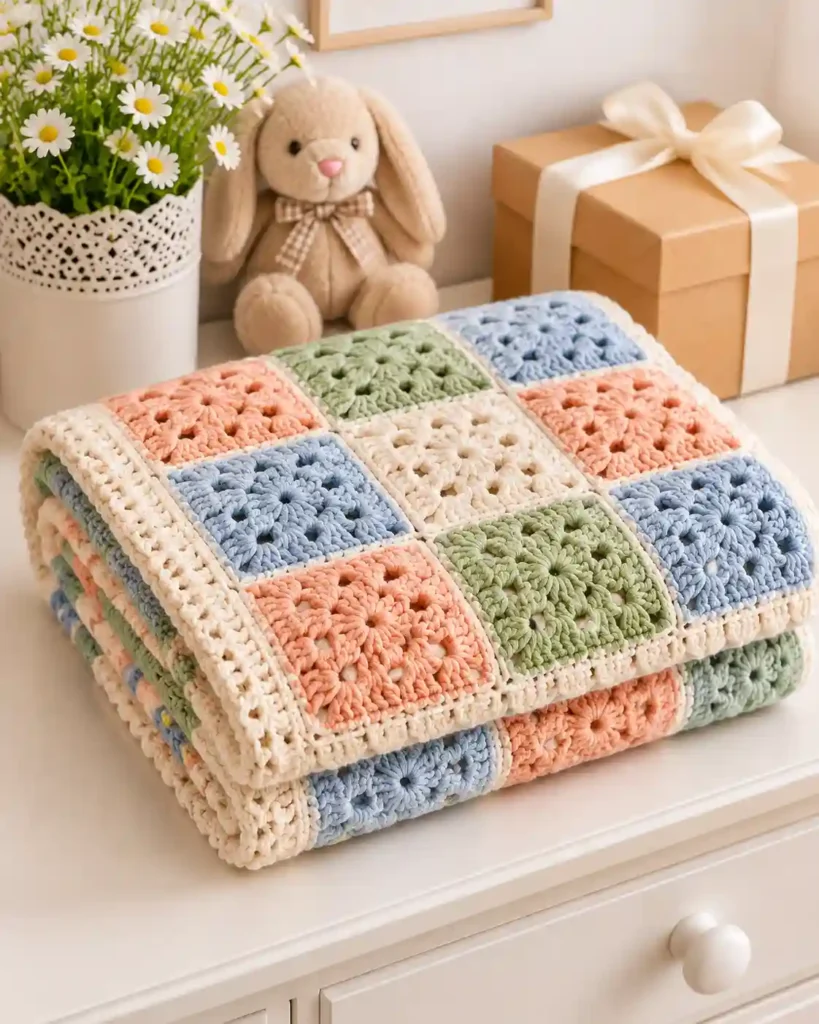
A soft pastel crochet patchwork baby blanket can make a thoughtful handmade gift, and these ideas can help when you want to crochet a baby blanket with simple, washable motifs that are securely joined. Pale peach, sage, powder blue and cream create a gentle palette, while smooth squares are easier to care for than very raised or heavily embellished blocks. Important: treat a handmade blanket as a keepsake or for supervised awake-time use, not as bedding for infant sleep. The U.S. Consumer Product Safety Commission (CPSC) advises keeping blankets and other soft objects out of cribs, bassinets and play yards. Choose washable yarn and check every seam and loose end before gifting.
22. Is a Small-Square Stroller or Travel Blanket Practical?
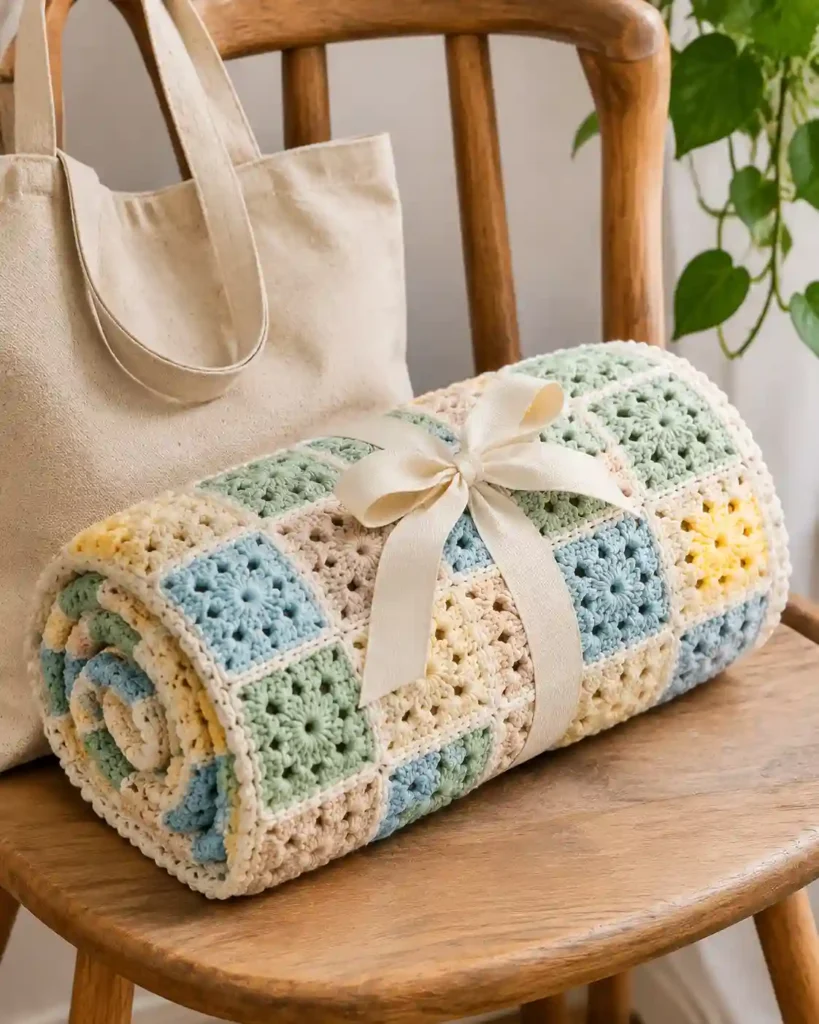
A compact blanket made from small squares is portable and gives you a chance to use mini motifs without committing to a bed-sized project. Mint, sand, soft yellow and sky blue make a gentle travel palette, while a firm join helps the smaller blocks hold their shape. Keep it for supervised use when the child is awake, and follow the CPSC’s safe-sleep guidance rather than using it as loose bedding. A compact finished size is easier to carry, but the edges should not have loose loops.
23. What Should You Know About a Hexagon Motif Patchwork Blanket?
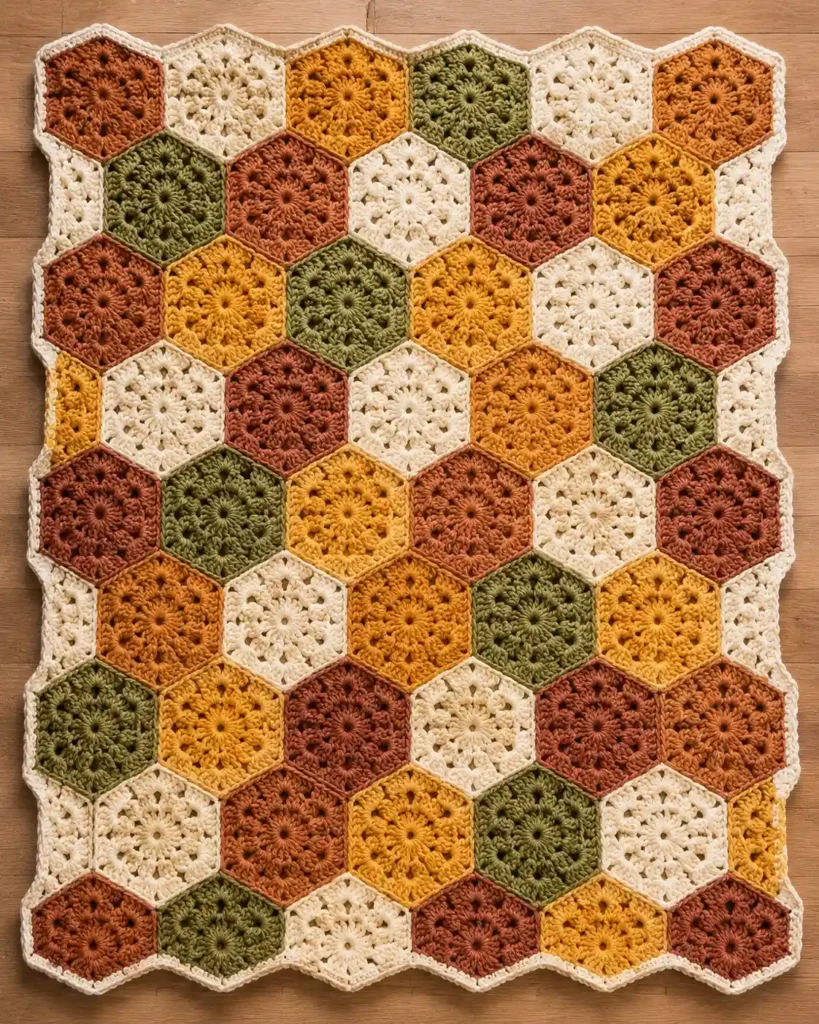
Hexagon motifs create a honeycomb effect that feels different from the familiar square grid. Join the shapes in a consistent orientation and use half-hexagons or another planned edge treatment to make the outside boundary straight. Terracotta, marigold, moss green and cream give the design a warm, earthy look; plan the border before you make dozens of motifs. Use half-hexagon fillers at the edges to turn the honeycomb outline into a rectangle.
24. Can a Scrap-Stitch Rectangle Patchwork Throw Use Leftovers Well?
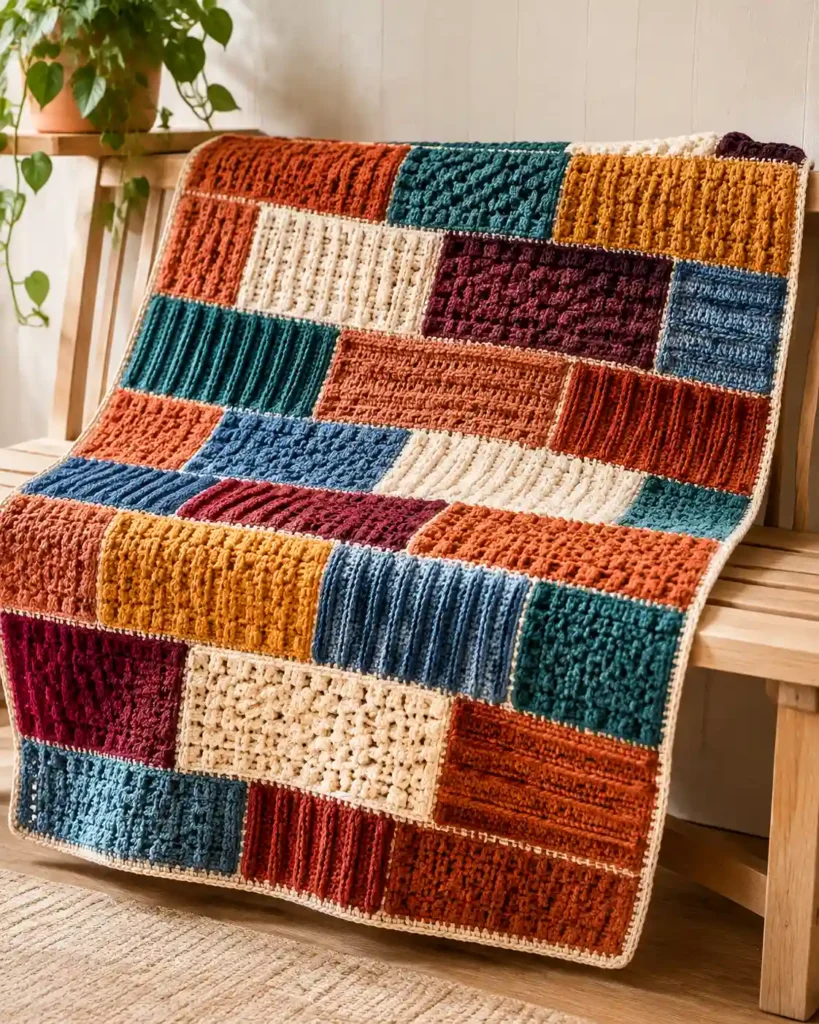
Rectangular patchwork blocks are useful when your leftover yarn amounts are too small for matching squares. Work a few compatible stitch patterns in staggered brick-like rows, keeping the rectangle widths consistent so the edges line up. This approach is especially useful for mixed lengths of yarn, but measure each piece as you go and repeat colors to keep the layout connected. A shared joining shade can help different stitch rectangles read as one composition.
25. How Do You Plan an Oversized Bedroom Patchwork Crochet Blanket?
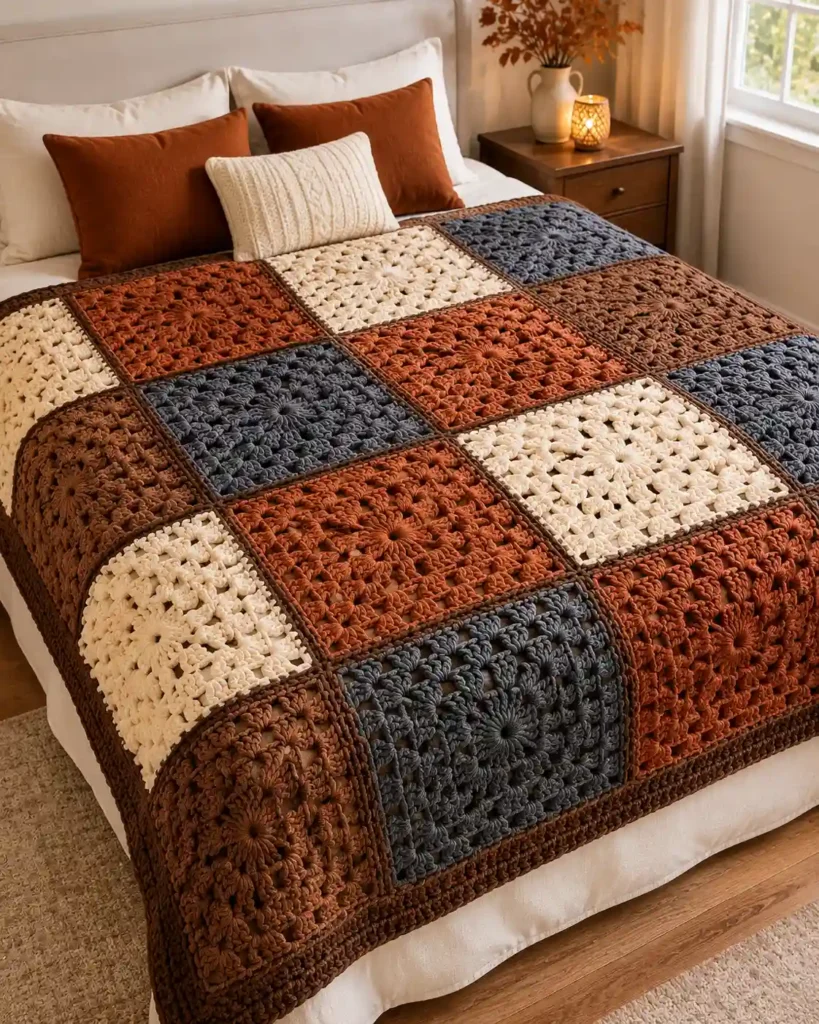
An oversized patchwork blanket can turn a set of manageable motifs into a full bedspread. Choose a limited palette, calculate the number of rows and columns from your blocked square size, and estimate yarn from a measured sample rather than guessing. Large projects need a practical assembly plan too: join manageable sections first, then connect those sections and finish with suitable crochet blanket edging. Join smaller panels on a flat surface so the blanket remains manageable as it grows.
How Do You Choose Yarn for a Crochet Patchwork Blanket?
Choose yarn with compatible weight, fiber characteristics and care instructions, then make and wash a test square before crocheting all the motifs.
- Match yarn weights across the blanket.
- Check fiber content and washing instructions.
- Make a test square before buying more yarn.
- Compare the finished gauge and drape.
- Keep notes about hook size and measurements.
Start with the way the finished blanket will be used. A sofa throw may benefit from a soft, easy-care yarn, while a decorative bedspread can use a lighter fiber or more delicate stitch texture. If you are combining leftover yarn, check that the weights and care instructions are compatible; two yarns that look similar in the ball can behave differently after washing.
The Craft Yarn Council’s Standard Yarn Weight System groups yarn from lace through jumbo and lists typical crochet gauge and hook-size ranges for each category. The Council also describes these ranges as guidelines, so use the gauge stated in your chosen pattern and make a test square before committing to the full blanket.
A useful starting checklist:
- Choose one main yarn weight for most or all motifs.
- Check the fiber content and washing instructions on every label.
- Make a test square with the hook you plan to use.
- Wash and dry the sample as you intend to care for the finished blanket.
- Keep notes on hook size, stitch count and finished motif measurements.
How Many Squares Do You Need for a Crochet Patchwork Blanket?
Calculate the number of squares by dividing your target blanket dimensions by the finished, blocked dimensions of each motif, then allow for joining seams and borders.
- Measure a completed and blocked square.
- Decide the desired blanket width and length.
- Calculate the number of columns and rows.
- Account for joining and border measurements.
- Round to whole motifs.
Use the finished, blocked size of your motif—not the measurement while it is still on the hook. Divide the target blanket width by the finished square width to estimate the number of columns, then divide the target length by the square height to estimate the rows. Round to whole motifs and allow for the joining seam and border.
For example, if a blocked square measures 6 inches and your target is approximately 48 by 60 inches, you would begin with 8 columns and 10 rows, or 80 squares. That is a planning example, not a universal blanket size; a wider join or a border will change the finished dimensions.
What Is the Best Way to Join Crochet Squares?
The best way to join crochet squares depends on whether you prefer an almost invisible seam, a raised decorative finish or a joining method worked as you crochet.
- Use whip stitch for a straightforward sewn seam.
- Choose slip stitch for a defined joining line.
- Try single crochet for a stronger visible seam.
- Use flat-braid joining for decorative openwork.
- Consider join-as-you-go to connect motifs during their final round.
The best joining method depends on the look and feel you want:
- Whip stitch: a straightforward sewn seam that can be subtle when worked neatly.
- Slip-stitch join: creates a defined ridge and can be worked on the wrong or right side, depending on the finish.
- Single-crochet join: adds a stronger visible line between motifs and can make the blanket feel more structured.
- Flat-braid join: creates a decorative openwork seam, but needs careful corner work.
- Join-as-you-go: connects motifs during the final round, reducing a separate joining stage but requiring you to plan the order as you crochet.
Try the chosen method on two spare squares before joining the whole blanket. Check that the seam does not pull the motifs out of shape and that the corners sit flat.
How Do You Keep Patchwork Motifs Even?
Keep crochet motifs even by checking stitch counts, using consistent tension, measuring finished dimensions and blocking pieces before joining.
At a Glance:
- Follow the same stitch count for repeated motifs.
- Use a consistent hook size where possible.
- Measure squares after finishing and blocking.
- Check the thickness of textured motifs.
- Test the joining method before assembly.
A patchwork blanket can include different stitches and colors, but the edges still need to fit. Keep a record of each motif’s stitch count, hook size and finished dimensions. If one square is smaller, check tension and blocking before adding extra rounds; if it is much thicker, consider whether it belongs in the same blanket.
Arrange all the motifs before joining. Photograph the layout, count repeated colors, and check that similar shades are spread across the whole blanket. This small planning step can save hours of unpicking later.
Where Can You Find a Crochet Patchwork Blanket Pattern?
Look for a crochet blanket pattern that provides clear yarn requirements, hook size, gauge, motif instructions, finished dimensions and joining guidance for a patchwork design.
At a Glance:
- Check the pattern’s skill level and instructions.
- Confirm the recommended yarn weight and hook.
- Look for finished motif and blanket measurements.
- Verify whether the complete pattern is genuinely free.
- Follow the original designer’s attribution and sharing terms.
Look for a pattern that clearly states its skill level, yarn weight, hook size, gauge, finished dimensions, stitch abbreviations and joining method. A pattern described as beginner-friendly should still explain how the motifs are assembled, not only how to crochet one square. If the pattern is advertised as free, check that the full instructions are genuinely available and that the designer is credited.
For a custom project, you can use the ideas in this guide as a starting point and build your own layout. Keep a written record of the motif repeat and color placement so you can reproduce the design if you need extra squares later.
FAQs About Crochet Patchwork Blanket
What Is the Easiest Crochet Patchwork Blanket for Beginners?
A blanket made from one repeated solid granny square is often the simplest starting point. You only need to learn one motif, keep the dimensions consistent and practise one joining method.
How Many Squares Do I Need for a Crochet Patchwork Blanket?
It depends on the blocked size of each square and the finished blanket dimensions. Divide the target width and length by the square measurements, then allow for joins and the border.
Can I Make a Crochet Patchwork Blanket with Leftover Yarn?
Yes, provided the yarns have compatible weights, care requirements and enough yardage for the planned motifs. Repeating a few colors across the blanket helps a mixed stash look intentional.
What Yarn Works Best for a Patchwork Crochet Throw?
Choose yarn according to comfort, washability and consistent gauge. Compare acrylic, cotton and wool blends, and make a test square before deciding which fiber works best for your project.
Can I Mix Granny Squares with Other Crochet Stitch Squares?
Yes. Make sure the motifs can be blocked to matching dimensions and that their thicknesses work together; very raised or bulky squares may sit unevenly beside flat motifs.
Final Thoughts
The best crochet patchwork blanket is the one that suits your skill level, yarn supply, preferred colors and intended use. Choose one motif or layout from these 25 ideas, make a sample, and check its size before you commit to the full project. A little planning around gauge, joining and finishing will help the individual pieces become one blanket that feels balanced and useful.
For more crochet inspiration and practical project guides, visit Crochetmind.com