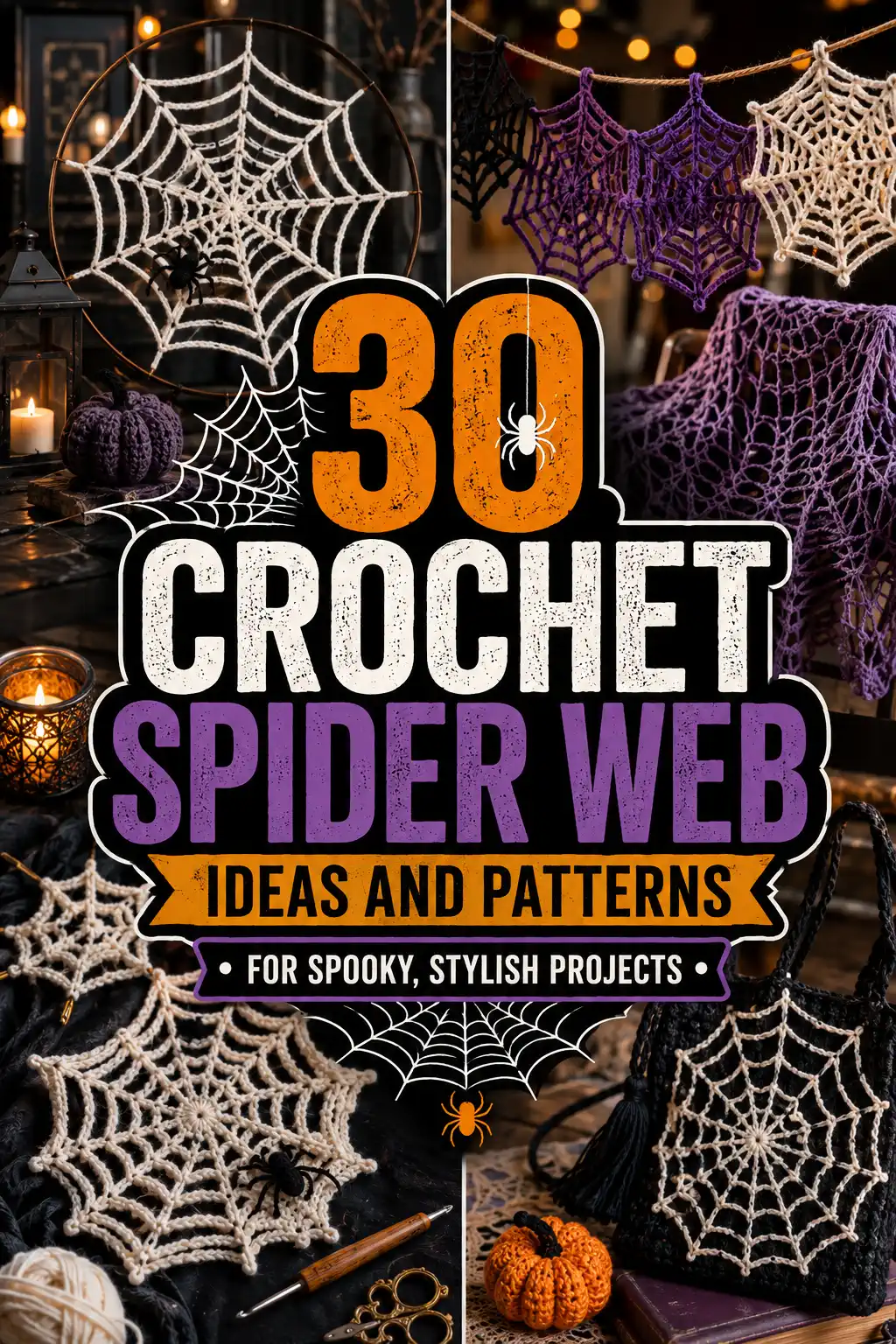
A crochet spider web can be much more than a simple Halloween decoration. The same open, radial structure can become wall art, bunting, shawls, sweaters, dresses, borders, coasters, table décor, and wearable accessories simply by changing the yarn weight, hook size, shape, and number of rounds.
If you are new to this style of crochet, the basic idea is surprisingly approachable. Most spider web designs rely heavily on chains separated by tall stitches, allowing each new round or row to expand while keeping the fabric airy and web-like.
I love crochet spider web projects because one basic motif can take you in so many different directions. You can make a tiny decoration in an evening, turn several motifs into garland, or use the same web-inspired structure for a shawl, sweater, or dress. If you are starting with a simple crochet spider web pattern, learning how the spokes and chain spaces expand will make many of the ideas below much easier to customize.
Key Takeaways
- Start with a simple round web to learn construction.
- Use lighter yarn for delicate, airy spider webs.
- Try a crochet spider web garland for quick seasonal décor.
- Block openwork webs for cleaner, more defined shapes.
- Adapt web motifs into shawls, tops, borders, and accessories.
- Adjust hook size to control openness and drape.
What Is the Best Crochet Spider Web Pattern to Start With?
A small round or half-circle web using chains and tall stitches is usually the easiest place to start.
At a Glance
- Begin with a small motif.
- Use repetitive chain spaces.
- Keep spoke placement consistent.
- Practice increases before making larger projects.
- Block the finished web for definition.
For beginners, start with a small round or half-circle web made from chains, single crochet, slip stitches, and tall stitches such as treble crochet. One Little Project’s beginner spider web, for example, uses a repeating round structure and explains that increasing the chain spaces allows the finished web to grow larger.
The Craft Yarn Council recommends identifying hooks by their metric millimeter measurement because letter and number sizing can vary between manufacturers. That is especially useful when experimenting with lace and openwork projects where even a small hook change can noticeably change the finished size.
| Project Style | Good Yarn Choice | Suggested Look | Difficulty |
|---|---|---|---|
| Small web ornament | Crochet thread or fingering | Fine and delicate | Easy |
| Wall hanging | DK or worsted | Defined and visible | Easy |
| Garland | Cotton or DK | Structured | Easy |
| Shawl | Fingering or sport | Soft and drapey | Intermediate |
| Sweater | DK or worsted | Open statement texture | Intermediate |
| Dress | Fingering or DK | Lightweight lace | Intermediate |
| Border | Crochet thread or fingering | Delicate edging | Easy to intermediate |
| Giant web | Worsted or bulky | Dramatic décor | Easy |
The Craft Yarn Council classifies yarn from category 0, lace, through category 7, jumbo. Its recommended hook ranges are guidelines rather than strict rules, and lace projects are often intentionally worked with larger hooks to create more open fabric.
30 Crochet Spider Web Ideas You Can Make
Crochet spider webs can be adapted into décor, garments, accessories, table pieces, borders, and seasonal projects.
At a Glance
- Make round or half-circle webs.
- Connect motifs into garlands.
- Turn openwork into wearable crochet.
- Use web motifs as decorative borders.
- Experiment with size, yarn, and color.
1. Classic Round Crochet Spider Web
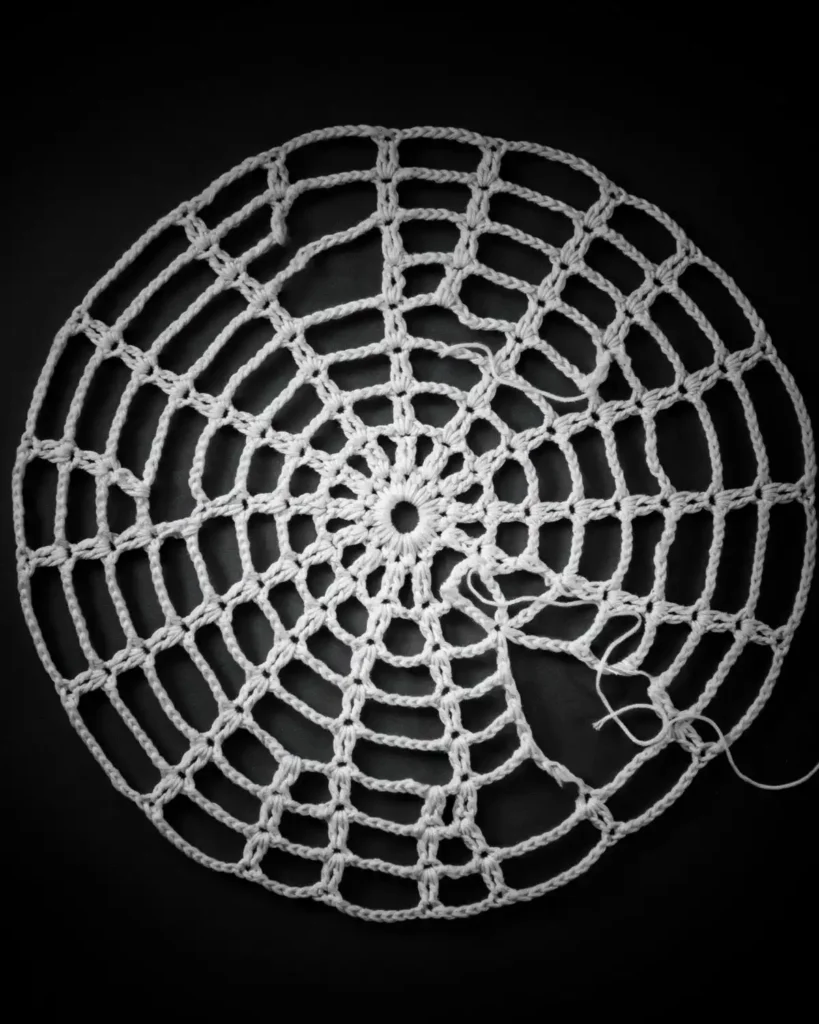
The classic round web is the first design I would try because you can understand the entire construction at a glance. Tall stitches form the spokes while increasingly long chain spaces create the rings between them.
What makes this version useful is how easily you can resize it. Keep repeating the established increase pattern and the little ornament can become a much larger wall decoration.
Hang one in a window, stretch it over a frame, or place it under a Halloween centerpiece. The open spaces look especially clear when the web is displayed against a contrasting background.
Special Tip: Block the finished web under gentle tension if you want sharper spokes and a more symmetrical shape.
2. Simple Crochet Spider Web Pattern
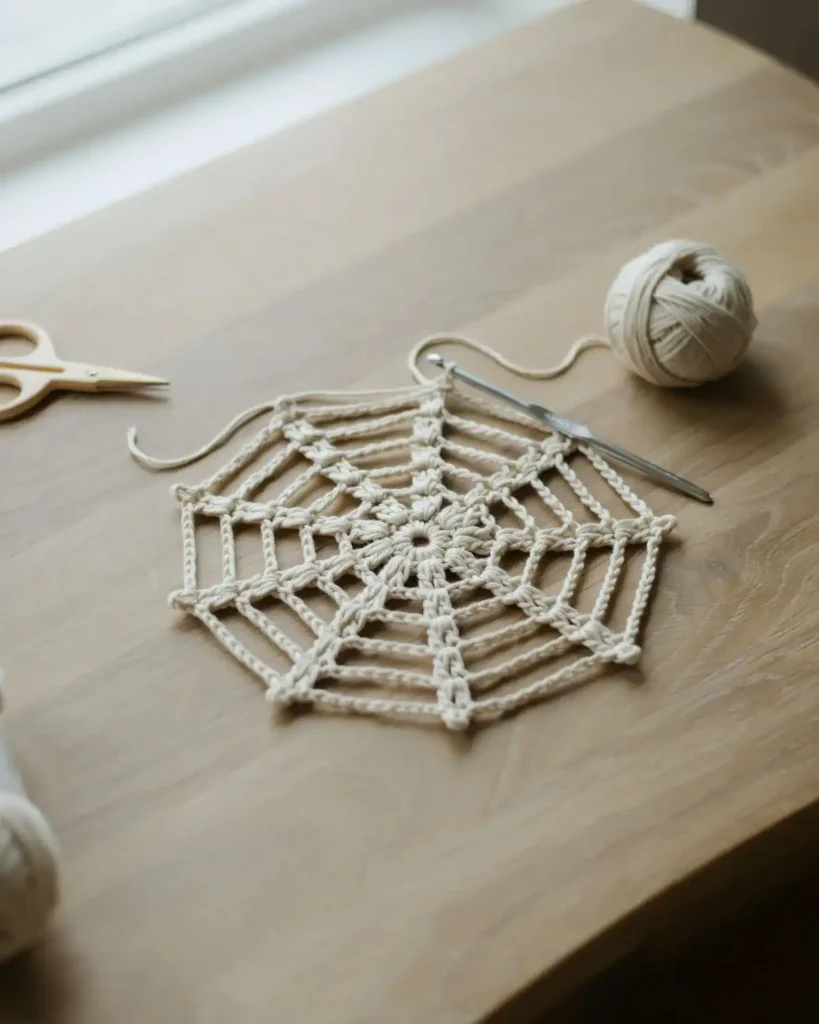
A simple crochet spider web pattern should rely on repetition rather than complicated stitch combinations. Chains and tall stitches are particularly effective because they create a recognizable web without making the fabric dense.
Delia Creates demonstrates this approach with spiderweb bunting made primarily from chains, single crochet, and triple crochet. The project uses worsted cotton and a 4.5 mm hook, showing that a web does not have to be made from tiny thread to look delicate.
I like this approach for someone who already knows the basic crochet motions but does not want to count complicated clusters.
Use white for a traditional cobweb, black for stronger contrast, or orange and purple when you want the design to feel more playful than spooky.
3. Half Crochet Spider Web
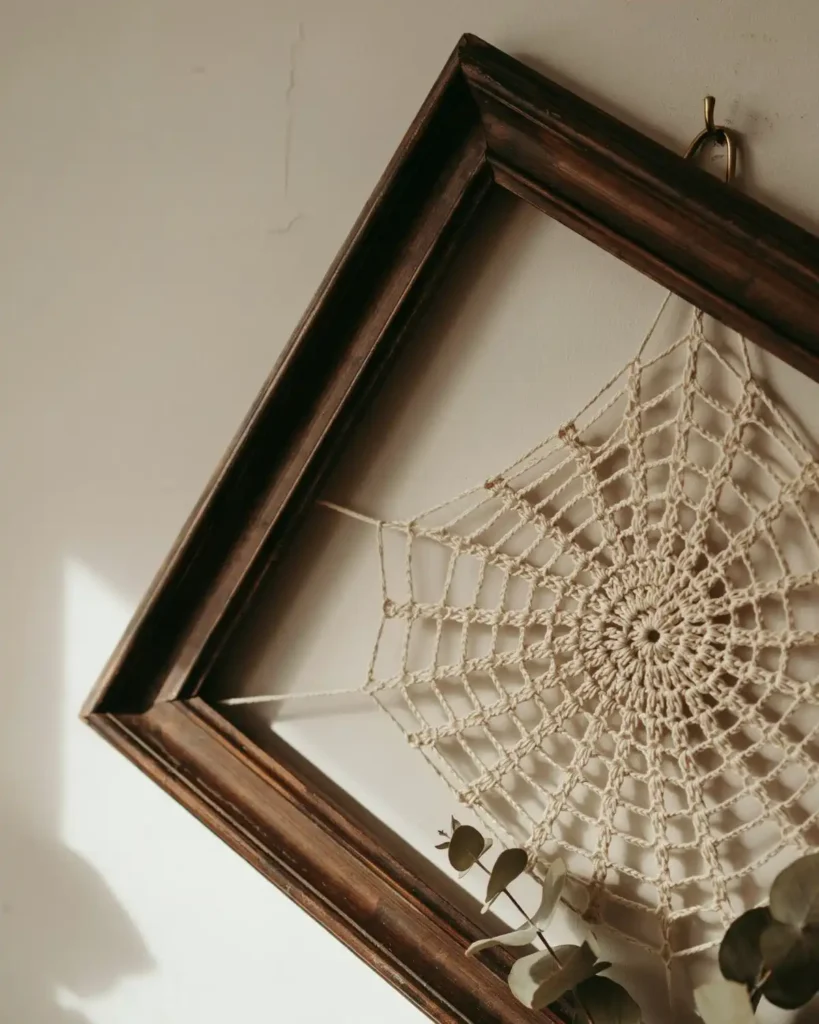
A half web fits corners beautifully. Instead of creating a complete circle, the design opens outward like a fan.
This is more practical than a full web when you are decorating the corner of a mirror, picture frame, shelf, doorway, or mantel. One Little Project notes that a round-web concept can be adapted into a half-web by working back and forth in rows instead of closing every round.
Make several identical pieces and suddenly you also have the foundation for a garland.
This is the version I would choose when the decoration needs to look intentional rather than like a web randomly placed on a wall.
4. Crochet Spider Web Garland
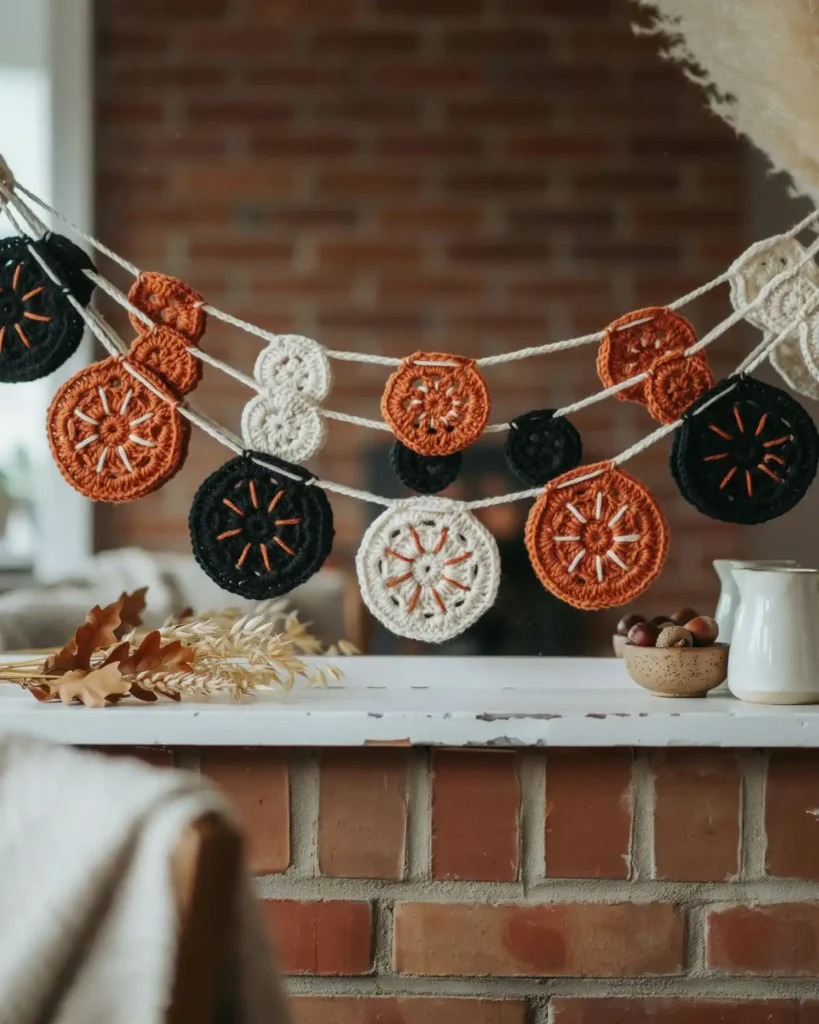
A crochet spider web garland turns several small motifs into one larger decoration without requiring one huge project.
You can make each web separately and connect them with chains, single crochet, or a simple cord. Delia Creates uses ten small webs for a bunting measuring about 5.5 feet, which demonstrates how quickly individual motifs can build into a substantial decoration.
Try alternating black and white webs, or place a bright orange web between neutral ones.
The best part is storage. Small connected motifs fold down much more easily than a giant stiffened web.
5. Crochet Spider Web Bunting
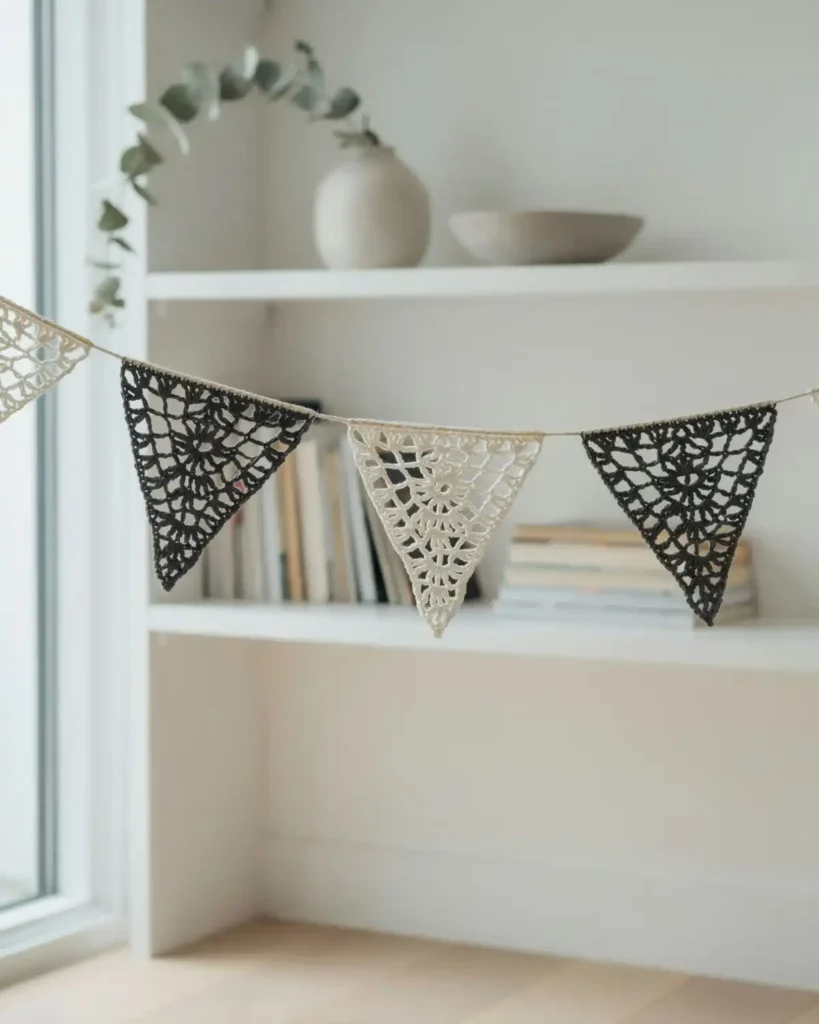
Bunting feels a little cleaner and more structured than a loose garland. Half-web shapes naturally resemble pennants, so they sit neatly along a horizontal cord.
Instead of making conventional triangular flags, let the open crochet itself create the triangular outline.
I would hang this across a bookshelf, fireplace mantel, party table, or entryway where people can see the stitch detail up close.
For a polished result, keep the spacing between motifs consistent.
6. Giant Crochet Spider Web Wall Hanging
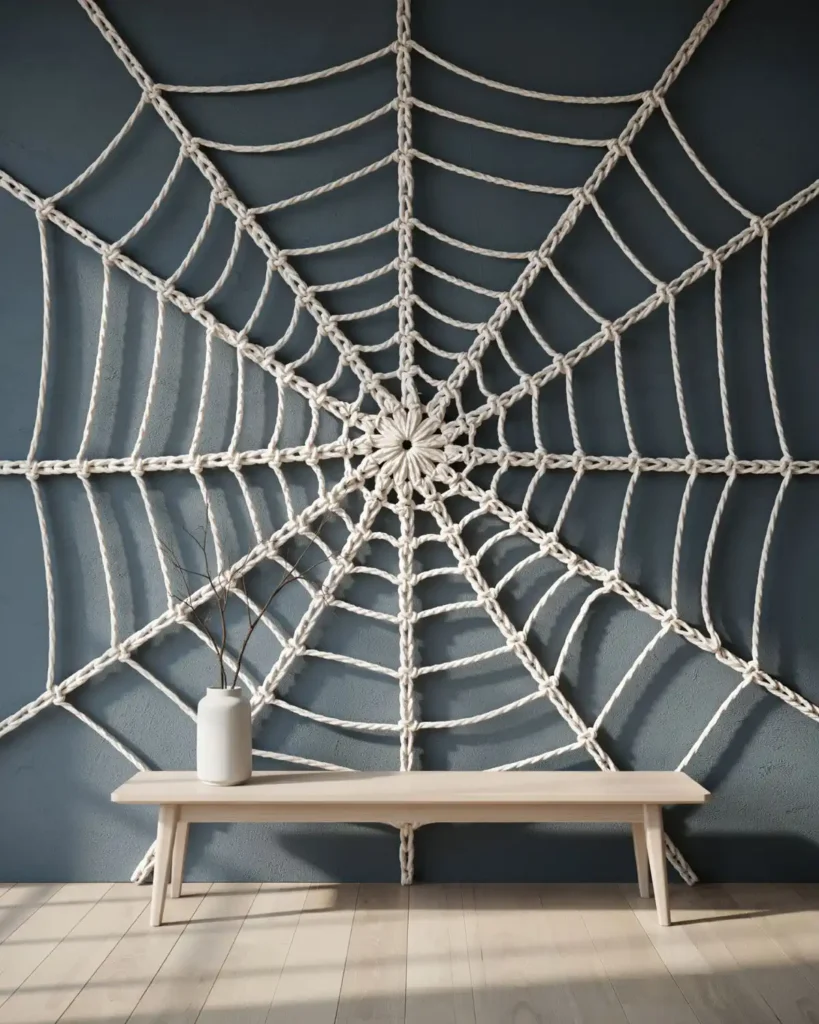
A giant wall web gives you maximum impact with relatively little yarn because most of the design is empty space.
Start with a traditional radial center, then continue expanding the chain spaces. A published DROPS spider web design demonstrates how dramatically scale can change depending on the yarn and construction, with one version measuring approximately 40 cm from tip to tip.
This project looks particularly effective over a blank wall, large mirror, or door.
Add long fastening strands around the perimeter so you can stretch the finished piece evenly.
7. Mini Crochet Spider Web Ornament
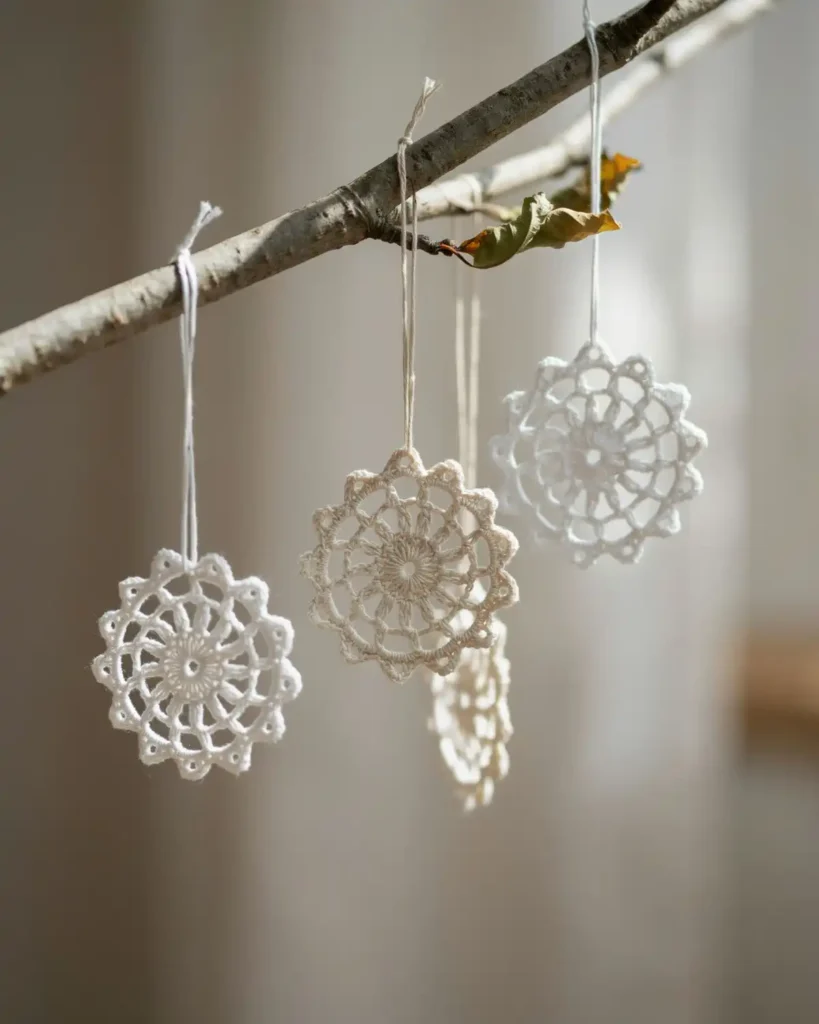
Go in the opposite direction and make tiny webs.
Fine cotton thread turns the same basic geometry into something light enough for ornaments, gift embellishments, place settings, or small hanging decorations. The Craft Yarn Council notes that steel hooks are commonly paired with crochet threads and lace-weight yarns.
A miniature version is also useful when you want to practice the pattern before committing to a large web.
Make a set in slightly different sizes rather than trying to make every one identical.
8. Crochet Spider Web Coaster
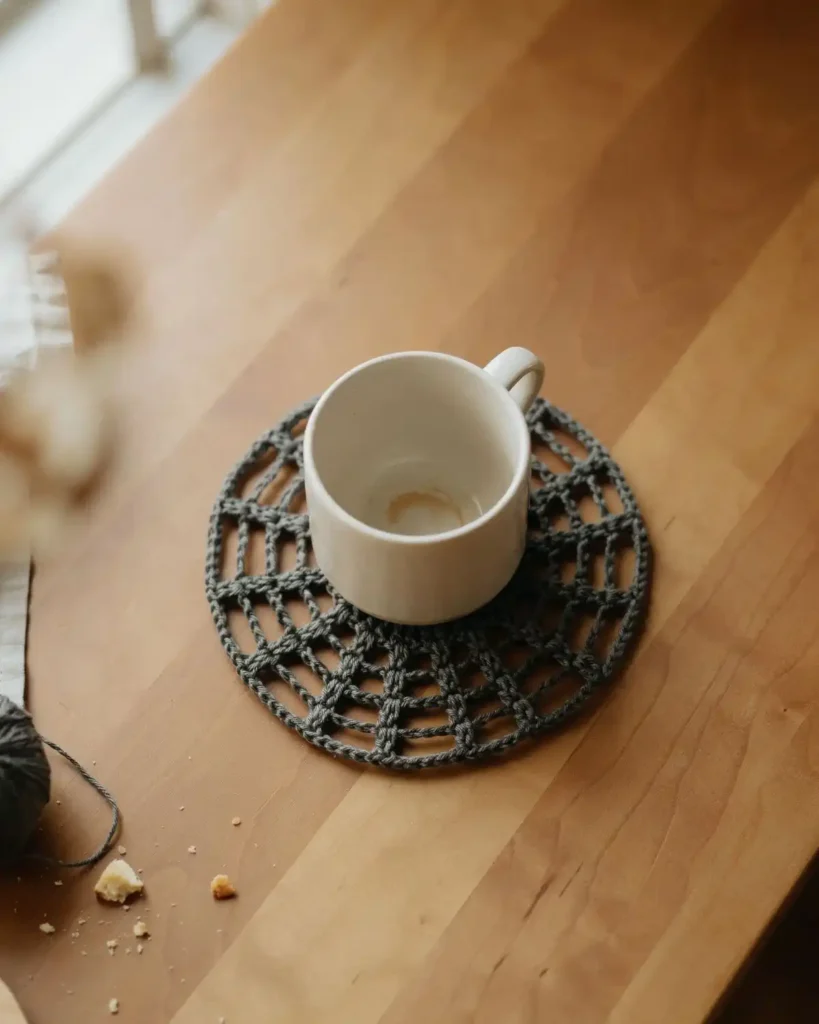
A web-shaped coaster gives the motif a practical purpose.
Keep the outer rounds relatively compact so cups have enough crochet fabric underneath them. For a coaster intended for regular drink use, cotton is usually a sensible choice because it creates a firmer, less fuzzy surface than many novelty yarns.
I prefer a dark charcoal or deep plum here rather than pure black because you can see the stitch work more clearly.
Make four or six matching pieces and they become an easy seasonal table set.
9. Crochet Spider Web Table Mat
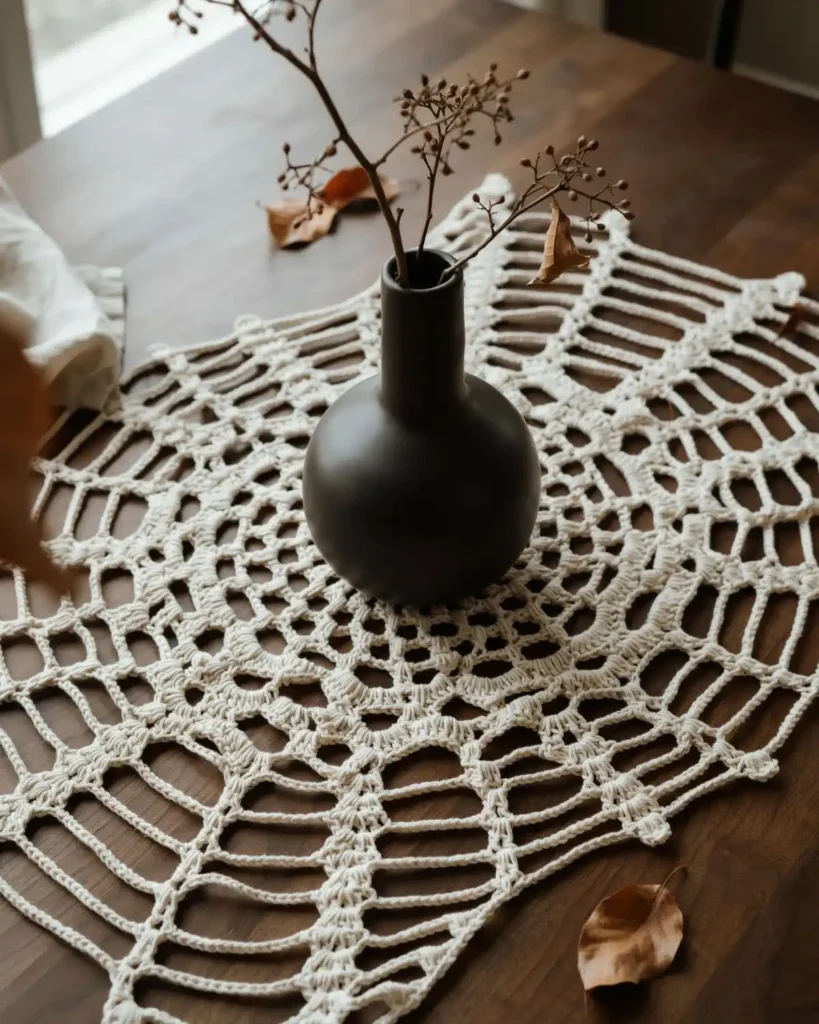
Take the coaster idea several rounds further and you have a striking table mat.
The open design lets the table color show through, which makes the web pattern more visible without needing additional decoration.
Place it beneath a vase, bowl, candle display, or Halloween centerpiece.
For dining-table use, test the finished fabric first so decorative objects remain stable on the open stitches.
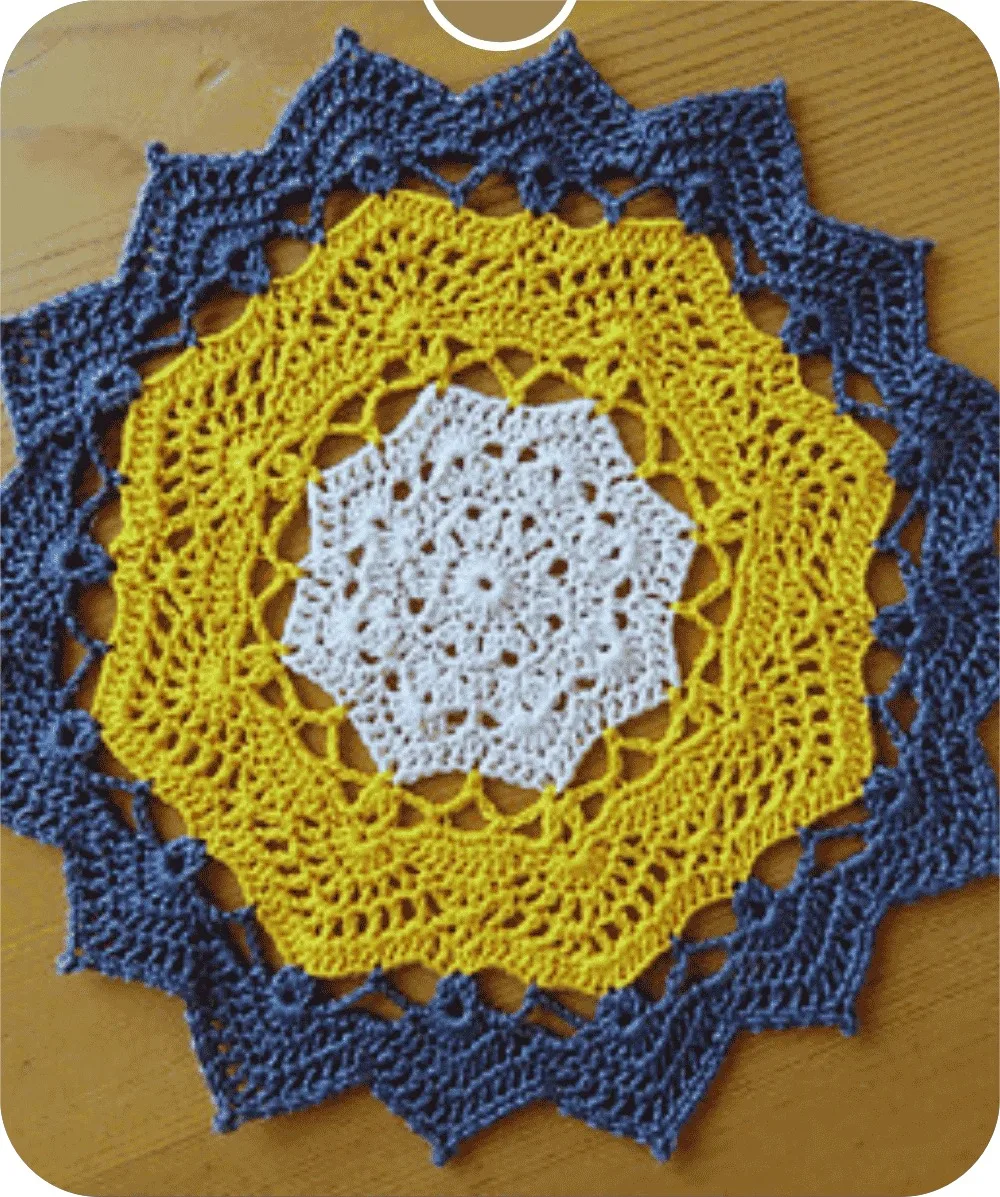
10. Crochet Spider Web Doily
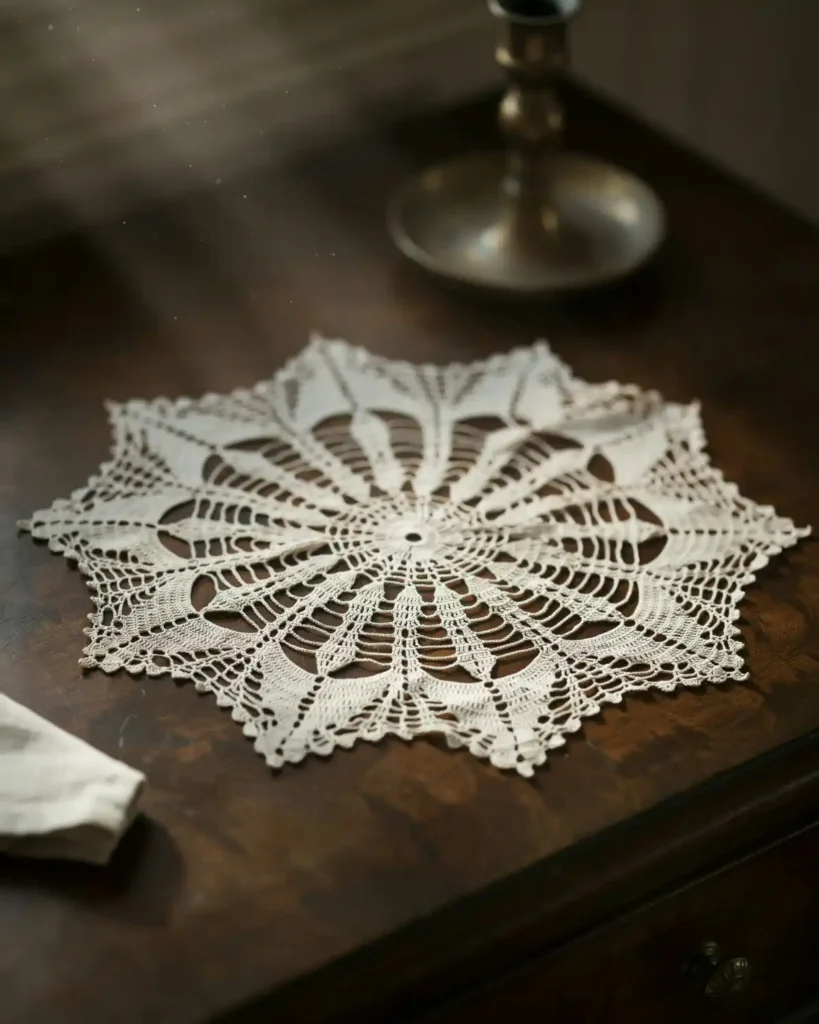
A doily is where the spider web concept starts looking elegant rather than purely seasonal.
Use fine thread, smaller stitches, and carefully shaped outer points. The design can resemble vintage lace even when the geometry still clearly suggests a web.
This is one of the best ideas if you like subtle Halloween décor that does not rely on bright orange pumpkins or novelty characters.
Blocking matters more here because every uneven chain space becomes visible in fine thread.
11. Crochet Spider Web Shawl
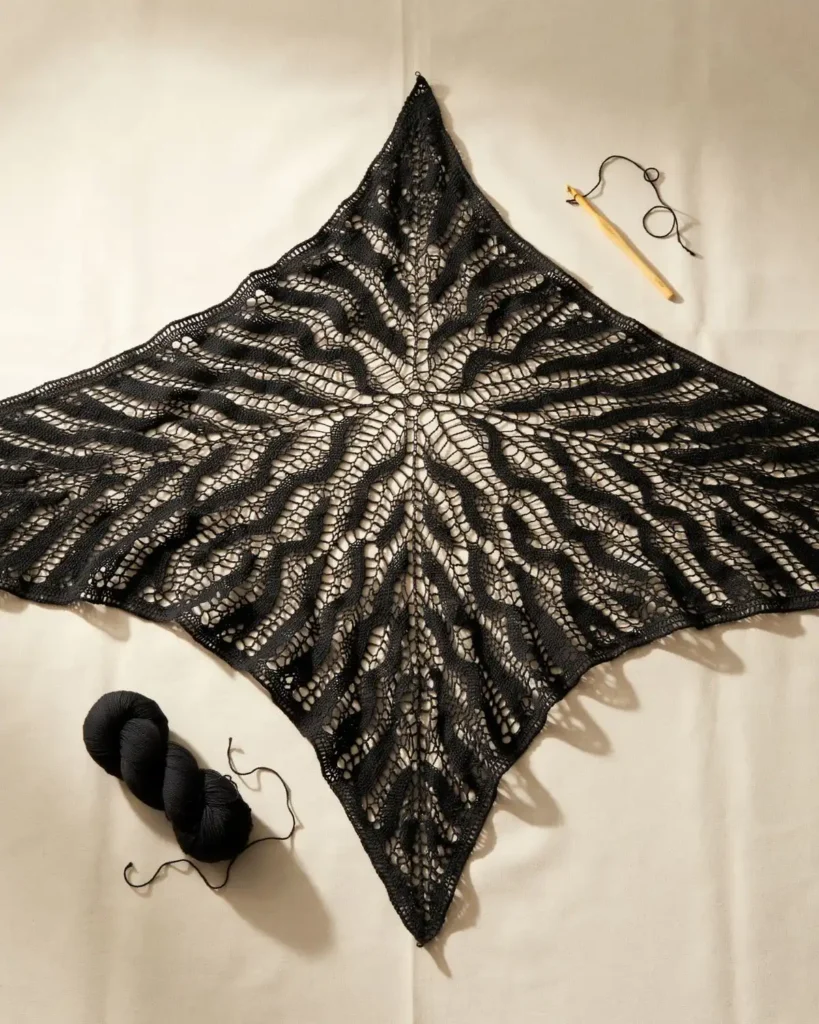
A crochet spider web shawl turns the motif into wearable lace.
Rather than building a complete circle, work outward from a central point or curved neckline and repeat web-like sections across the fabric. Fingering or sport yarn can make the open spaces look delicate while still giving the shawl enough fabric to drape.
The advantage over a solid shawl is movement. Every chain space opens slightly when the garment is worn.
Try black for gothic styling, cream for something softer, or burgundy for an autumn version that does not look costume-specific.
12. Spider Web Triangle Shawl
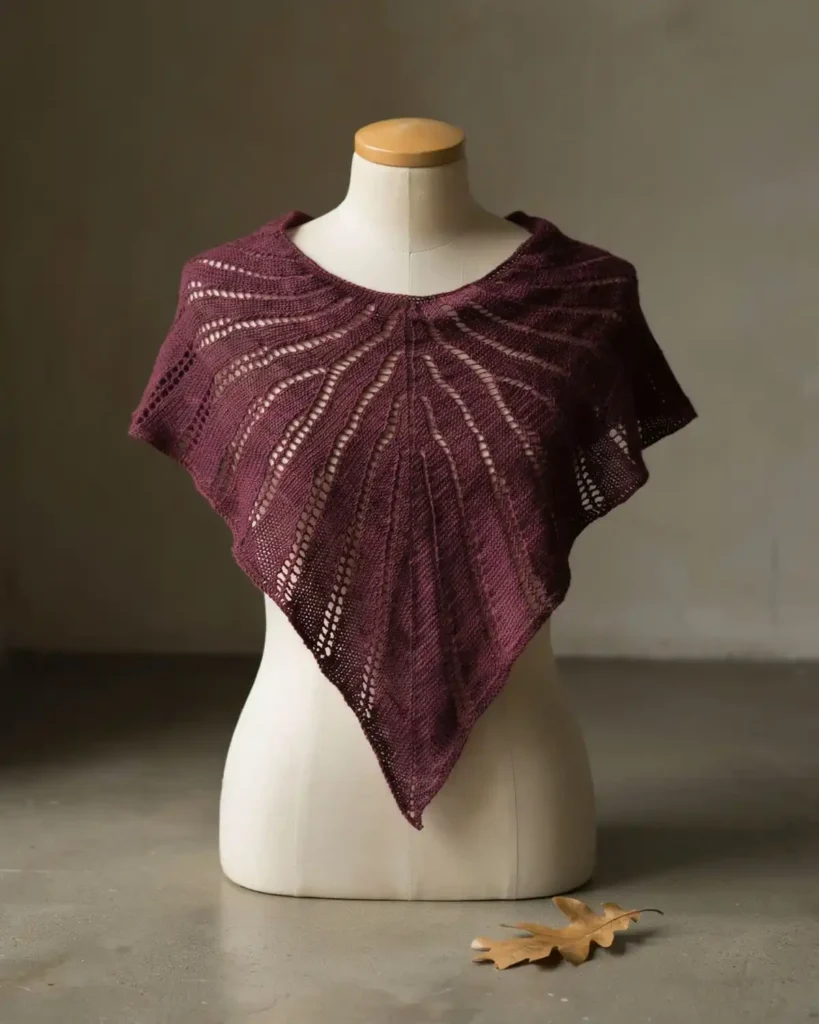
A triangle construction works naturally with web lines radiating from a center point.
The increases become part of the design instead of something you have to hide. This makes a triangle shawl an especially satisfying project once you understand how chain spaces grow.
Wear it traditionally across the shoulders or turn it forward and style it more like a scarf.
A lightly contrasting border around the final row can help define the triangular silhouette.
13. Spider Web Capelet
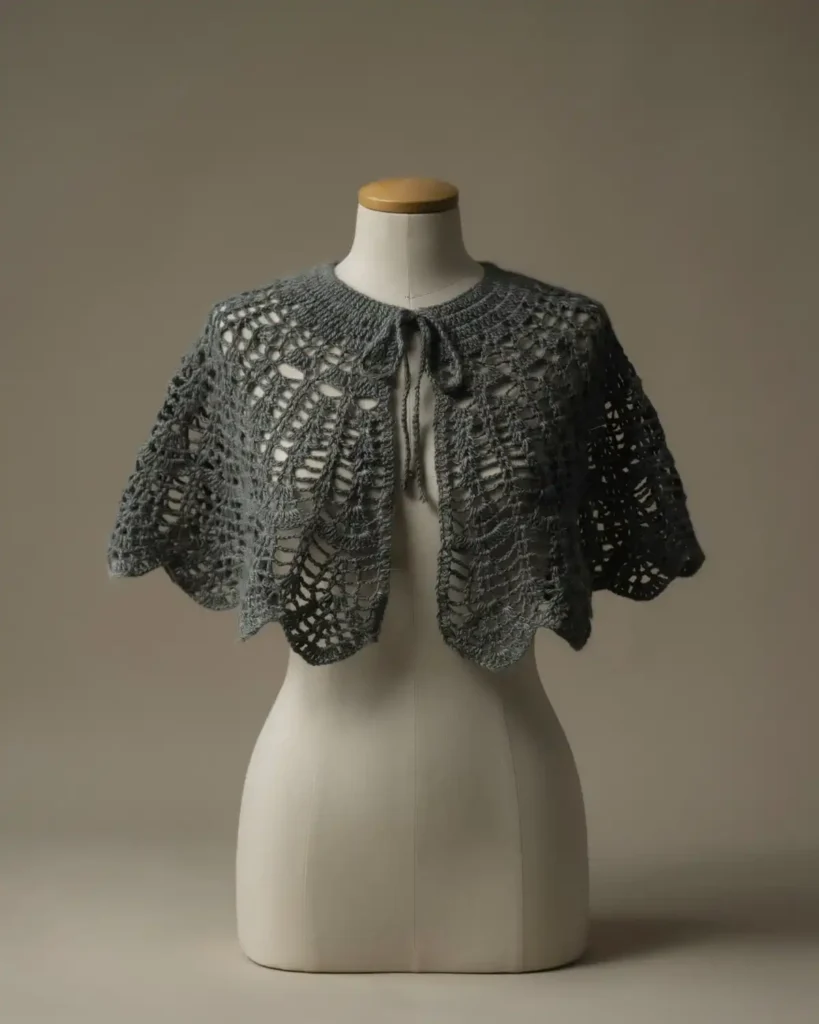
A capelet gives you the drama of a spider web shawl in a shorter, more wearable shape.
Start around the neckline and increase outward so the web appears to spread across the shoulders.
Unlike a large shawl, a capelet does not need to reach the waist to make the motif obvious. That makes it a more realistic weekend project.
Add a simple tie or button at the neck instead of complicated shaping.
14. Crochet Spider Web Sweater
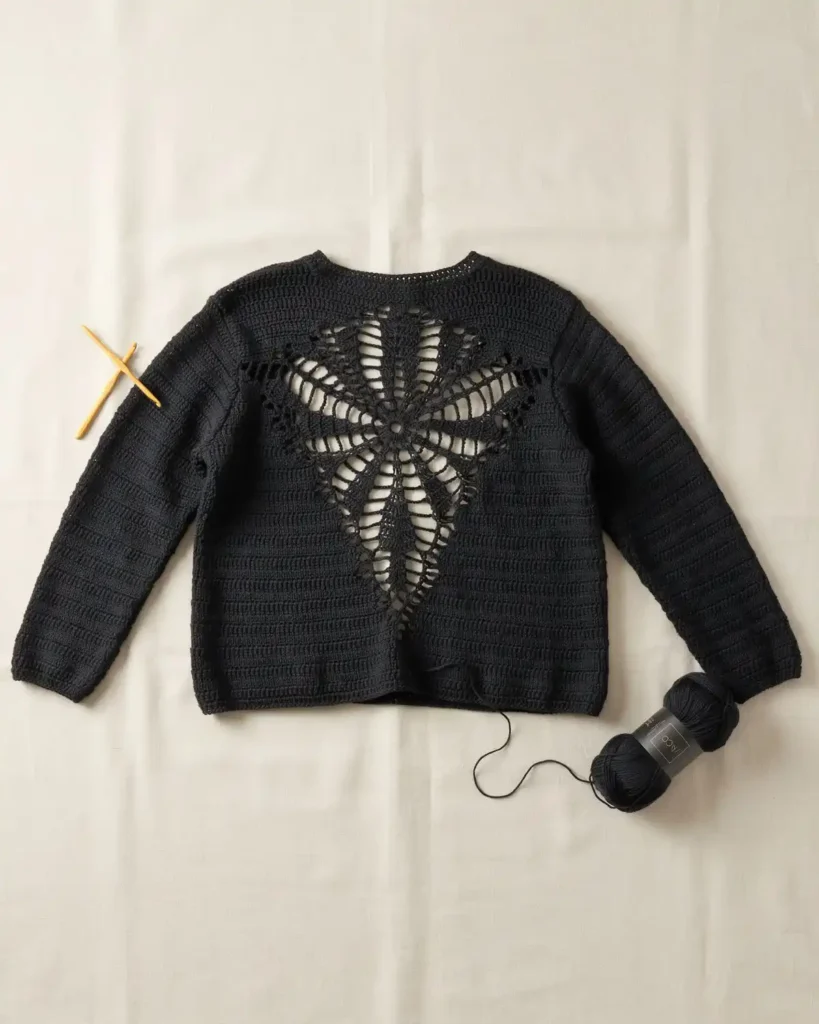
A crochet spider web sweater can turn openwork into the main feature rather than a small decorative panel.
Place a large web across the back, use smaller webs on the sleeves, or build the body from repeating lace sections. For clothing, gauge becomes much more important than it is for hanging décor.
The Craft Yarn Council specifically recommends making a gauge swatch when substituting yarn because yarns within the same weight category are not automatically interchangeable. Fiber, softness, and drape can differ even when the weight number matches.
If you want the sweater to be wearable beyond Halloween, use the spider web structure sparingly and let the silhouette stay simple.
15. Oversized Spider Web Sweater
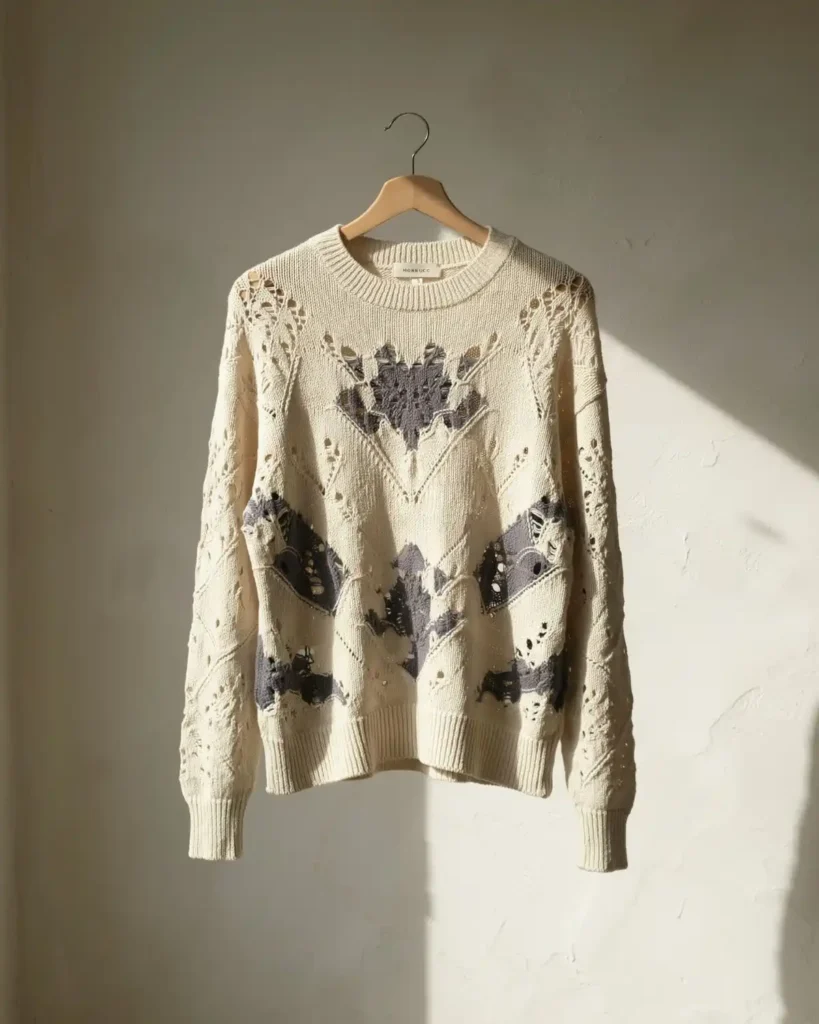
An oversized version makes the airy fabric feel casual rather than fitted.
Use generous sleeves and a boxy body, then let the open web stitches create ventilation and movement. A contrasting camisole or shirt underneath makes the pattern much easier to see.
This style works especially well when you dislike precise garment shaping.
The key is measuring the finished width rather than assuming loose stitches will behave like solid crochet fabric.
16. Crochet Spider Web Top Pattern Free Style
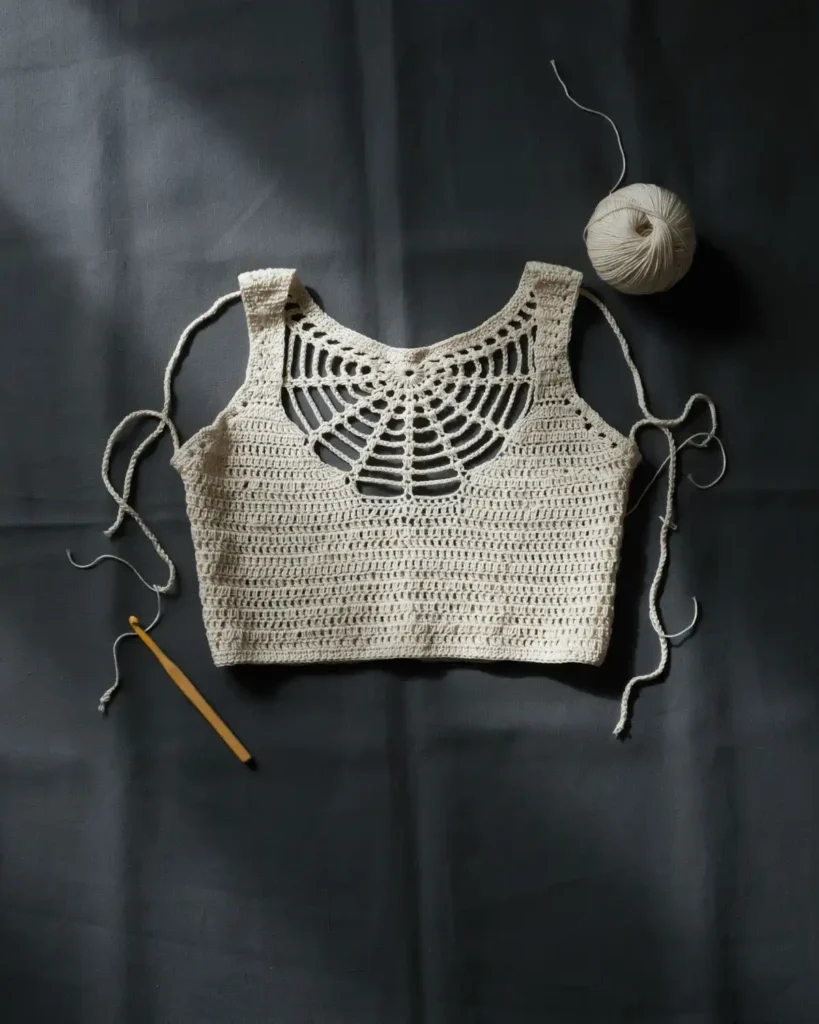
If you are searching for a crochet spider web top pattern free idea, one of the easiest approaches is a large circular or semicircular web adapted into a wearable panel.
Create matching front and back sections, or use the web only on the back and crochet a simpler front. Side ties are useful because they reduce the amount of exact sizing required.
The openwork should be treated as decorative fabric rather than full coverage.
Layer it over an ordinary top and the web becomes the focal point without requiring complicated garment construction.
17. Spider Web Crop Top
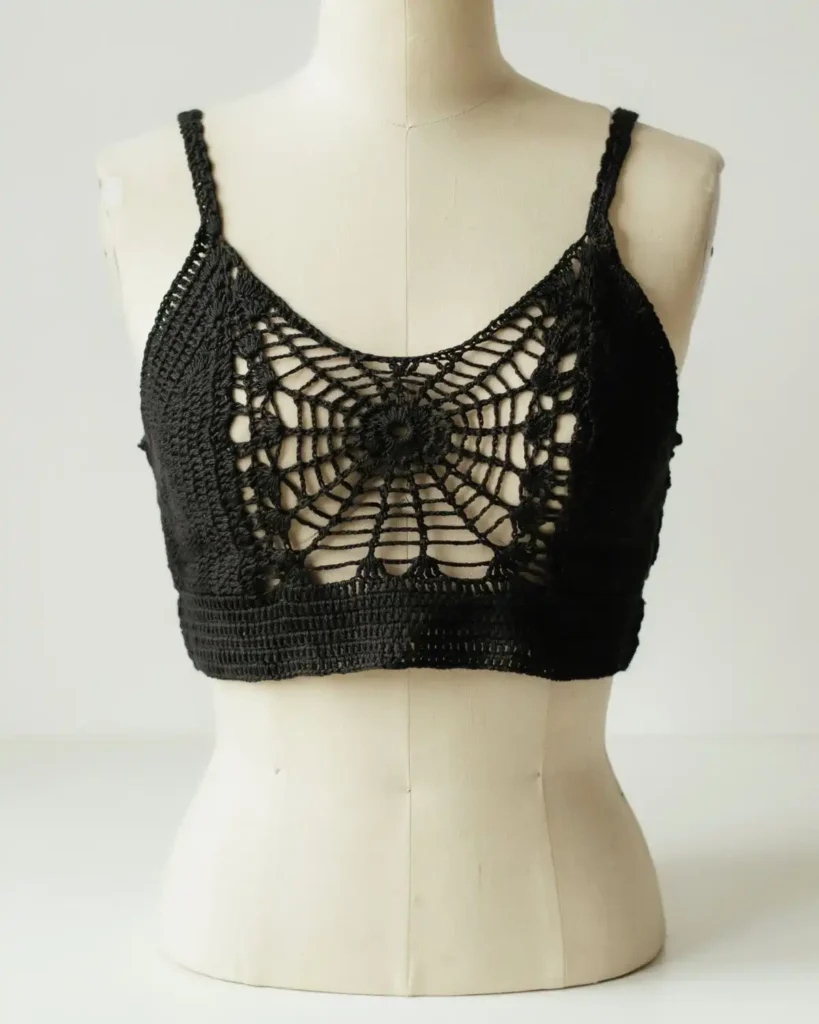
A crop top needs less fabric, so it is an approachable way to test wearable web crochet.
Keep the strongest radial section across the center or back and use more stable stitches around the neckline and straps.
I would avoid making every part equally open. A combination of solid bands and web lace usually gives the garment better structure.
Use a yarn that feels comfortable against the skin if the piece will be worn rather than simply used as a costume layer.
18. Crochet Spider Web Dress
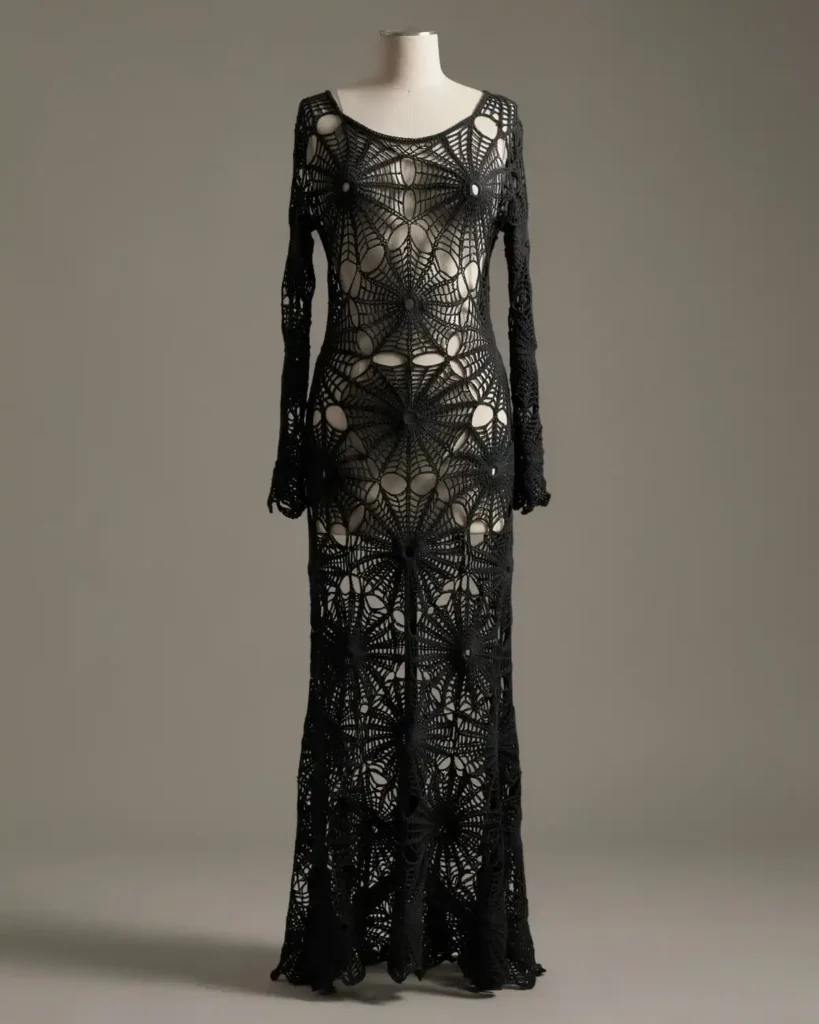
A crochet spider web dress makes the motif dramatic enough to become the entire outfit.
Instead of repeating one enormous web everywhere, combine strategic web panels with simpler mesh or solid crochet. That creates visual breaks and makes the garment easier to shape.
A short overlay can work for party styling, while a long openwork version can function as a layering piece.
This is one of the projects where making and measuring a swatch before starting is worth the extra time.
19. Spider Web Skirt Overlay
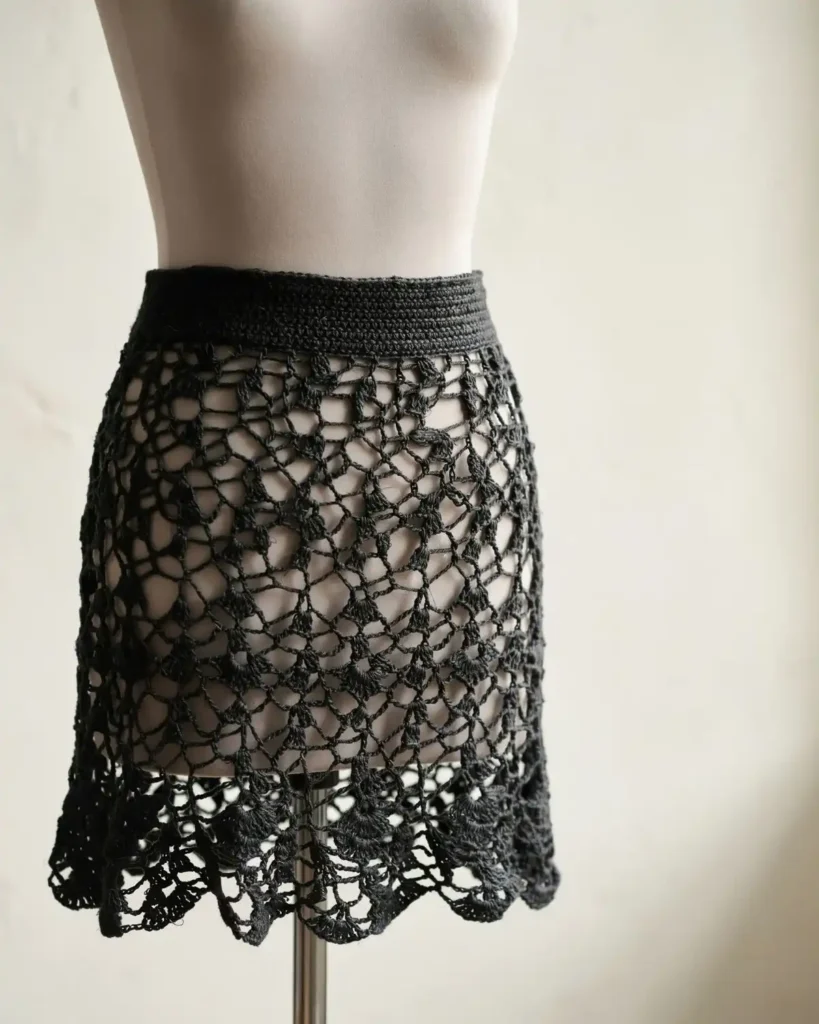
A skirt overlay gives you the look of a web dress with far less fitting.
Begin at the waistband and increase as you work downward, allowing the chain spaces to widen gradually.
Wear it over a simple skirt, leggings, or another opaque layer.
The expanding silhouette naturally complements the widening sections of a spider web, so the motif does not look forced.
20. Crochet Spider Web Sleeves
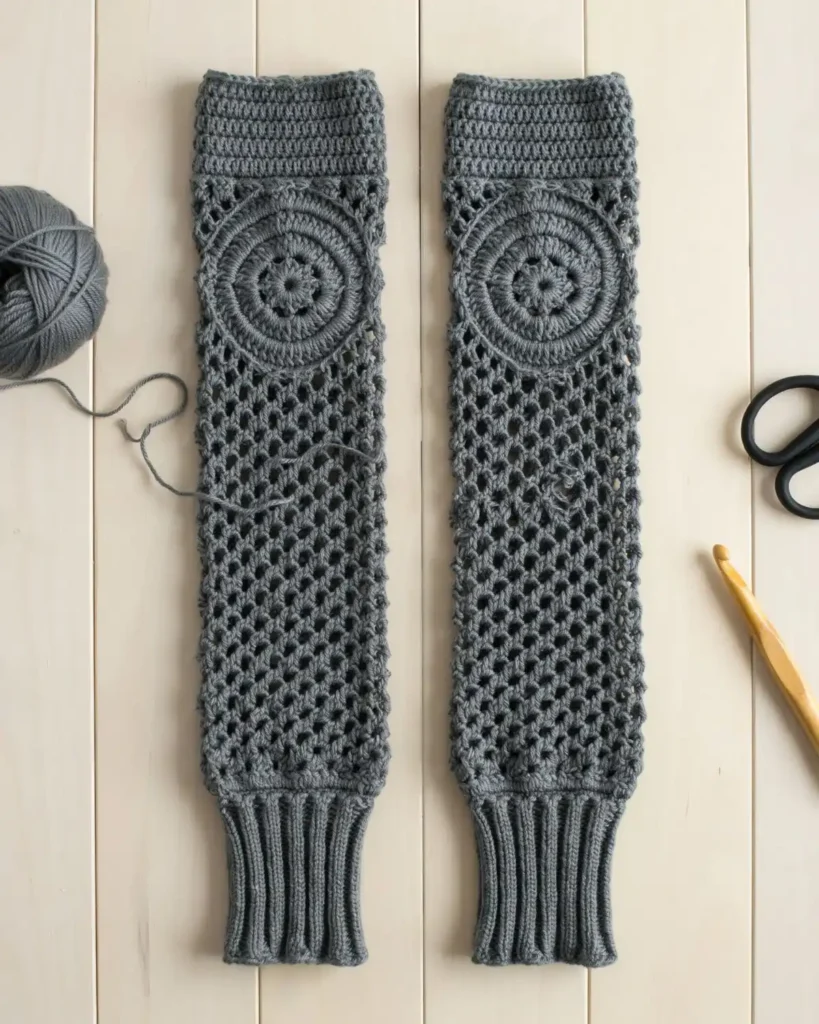
Spider web sleeves can transform a plain top without making an entire sweater.
Use circular web motifs at the elbows or build long open sections down the arms. A fitted cuff helps control all that loose lace.
This idea is particularly useful when you have leftover yarn but not enough for a complete garment.
Match the sleeve color to the base top for subtle texture, or use contrast if you want the web structure to stand out immediately.
21. Crochet Spider Web Collar
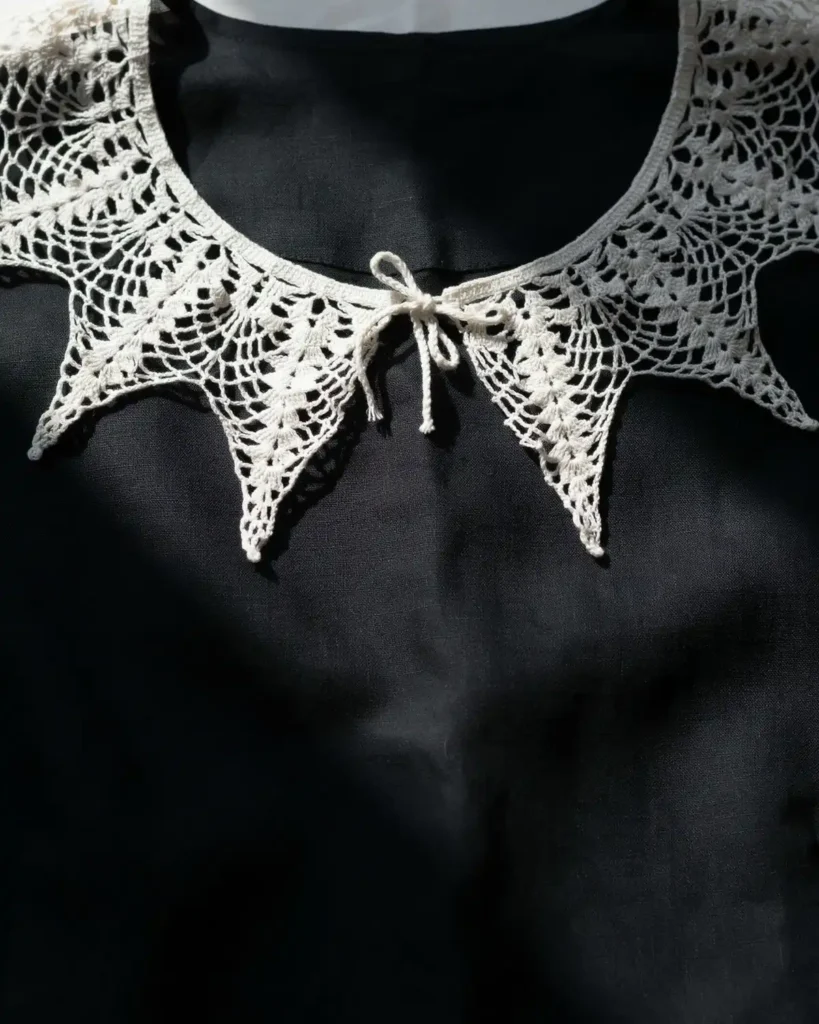
A collar is small, detailed, and surprisingly effective.
Half-web motifs can radiate from the neckline and create pointed edges around the shoulders. Fine cotton produces a crisp lace effect, while DK yarn gives the collar a bolder costume-like appearance.
Because the project is compact, it is also an excellent place to experiment with a crochet spider web diagram before tackling a larger garment.
Attach ties at the front so the collar remains removable.
22. Crochet Spider Web Cuffs
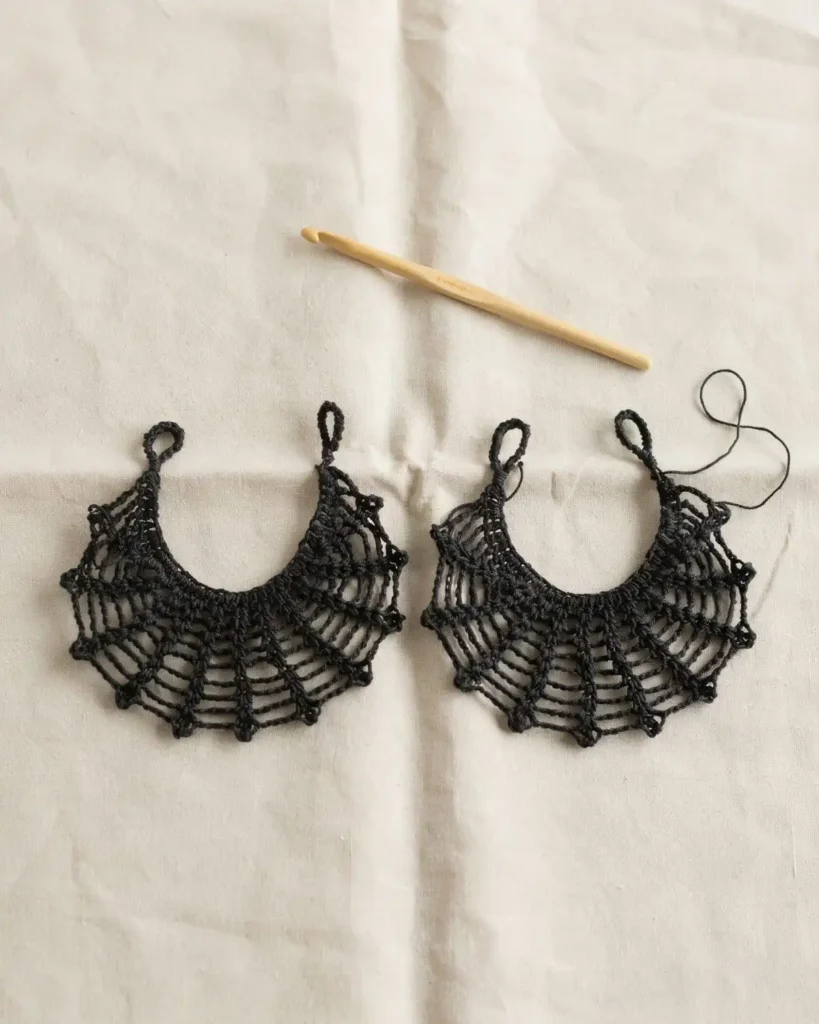
Cuffs are even quicker.
Make narrow web-inspired strips and join them around the wrist, or create a small semicircular web that flares over the hand.
These are useful when you want a handmade accessory without committing to a complete Halloween outfit.
Pair them with a matching collar and two small projects suddenly look like one coordinated set.
23. Crochet Spider Web Bag
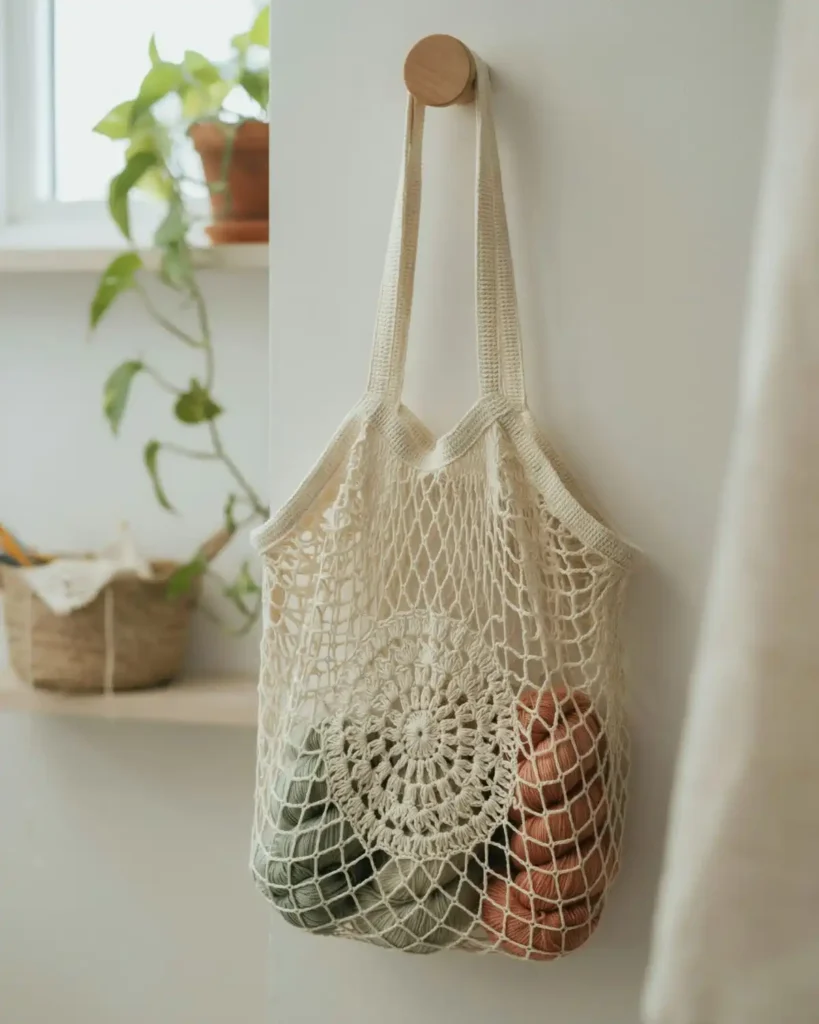
A web bag can be decorative and functional at the same time.
Crochet a sturdy inner bag first, then place an open spider web panel over it. That solves the obvious problem of small objects slipping through large chain spaces.
For a simpler version, add just one round web motif to an existing crochet tote.
A contrasting lining makes every spoke and chain section much easier to see.
24. Crochet Spider Web Market Bag
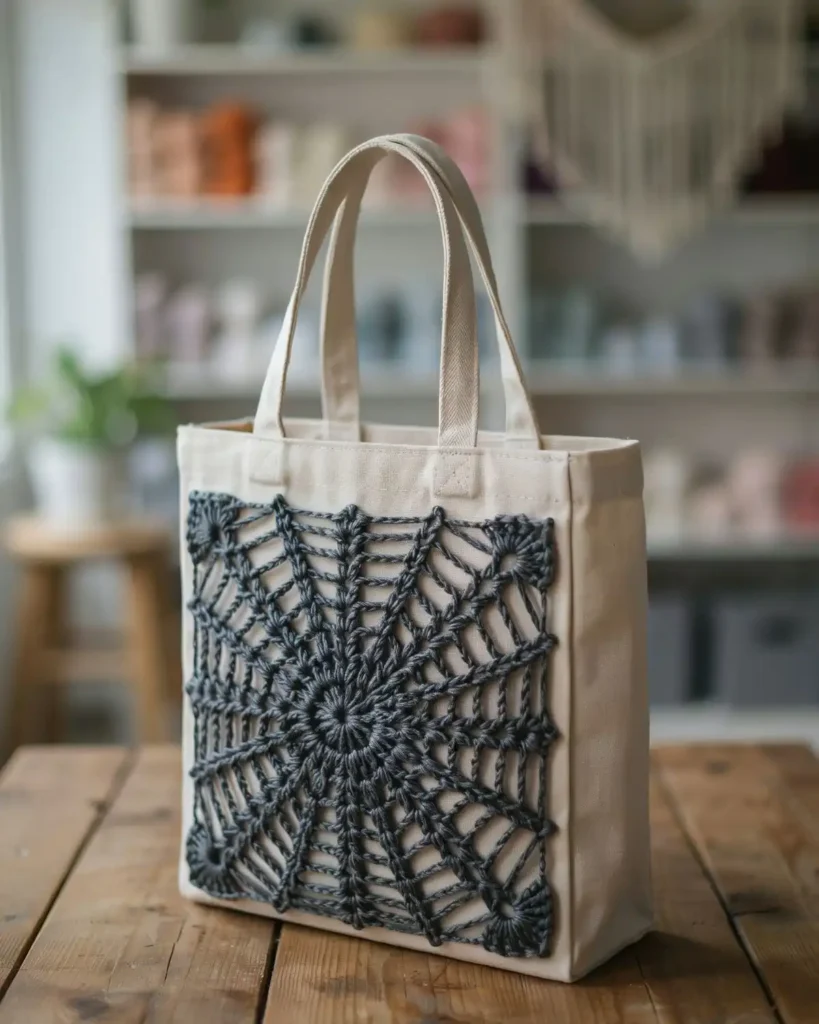
Mesh bags already use open stitches, so spider web geometry fits naturally into the design.
Instead of ordinary square mesh, let the central portion radiate outward before transitioning into handles.
This is less literal than Halloween wall décor, which means the bag can work year-round.
Choose strong yarn and reinforce the handles because decorative openwork stretches more than dense crochet.
25. Crochet Spider Web Border
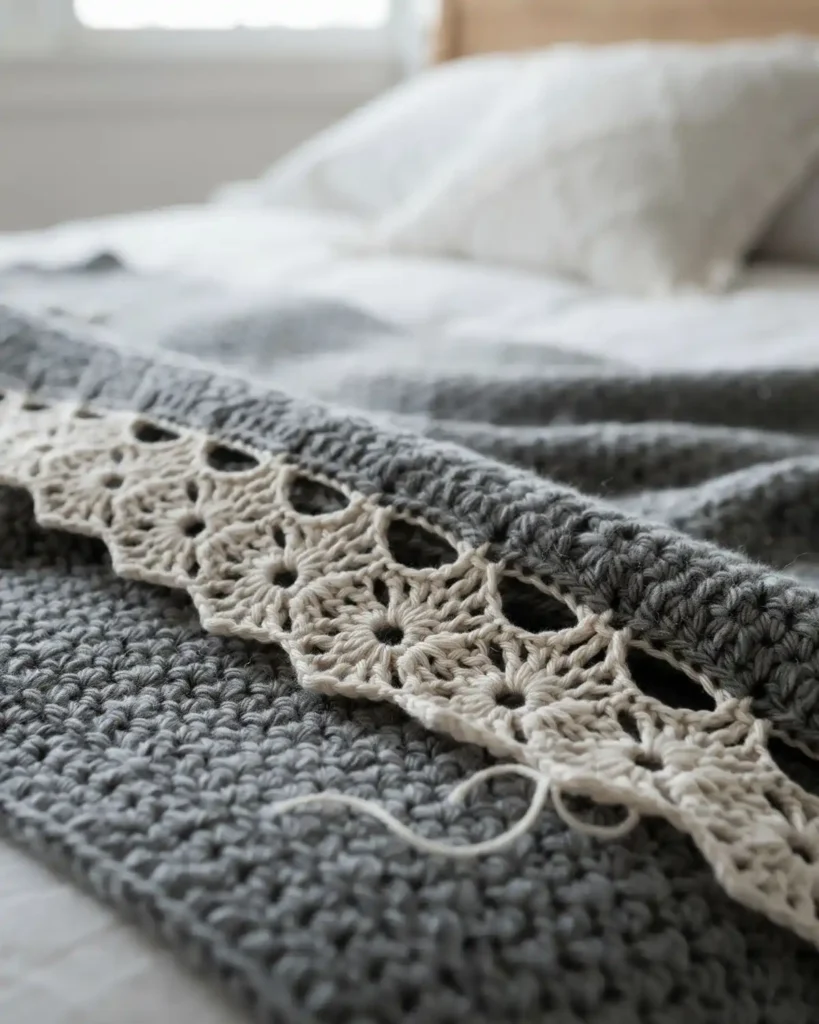
A crochet spider web border can completely change a plain project without requiring you to remake the whole thing.
Add small half-webs around a scarf, blanket edge, table runner, shawl, or sleeve cuff. Repeating arches and tall stitches create a scalloped outline that hints at spider webs even without complete circular motifs.
This is one of my favorite options for using tiny amounts of leftover yarn.
Test one repeat first so you know exactly how much space each web needs along the edge.
26. Spider Web Blanket Corner
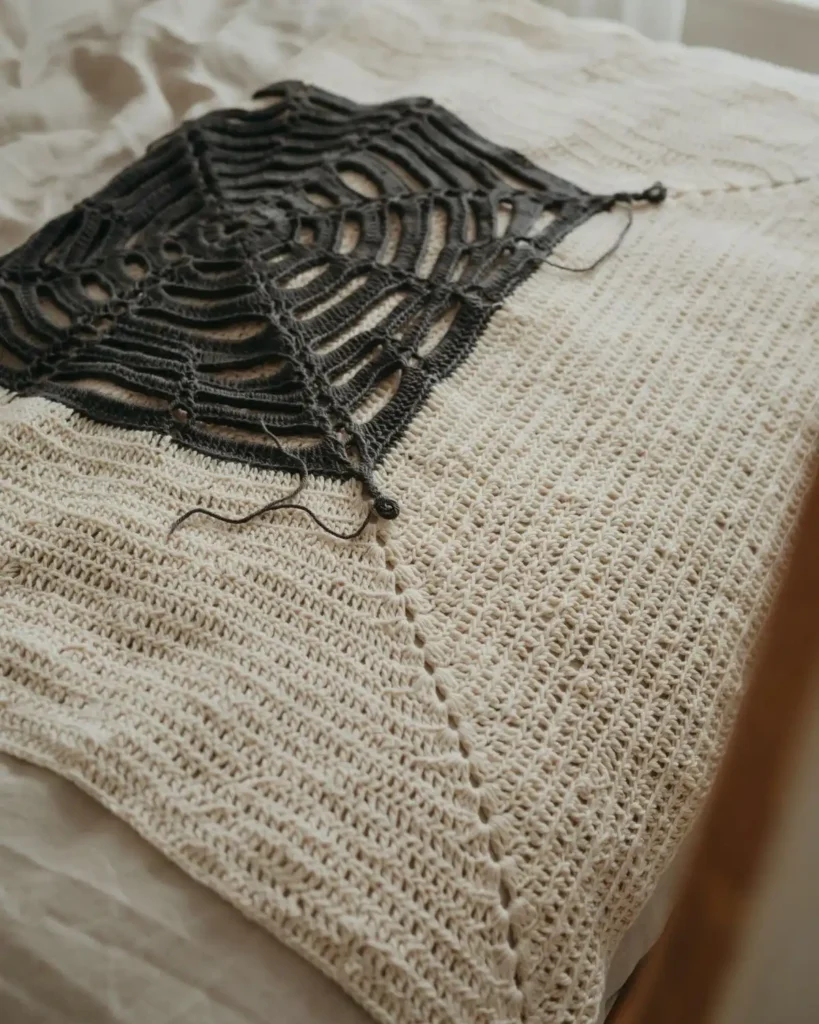
Instead of covering an entire blanket with web motifs, decorate only the corners.
Large quarter-web sections can spread inward from two or four corners while the center remains simple.
That contrast makes the detail look intentional and keeps the blanket from becoming overly busy.
It is also easier to adapt to different blanket sizes because the web does not need to span the complete width.
27. Crochet Spider Web Pillow Cover
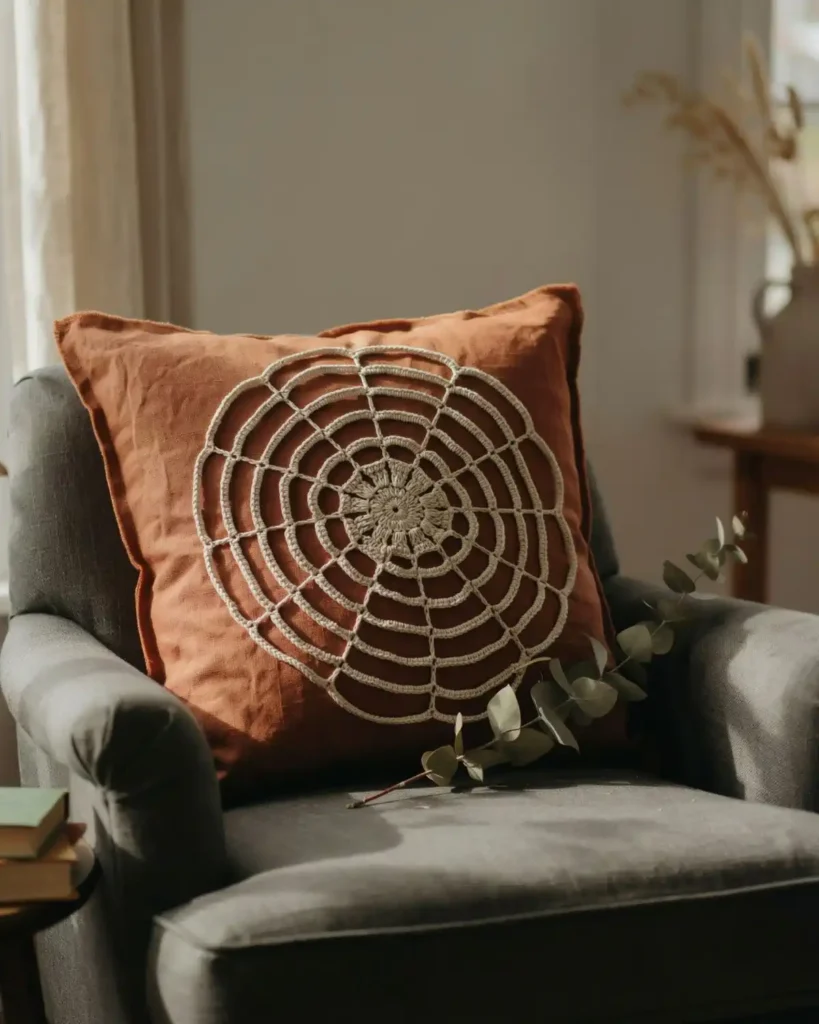
A pillow gives your web a built-in contrasting background.
Crochet one large circular web and stitch or tie it over a plain cushion cover. You could also create the web directly as the front panel and place fabric behind it.
This is more comfortable than using stiffened web decorations around seating areas.
Try cream over black, black over rust, or charcoal over muted orange for a less cartoonish Halloween palette.
28. Framed Crochet Spider Web Art
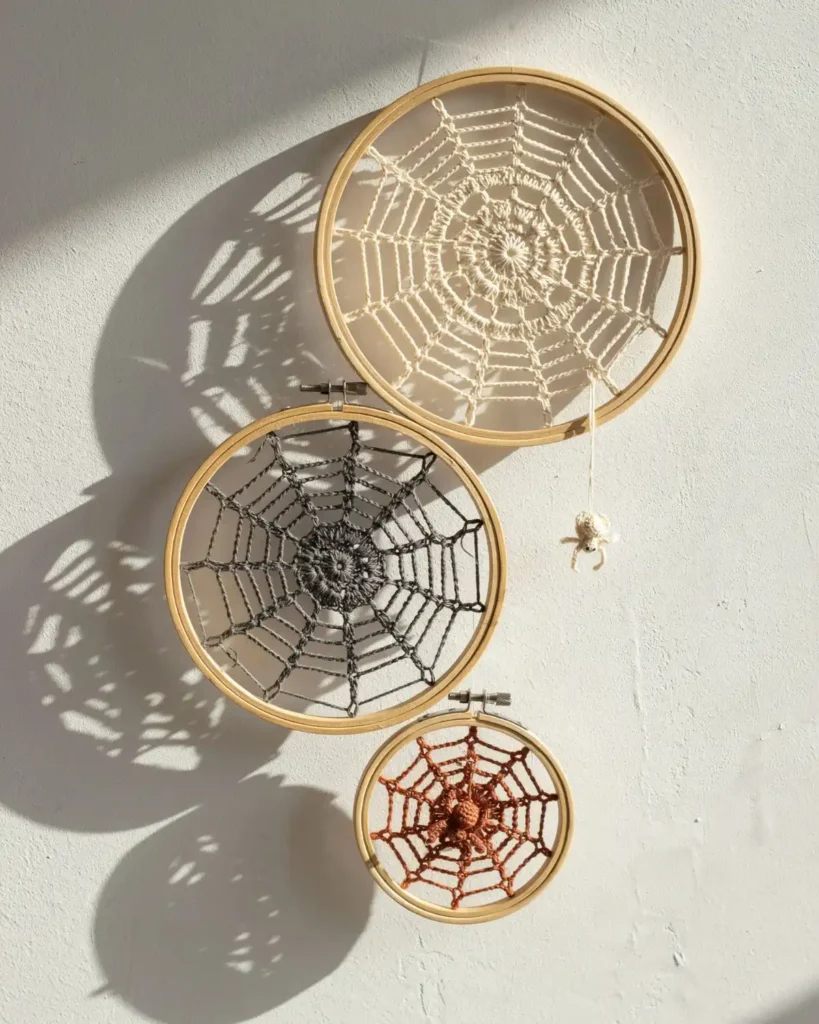
A frame turns a small crochet web into something that feels finished.
Stretch the web inside an embroidery hoop, wooden frame, or simple geometric support. Because the piece is held under tension, the shape stays visible without relying entirely on blocking.
This is particularly useful for delicate thread crochet.
Make three different sizes and hang them together instead of trying to fill the wall with one giant motif.
29. Glow Effect Crochet Spider Web
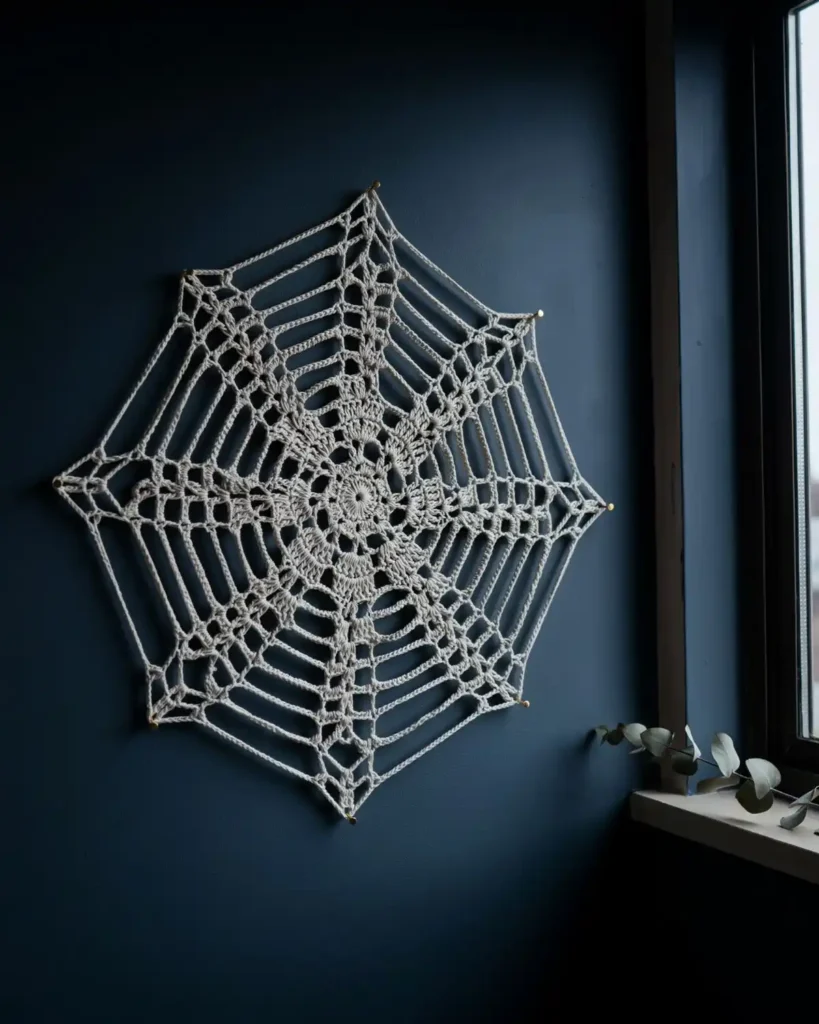
A web becomes much more dramatic when the yarn itself creates visual contrast.
One Little Project suggests glow-in-the-dark yarn as an option for a spooky variation. You could also simply use very pale yarn against a dark surface to create a similar high-contrast effect without changing the pattern itself.
I would keep the crochet pattern simple here because unusual yarn already attracts attention.
Use this idea for a window piece, party backdrop, or statement wall decoration.
30. Multi-Color Scrap Yarn Spider Web
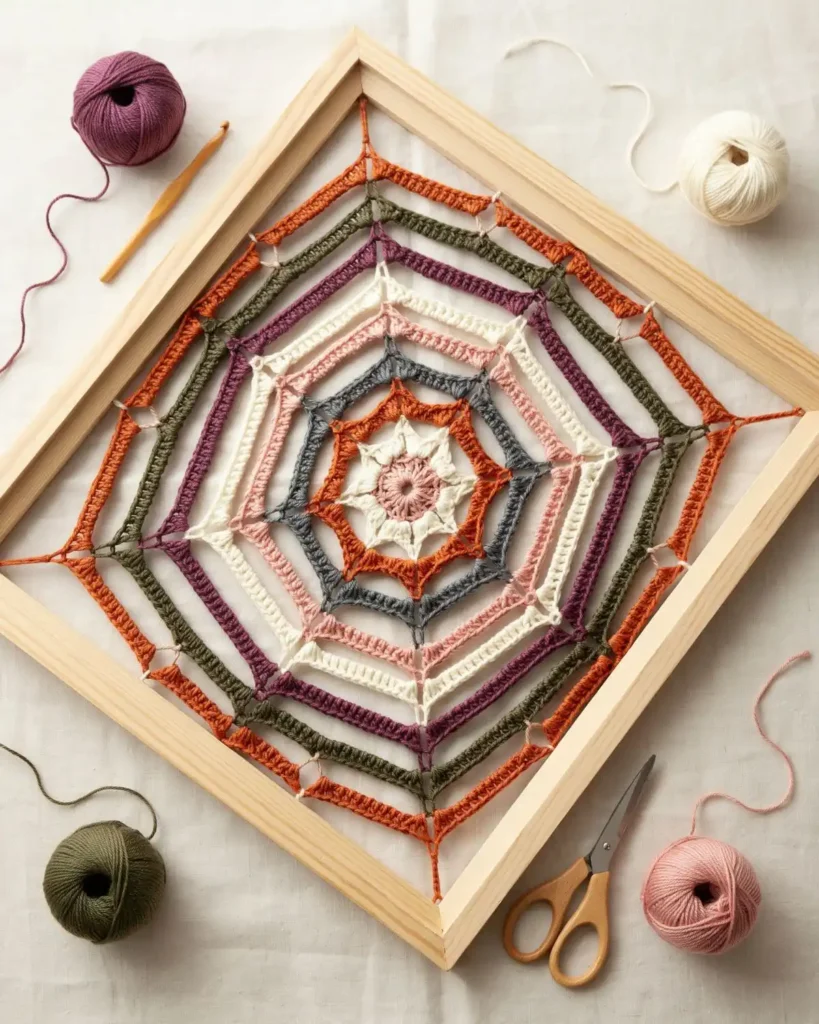
The final idea is also the easiest one to personalize.
Change color every few rounds and let leftover yarn determine the design. Instead of imitating a realistic cobweb, you end up with something closer to graphic fiber art.
This is ideal when your stash contains several small amounts that are not enough for separate projects.
Keep the yarn weights reasonably similar, or deliberately use different thicknesses if you want a more irregular handmade look.
How Do You Read a Crochet Spider Web Diagram?
Read a crochet spider web diagram from the marked starting point outward, following the stitch symbols and repeated spoke-and-chain structure.
At a Glance
- Find the center or starting symbol.
- Identify the repeated spokes.
- Count chains between each spoke.
- Follow round or row direction carefully.
A crochet spider web diagram typically represents stitches with standardized symbols arranged in circles, arcs, or rows. Start at the center or marked beginning and follow the symbols outward in the direction shown by the chart.
Written abbreviations can help you confirm what you are seeing. The Craft Yarn Council’s U.S. terminology list includes common abbreviations such as ch for chain, sc for single crochet, and standard abbreviations for taller stitches.
For a web, pay particular attention to three things.
- The number of radial spokes
- The number of chains between spokes
- Where each tall stitch is anchored
Once you recognize that repeating structure, the diagram becomes much less intimidating.
What Yarn Is Best for a Crochet Spider Web?
Choose yarn according to the effect you want, with fine yarn creating delicate lace and thicker yarn producing a bolder, more visible web.
At a Glance
- Use thread for intricate lace.
- Try fingering yarn for lightweight wearables.
- Choose DK for balanced structure and drape.
- Use worsted yarn for bold decorations.
There is no single best yarn because the right choice depends on the finished project.
Fine thread or fingering yarn creates delicate lace. DK and worsted make the web more visible and easier to handle. One Little Project notes that sport and DK can produce a thinner web-like appearance, while its own example also works in worsted yarn.
For comparison, the Craft Yarn Council’s system identifies DK or light worsted as category 3 and worsted, Afghan, or Aran as category 4. Recommended hook sizes vary by weight, but those ranges are guidelines rather than fixed rules.
For decorative webs, I often prefer slightly more open tension because empty space is part of the design.
What Crochet Hook Should You Use?
Start with the crochet hook size recommended for your yarn or pattern, then adjust the size if you want tighter stitches or a more open web.
At a Glance
- Smaller hooks create tighter fabric.
- Larger hooks open chain spaces.
- Use metric sizing for easier comparison.
- Swatch wearable projects before committing.
Start with the hook recommended for your yarn and pattern, then adjust if necessary.
A smaller hook generally creates tighter fabric. A larger hook tends to open the chain spaces and produce more drape. The Craft Yarn Council recommends relying on millimeter measurements because U.S. hook letters and numbers can vary among manufacturers.
For reference, published spider web projects vary substantially. Delia Creates uses a 4.5 mm hook with worsted cotton, while another published spider web example from DROPS uses a 4 mm hook with a finished measurement of about 40 cm across.
That variation is useful. It shows that the spider web idea is a construction method, not one fixed yarn-and-hook formula.
Do You Need to Block a Crochet Spider Web?
Blocking is usually helpful because it opens the chain spaces and helps the spokes sit in a cleaner, more symmetrical shape.
At a Glance
- Block webs that will lie flat.
- Stretch spokes evenly.
- Follow yarn care instructions.
- Skip separate blocking when permanent tension shapes the piece.
Usually, blocking improves the result considerably.
Open crochet can look compressed when it comes off the hook. Stretching and blocking allows the spokes and chain spaces to open into the shape you intended. Creativebug’s spider web tutorial specifically notes that the project comes to life when blocked or placed under tension.
If the web will be permanently stretched across a window or frame, that tension may shape it naturally. One Little Project similarly notes that a wall or window web may not require separate blocking, while a flat or freely hanging web benefits from it.
Always consider the care instructions for your specific yarn before applying heat or another treatment.
How Can You Make a Crochet Spider Web Bigger?
Continue the established increase pattern while gradually expanding the spaces between the web’s spokes.
At a Glance
- Follow the existing increase sequence.
- Add chain space gradually.
- Check that the web stays flat.
- Adjust if the fabric cups or ruffles.
The simplest method is to continue the established increase sequence.
In many web patterns, the tall stitches remain aligned as spokes while the chain spaces between them become progressively longer. One Little Project describes increasing the chains between triple crochets to continue enlarging its round design.
Do not assume every pattern uses the same mathematical increase. Follow the logic of the pattern you are working from and lay the web flat periodically to check for ruffling or pulling.
If it ruffles badly, you may be adding space too quickly. If it cups inward, you may not be adding enough.
FAQ About Crochet Spider Web Patterns
Is a crochet spider web beginner friendly?
Yes. Many web patterns use only chains, slip stitches, single crochet, and one taller stitch. Delia Creates specifically describes its bunting version as beginner friendly and builds it from a small group of stitches.
A simple crochet spider web pattern is usually the easiest place to begin because the repeating structure lets you practice chains, tall stitches, and increases without complicated shaping.
Can I make a spider web with worsted yarn?
Yes. Worsted yarn creates a thicker and more visible web than thread or fingering yarn. Both Delia Creates and One Little Project demonstrate spider web projects using worsted-weight yarn.
It is particularly useful for wall decorations, bunting, and a crochet spider web garland where you want the individual motifs to remain easy to see.
Can I turn one web pattern into a garland?
Usually, yes. Make multiple small or half-web motifs, then connect them along a crocheted chain or cord. Ravelry’s Half Spiderweb listing specifically describes joining multiple motifs to create a garland.
A crochet spider web garland can be customized by changing motif size, spacing, yarn color, or the number of webs along the cord.
How do I keep a crochet spider web from curling?
First check that your increases are correct. Then gently block the finished piece so the spokes and chain spaces are stretched evenly.
If the web continues to curl, compare your stitch count and chain-space increases with the pattern before changing hook size or tension.
Can I use a crochet spider web pattern for clothing?
Yes, but clothing requires more attention to gauge, fit, stretch, and coverage than decorative webs. Swatch first, especially if you substitute yarn.
The same openwork idea can be adapted into a crochet spider web shawl, crochet spider web sweater, crochet spider web dress, or layered top.
Final Thoughts
A crochet spider web is one of those patterns that becomes much more useful once you stop thinking of it as a single Halloween decoration.
One basic openwork structure can become a wall hanging, garland, border, shawl, crochet spider web sweater, crochet spider web dress, collar, bag, pillow, or framed piece. Change the shape from full circle to half circle, adjust the yarn and hook, and the same visual idea takes on an entirely different personality.
For CrochetMind, I would start with the simple round web or garland, then experiment with wearable versions once the increases feel familiar.
The most useful habit is not memorizing one pattern. It is learning how the spokes, chain spaces, and increases work together. Once you understand those three pieces, you can start designing webs that fit your own projects.

![The Best 30+ Free Crochet Cat Patterns [Beginner-Friendly Guide]](https://crochetmind.com/wp-content/uploads/2025/04/1-The-Best-30-Free-Crochet-Cat-Patterns-Beginner-Friendly-Guide.webp)