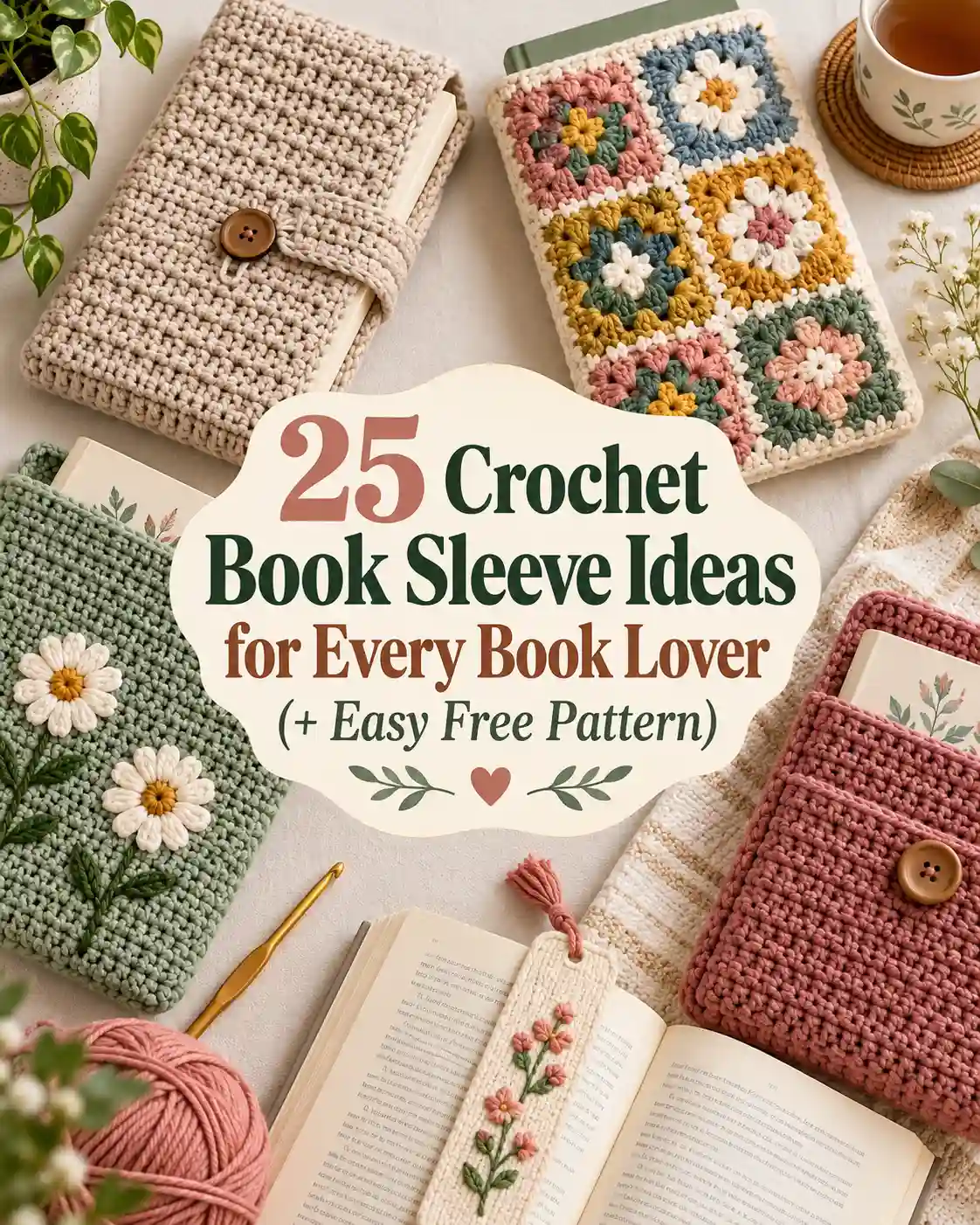
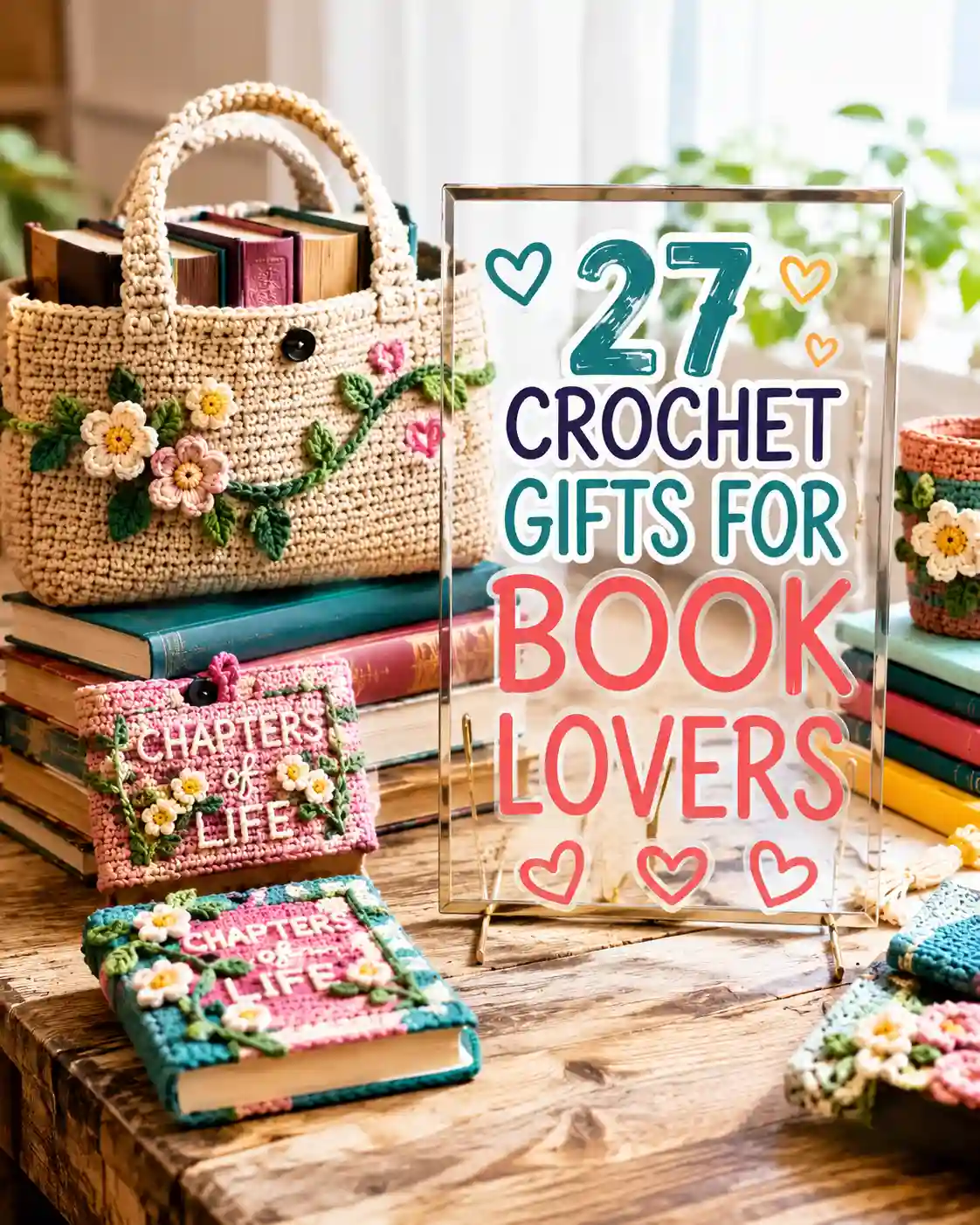
A crochet book sleeve is a soft, handmade pouch that keeps a paperback, hardcover, or e-reader separated from the everyday clutter in your bag. These 25 crochet book sleeve ideas range from easy single-crochet designs to granny squares, floral details, pockets, and secure closures, plus an adjustable beginner pattern you can make to fit your own book.
Maybe you carry a paperback everywhere. Maybe your current read lives at the bottom of a tote with your keys, lip balm, and notebook. Either way, a crocheted sleeve makes that little reading routine feel more intentional, and gives you a lovely excuse to use the yarn you already have.
A sleeve can help reduce everyday rubbing and scuffs, but it is not waterproof, rigid, or crush-proof. For the best result, choose a fairly close stitch, measure the actual book, and avoid bulky decorations on the inside.
Key Takeaways
- Measure your book before choosing a sleeve size.
- Try the Crochet book sleeve free pattern below.
- Explore granny squares, appliqués, and colorful stitch designs.
- Add pockets, buttons, or lining for practical details.
- Choose dense stitches and check the fit before finishing.
Which Crochet Book Sleeve Ideas Should You Try?
Start with a single-panel sleeve for easy construction, choose granny squares or appliqués for decorative styles, or add pockets and closures for everyday practicality.
At a Glance
- Beginners: Start with a folded rectangle and simple stitches.
- Creative designs: Explore granny squares, flowers, and colorwork.
- Crochet book sleeve with pocket: Store slim bookmarks or reading notes.
- Everyday use: Consider secure closures and smooth interior fabric.
There is no single right style. Start with a plain rectangle if you are new to crochet; try granny squares if you enjoy motifs; or choose a button, pocket, or fabric lining if you want more function.
| Style | Best for | Skill level | Detail to plan |
|---|---|---|---|
| Single-panel sleeve | First-time makers | Beginner | Measure before seaming |
| Granny square sleeve | Colorful, customizable designs | Confident beginner | Close gaps or add lining |
| Checkered sleeve | Bold, modern colorwork | Intermediate | Keep yarn changes tidy |
| Button or envelope sleeve | A more secure opening | Beginner–intermediate | Position closure away from pages |
| Lined or double-layer sleeve | Smoother interior, added fabric | Intermediate | Allow room for extra thickness |
| Kindle sleeve | An e-reader rather than a book | Beginner–intermediate | Measure the device and any case |
25 Crochet Book Sleeve Ideas for Every Book Lover
1. Is a Simple Single-Panel Book Sleeve the Easiest Place to Start?
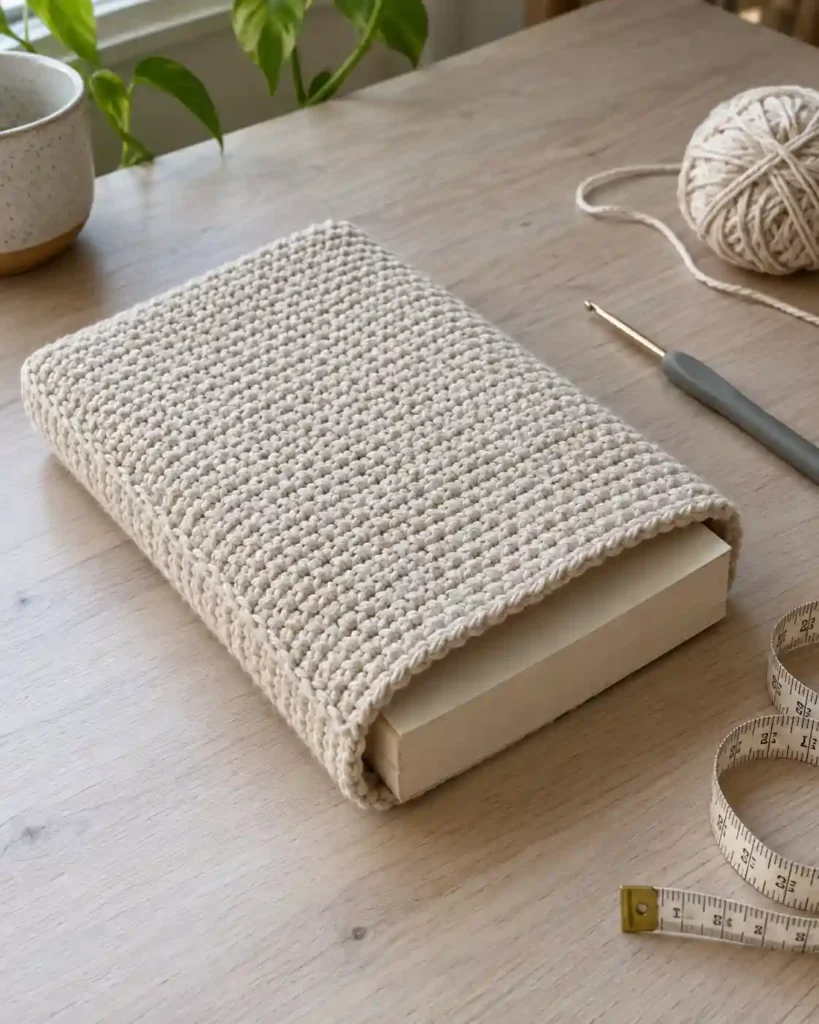
A simple single-panel book sleeve turns one long piece of crochet into a useful pouch. There is no complicated shaping or motif joining, so you can focus on keeping the stitches neat. I would choose an oatmeal or sage cotton yarn for something that looks good beside almost any book cover. It is a lovely first project when you want a finished accessory without learning five new techniques.
Work a dense rectangle, fold it in half, and seam the two sides. Keep the opening clear so the book slides in easily. You will find an adjustable version of this construction in the free pattern below.
2. Sturdy Two-Panel Book Sleeve
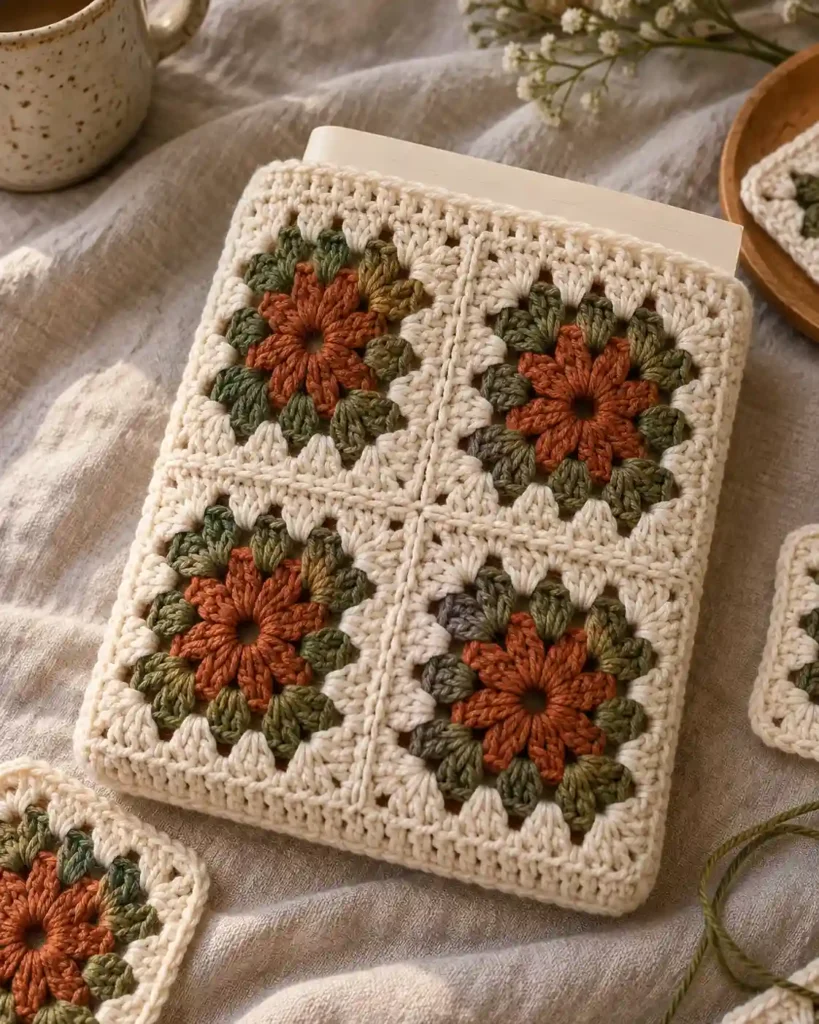
Two separate rectangles make the front and back of this sturdy book sleeve, giving you control over both sides. Compared with one folded panel, the construction makes it easier to add different colors or a front decoration before assembly. It suits a paperback you take on a daily commute, especially if the fabric is tightly stitched. Choose this approach when you care more about a neat shape than working everything in one piece.
Make the panels the same size, check them against the book, and seam along three edges. Reinforce the lower corners, and keep any decorative stitches flat on the inside.
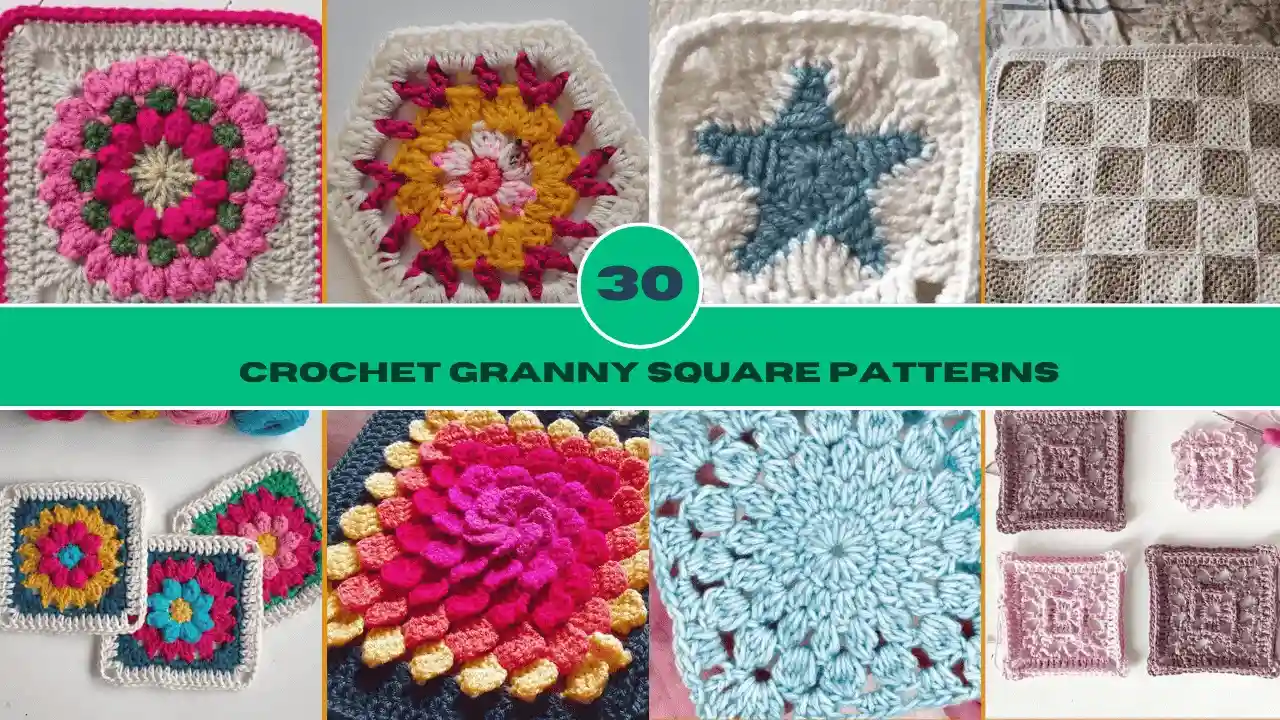
3. Why Choose a Classic Granny Square Crochet Book Sleeve?
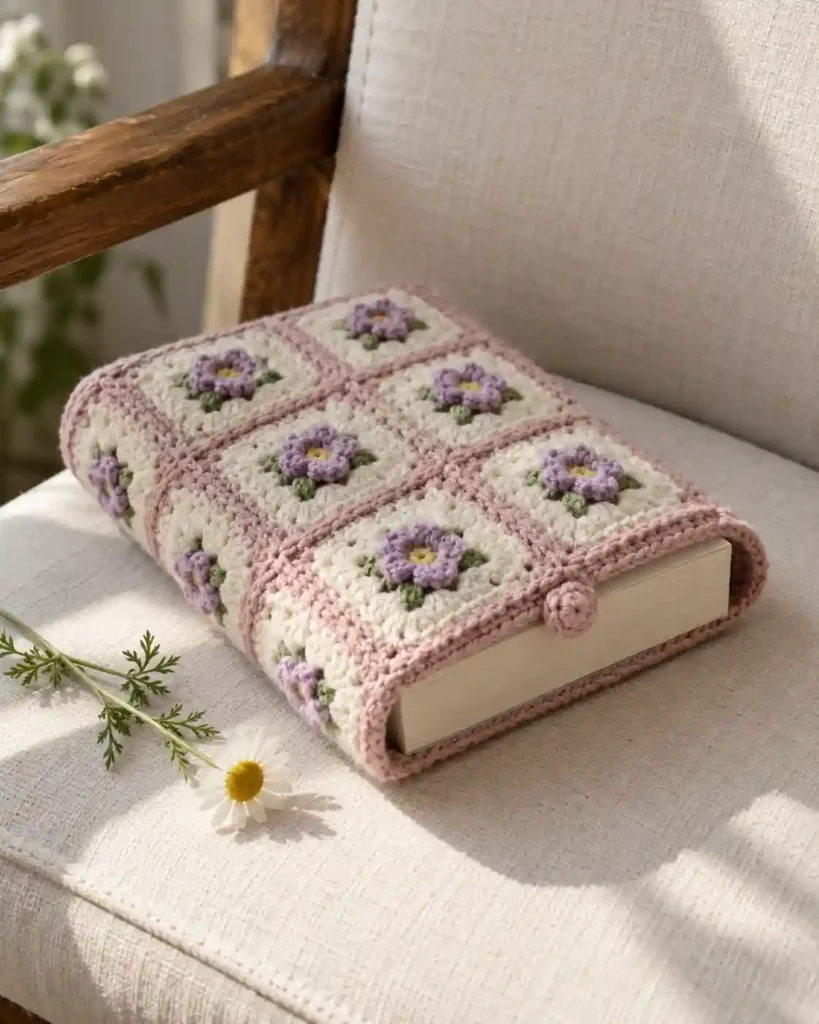
A classic granny square crochet book sleeve feels cheerful before you even add a book. Each square is a small opportunity to play with color, rather than committing to one shade for a whole project. Picture cream, moss, and rust squares tucked into a canvas tote for an afternoon at the library. This is a good fit for crocheters who love portable motifs and want a sleeve that feels personal.
Arrange finished squares in a grid before joining, then check the finished panel dimensions. Explore crochet granny square patterns for more motif options, and consider a close-stitch backing or fabric lining if you do not want book corners catching in the gaps.
4. Sunburst Granny Square Book Sleeve
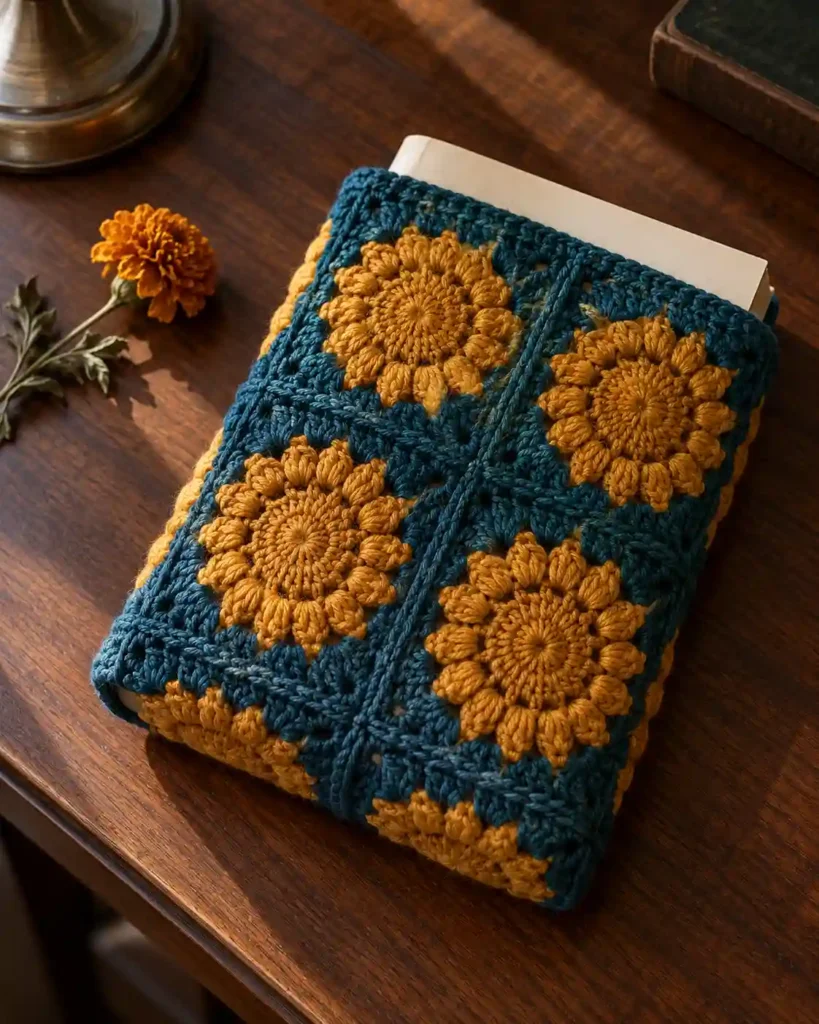
Sunburst squares bring a warm, flower-like center to an otherwise geometric sleeve. Their raised rounds create more depth than a traditional granny square, which is beautiful in photographs but adds thickness. I like this look in ochre and deep teal on a cozy autumn reading day. Try it when you enjoy textured motifs and do not mind taking extra care around the sleeve opening.
Place the puffed centers away from the top edge so the mouth stays flexible. Block the squares to a consistent size before joining them.
5. Could a Floral Granny Square Book Sleeve Be Your Next Cottagecore Project?
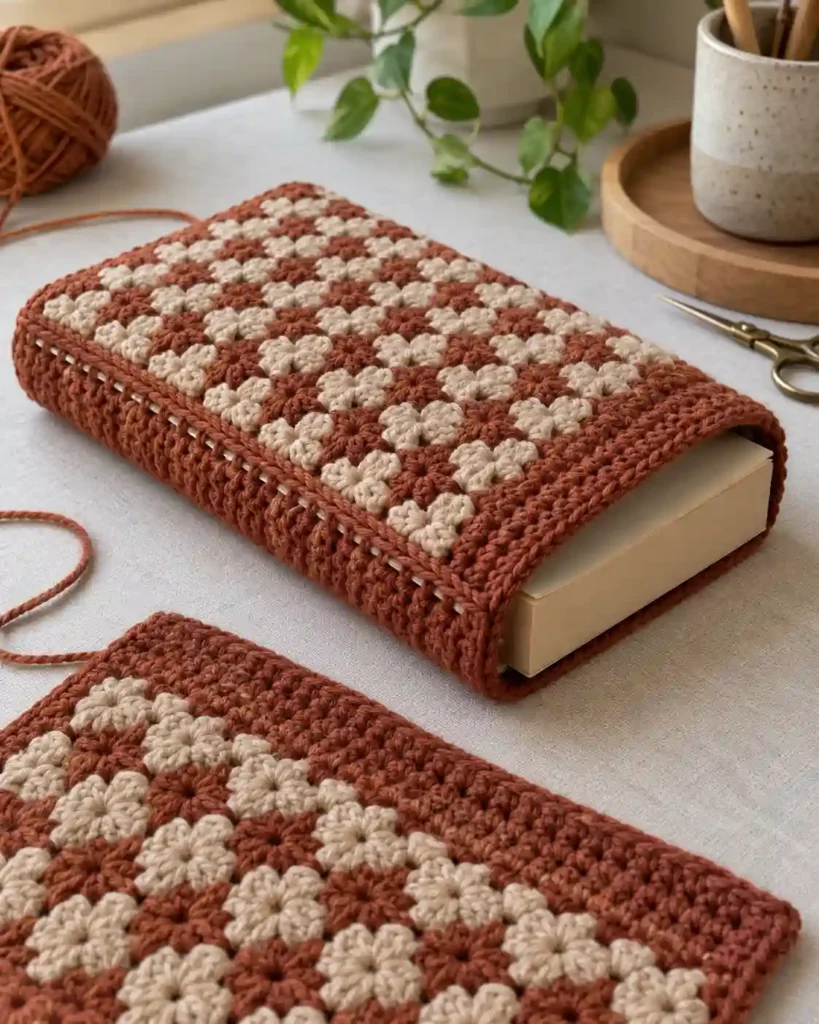
A floral granny square sleeve has tiny flowers built right into each square. Unlike a plain crochet pouch, the decoration is part of the fabric instead of being sewn on later. Soft lavender blooms and cream borders would look sweet beside a stack of spring novels. It is an especially pretty choice for someone who enjoys cottagecore accessories and handmade gifts.
Check the flower centers for loose loops and use firm joins. If the motifs create noticeable holes, add a smooth cotton lining so the book does not snag.
6. Checkered Crochet Book Sleeve
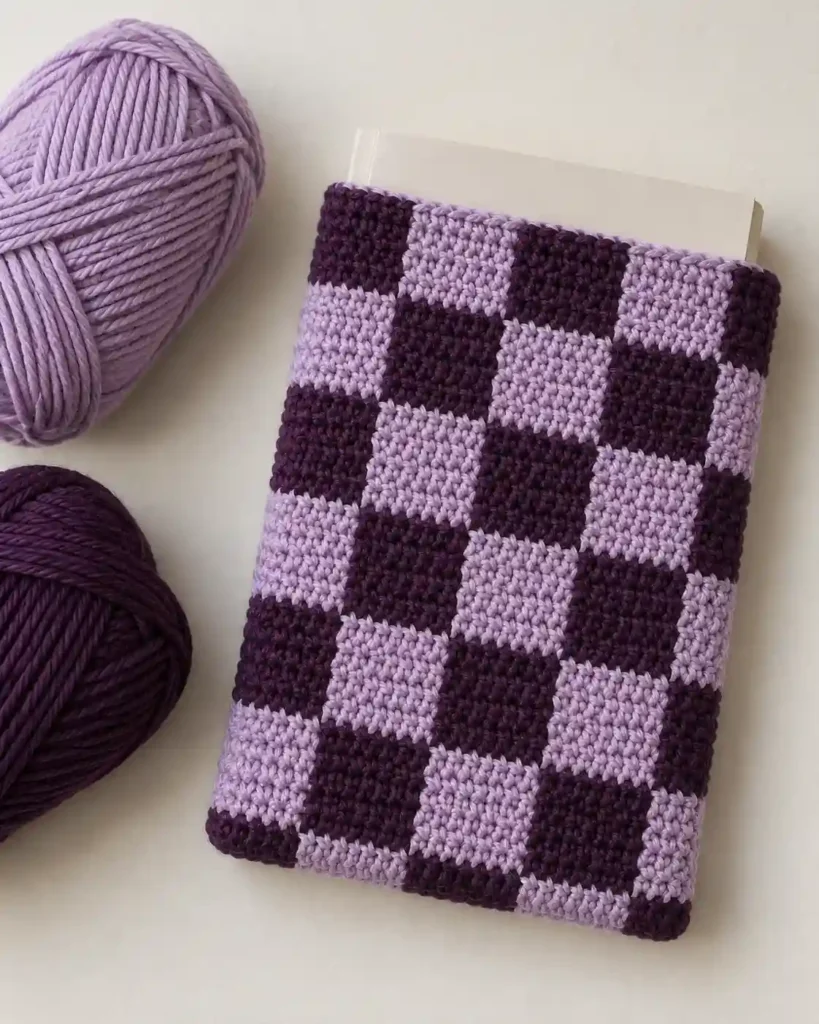
A checkered book sleeve gives a familiar accessory a graphic, modern look. The two-color blocks make a stronger statement than ordinary stripes, but they demand a little more attention when you change yarn. Plum and lilac work beautifully together for a book sleeve that feels playful without being childish. Pick this design if you already know basic stitches and want to practice colorwork on a small project.
Plan the checker size on paper first. Keep carried yarn and color changes even, and check that the fabric does not leave openings at block boundaries.
7. Can You Turn Scrap Yarn into a Striped Book Sleeve?
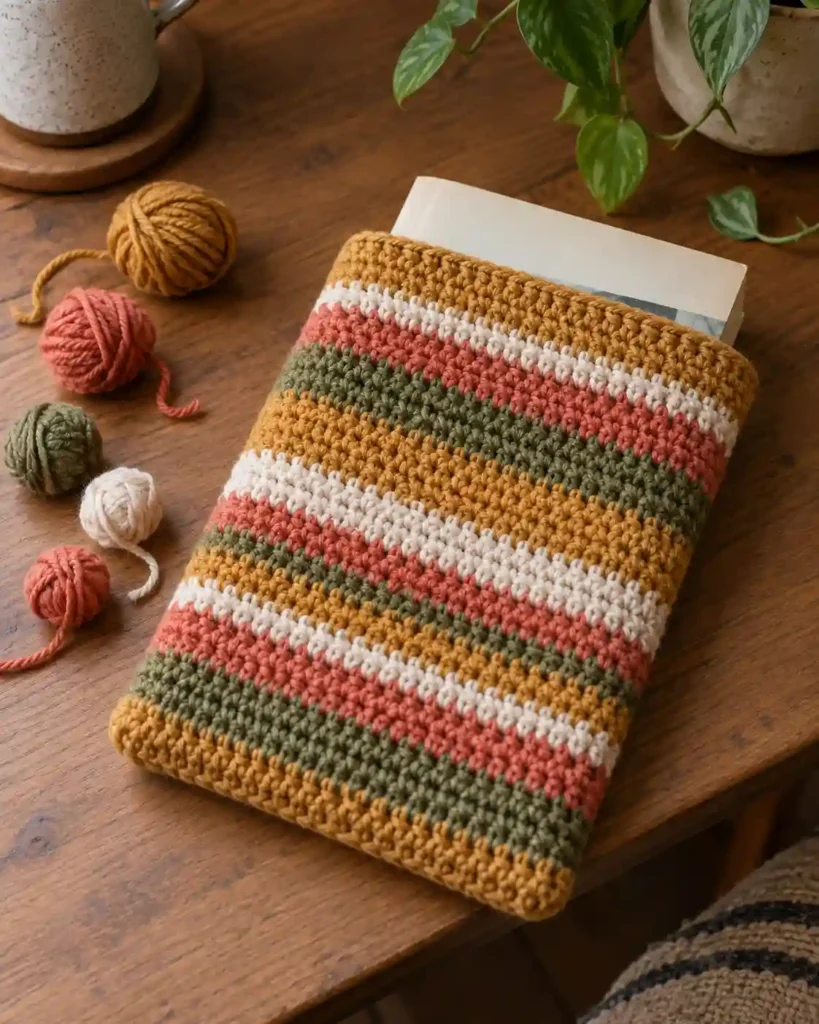
A scrap-yarn striped book sleeve is the kind of project that makes your leftover yarn feel useful again. Instead of buying a full new skein, you can build uneven bands of color from smaller pieces. This is the sleeve I would make after finishing several blankets or scarves and discovering a basket of matching odds and ends. It is perfect for relaxed, colorful crochet with very little planning.
Choose leftovers of similar weight and feel, and weave in every color-change end securely. A consistent stitch pattern keeps the stripes looking deliberate even when the colors change often.
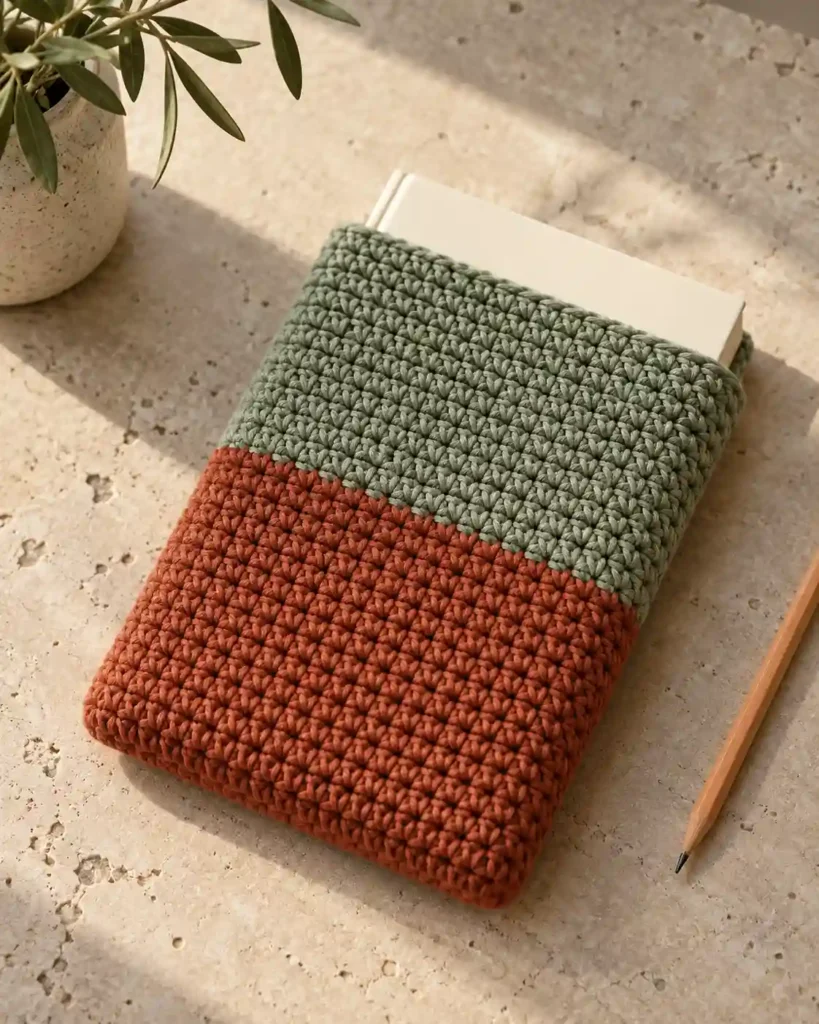
8. Two-Tone Colorblock Book Sleeve
A two-tone colorblock sleeve is simple without looking unfinished. One bold color break gives it a cleaner shape than a busy checkered pattern, making the book pouch easy to coordinate with everyday bags. Terracotta on the bottom and sage on top feels particularly calm on a neutral desk. This is a wonderful choice for anyone who prefers minimalist handmade accessories.
Try a horizontal divide, a vertical split, or a small offset block. Keep both colors in the same yarn weight so the panel does not change width halfway through.
9. Why Add Daisy Appliqués to a Crochet Book Sleeve?
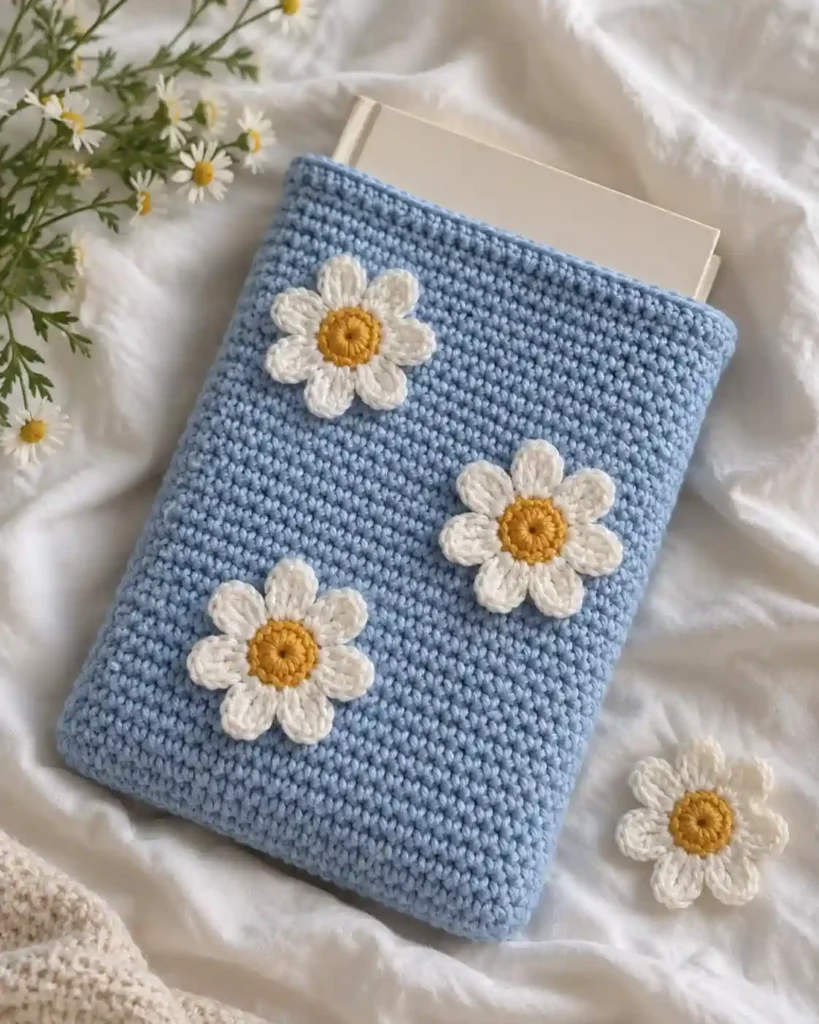
A daisy appliqué sleeve starts with a practical, tightly stitched base and adds just enough floral charm. Unlike open flower squares, separate daisies let you control exactly where the decoration sits. Three small white flowers on powder-blue yarn would be lovely for a picnic read. It is a fun choice if you want a cute crochet book sleeve without working a completely different body pattern.
Sew each petal down securely, not just the center. Flat appliqués are less likely to catch on pens or zippers inside a bag.
10. Tulip Motif Book Sleeve
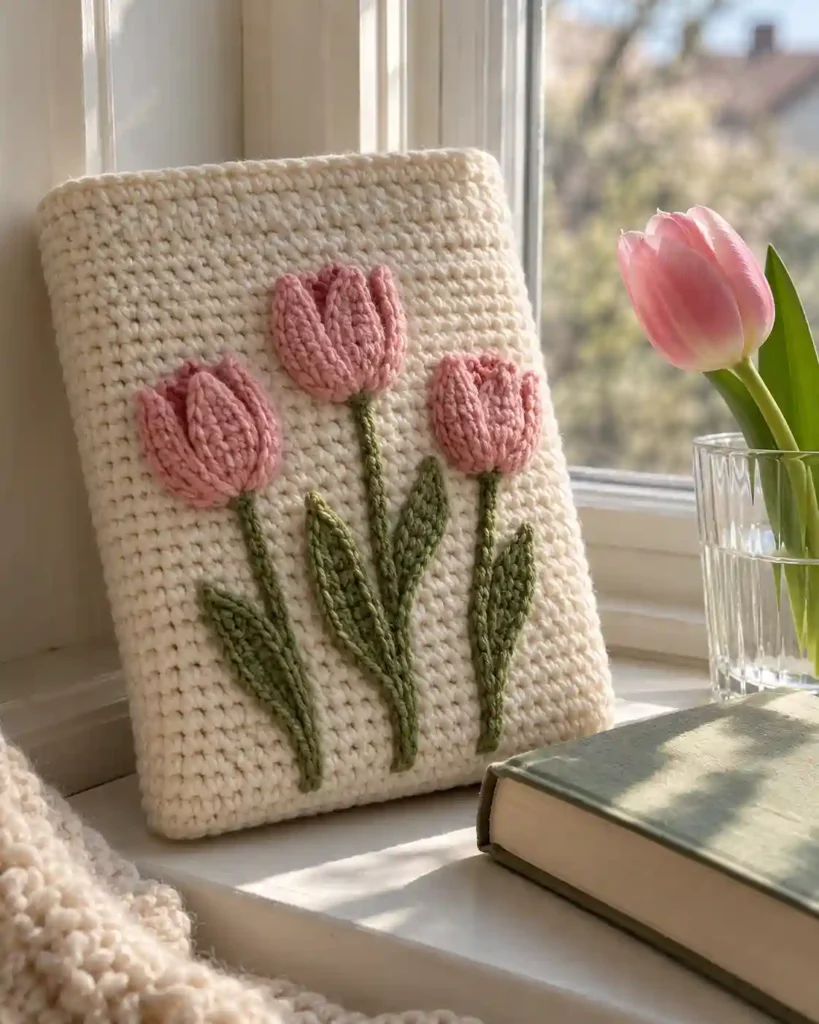
A tulip motif book sleeve brings a little spring garden to your reading routine. The long stems create a vertical design that looks different from scattered daisies or all-over floral squares. Imagine pink tulips climbing an ivory pouch next to your favorite romance paperback. Make this one for someone who loves botanical details but still wants a tidy, compact accessory.
Use flat appliqués or carefully planned colorwork for the stems and petals. Secure the tips of the leaves so they do not curl away from the sleeve.
11. Would a Strawberry Crochet Book Sleeve Make a Cute Gift?
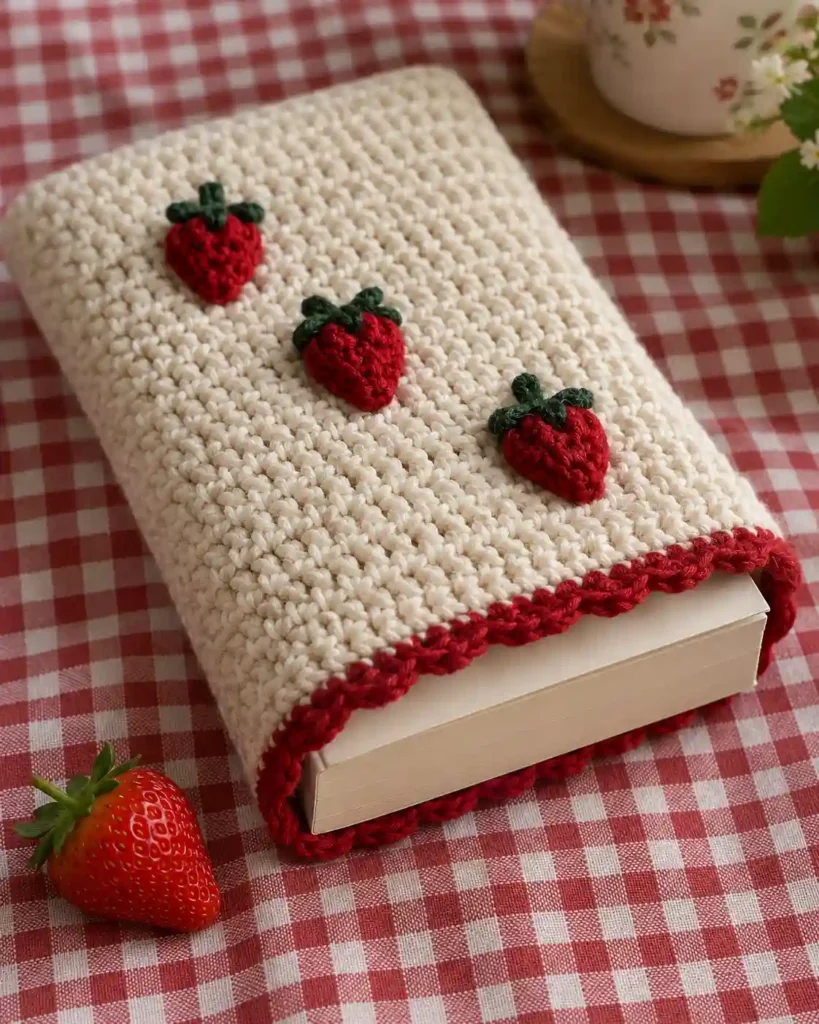
A strawberry crochet book sleeve is playful in the nicest possible way. Tiny red fruit appliqués give a plain cream pouch more character without requiring complicated shaping in the main body. Paired with a light summer novel, it would make a charming birthday gift for a bookish friend. Choose it when you want a cheerful seasonal project with small decorative pieces.
Make the strawberries low-profile rather than stuffed. Stitch the leafy tops down firmly, particularly if the sleeve will live inside a tote.
12. Butterfly Motif Book Sleeve
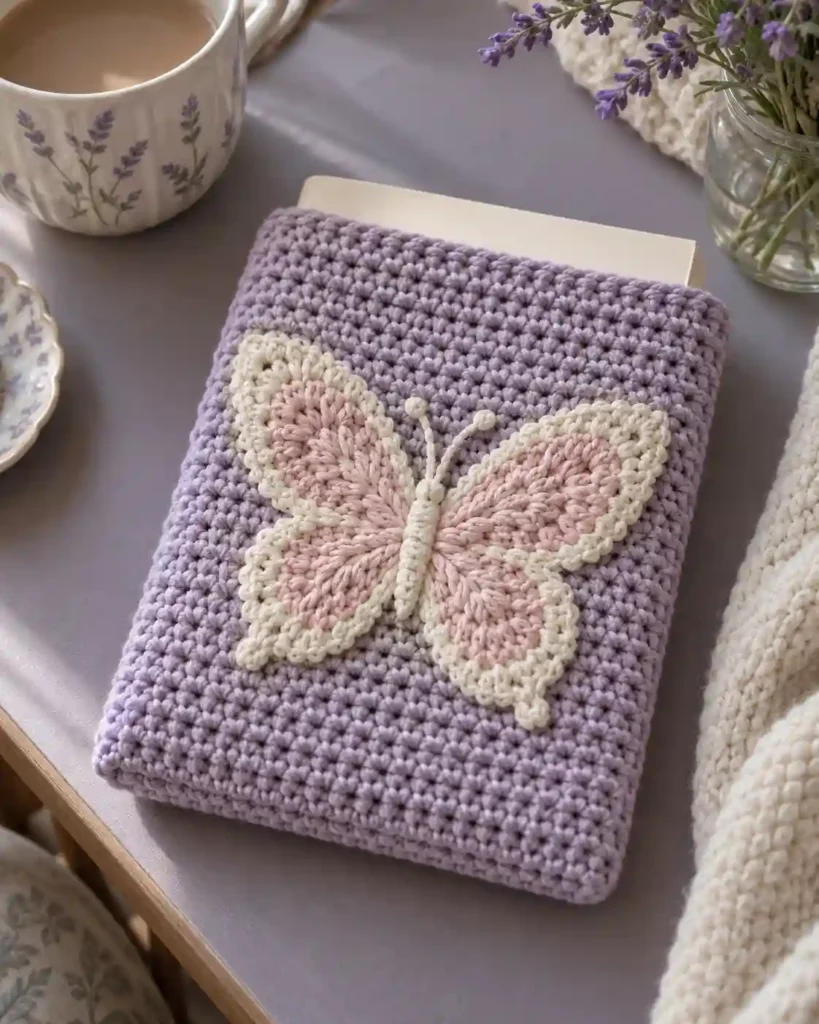
One centered butterfly can be all a book sleeve needs. Compared with a pattern covered in motifs, the single appliqué leaves plenty of quiet space for beautiful yarn texture. Lavender and blush are lovely together for a soft reading accessory that feels a little dreamy. This is a good option for anyone who likes whimsical crochet but wants an uncomplicated base.
Anchor the butterfly wings at their outer edges so they lie flat. A smooth single-crochet background helps the motif stand out.
13. What Makes a Heart-Pocket Book Sleeve Special?
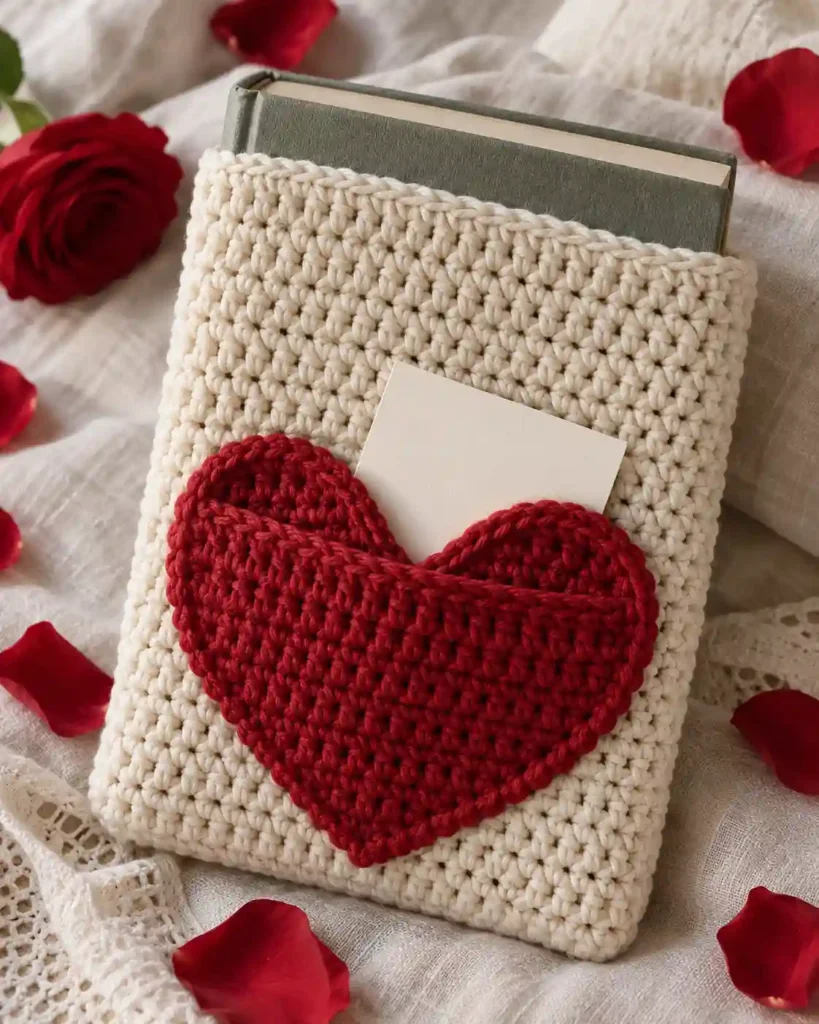
A heart-pocket book sleeve has a small surprise on the front: a place to tuck a tiny note. It feels more personal than a purely decorative heart because the shape actually has a purpose. Slip a short message into the pocket before gifting the sleeve with a favorite novel. This is ideal for Valentine’s Day, an anniversary, or a thoughtful gift that does not need expensive materials.
Keep the heart pocket shallow and sew its lower edges firmly. It is best for a note or slim bookmark, not a pen or anything bulky; explore crochet heart patterns for more motif ideas.
14. Love Letter Envelope Book Sleeve
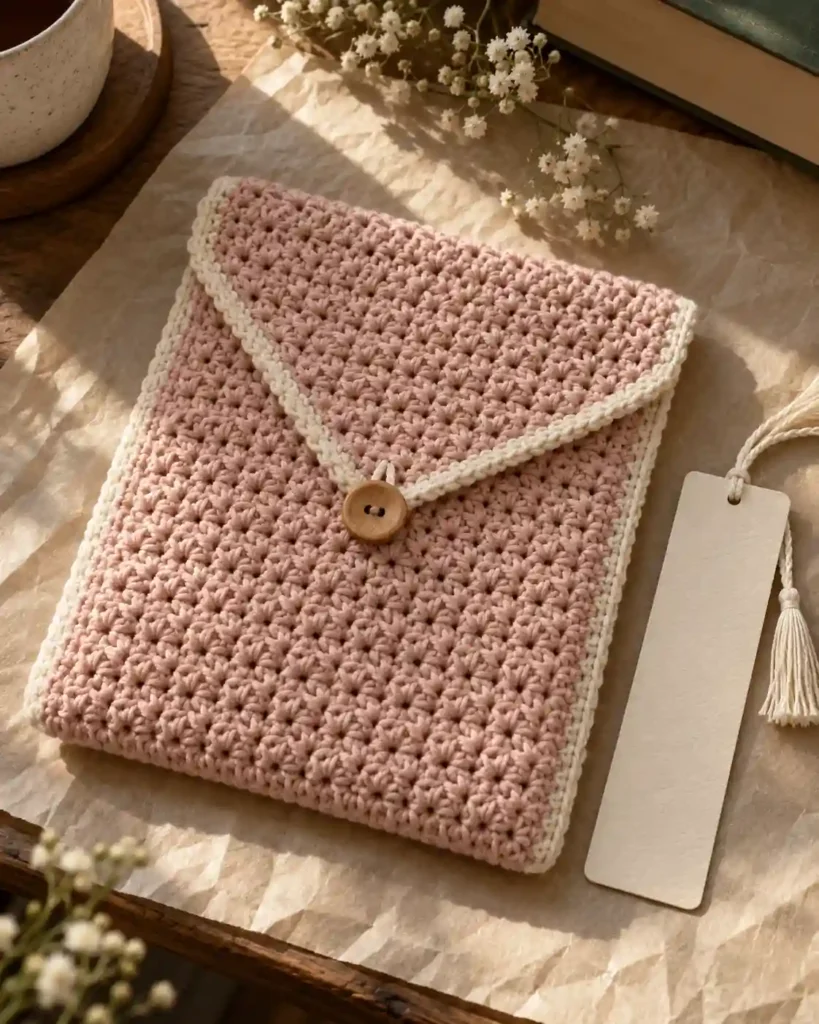
An envelope-style book sleeve looks like a soft little letter wrapped around your current read. Its triangular flap offers a different silhouette from the usual open-top pouch and gives you a natural place for a closure. Pale blush yarn and a small wooden button would make this especially sweet on a bedside table. Pick this design if the presentation matters as much as the storage.
Shape the flap carefully so it covers the opening without pulling on the book’s top edge. Test the button or loop with the book inside before fastening it permanently.
15. Is a Crochet Book Sleeve with a Button More Secure?
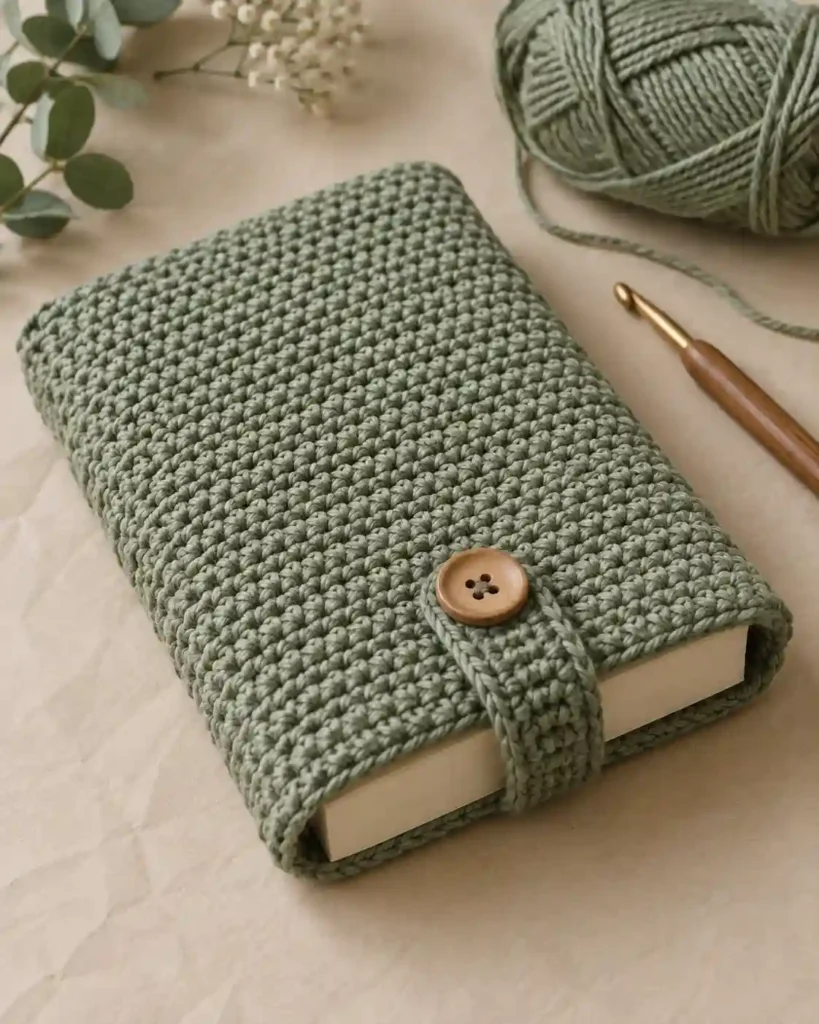
A crochet book sleeve with a button keeps the opening from gaping in a busy bag. It is less fussy than a drawstring and usually quicker to open than an envelope-style flap. I would use a short strap and a smooth button on a sleeve meant for regular train or bus journeys. Try this version when you want a simple closure that feels finished and practical.
Reinforce the button stitches and leave enough slack in the loop for easy fastening. Position any hard button outside the book’s main contact area, especially if you are making a sleeve for an e-reader.
16. Drawstring Book Pouch
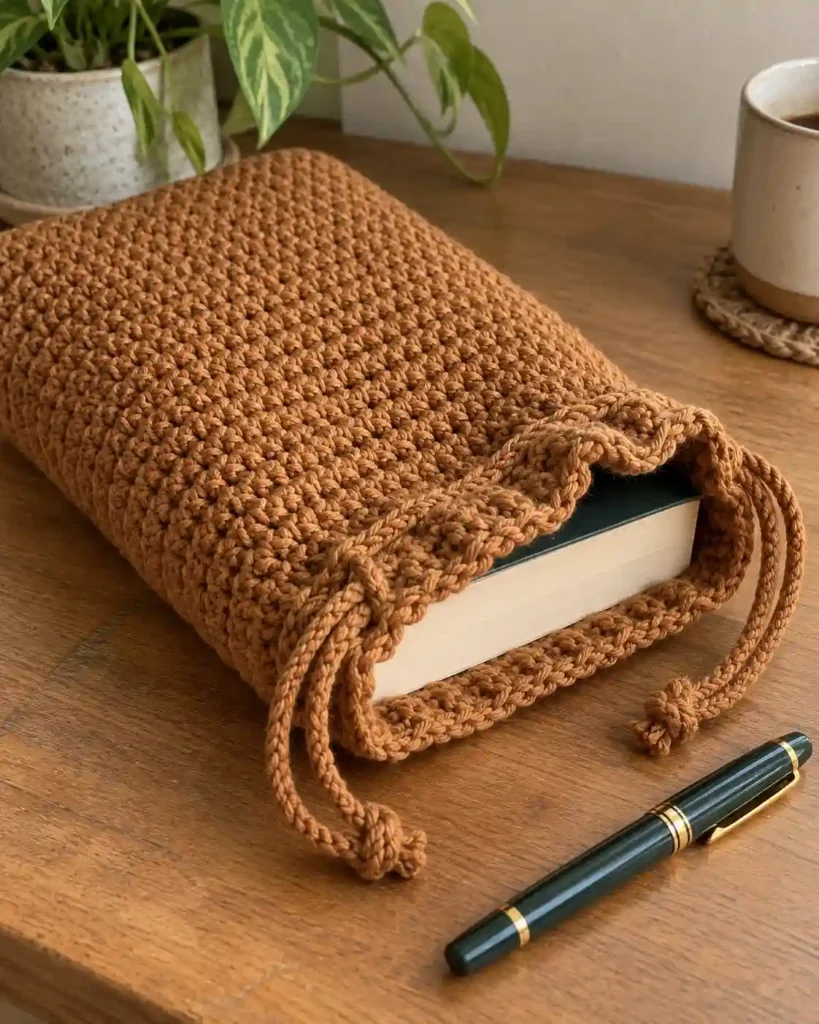
A drawstring book pouch looks relaxed and a little old-fashioned, almost like a small project bag for a novel. Unlike a flat sleeve, the gathered top can cover the book more completely when the pouch is sized well. Caramel or oatmeal yarn would suit a slow weekend read and a quiet café visit. Choose this design if you like the look of soft bags and do not need instant access to the book.
Make the opening wide enough to slip the book in without scraping its corners. Avoid pulling the cord so tightly that the pages or cover bend.
17. Why Is a Front-Pocket Crochet Book Sleeve So Useful?
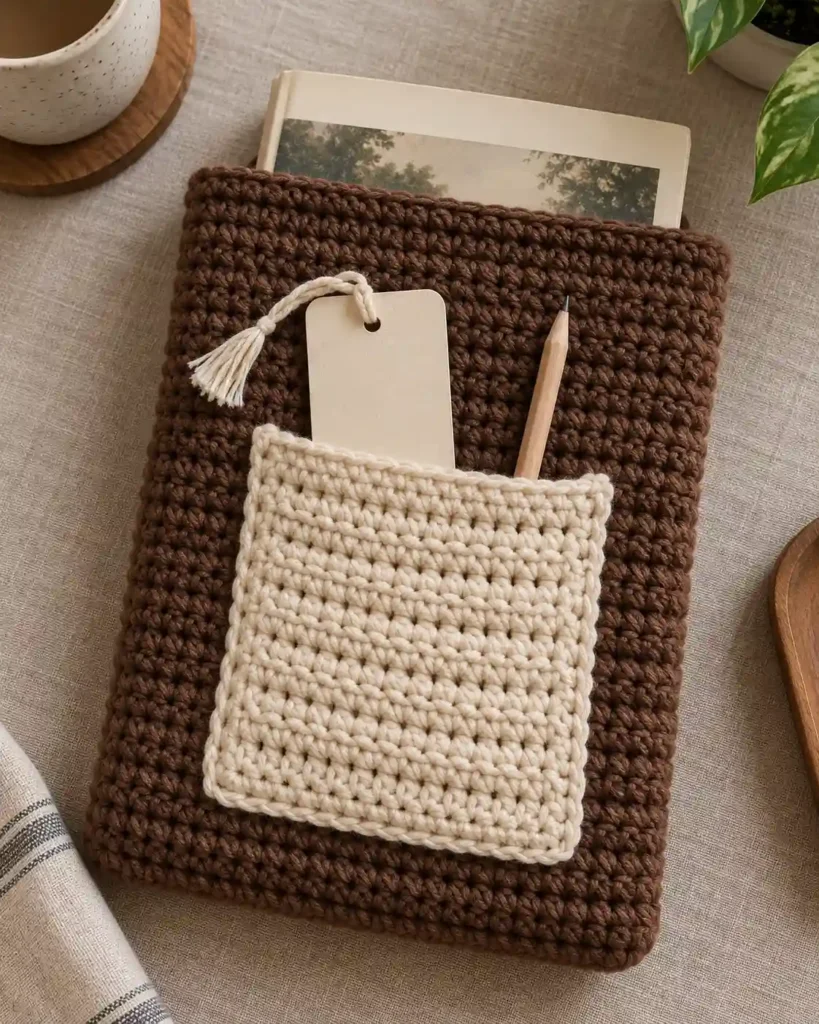
A crochet book sleeve with a front pocket gives your reading essentials their own little home. The rectangular pocket is more useful than a small heart decoration because it can hold a flat bookmark or a few sticky notes. I can imagine reaching for it during a long reading session without searching through a bag. It is especially handy for readers who annotate or like to keep a note card nearby.
Make the pocket deep enough for its intended contents and reinforce both top corners. Keep pens with sharp or exposed tips out of the pocket to avoid marking the book.
18. Fabric-Lined Book Sleeve
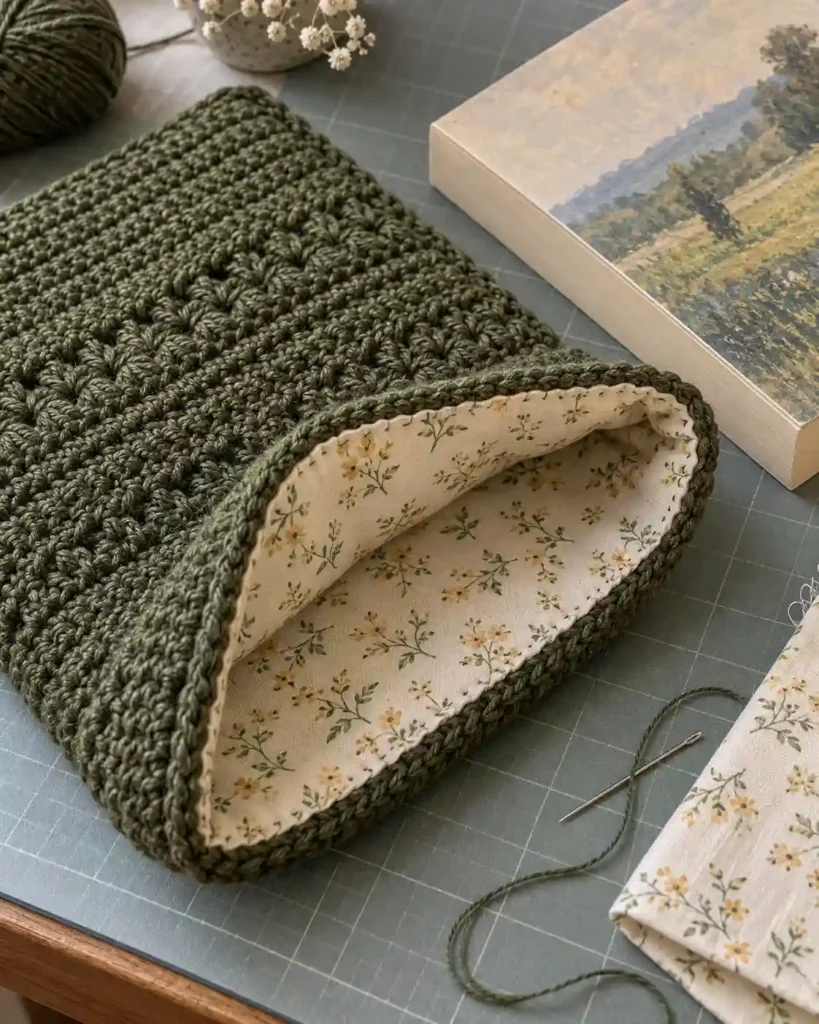
A fabric-lined book sleeve feels noticeably smoother inside than an open-texture crochet pouch. A lightweight cotton lining also helps keep book corners from poking through granny-square spaces. A tiny floral print hidden inside an olive-green sleeve makes a lovely detail that only the owner sees. This is worth trying when you love decorative stitches but want the interior to be more book-friendly.
Cut the fabric after measuring the finished crochet shell, leaving appropriate seam allowance. Attach it neatly around the opening, and keep pins, needle points, and loose seam edges away from the book.
19. Is a Double-Layer Crochet Book Sleeve Worth the Extra Yarn?
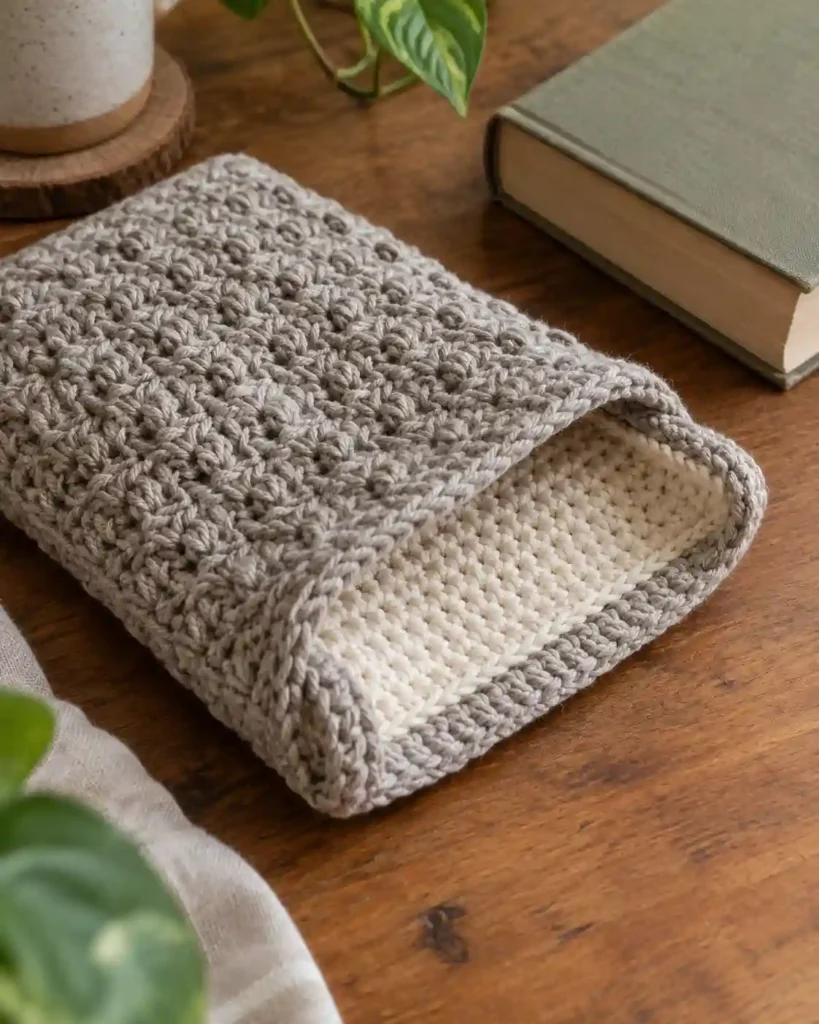
A double-layer crochet sleeve has a dense inside and a more decorative outside. It is thicker than a standard pouch, which can feel reassuring when books are carried among everyday belongings. A muted gray outer layer with a cream interior would look understated and polished. Choose it if you value a substantial handmade feel and do not mind a little extra bulk.
Join the layers so they cannot shift or bunch around the corners. Extra yarn adds cushioning against small rubs, not rigid protection from heavy pressure or drops.
20. Waffle-Stitch Book Sleeve
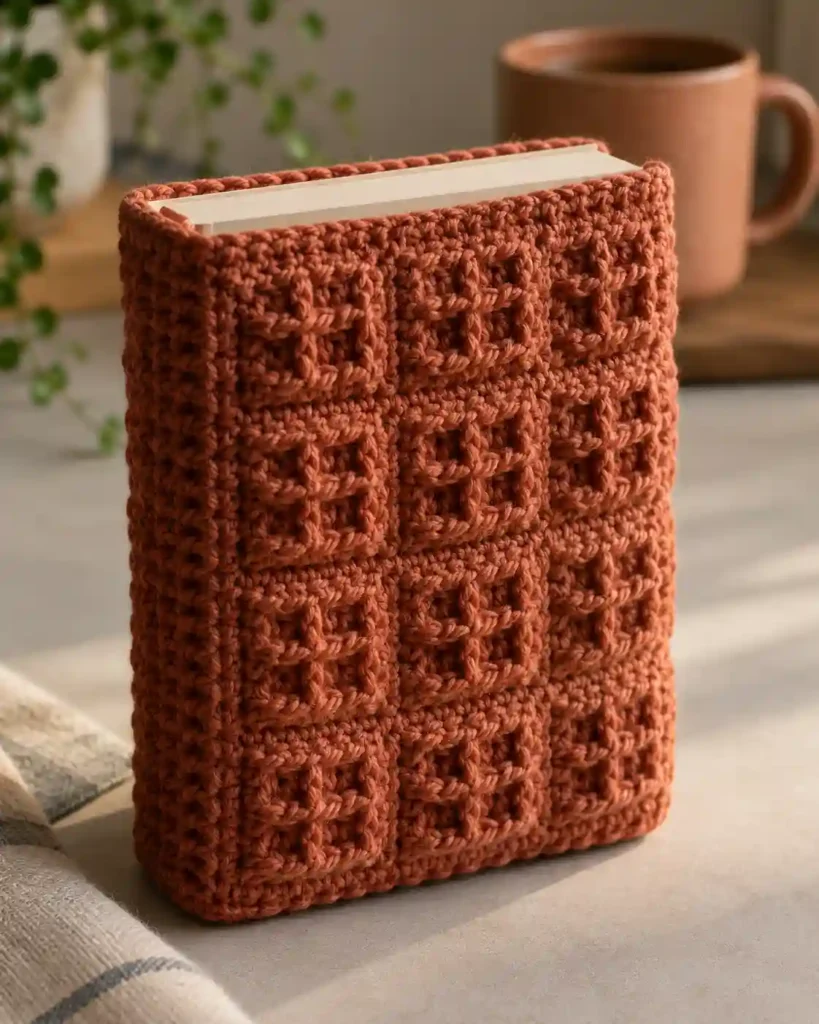
Waffle stitch gives a book sleeve a wonderfully defined grid of raised squares. The texture is more architectural than granny squares and does not require changing colors to look interesting. Terracotta waffle stitch would be cozy beside a mug of tea and a mystery novel. It is a satisfying project for crocheters who enjoy visible stitch texture and want a solid-color design.
Make a swatch first: front-post stitches affect both thickness and the amount of yarn used. Measure your finished fabric rather than assuming it behaves like ordinary single crochet.
21. Could Puff Stitch Make a Book Sleeve Too Bulky?
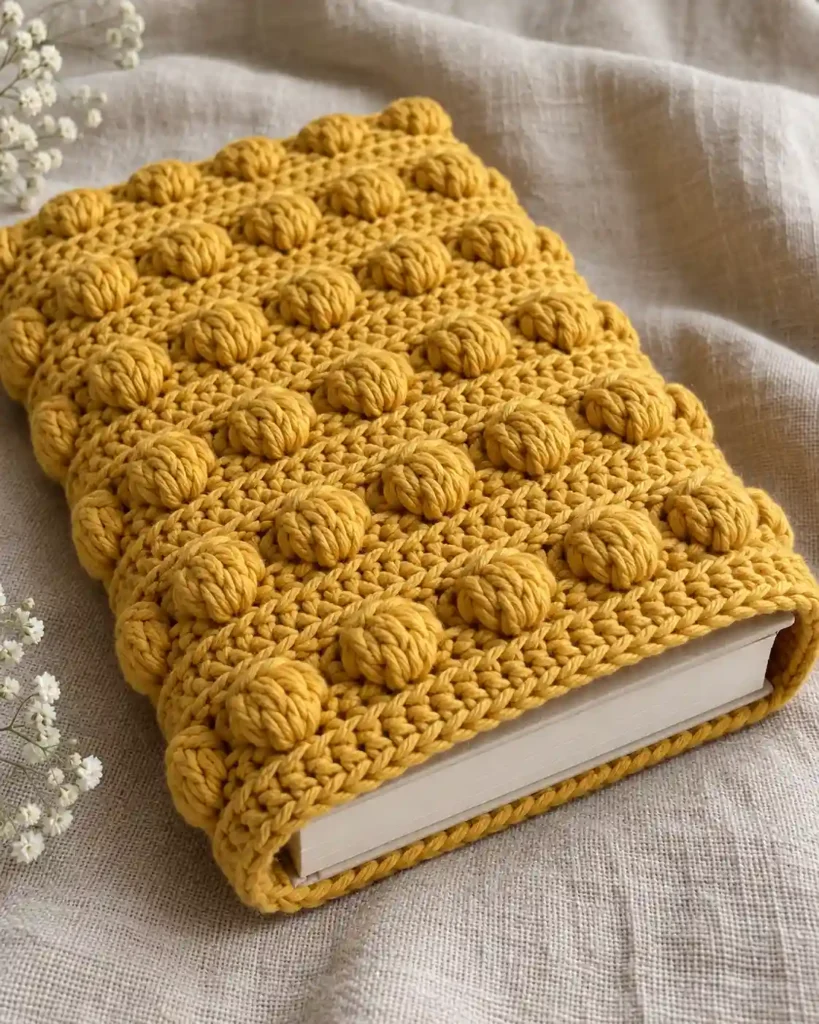
Puff stitch can make a book sleeve feel soft and decorative, but a little goes a long way. Rows of carefully spaced puffs have more depth than a flat single-crochet fabric and can look lovely in mustard or cream. I would reserve them for the outside of a sleeve meant for a small paperback. Choose this style if you love texture and are happy to keep the inside smooth.
Space the puffs with dense stitches between them. Too many raised stitches make a sleeve bulky and may leave gaps that catch book corners.
22. Scalloped-Edge Book Sleeve
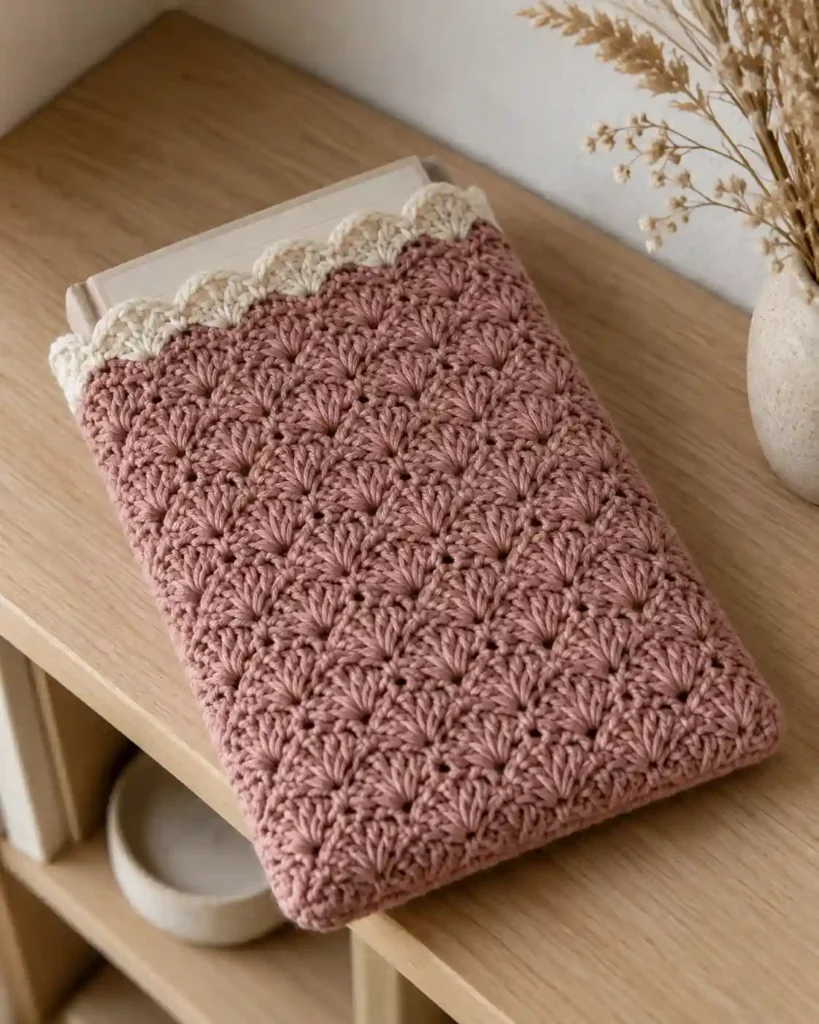
A scalloped-edge sleeve proves that even a plain pouch can have a beautiful finishing touch. Small shell stitches around the opening bring movement to the design without covering the entire front in decoration. Dusty rose with an ivory border feels romantic but still easy to carry every day. It suits someone who wants a delicate detail without learning complicated motifs.
Work an even number of shell repeats across the mouth and check that the border does not tighten the opening. Keep the main sleeve dense and simple.
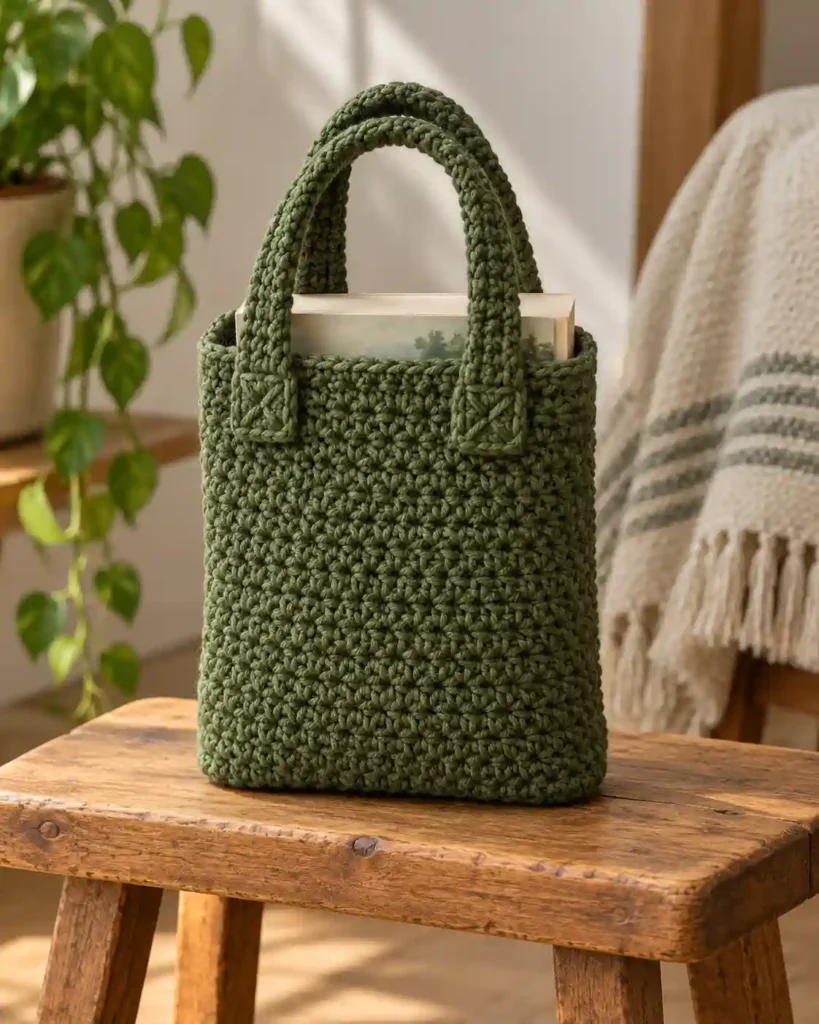
23. Can a Book Sleeve Have a Carry Handle?
A crochet book sleeve with a short carry handle sits somewhere between a pouch and a mini tote. Unlike a regular sleeve, it can be carried on its own when you only need a book for a short walk. I picture a moss-green version coming along to a park bench with a paperback and a bookmark. Make it for someone who likes hands-free convenience on small outings, not for hauling a heavy stack of books.
Use short, sturdy handles and reinforce their attachment points. Always test the loaded sleeve at home before relying on the handles outside.
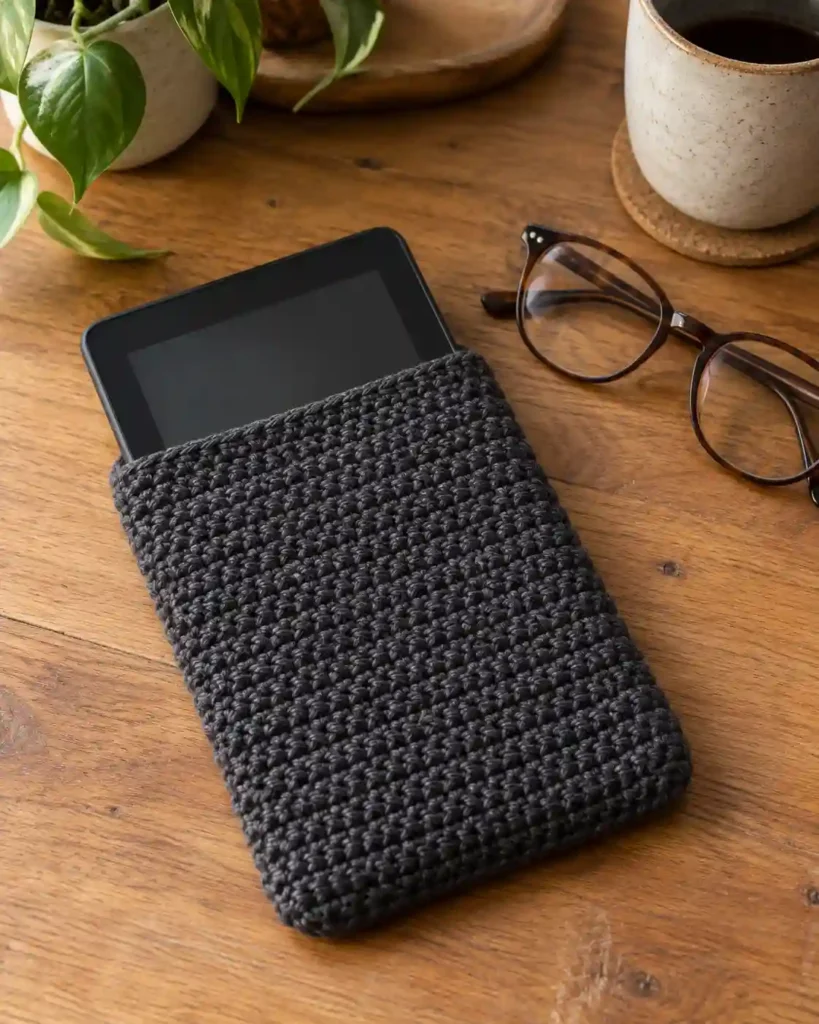
24. Crochet Kindle and E-Reader Sleeve
A crochet Kindle sleeve gives an e-reader its own handmade resting place. It may look like a tiny book pouch, but the smooth interior matters more because raised buttons and hard decorations can press against the screen. Charcoal or soft beige cotton makes an easy-to-match everyday cover. Pick this project if you usually read digitally and want something that fits your particular device.
Measure the actual e-reader with its existing case, if it has one. Use flat, close stitches, and remember that crochet alone does not replace a rigid protective case.
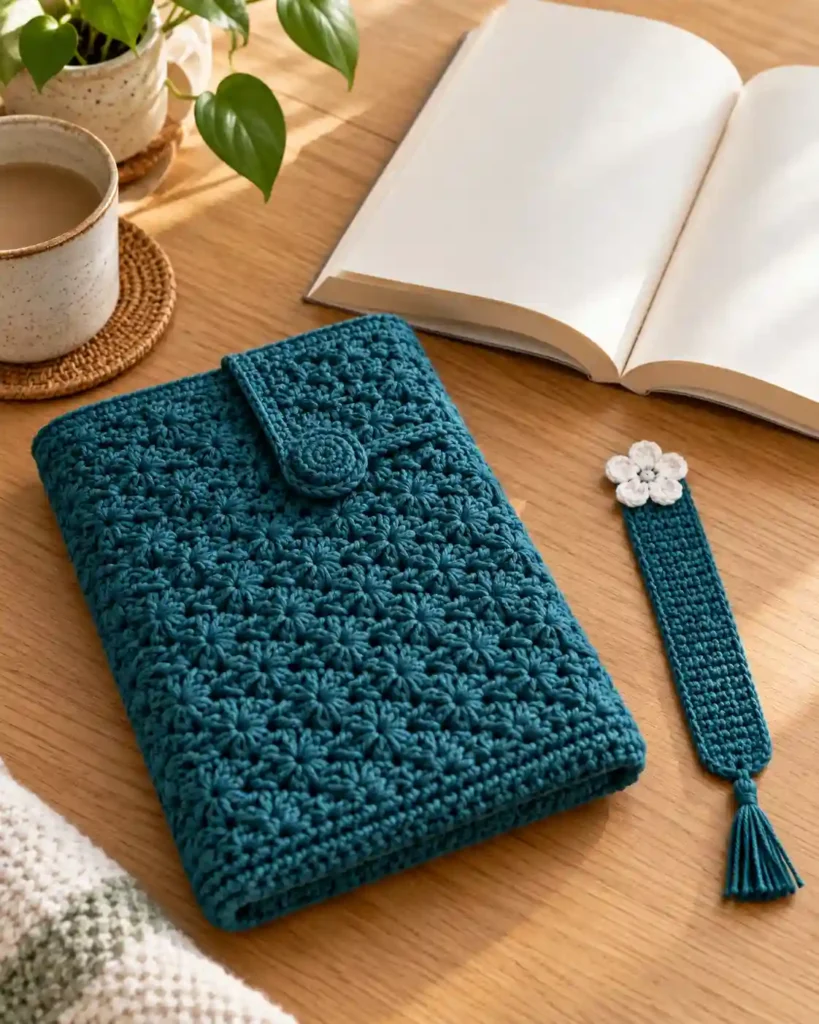
25. Why Make a Matching Book Sleeve and Bookmark Set?
A matching sleeve and bookmark set turns one practical project into a complete reader’s gift. Using the same yarn or a tiny shared motif makes the pieces feel connected without needing extra decoration. A teal sleeve with a crochet flower bookmark would look lovely tucked beside a new novel. It is my pick for birthdays, teacher gifts, or anyone whose idea of a perfect afternoon involves a good book.
Keep the bookmark thin enough that it does not strain the book’s spine. Bundle the pair with a note about the yarn’s care instructions.
How Do You Crochet a Book Sleeve? Free Adjustable Beginner Pattern
Crochet a dense rectangular panel, fold it in half, seam the sides, and adjust the finished dimensions to your book.
At a Glance
- Simple crochet book sleeve free pattern: One rectangle and two side seams.
- Main stitch: Single crochet worked in repeated rows.
- Sizing: Measure your book and check your gauge.
- Finishing: Reinforce seams and test the opening.
This simple crochet book sleeve free pattern uses a single rectangular panel, basic single crochet stitches, and two side seams. The instructions are written in US crochet terms and can be adjusted for a paperback or a larger book. Production note: This is an original, measurement-based draft; the illustrative stitch counts and yarn quantity below have not been physically tested and should be sample-made before publication as a verified pattern.
What materials do you need?
- Medium-weight (#4) cotton or cotton-blend yarn; 150–200 yards is a preliminary planning allowance, not a tested requirement.
- A 4.5 mm crochet hook, or the hook that gives you a firm, flexible fabric.
- Gather your essential crochet supplies, including a measuring tape, stitch markers, scissors, and a tapestry needle.
- Your actual book for repeated fit checks.
- Optional: matching thread, fabric for lining, and a smooth button for a closure.
The Craft Yarn Council’s standard yarn weight system identifies medium yarn as category 4 and lists typical hook ranges, but these are guidelines. A smaller hook may make a denser book-sleeve fabric; let your swatch and comfort decide.
How do you size the rectangle?
Measure your book’s front-cover width (W), height (H), and spine thickness (T). As a starting calculation, try a flat panel width of W + T + ¼ inch (0.6 cm) of ease, plus any width your seams will consume. For a folded rectangle, start with a panel length of 2 × (H + T/2 + ¼ inch). The resulting fit depends on your fabric’s stretch and thickness, so these are planning formulas, not universal dimensions.
For example, a paperback measuring 5¼ inches wide × 8 inches tall × 1 inch thick gives an estimated flat rectangle of 6½ × 17½ inches before any adjustment for your particular seams. Hold the swatch around your book first; add or subtract ease if the yarn is especially firm or stretchy.
What is the stitch count for the sample size?
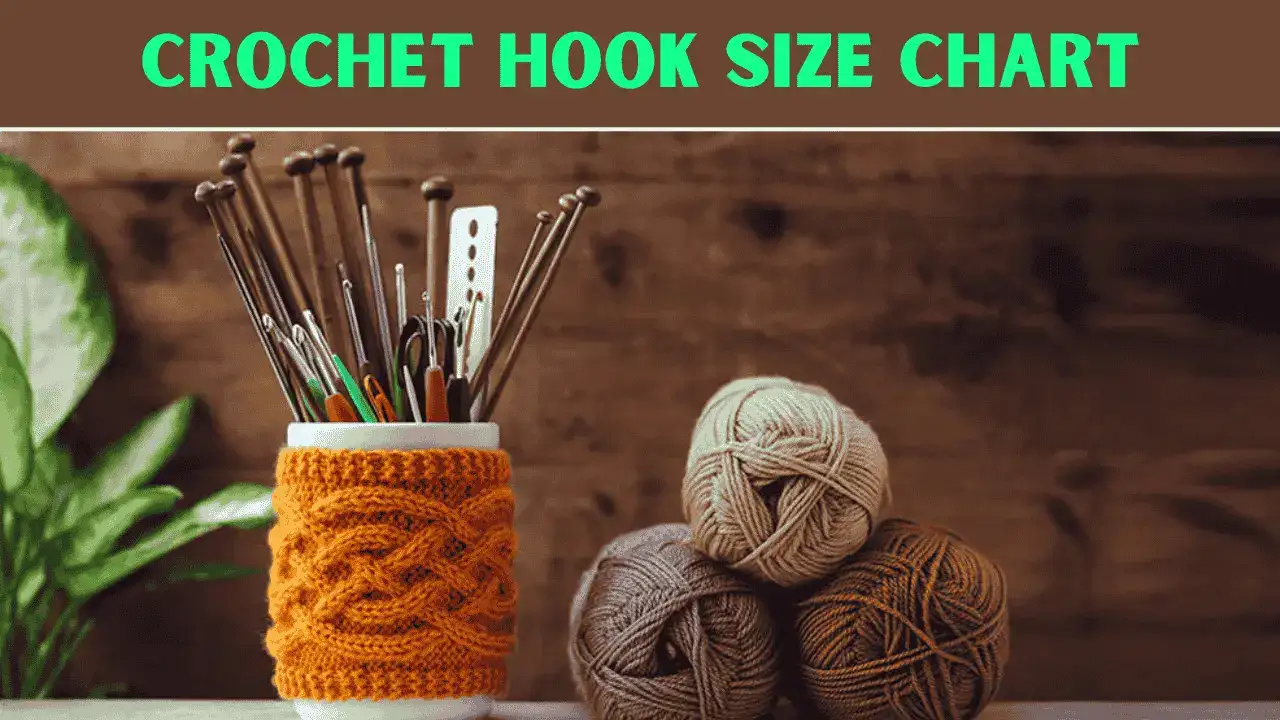
Make a swatch with your chosen hook, using a crochet hook size chart as a starting reference if you are unsure which size to try. The Craft Yarn Council recommends measuring gauge over a 4-inch (10 cm) area, because a small change in tension can change the finished size. If, for example, your fabric measures 16 single-crochet stitches and 18 rows over 4 inches, a 6½-inch-wide panel requires roughly 26 stitches, and a 17½-inch-long panel requires about 79 rows. These are conditional calculations, not a measured CrochetMind sample gauge.
What are the step-by-step crochet instructions?
- Foundation: Chain 27. Work 1 single crochet (sc) in the second chain from the hook and in each chain across: 26 sc.
- Body: Chain 1 and turn. Work 1 sc in each of the 26 stitches. Repeat until the panel is about 17½ inches long; at the example gauge, this is approximately 79 total rows. Actual length matters more than the row count.
- Check fit: Lay your book in the center of the panel, fold the lower half up, and check its width and height before cutting the yarn. Make extra rows or adjust the panel if needed.
- Fold and seam: Fold the rectangle in half with the preferred exterior facing inward. Sew or slip-stitch the two side edges together, working from the folded bottom toward the opening.
- Finish: Turn the sleeve right side out. Weave in the ends, insert the book gently, and check that the opening does not stretch around its corners.
- Optional edging: Add one round of single crochet around the opening if it needs a firmer edge. Stop if the edge begins to pull in.
Beginner tip: If a chain of 27 does not give you the needed width with your swatch, change the chain length rather than trying to force the sample numbers. For the first row, the number of single-crochet stitches will be one less than the foundation chain in this construction.
Can you turn this into a granny square crochet book sleeve free pattern?
Yes, but it becomes a different construction. Make enough matching squares to form two book-sized panels, block them, then join the squares and seam the panels on three sides. Plan a denser backing or lining when the square openings are large. A true stitch-by-stitch granny-square pattern should also specify its own motif rounds and measured joining layout; the simple rectangle instructions above are not that separate pattern.
How Do You Choose the Right Crochet Book Sleeve Size?
Measure the book’s height, cover width, and spine thickness, then allow enough room for the book to slide in without stretching the fabric excessively.
At a Glance
- Measure the exact book rather than relying on standard sizes.
- Include spine thickness, seam allowance, and a little ease.
- Test the fit before permanently closing the side seams.
- Measure e-readers with their existing cases.
Do not assume all paperbacks are interchangeable. A thick fantasy paperback, a slim romance novel, and a hardcover can have very different measurements. Measure the book you actually intend to carry and test the sleeve while the side seams are still easy to change.
The difference between a sleeve and a fitted crochet book cover matters, too: a sleeve holds the entire closed book inside a pouch, while a fitted cover usually wraps around the book’s covers and stays on during reading.
For e-readers, include any case or grip in your measurements and avoid placing buttons against the screen. The finished cover should allow the device to slide in without pressure.
Which Yarn, Stitches, and Closures Work Best?
Choose a yarn that creates a firm yet flexible fabric, use relatively dense stitches, and select a closure based on how frequently you access your book.
At a Glance
- Yarn: Cotton, cotton blends, and suitable acrylic yarns work.
- Stitches: Single crochet creates a relatively dense surface.
- Crochet book sleeve with button: Reinforce the fastening and check placement.
- Decorative styles: Consider lining open or heavily textured stitches.
Cotton and cotton blends can make a neat, clearly defined stitch fabric. Acrylic is another workable choice, especially for a lightweight, colorful design; the exact softness, durability, and washability depend on the individual yarn. If you are unsure, make a small swatch and check how it feels against a book cover.
For a beginner sleeve, single crochet is a practical starting point because it creates a relatively close fabric. Half double crochet can work too if your tension is firm. Granny squares look beautiful, but the openings may need a lining. Buttons and envelope flaps make the sleeve more secure; open tops keep it quick to use.
Should You Line and Wash a Crochet Book Sleeve?
Add a smooth lining if the crochet has gaps or rough interior stitches, and follow the yarn manufacturer’s washing instructions before cleaning your sleeve.
At a Glance
- Use lightweight cotton fabric for a smooth lining.
- Attach lining after the crochet pouch is assembled.
- Follow the yarn label for washing and drying instructions.
- Let the sleeve dry completely before storing a book.
A cotton lining is useful when the crochet fabric has holes, loose fibers, or raised joins. Measure and sew the lining to the finished crochet pouch, not to the unseamed rectangle, and keep the inside smooth. Lining improves the surface that touches the book, but it does not make a fabric sleeve waterproof.
Follow the care label for the yarn rather than assuming every handmade project can go in a washing machine. The Craft Yarn Council’s care-symbol guide explains how labels indicate washing, drying, and other restrictions; keep a label scrap with a gifted sleeve so its new owner knows what to do.
Let the sleeve dry completely before putting a book back inside. The Library of Congress advises cool, relatively dry conditions for book storage, including a typical safe range of 30–55% relative humidity for most books. A damp handmade pouch is not a safe place to leave your reading material.
Frequently Asked Questions About Crochet Book Sleeves
What is the easiest crochet book sleeve for beginners?
A folded single-crochet rectangle is a good starting design. It needs only a foundation chain, repeated rows, and two side seams.
How much yarn do you need for a crochet book sleeve?
The amount depends on book size, yarn thickness, and stitch texture. A dense fabric or decorative puff stitches may use more yarn than an open stitch, so calculate from a sample and keep extra yarn on hand.
Yes. Make the main sleeve first, sew a flat front pocket to the exterior, then add a short button strap at the opening. Reinforce both additions so they do not pull on the crochet fabric.
Does a granny square crochet book sleeve need a lining?
Not always, but lining is useful when the squares have holes or raised joins that could catch a book corner. Choose a smooth, lightweight fabric and test the fit after adding it.
Can a crochet book sleeve protect a hardcover or Kindle?
It can help reduce ordinary surface rubbing if it fits well. It cannot promise protection from liquid spills, crushing, or drops, and e-readers may still need a rigid case.
Final Thoughts
Crochet book sleeves are a thoughtful way to protect your favorite reads while adding a personal touch to your reading routine. From simple everyday covers to colorful granny square designs, floral details, and cozy handmade gifts, there are plenty of styles to explore. Choose a pattern that matches your skill level, experiment with yarn colors and textures, and create a book sleeve that makes every reading moment a little more special.