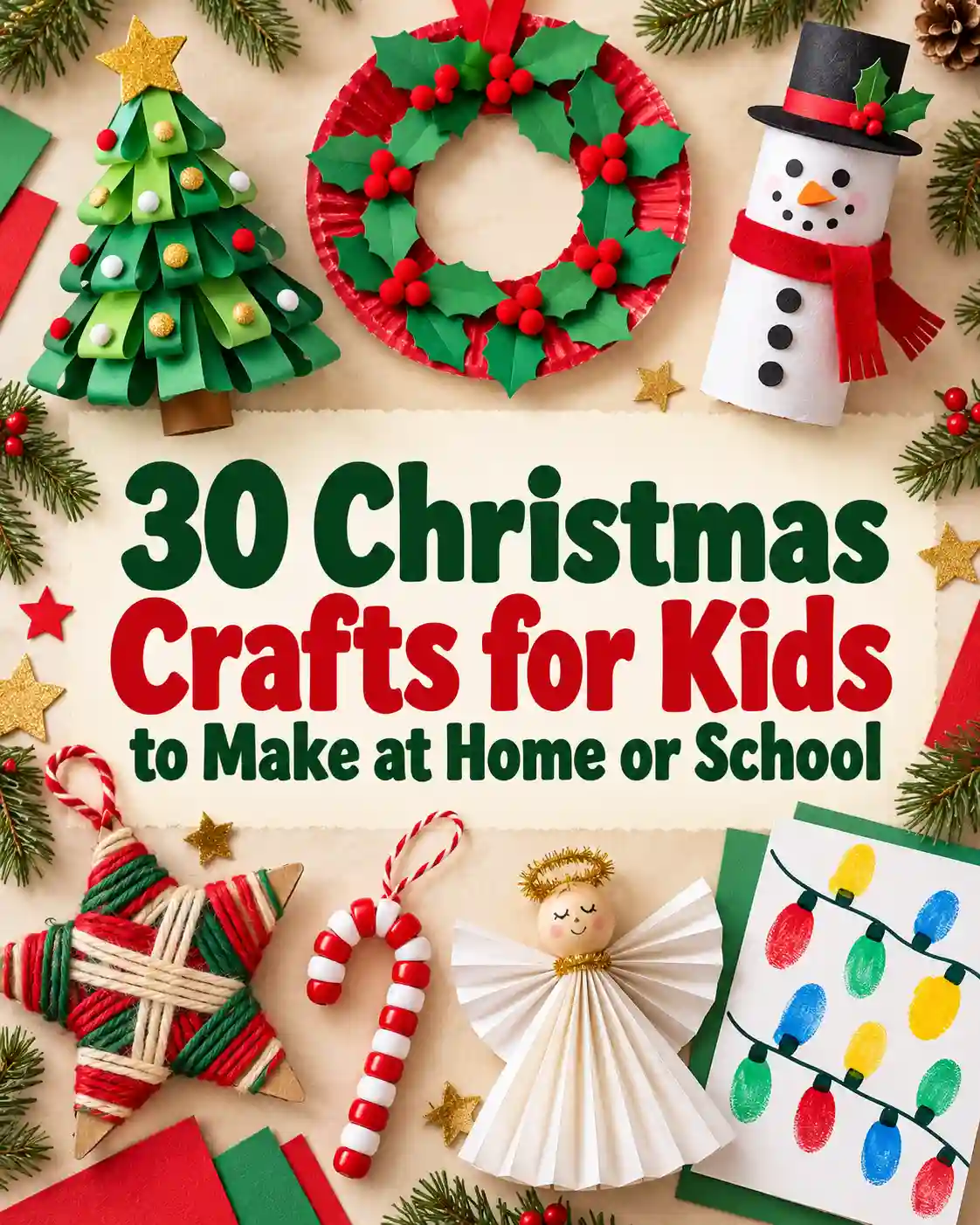






The easiest Christmas crafts for kids start with paper, cardboard, glue sticks, and a little imagination. These 30 ideas include festive cards, Christmas crafts, family keepsakes, and classroom decorations, with simpler options for younger makers and folding or weaving projects for older children.
A wonky paper tree still deserves a place on the mantel. Choose something your child wants to make, clear a corner of the table, and let the decorating be theirs.
Key Takeaways
- Choose projects that match your child’s interests and available help.
- Easy Christmas crafts to make: start with familiar supplies.
- Prepare tricky cuts before younger children begin.
- Allow glue, paint, and modeling materials to dry fully.
- Personalize keepsakes with names, dates, or handwritten messages.
Which Christmas Crafts for Kids Should You Try First?
Begin with paper trees, tissue collages, or decorated crowns, then choose more involved projects when your child wants a challenge.
Start with the supplies you already have and the help you can realistically offer. Easy Christmas crafts for kids should leave plenty of room for choosing colors, arranging shapes, and making decisions—not just watching an adult assemble everything.
| What you need | Projects to try | Main supplies | Preparation to allow for |
|---|---|---|---|
| Preschool-friendly shapes | Tissue trees, plate Santas, paper crowns | Paper, large stickers, glue sticks | Adult cutting and fitting |
| Christmas crafts for kids with paper | Strip trees, chains, angels, woven hearts | Colored paper, scissors, tape or glue | Folding help varies by project |
| Homemade tree ornaments | Stick trees, yarn stars, felt trees | Craft sticks, cardboard, yarn, felt | Glue drying or curing |
| Gifts for grandparents | Photo frames, handprint wreaths, footprint tags | Cardstock, photos, washable paint | Photo preparation and drying |
| Christmas craft ideas for school | Collages, light garlands, laced stockings | Shared paper supplies and yarn | Portion materials and prepare holes |
| A challenge for older children | Woven hearts, felt ornaments, folded boxes | Paper, felt, ruler, suitable adhesive | Careful measuring and assembly |
These are project-selection suggestions, not fixed age ratings. Follow the age guidance on the materials you buy and adjust the activity to the individual child.
For art supplies, the U.S. Consumer Product Safety Commission recommends choosing products labeled “Conforms to ASTM D-4236” without cautionary warnings. That wording concerns evaluation and labeling; it does not mean a product is edible or suitable for every activity.
30 Christmas Crafts for Kids to Make at Home or School
1. How Do You Make Paper Strip Christmas Trees?
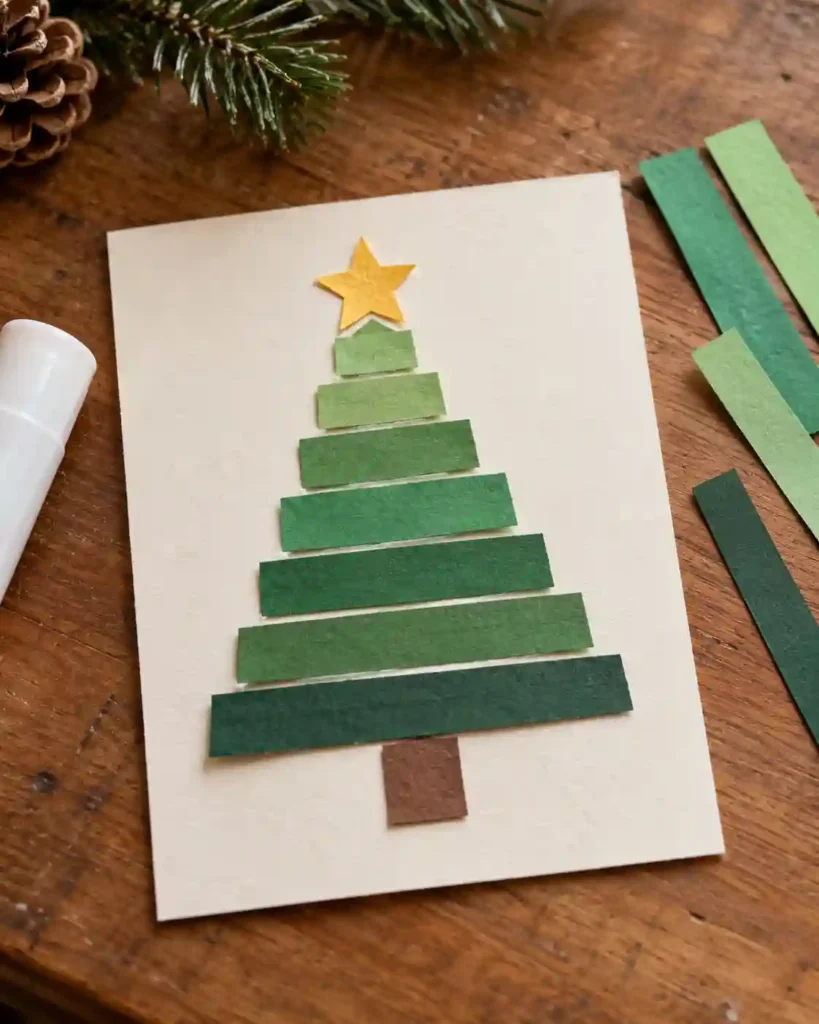
Paper strip Christmas trees turn leftover green scraps into a cheerful picture. Their layered branches are easier to arrange than a complicated folded tree, especially when an adult prepares the strips. Spread several lengths on a tray for a quiet after-school activity. For children who enjoy sorting and sticking, the satisfying part is watching the tree take shape.
- Cut green paper into strips of different lengths.
- Arrange them from shortest at the top to longest at the bottom.
- Glue them onto cardstock and add a trunk and paper star.
Leave gaps between the branches for a lighter design, or overlap them for a fuller tree.
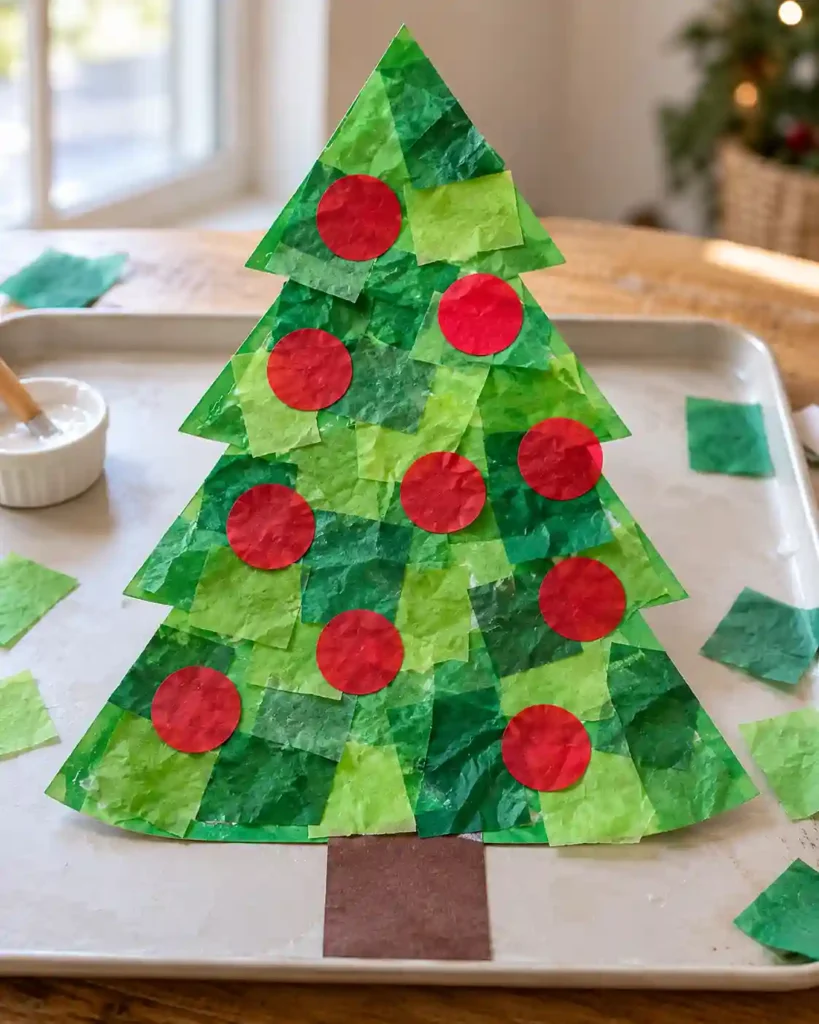
2. What Makes Tissue Paper Christmas Tree Collages So Simple?
Tissue paper Christmas tree collages welcome every crumpled corner and uneven edge. Children can tear the pieces instead of managing precise scissor cuts. This is a lovely choice for a preschool table where everyone wants a different-looking tree. Younger makers get a textured decoration without needing to follow a pattern perfectly.
Give each child a large cardstock tree, green tissue paper, and a glue stick. Cover a small area with glue, press the tissue onto it, and continue in sections. Finish with broad paper circles as ornaments.
Prefer a smoother finish? Keep the tissue flat rather than scrunching it.
3. How Can Kids Make Paper Plate Christmas Wreaths?
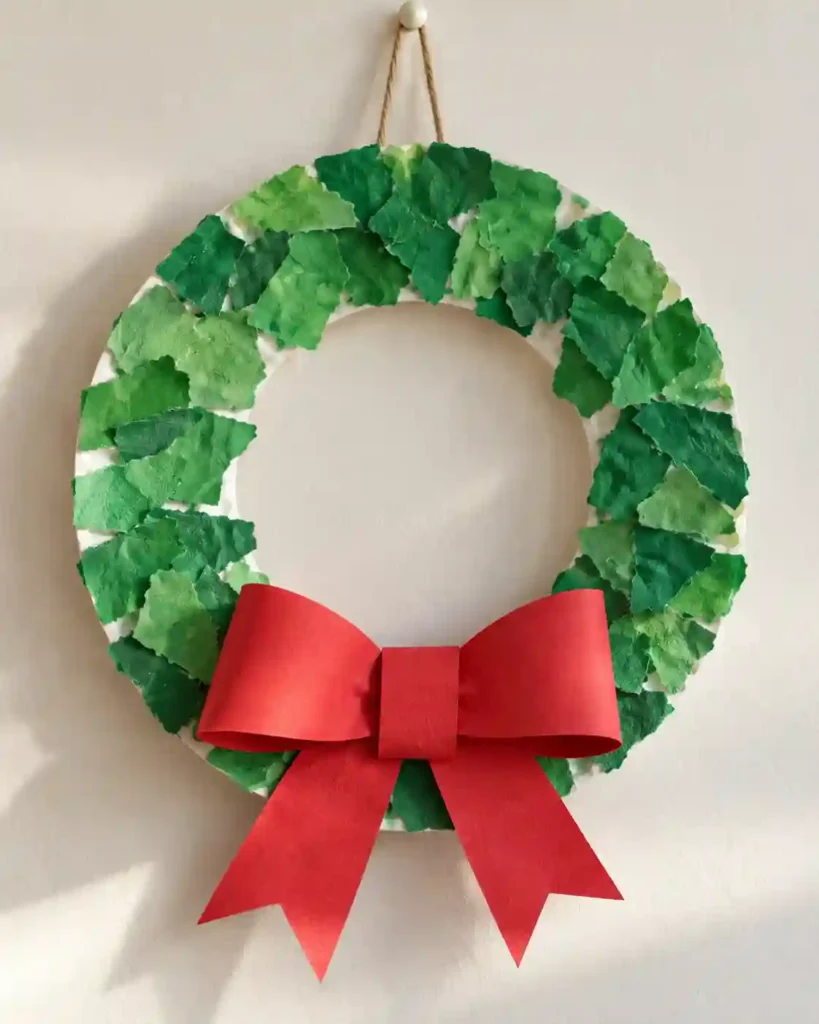
A paper plate Christmas wreath comes with its circular shape already built in. That makes it easier to assemble than a wreath made from separate branches or wire. Hang several on an interior door for a family display, each with its own color scheme. Children who like generous amounts of decoration have plenty of space to fill.
Have an adult remove the plate’s center. Cover the ring with overlapping green paper leaves, then attach a large paper bow. Tape a short hanging loop securely to the back and let everything dry before displaying it.
4. How Do You Turn a Handprint into a Reindeer Card?
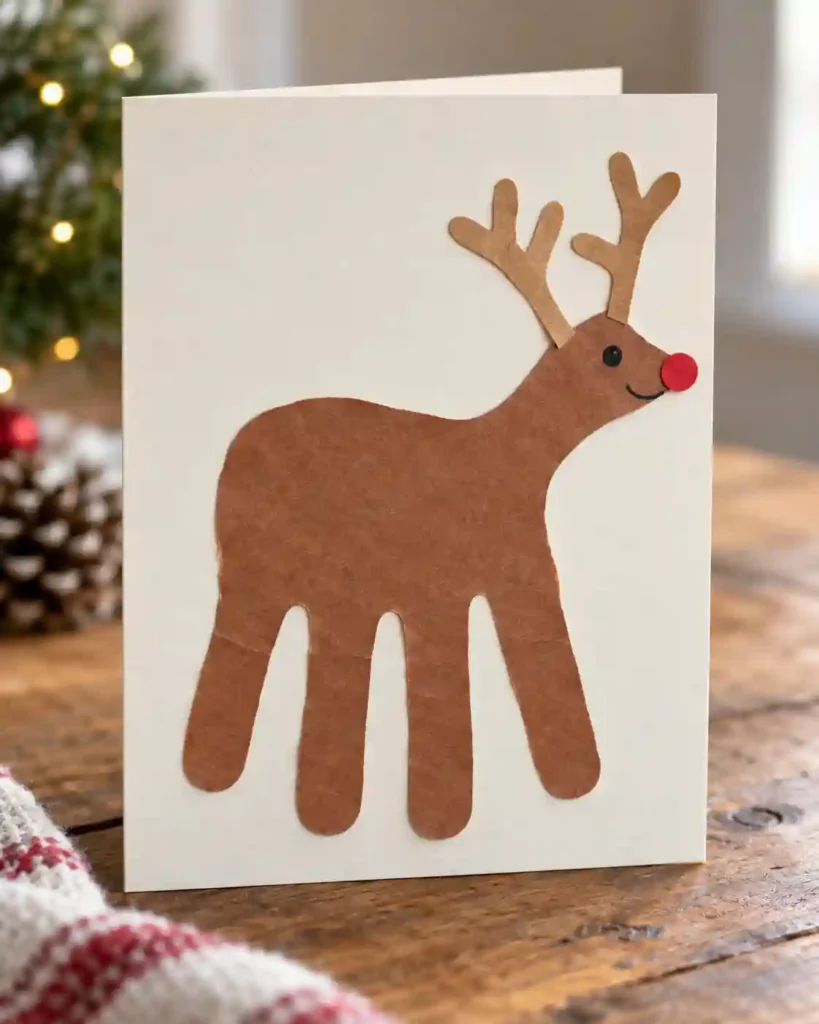
Handprint reindeer cards hide a little family memory inside a playful animal shape. Tracing a hand avoids the paint cleanup of a stamped print while preserving its outline. Slip the finished card into a grandparent’s parcel or leave it beside a place setting. It is especially useful when you want a keepsake that fits in an envelope.
Trace a hand onto brown paper and cut it out with appropriate help. Position the fingers downward as legs and the thumb upward as the head; add paper antlers, a nose, and drawn eyes. Glue the reindeer onto a folded card, keeping the greeting inside.
5. Why Try Fingerprint Christmas Lights Cards?
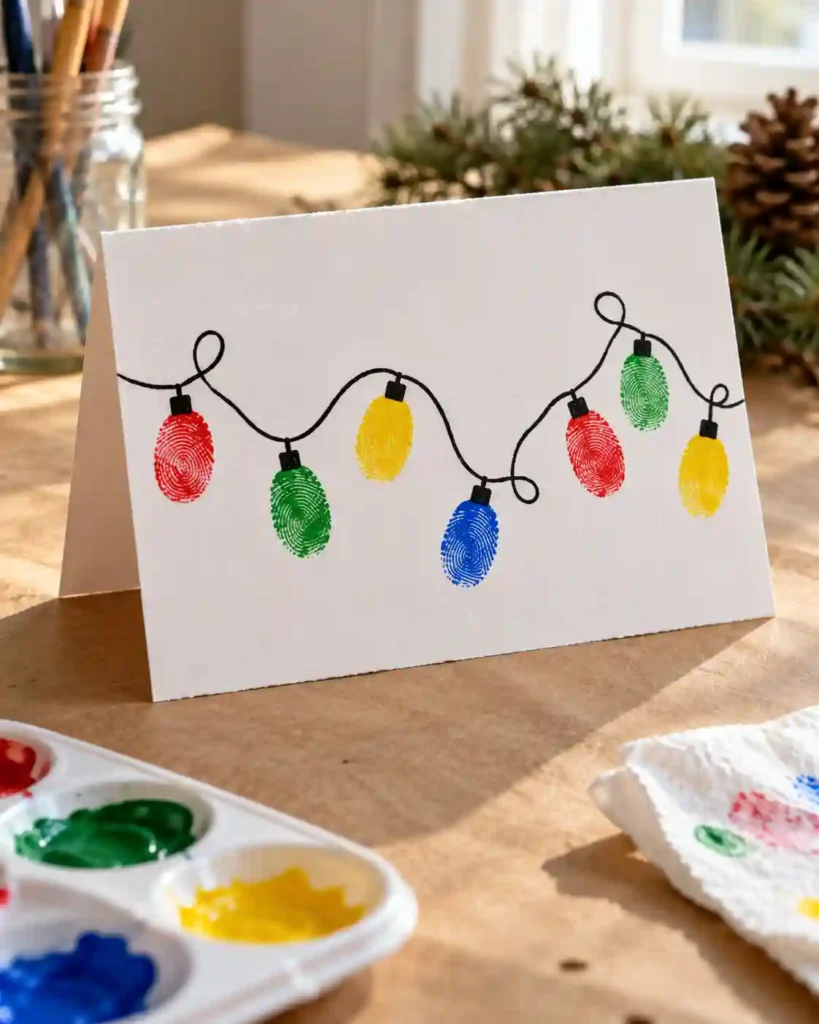
Fingerprint Christmas lights cards make colorful marks look like a string of glowing bulbs. The drawn cable brings the design together, so the prints do not need to line up neatly. Set out a few paint colors for children making cards for teachers or neighbors. Every card ends up different, even when the starting design is identical.
Draw a looping line across a folded card. Add fingerprints along it using paint intended for finger painting, then draw little bulb sockets once the paint dries. Children who dislike paint on their fingers can use a suitable stamping tool instead.
6. How Do You Make Paper Plate Santa Faces?
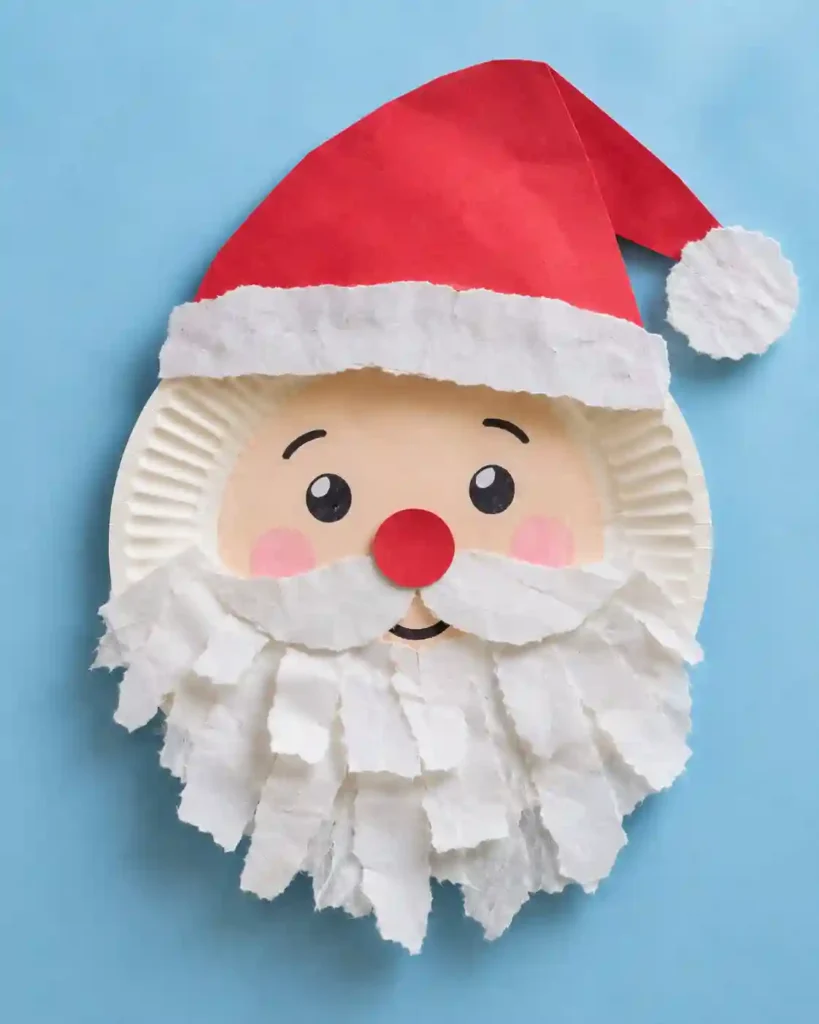
Paper plate Santa faces get their character from a fluffy-looking torn-paper beard. Using white paper instead of paint keeps the drying stage mostly to the glue. They work nicely on a classroom wall where the different expressions become part of the display. For children who enjoy building faces, this is an approachable starting point.
Attach a red paper hat to the top of a plate. Add drawn eyes and a paper nose, then layer torn white strips around the lower edge. Curl a few beard strips loosely around a pencil before gluing them down.
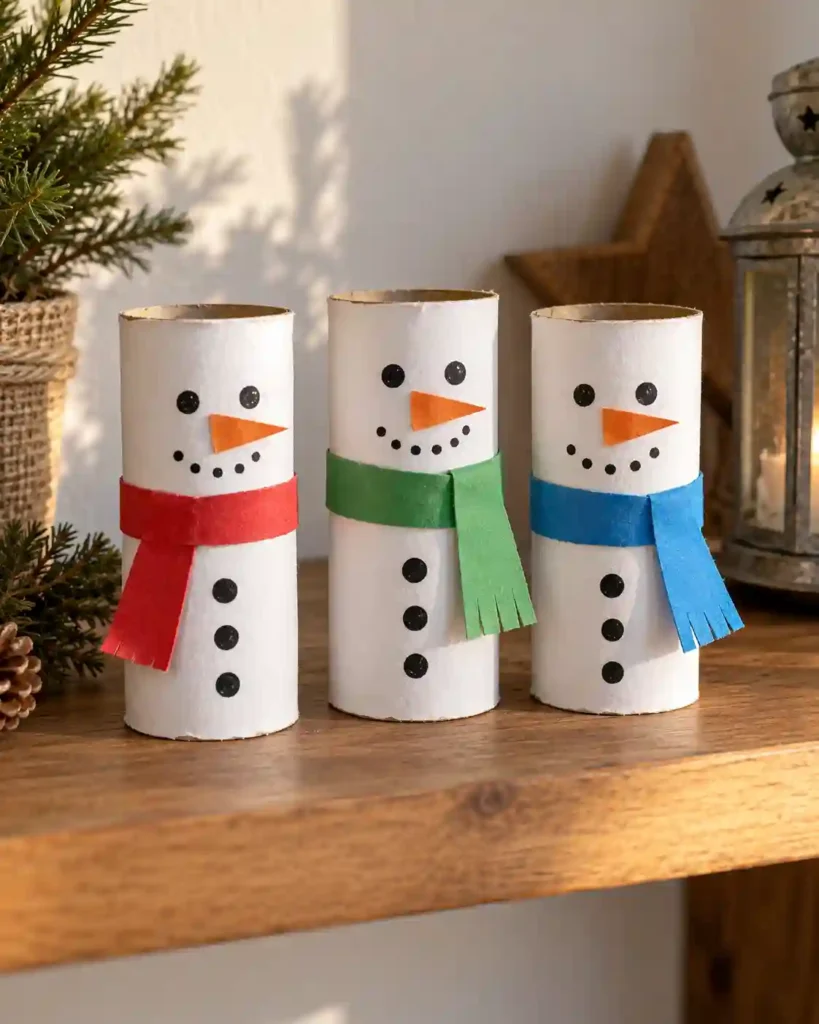
7. What Can You Make with Cardboard Tubes?
Cardboard tube snowmen stand up on their own, ready for a tiny winter scene. Wrapping the tubes in white paper saves waiting for several coats of paint. Place a family of them along a shelf or use them in a holiday storytelling activity. Children who prefer making characters to flat pictures will enjoy giving each one a personality.
Use clean, dry craft tubes. Wrap them in white paper, draw the faces and buttons, and add paper scarves. Check that the bottom edges sit flat before adding hats or other decorations.
8. How Do Paper Bag Reindeer Puppets Work?
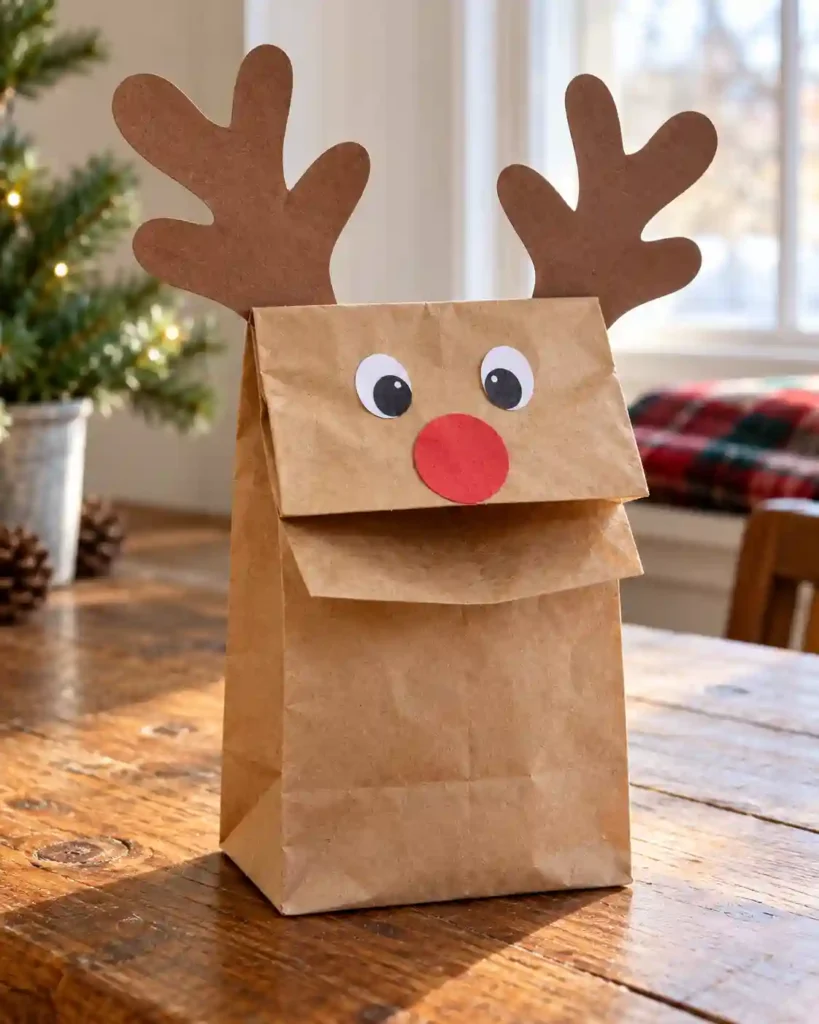
Paper bag reindeer puppets give children something to play with after the crafting ends. The bag’s existing flap becomes a moving mouth, so no extra mechanism is needed. They are handy for a Christmas party activity followed by a little puppet show. Story-loving children get both a character and a reason to invent its voice.
Lay a paper lunch bag flat with its folded base facing you. Decorate that flap as the reindeer’s face and attach broad antlers behind it. Keep glue away from the moving fold so a hand can still open and close the mouth.
9. How Can You Fold Paper Christmas Angels?
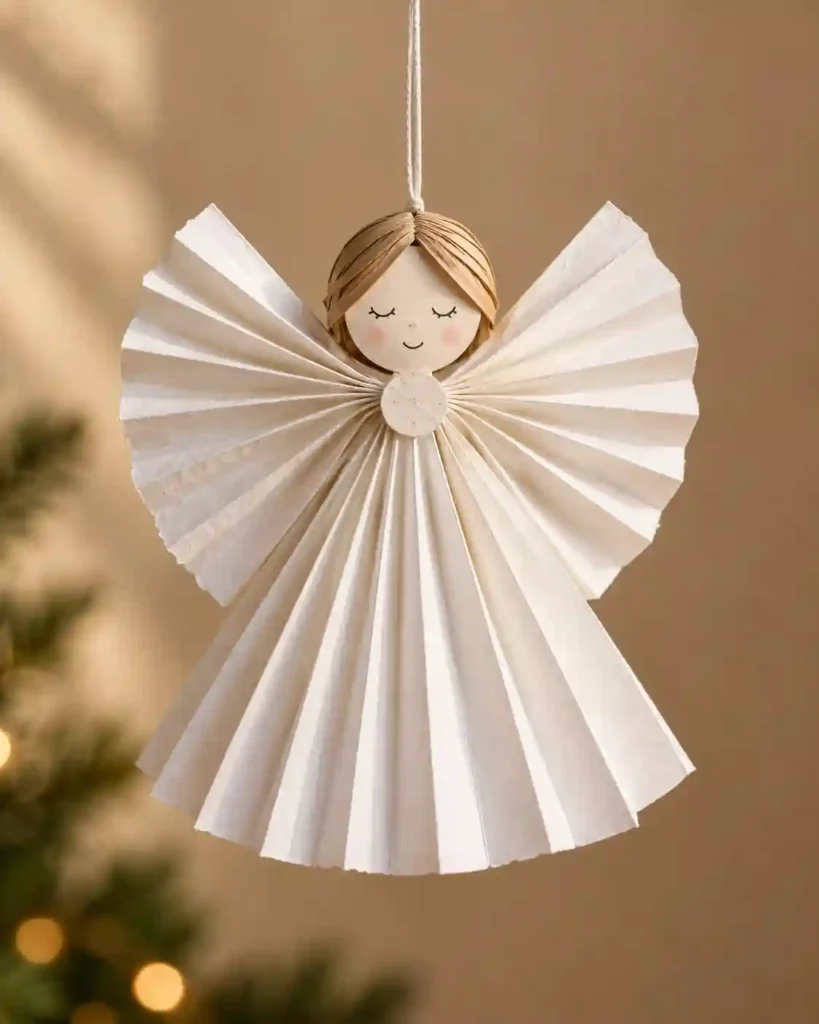
Folded paper Christmas angels have fan-shaped wings that look detailed without many separate pieces. The accordion folds create the decoration, so plain white paper works beautifully. Try a few for a quiet Sunday school activity or a small branch display. Patient beginners can practice repeated folds and finish with something light enough to hang.
Accordion-fold one rectangle for the dress and another for the wings. Pinch and secure the dress at the top, attach the wings behind it, and add a paper face. An adult can help secure a short hanging loop between the layers.
10. How Do You Make a Paper Chain Christmas Countdown?
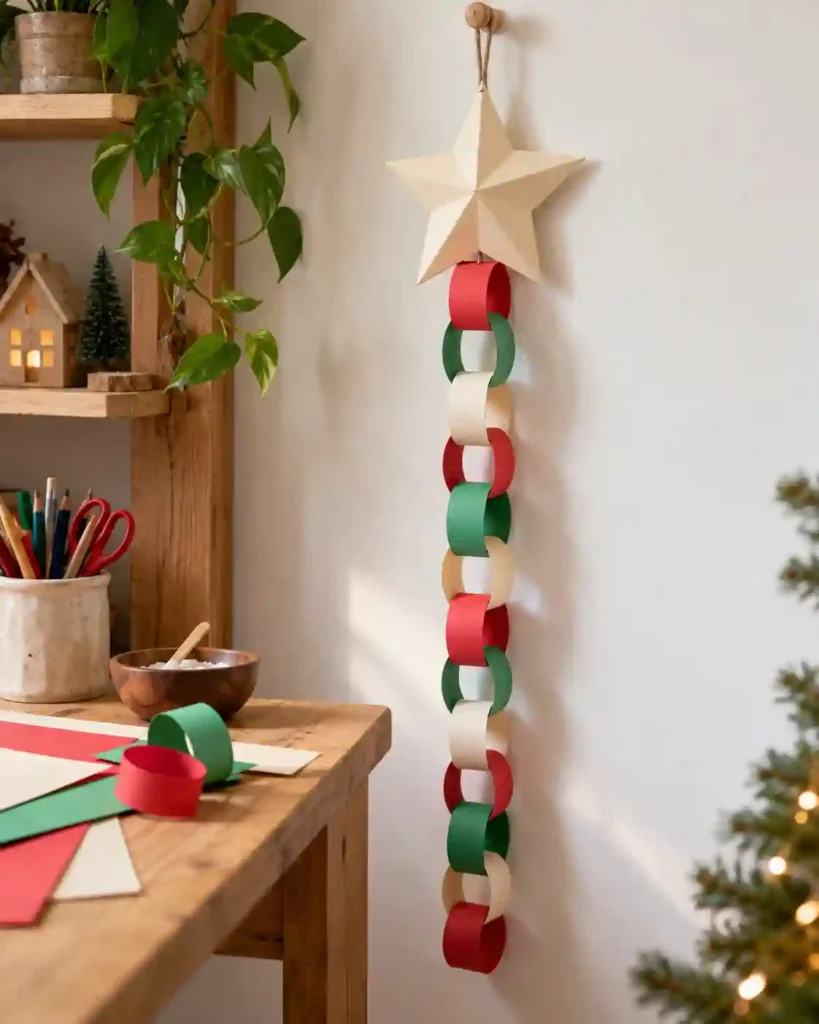
A paper chain Christmas countdown makes the wait visible, one link at a time. Children can see the chain getting shorter rather than relying only on a calendar. Hang it beside the breakfast table and remove a link at an agreed time each day. Families who enjoy a small December ritual can make the preparation part of the fun.
Count how many days you want to include and prepare that many strips. Form the first loop, thread the next strip through it, and continue. Decide whether your countdown includes Christmas Day before counting the links.
11. How Do Craft Sticks Become Christmas Tree Ornaments?
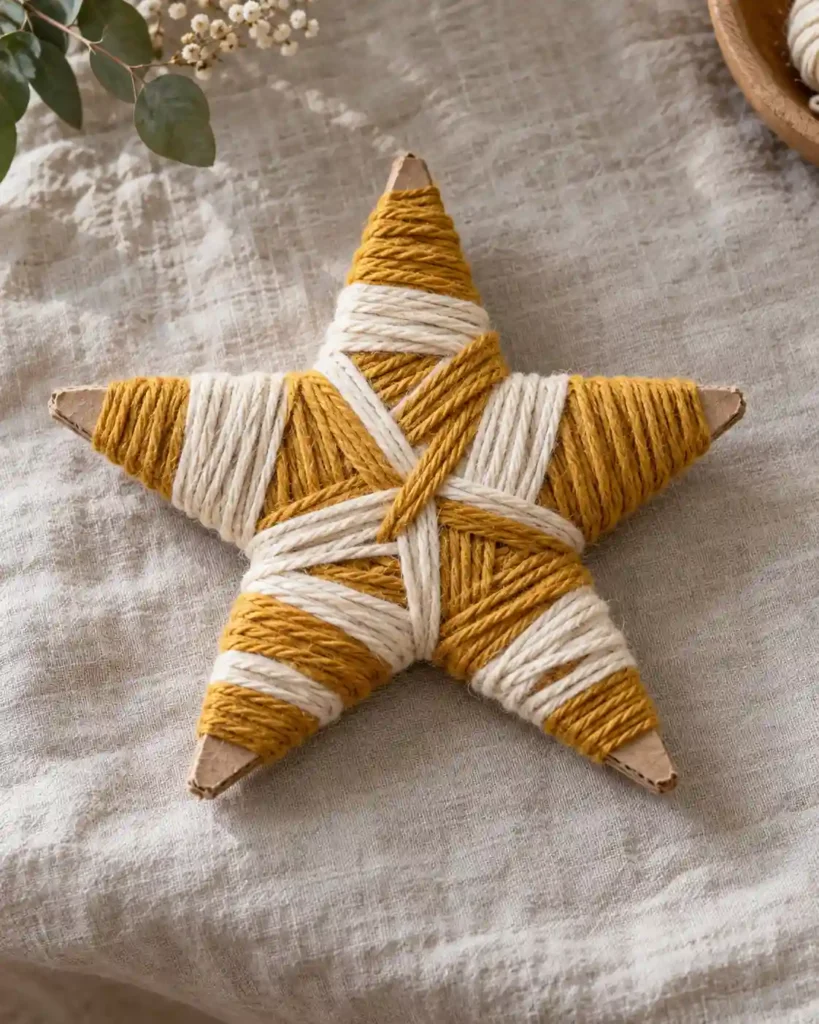
Popsicle stick Christmas tree ornaments use a simple triangle as their frame. The open center makes them feel lighter than a solid cardboard decoration. They suit an ornament-making afternoon when children want several designs from the same supplies. Beginners can concentrate on color and decoration once the frame is secure.
- Glue three craft sticks into a triangle.
- Attach a short cardboard trunk behind the bottom edge.
- Decorate with markers or flat paper shapes.
- Secure a hanging loop after the joints have dried.
Let the ornament rest flat while the glue sets.
12. What Is the Easiest Way to Make Stick Snowflakes?
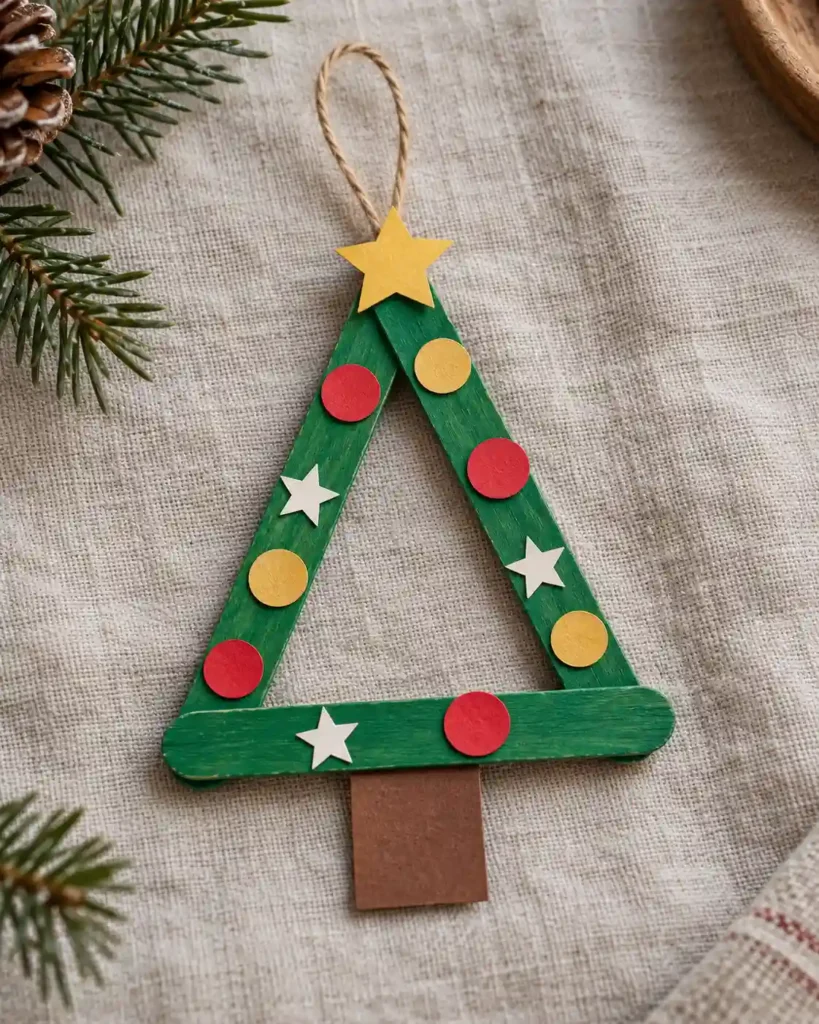
Popsicle stick snowflakes offer a winter decoration without intricate paper cutting. Three crossed sticks provide six arms, ready for stripes, dots, or a snowy coat of paint. A blue-and-white collection looks lovely across an interior window frame. Children who enjoy repeating patterns can make each arm match, or happily ignore symmetry.
Cross three sticks at their centers and glue the contact points. Decorate after the frame holds together, then attach a loop behind the center. Keep embellishments light so the joints are not carrying unnecessary weight.
13. How Do You Wrap Cardboard Stars with Yarn?
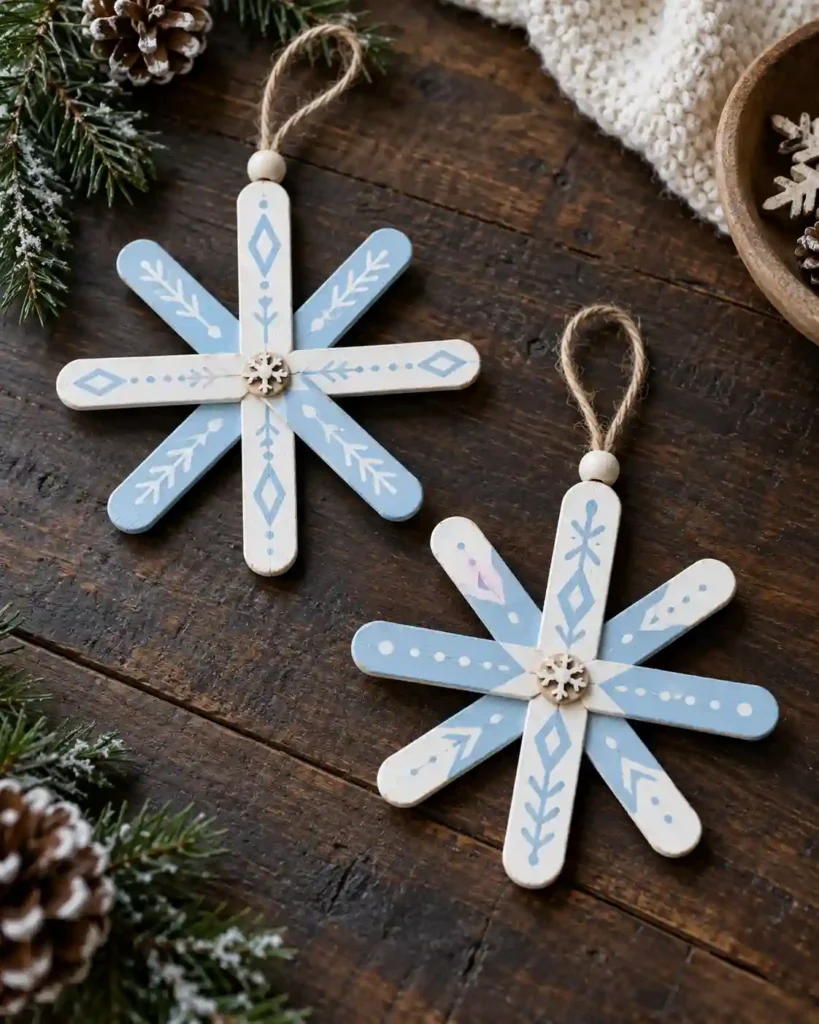
Yarn-wrapped cardboard stars bring soft texture to the tree without knitting or crochet. The cardboard supports the shape while the yarn supplies the color. Put a few leftover yarn lengths beside a prepared star for a calm tabletop activity. This is a good bridge for children curious about yarn crafts but not ready for hooks or needles.
An adult cuts a sturdy star and a small starting notch. Tuck in the yarn end, wrap across the center and around different points, then secure the final tail at the back. Avoid pulling so tightly that the cardboard bends.
14. How Can Pipe Cleaners Make a Mini Christmas Tree?
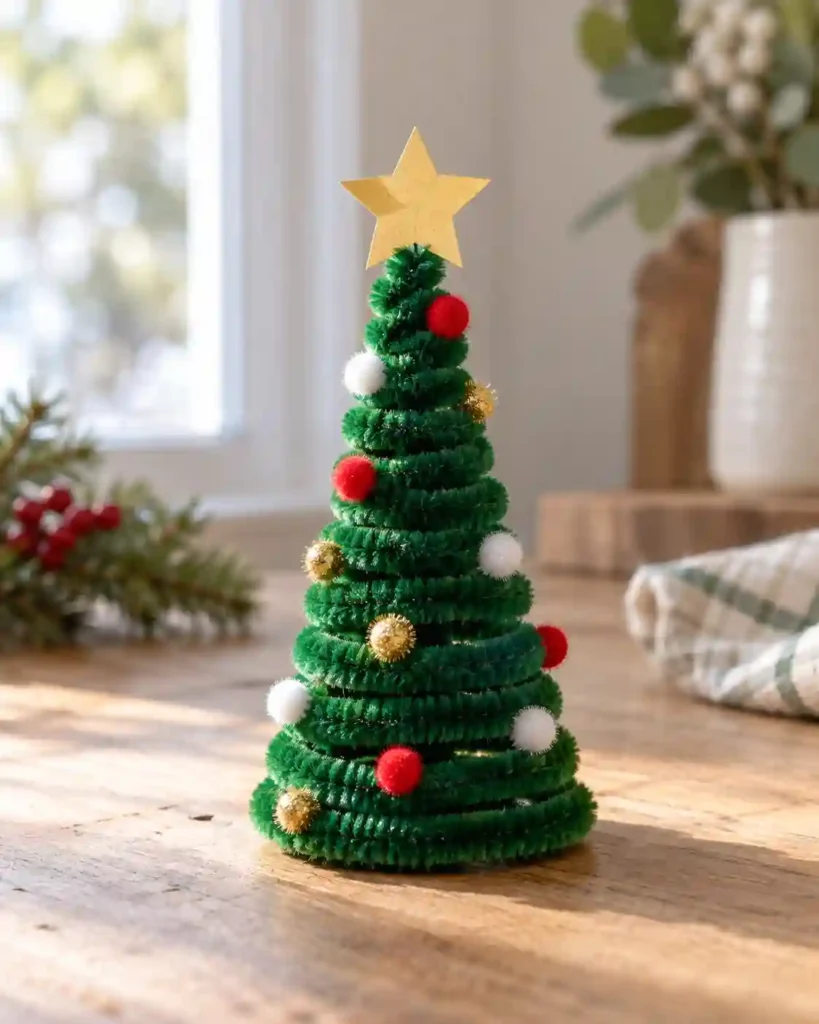
Pipe cleaner Christmas trees turn a fuzzy spiral into a standing decoration. Their three-dimensional shape offers a change from sticking a tree onto paper. Group a few beside cardboard houses for a little tabletop village. Children comfortable shaping wire stems can experiment with a tall narrow tree or a squat bushy one.
Shape a green chenille stem into a widening spiral, starting with a small top coil. Spread the lower coil into a stable base and add a paper star. An adult should fold exposed wire ends inward and check the finished piece.
15. Who Can Make Pony Bead Candy Cane Ornaments?
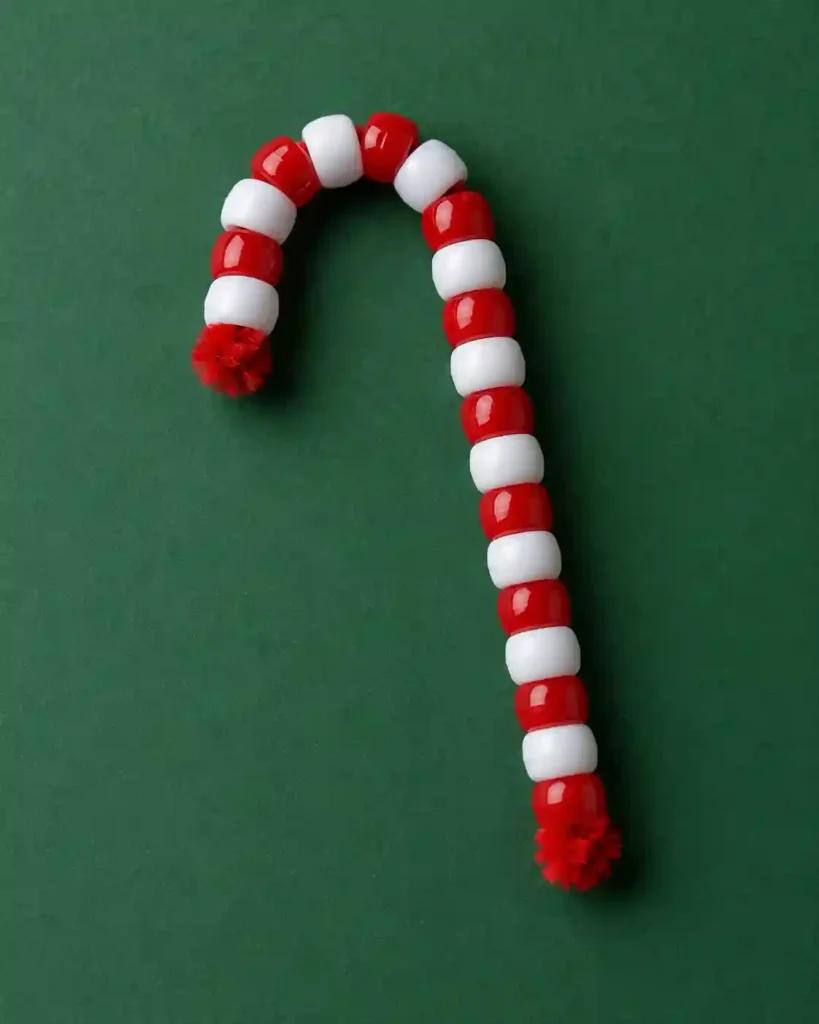
Pony bead candy cane ornaments have a clear repeating pattern that is easy to see as it grows. The beads create the stripes without paint or drying time. Set this up separately for older children while younger siblings work with paper. For careful makers who enjoy threading, the curved finish makes a small project feel complete.
Thread alternating red and white beads onto a chenille stem. Leave enough stem at each end for an adult to fold and secure, then bend the top into a hook. These are decorations, not sweets.
Keep beads away from children who mouth objects. The NHS advises that toys marked unsuitable for children under 36 months should not be given to children under three, and recommends checking for small parts and sharp edges. Apply the same caution when choosing components for this activity.
16. Can You Make Handprint Keepsakes Without Raw Salt Dough?
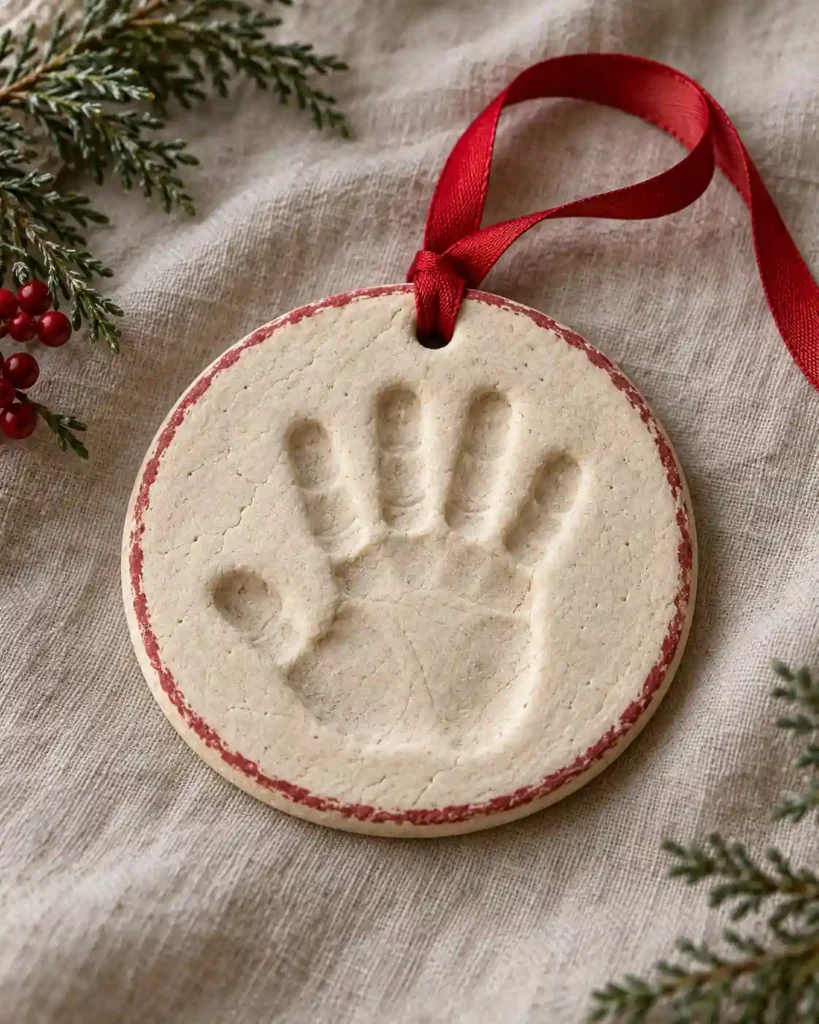
Handprint keepsakes capture the tiny lines and proportions that a traced outline misses. A child-suitable impression kit or modeling material can provide the familiar salt-dough-style finish without mixing raw flour. Make one for a family ornament collection and write the year on the reverse. For sentimental gifts, the handprint itself is enough decoration.
The FDA advises against letting children use raw dough for crafts or play clay because flour can contain harmful bacteria. For this project, choose an age-appropriate product specifically intended for children’s hand impressions and follow its instructions for skin contact and drying.
Prepare the material as directed, help the child press and lift their hand, and add a hanging hole if the product instructions permit it. Decorate only after the piece has fully set.
17. How Do You Make Photo Frame Christmas Ornaments?
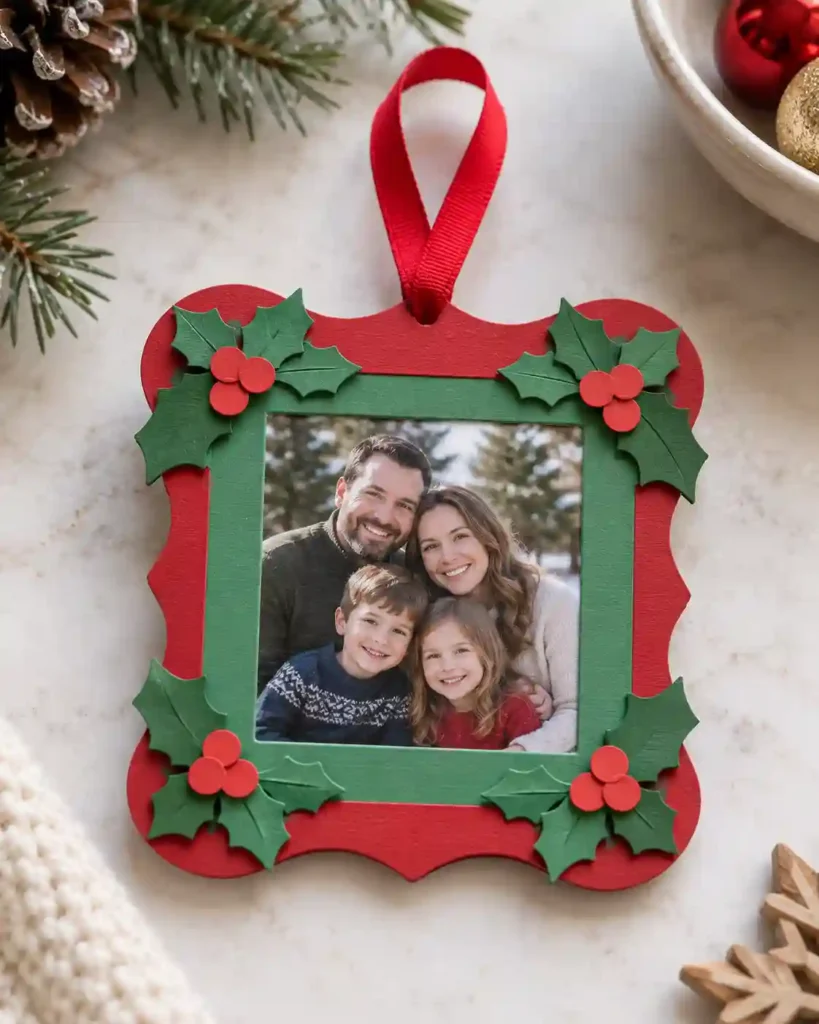
Crochet Christmas ornaments offer another handmade way to decorate the tree, while photo frame Christmas ornaments put a familiar face among the branches. Cardstock keeps the finished frame lighter than a bulky wooden version. They make a thoughtful end-of-term project when families provide a photo they are happy to use. Children can personalize the border while the photograph gives the ornament its meaning.
Cut a cardstock frame with an opening slightly smaller than the photo. Attach the picture behind the opening, add a backing, and trap a ribbon loop securely between the layers. Write the date on the reverse before the ornament goes home.
18. What Is a Photo Snow Globe Card?
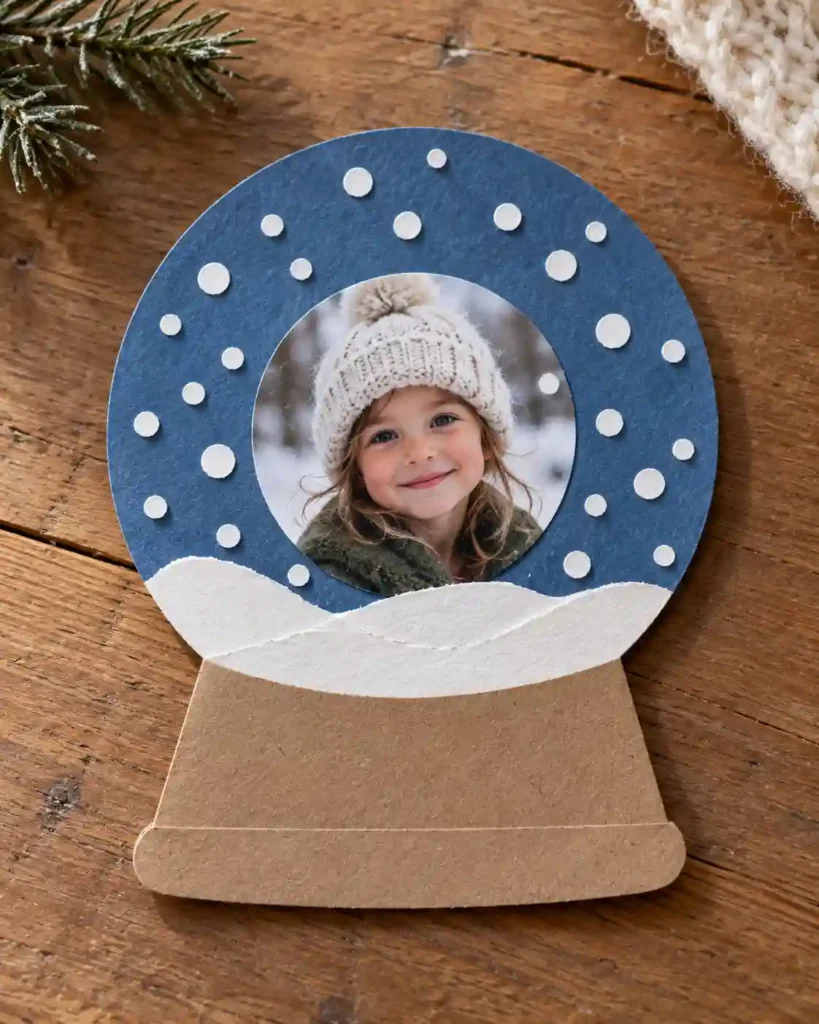
A photo snow globe card places a child inside a tiny paper winter scene. Unlike a water-filled globe, it stays flat and slips into an envelope. It is a sweet choice for sending a holiday hello to relatives who live far away. Children who love seeing themselves in their artwork get an especially personal result.
Cut a large paper circle and a separate globe base. Glue a photo inside the circle, add white paper snow dots around it, and mount everything on a folded card. Leave the face clear rather than covering the entire picture with snow.
19. How Can Handprints Become a Christmas Wreath?
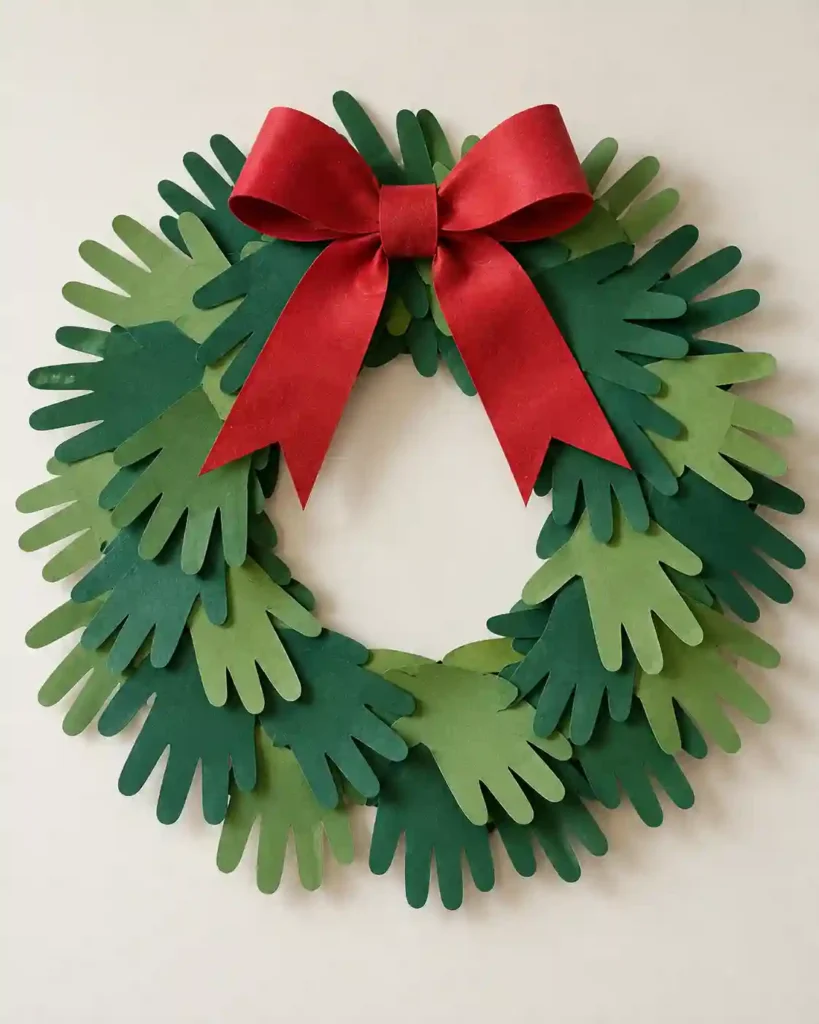
Handprint Christmas wreaths turn several little outlines into a ring of leaves. Cut-paper prints offer more control over placement than stamping directly onto a finished wreath. Let siblings contribute different shades of green for a shared decoration. The result suits families who would rather keep one collaborative piece than several separate pictures.
Trace and cut several hand shapes with adult help. Overlap them around a cardboard ring, keeping the fingers pointing outward, then add a paper bow. Names and dates on the back help you remember whose hands made it.
20. How Do You Make Footprint Reindeer Gift Tags?
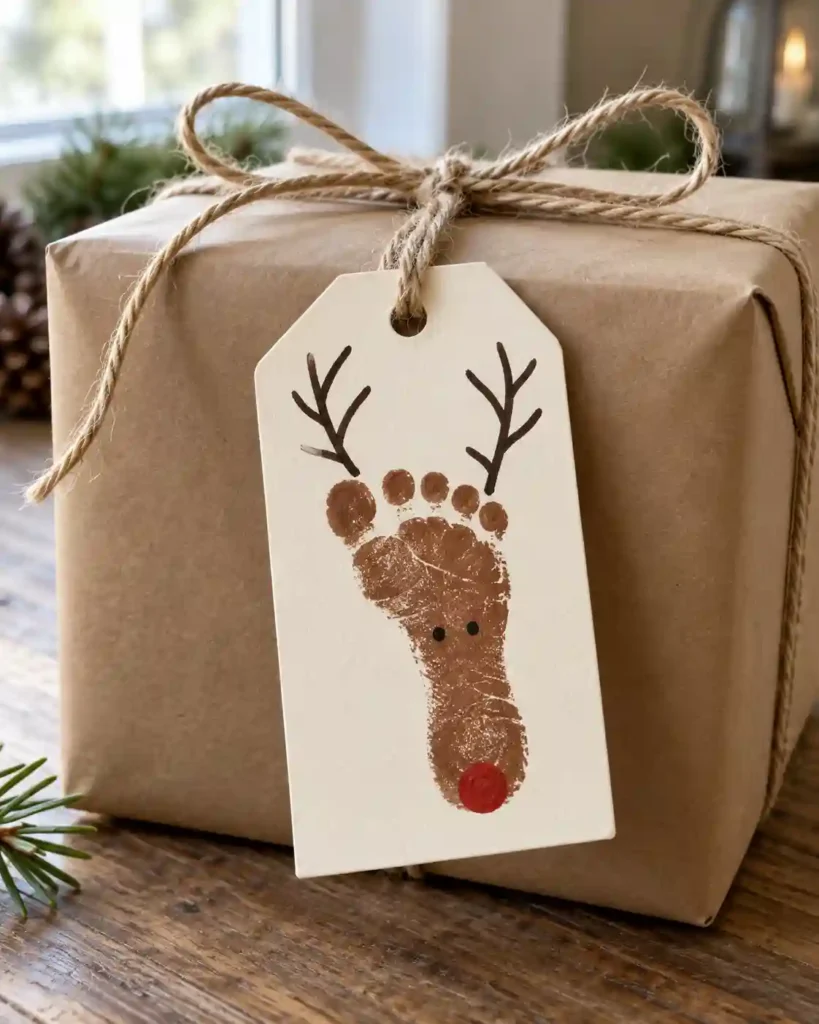
Footprint reindeer gift tags make the wrapping part of the present. A single print provides the face, so the design needs very little extra decoration. Tie one onto a grandparent’s parcel for a personal touch before the gift is opened. Younger children can contribute with adult support, or use a traced footprint if paint feels uncomfortable.
Use paint intended for the relevant skin-contact activity and follow its label. Make the print on sturdy paper, let it dry, and add drawn antlers and a nose. An adult can trim the tag and punch its attachment hole.
21. How Do Tissue Paper Snowflake Suncatchers Catch the Light?
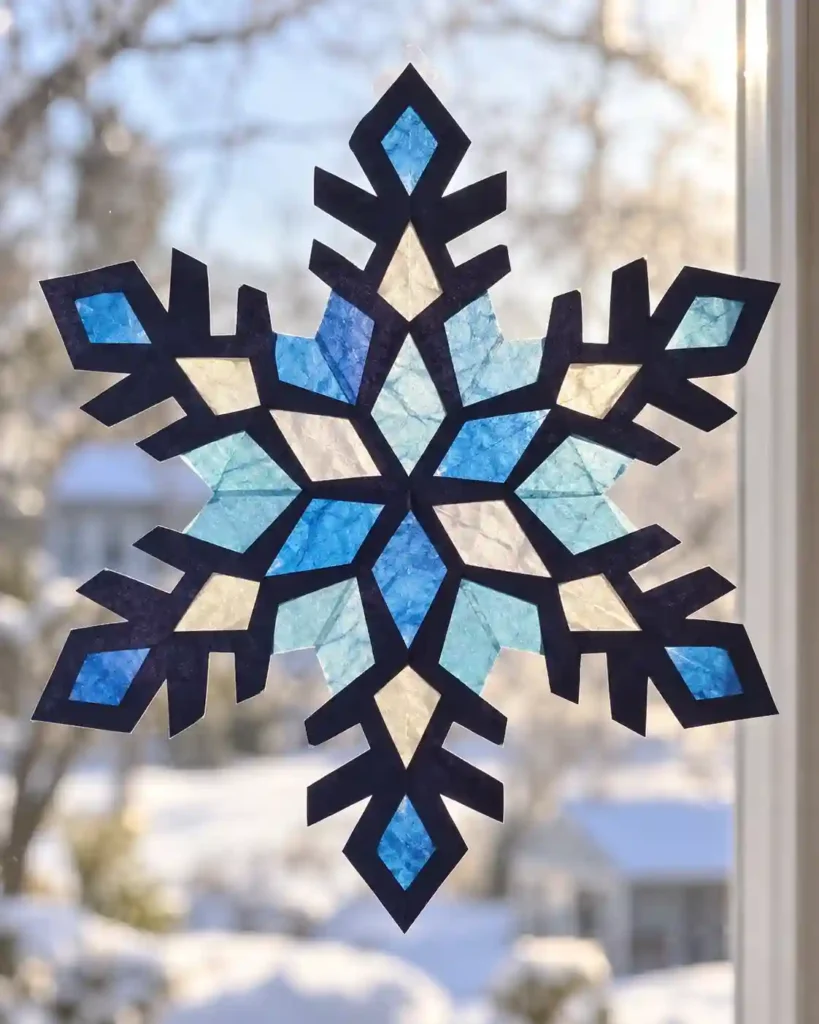
Tissue paper snowflake suncatchers look different once daylight passes through them. Their translucent centers give a window more color than ordinary paper cutouts. They are lovely for a room where hanging decorations would get in the way. Children who enjoy layering colors can explore the effect without needing precise paintwork.
Prepare a broad paper snowflake outline and place it onto clear adhesive film. Fill the openings with tissue pieces, cover with another sheet of film, and trim the edges. Attach the finished shape to a window using a suitable removable method.
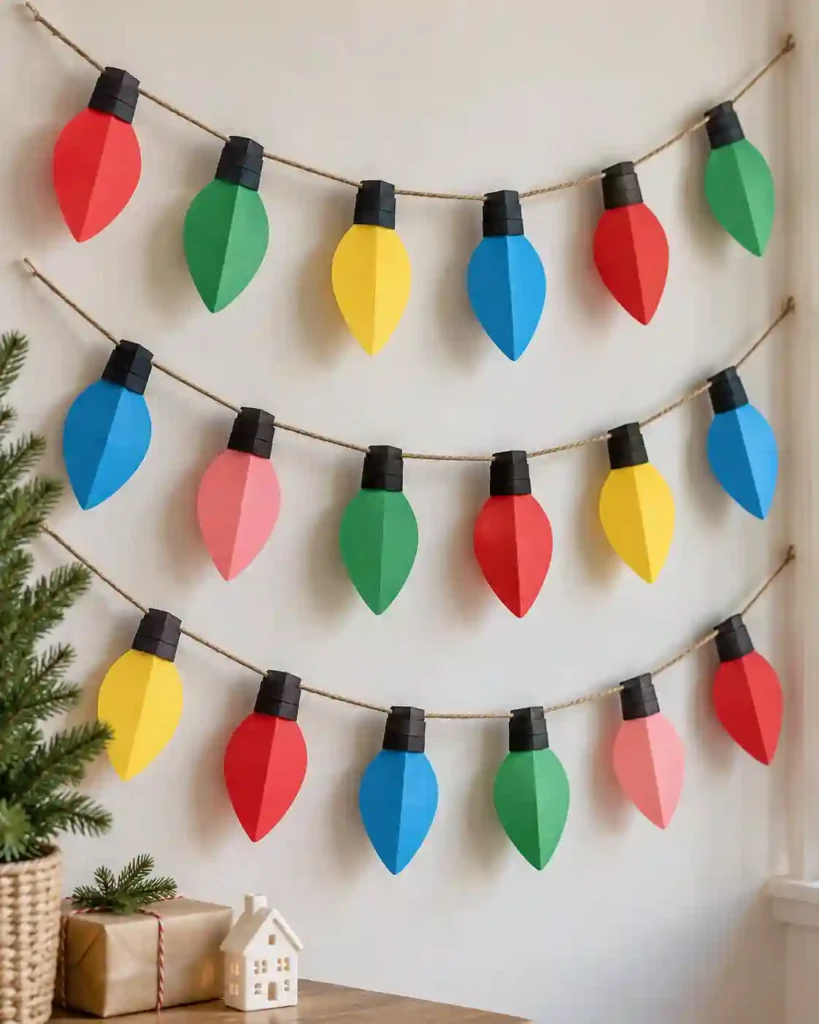
22. How Can You Make Christmas Lights Without Electricity?
Paper Christmas light garlands bring bright bulbs to a wall using only paper and string. There are no real lights to plug in, making the design easy to rearrange. Give each child a few bulbs to decorate for a shared classroom garland. A mixed collection of colors looks cheerful without anyone needing to match a sample.
Cut broad bulb shapes and add dark paper sockets at the top. Decorate with markers, then tape the sockets onto a display string. An adult should hang the garland where children cannot become tangled in the cord.
23. What Makes Laced Paper Christmas Stockings Different?
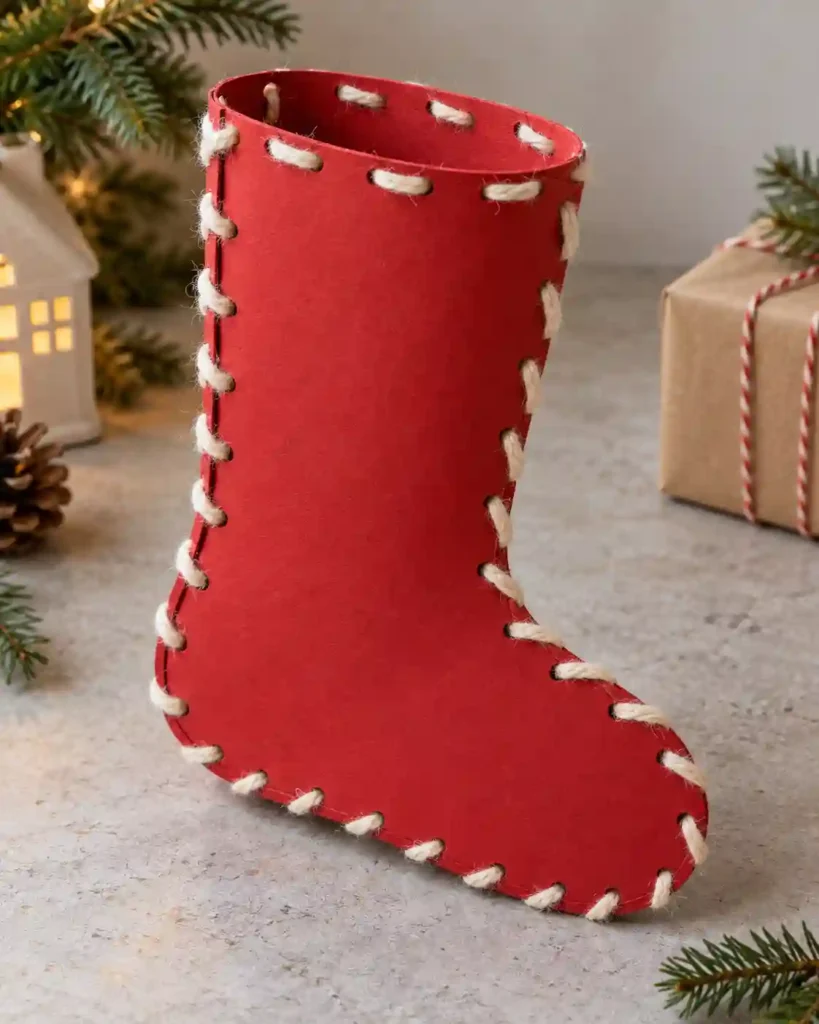
Laced paper Christmas stockings have a real opening for a lightweight note. For a yarn-based alternative, explore crochet Christmas stocking ideas. Yarn joins the edges, adding a simple sewing-like action without a needle. They work well when children are ready for something beyond glue-and-stick activities. Patient beginners get a small pocket they have assembled themselves.
Cut two matching cardstock stockings. An adult punches aligned holes around the sides and bottom, leaving the top open. Lace the layers together with a manageable length of yarn and secure the ends.
Wrapping a little tape around the yarn tip can make threading easier.
24. Can Egg Cartons Become Christmas Bells?
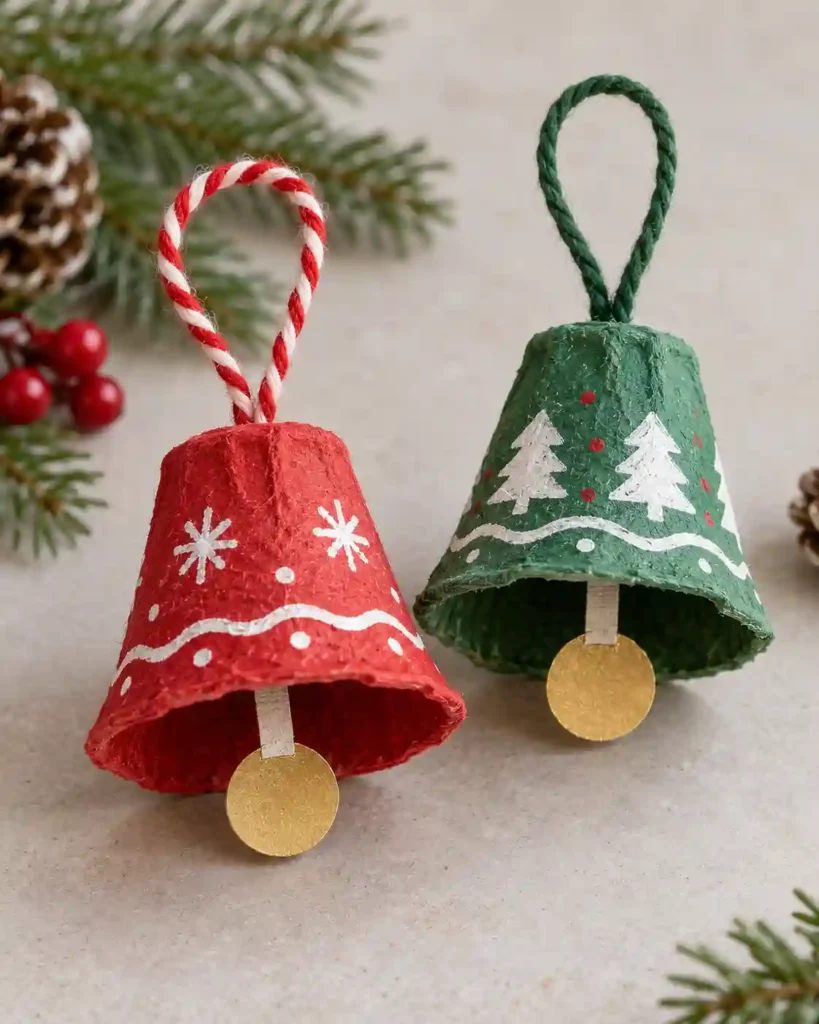
Egg carton Christmas bells use the cup’s shape instead of building a bell from scratch. A paper clapper gives the appearance of a bell without adding a loose metal part. Hang a pair from a shelf or use them as lightweight gift decorations. Children interested in reusing materials can see the original packaging turn into something new.
Choose clean, uncontaminated carton sections, or use new paper craft cups instead. An adult trims the cups and makes the hanging holes. Paint, dry, and add yarn loops with flat paper clappers tucked inside.
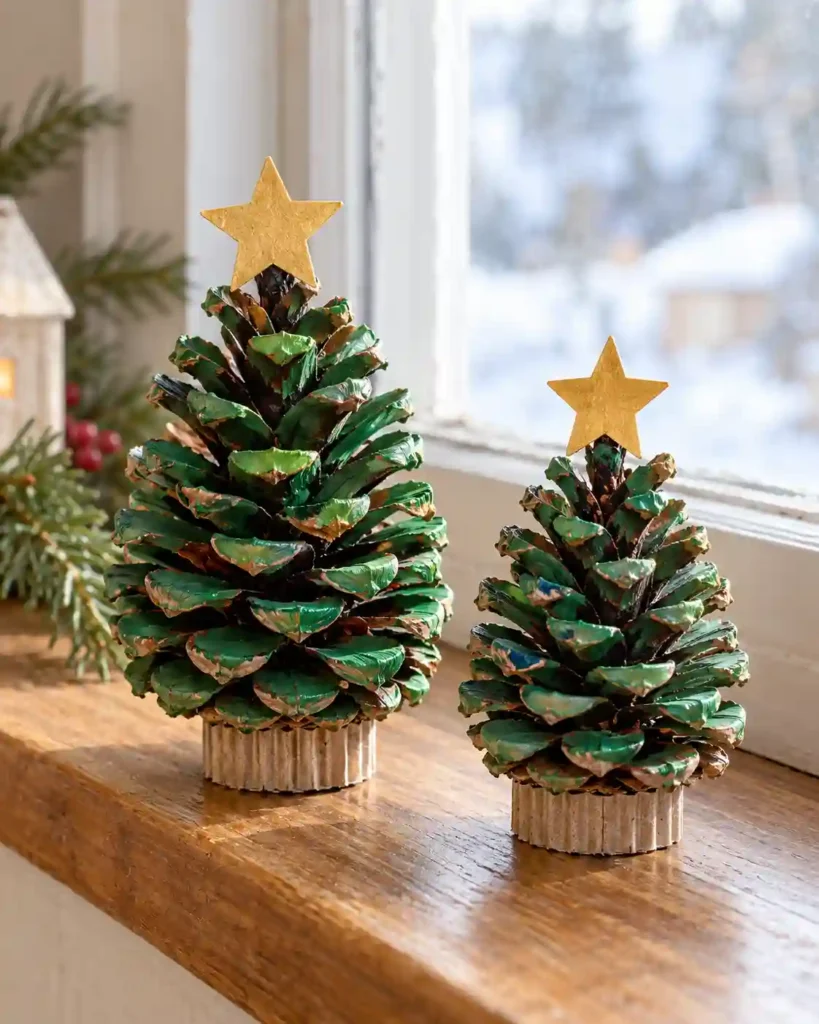
25. How Do Pinecones Become Mini Christmas Trees?
Pinecone mini Christmas trees already have a layered shape that resembles branches. A little green paint emphasizes the form without hiding the natural texture. They look at home beside a stack of winter books or a handmade village. Nature-loving children get to work with an object that does not need cutting into shape.
Use clean, dry pinecones checked by an adult for sharp points and loose pieces. Add a light coat of suitable paint and a paper star, then secure each cone to a stable cardboard base. Let the adhesive set before moving the display.
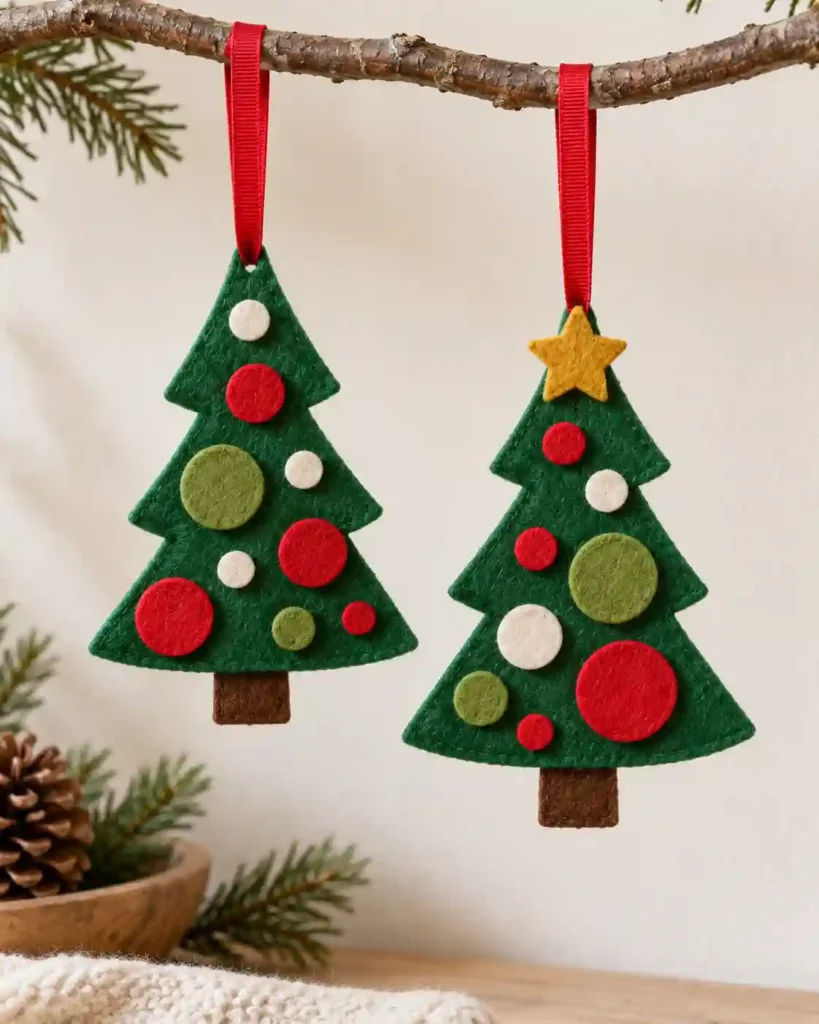
26. How Do You Make No-Sew Felt Tree Ornaments?
No-sew felt Christmas tree ornaments give older children a fabric project without requiring stitches. Flat layers are easier to finish than a stuffed decoration with seams. Choose two or three coordinating colors for a small set of handmade gifts. Makers who enjoy careful cutting can produce a neat result while keeping the design simple.
Cut two matching felt trees. Use an age-appropriate fabric adhesive to join them, capturing a ribbon loop between the top edges. Add felt circles and follow the adhesive’s full curing instructions before hanging.
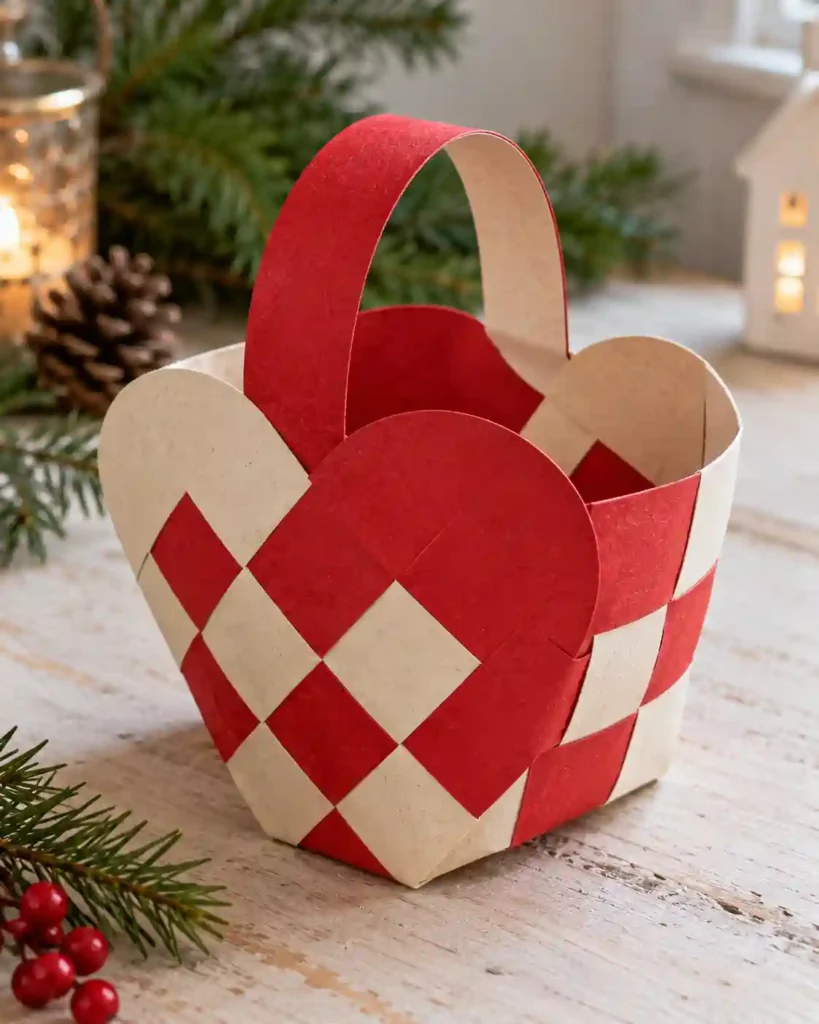
27. How Are Woven Paper Christmas Hearts Made?
Woven paper Christmas hearts hide a little basket inside their checkerboard pattern. Interlocking folded loops, rather than gluing strips onto a backing, creates the pocket. Try one together first when an older child wants a more absorbing project. The payoff is a decoration that can hold a tiny folded message.
- Fold two contrasting paper rectangles in half and round their open ends.
- Cut matching slits from each folded edge toward the rounded end, leaving the curved section connected.
- Interweave the folded strips, passing one loop through the other, then reversing which loop goes through on the next crossing.
- Gently open the pocket and attach a paper handle.
Start with two broad strips per piece before attempting a finer pattern.
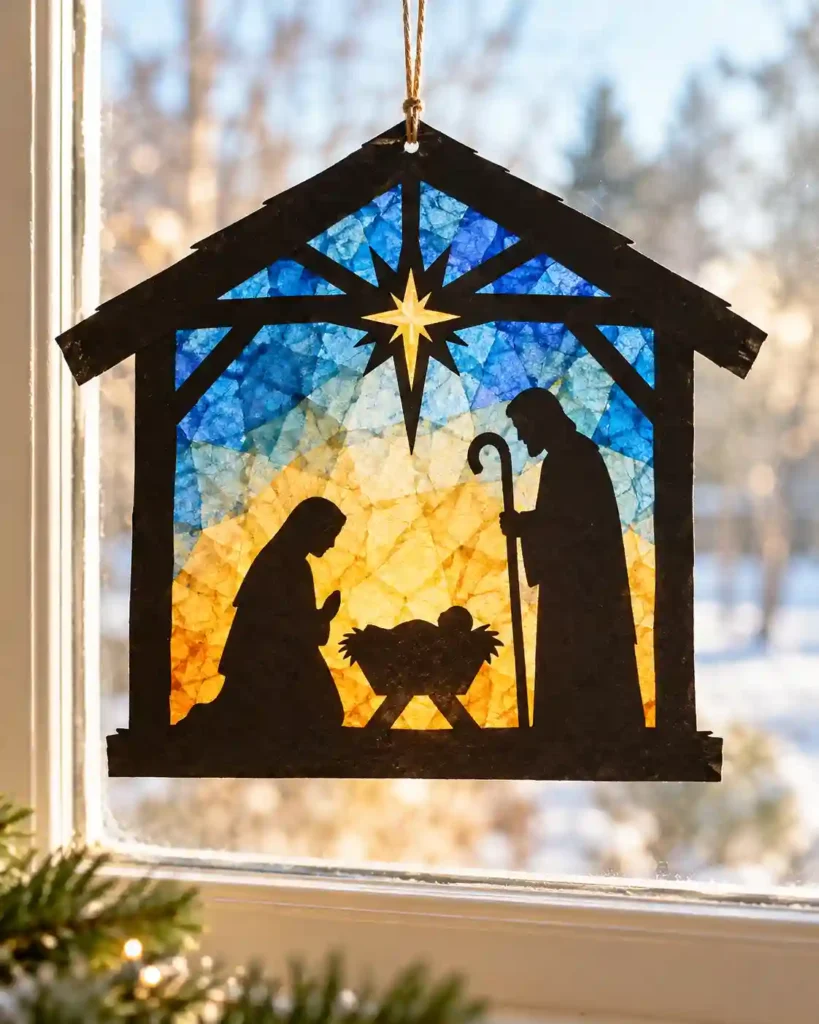
28. How Can Kids Make Nativity Silhouette Suncatchers?
Nativity silhouette suncatchers place a simple stable scene against glowing tissue-paper color. The dark outline makes the figures recognizable without detailed drawing. This is a fitting activity for a faith-based group discussing the Christmas story. With an adult-prepared silhouette, children can focus on arranging the background.
Layer tissue paper onto clear adhesive film. Add a broad paper stable and manger silhouette, then seal with a second sheet. Keep the shapes simple enough to recognize when displayed against daylight.
29. What Can Kids Wear to a Christmas Craft Party?
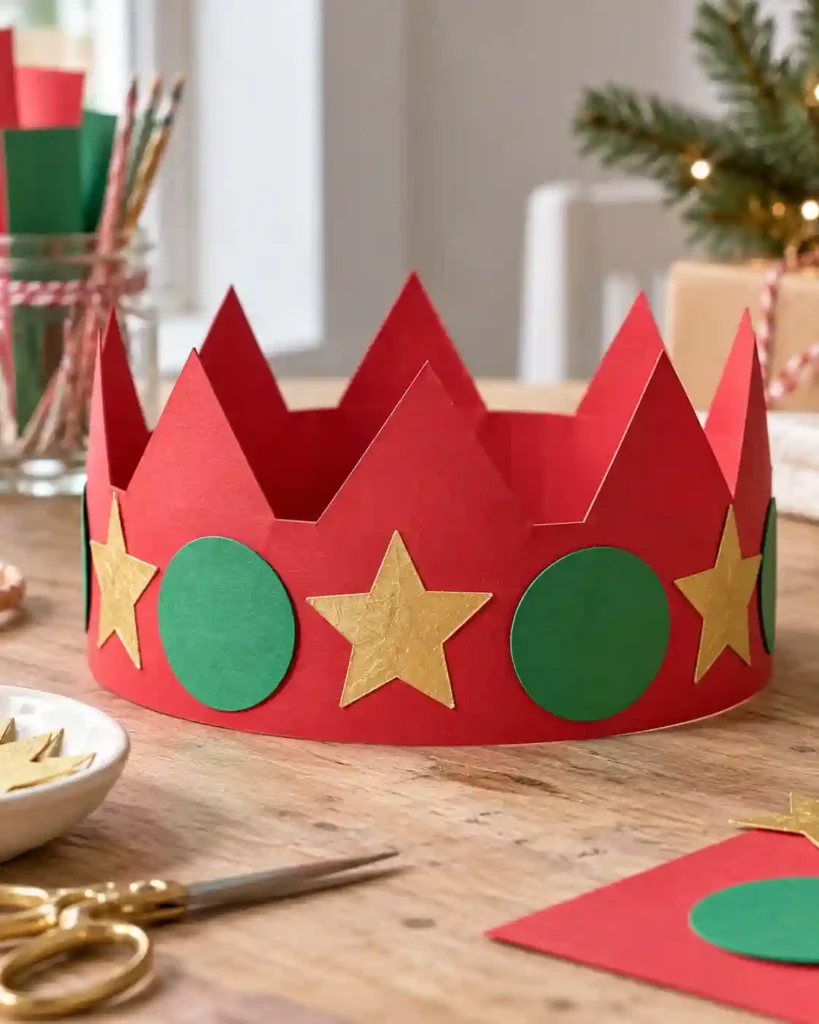
Decorated paper Christmas crowns let children wear their finished artwork straight away. Stickers and markers avoid the wait that painted party accessories can involve. Set out wide cardstock bands near the start of a celebration so everyone can make their own. Children who like dressing up get an activity and a party accessory in one.
Decorate the band while it lies flat. An adult can then measure it around the child’s head, overlap the ends, and tape them securely. Keep the fit comfortable and use flat paper decorations instead of heavy additions.
30. How Do You Make Paper Gift Boxes with Folded Lids?
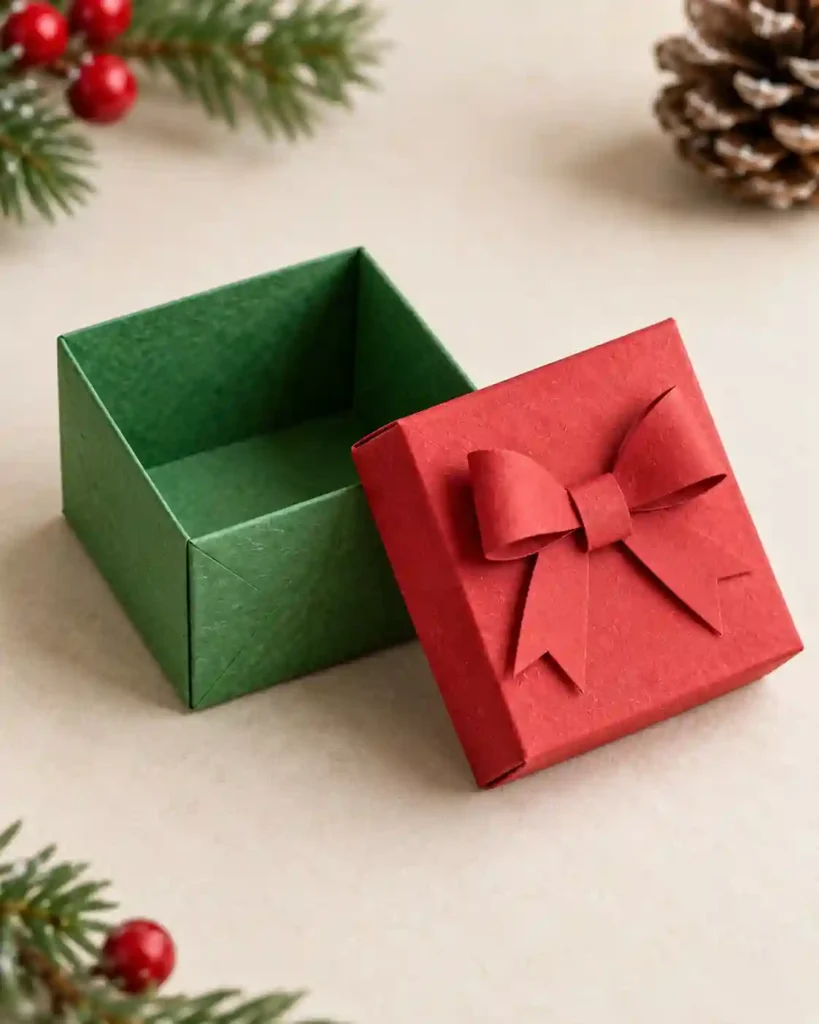
Paper gift boxes with folded lids turn a small present into a complete handmade package. A separate lid makes the box reusable, unlike wrapping that has to be torn open. They suit older children preparing tiny gifts or notes for friends. Careful folding pays off in a box that feels surprisingly satisfying to open and close.
For a simple cut-and-fold version, mark a square sheet into a three-by-three grid. Fold along the lines, cut the two short corner slits on each of two opposite sides, and glue the resulting tabs inside the raised walls. Make a second, slightly larger box for the lid, testing the fit before decorating.
Use lightweight contents and let the glued corners set fully.
How Do You Choose Easy Christmas Crafts for Kids by Age?
Match the cutting, folding, threading, and decorating tasks to the child’s abilities and the adult support available.
At a Glance
- Offer large shapes for easier handling.
- Prepare difficult cuts and holes beforehand.
- Introduce weaving and measuring when children feel ready.
- Adapt textures and tools to individual preferences.
Choose the task, not just the finished picture. A younger child may manage tearing tissue and placing large shapes, while an older child may prefer measuring, weaving, or threading.
For easy Christmas crafts for kids with mixed abilities, prepare the difficult parts in advance. Offer larger pieces, an easy-to-grip tool, or a dry-material alternative when that makes participation more comfortable.
Let children change the colors or leave a design unfinished. A project does not need to look like the sample to belong on the tree.
Which Christmas Craft Ideas for School Are Easiest to Organize?
Christmas craft ideas for school are easier to manage when projects share supplies, use prepared components, and have a designated drying area.
The most practical Christmas craft ideas for school share materials and have a clear place to dry. Paper strip trees, tissue collages, light garlands, and paper crowns are useful starting points.
Before the session:
- Prepare one example without asking everyone to copy it exactly.
- Portion materials into table trays.
- Put names on the reverse of the work before decorating begins.
- Reserve space for wet pieces and prepare take-home folders or trays.
Paper-first projects are easy Christmas crafts to make when storage is limited. Keep active making time separate from drying time when planning the lesson.
Which Christmas Crafts for Kids to Sell Could Suit a School Fair?
Christmas crafts for kids to sell could include small card sets, flat ornaments, and gift tags, with adults overseeing costs, quality, and event arrangements.
At a Glance
- Make one sample before preparing a batch.
- Record materials and packaging costs.
- Choose pieces that are easy to transport.
- Check hanging loops and glued joints.
- Confirm the organizer’s requirements before making stock.
For Christmas crafts for kids to sell at an adult-run school fair, consider paper card sets, flat felt ornaments, yarn stars, and crochet gifts that are easy to display and package. They are relatively easy to display and can share materials across a small batch.
Start with a sample, record the materials used, and ask the organizer what is suitable for the event. An adult should oversee pricing, quality checks, payments, and any applicable event requirements; a handmade item is not automatically ready for sale.
When choosing Christmas crafts for kids to sell, avoid promising profit before checking costs and interest. Keep family photographs for personal gifts unless you have appropriate permission to use them.
How Can You Keep Crafting Less Messy?
Use markers, glue sticks, large stickers, and precut paper when cleanup time is short. Christmas crafts for kids with paper can still involve folding, layering, lacing, and moving puppet parts, so a simpler supply tray need not mean a dull project.
Place a scrap container beside the table and give each child a working tray. Bring out paint only when the chosen design benefits from it, and leave wet pieces somewhere they will not need moving immediately.
How Should You Personalize and Store Handmade Keepsakes?
Write the child’s name and year on the reverse of cards and ornaments. For more inspiration, explore crochet Christmas decorations alongside these handmade keepsakes.
Pack only fully dry pieces. Separate fragile shapes with tissue, keep photographs away from damp storage, and place heavier decorations beneath lighter paper ones. Check hanging loops before using the ornaments again.
Frequently Asked Questions
What are the easiest Christmas crafts for preschoolers?
Tissue paper trees, paper plate Santas, and sticker-decorated crowns are approachable choices with adult-prepared pieces. Keep the shapes large and let children handle the decorating. Easy christmas crafts for kids work best here when adults manage difficult cuts and children choose the colors. For bead-based activities, review NHS guidance on small parts and age suitability before setting out materials.
What Christmas crafts can kids make with just paper?
Paper strip trees, countdown chains, folded angels, and woven hearts all use paper as their main material. Depending on the project, you may also need scissors, tape, or glue. Christmas crafts for kids with paper can stay flat for cards or become three-dimensional decorations.
Which homemade Christmas crafts make good gifts for grandparents?
Photo frame ornaments, handprint wreaths, and footprint gift tags offer a personal connection. Adding a name, date, or handwritten message makes it easier to remember the occasion.
What can older children make for Christmas?
Woven hearts, laced stockings, felt ornaments, and folded gift boxes offer more involved steps. Choose a project that matches their experience with cutting, measuring, and following instructions.
Do you need a craft kit for these projects?
Many ideas use basic paper, cardboard, and drawing supplies. Felt ornaments, bead decorations, and impression keepsakes need additional materials, so check the project before setting up and consult CPSC art-material labeling guidance when choosing supplies. Easy Christmas crafts to make at home often start with supplies already in your craft drawer.
Final Thoughts
Christmas crafts give kids a fun way to celebrate the holiday while exploring their creativity and imagination. From simple paper ornaments and handmade cards to festive decorations and thoughtful gifts, these projects offer something for every age and skill level. With a few basic supplies and a little adult guidance, children can create meaningful keepsakes at home or school. Choose a few favorite ideas, gather your materials, and enjoy making special Christmas memories together!