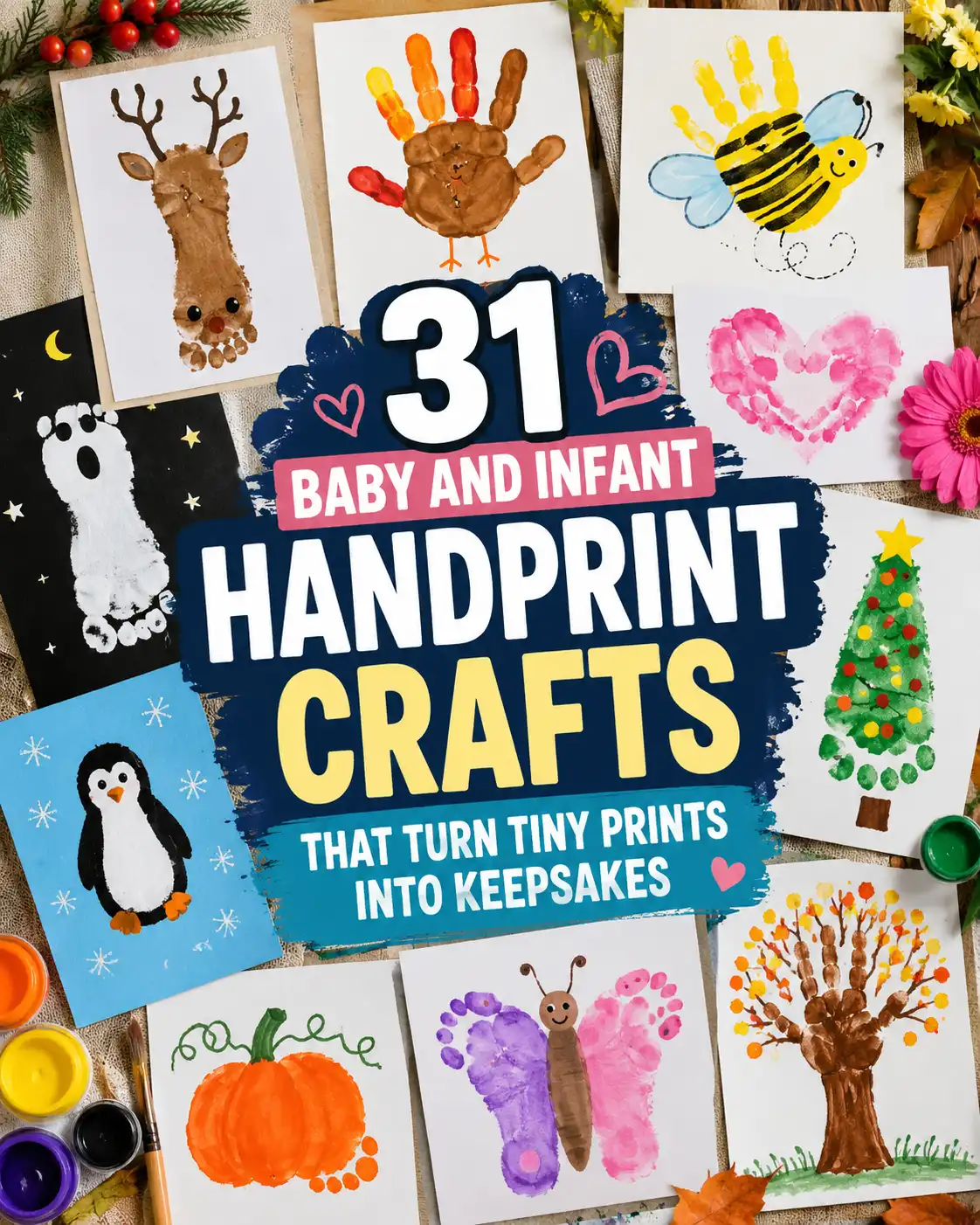
Baby and Infant Handprint Crafts turn the smallest hands and feet into keepsakes you can save long after the baby stage is gone. From pumpkin footprint art and Halloween spiders to flowers, animals, Christmas ornaments, and first-birthday memories, these 31 ideas are designed to be simple enough for babies while still looking special enough to frame or gift.
I love these projects because they do not need to look perfect to become meaningful. A slightly smudged palm, curled toe, or uneven little fingerprint often makes the finished keepsake feel more personal, especially when you add your baby’s name, age, and date. You can pick one idea for a special occasion or create a small collection throughout the first year and watch those tiny prints change.
For projects that involve paint, choose supplies specifically intended for children and follow the product directions. The Art & Creative Materials Institute recommends AP-certified art materials for young children, while the U.S. Consumer Product Safety Commission says consumer art materials should carry appropriate ASTM D-4236 conformity labeling.
Key Takeaways
- Prepare every supply before bringing baby to the table.
- Choose simple one-print projects for easier cleanup.
- Try footprint crafts for seasonal and milestone keepsakes.
- Add baby’s name, age, and exact date.
- Keep small decorations completely out of baby’s reach.
- Save imperfect prints—they often become the sweetest memories.
What Are the Best Baby and Infant Handprint Crafts?
The best baby handprint and footprint crafts use one simple print as the main design, then let an adult add the finishing details.
At a Glance:
- Use handprints for spiders, flowers, trees, and animals.
- Use footprints for pumpkins, ghosts, reindeer, and butterflies.
- Choose seasonal ideas for first holidays and celebrations.
- Add dates to turn simple art into lasting keepsakes.
The best Baby and Infant Handprint Crafts use one simple print as the main feature rather than expecting a baby to actually “make” the whole project. A handprint can become a spider, flower, turkey, tree, fish, or butterfly, while tiny feet work beautifully for pumpkins, ghosts, reindeer, hearts, and seasonal keepsakes.
This approach also matches the kinds of baby handprint and footprint activities commonly used in early-years craft resources. Twinkl, for example, features handprint and footprint themes ranging from animals and spiders to autumn trees and seasonal keepsakes, while Etsy’s baby handprint category includes thousands of keepsake-style ideas.
| Craft Idea | Print Used | Best Occasion | Difficulty |
|---|---|---|---|
| Pumpkin | Footprint | Fall/Halloween | Easy |
| Spider | Handprint | Halloween | Easy |
| Ghost | Footprint | Halloween | Easy |
| Autumn Tree | Handprint | Fall | Easy |
| Turkey | Handprint | Thanksgiving | Easy |
| Reindeer | Footprint | Christmas | Easy |
| Flower Bouquet | Handprint | Mother’s Day | Easy |
| Butterfly | Footprints | Spring | Easy |
| Heart | Handprints | Valentine’s Day | Easy |
| First Birthday Keepsake | Hand or Foot | Birthday | Easy |
Before You Start: How Do You Make Handprint Crafts With a Baby?
Preparation matters more than artistic skill.
Have your paper, paint, damp cloth, wipes, and clean-up area ready before bringing your baby over. Try the print when your baby is rested and comfortable, work with one hand or foot at a time, and accept that the first print may not be perfect.
That imperfect little smear often becomes the part you treasure most.
ACMI advises using its AP-certified products for young children and reading product labels before use. CPSC also notes that U.S. art materials undergo toxicological review and generally carry an ASTM D-4236 conformity statement.
Never leave a baby alone with paint, glue, decorations, ribbons, buttons, pom-poms, or other craft materials. Anything small or detachable should remain an adult-only decorating material and the finished craft should be kept out of baby’s reach.
31 Baby and Infant Handprint Crafts to Save, Gift, and Display
Start with a simple handprint or footprint, let it dry, and turn the shape into a seasonal picture, animal, milestone design, or framed keepsake.
At a Glance:
- Make holiday prints for baby’s first celebrations.
- Create animals from simple hand and foot shapes.
- Try fall handprint crafts for easy seasonal memories.
- Frame milestone prints instead of adding elaborate decorations.
- Repeat favorite ideas later to compare growth.
1. Pumpkin Footprint Art
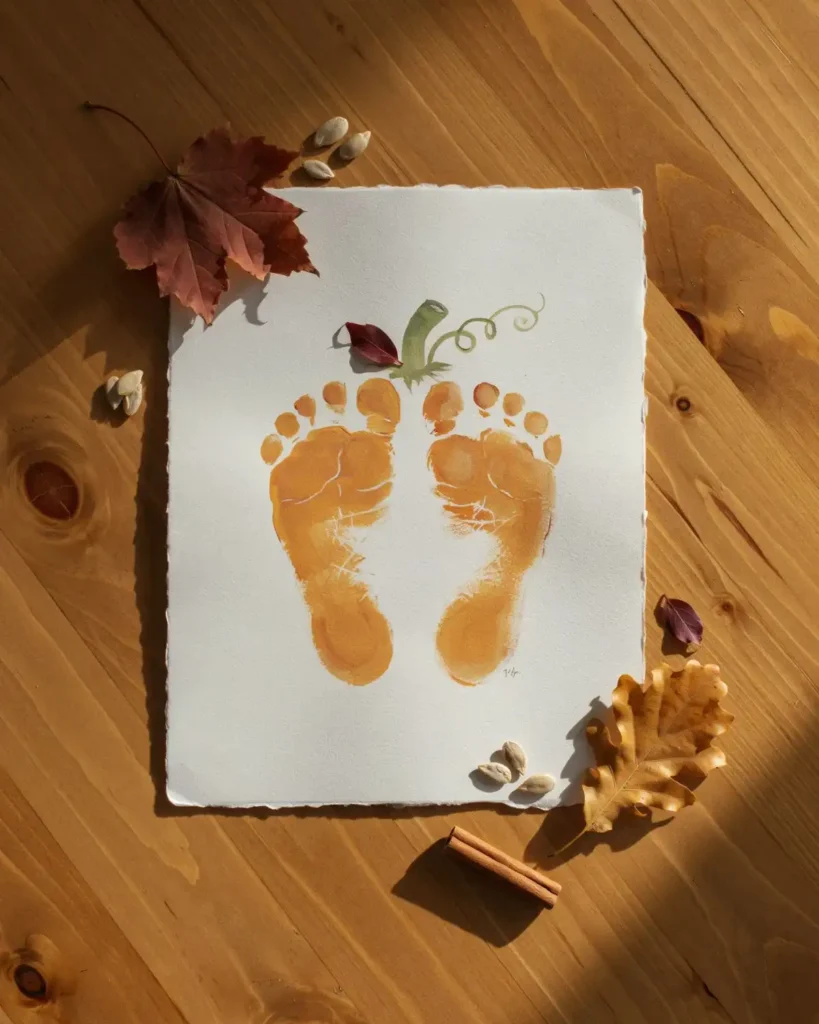
Tiny toes make surprisingly perfect pumpkins. Pumpkin footprint art stands out from a normal painted pumpkin because the uneven outline is exactly what gives it that sweet first-fall feeling. I would make this one during a quiet October afternoon, then add the year underneath before it disappears into the seasonal decoration box. It is especially lovely for a fall baby craft because one orange footprint does almost all the work. If you want more seasonal inspiration, you can also explore these fall crafts for other simple autumn projects.
Paint the sole of baby’s foot orange and press it onto thick paper. Once dry, add a small green stem and curling vine with a marker.
Special Tip: Make two prints on separate cards and give one to grandparents.
2. Spider Handprint Craft
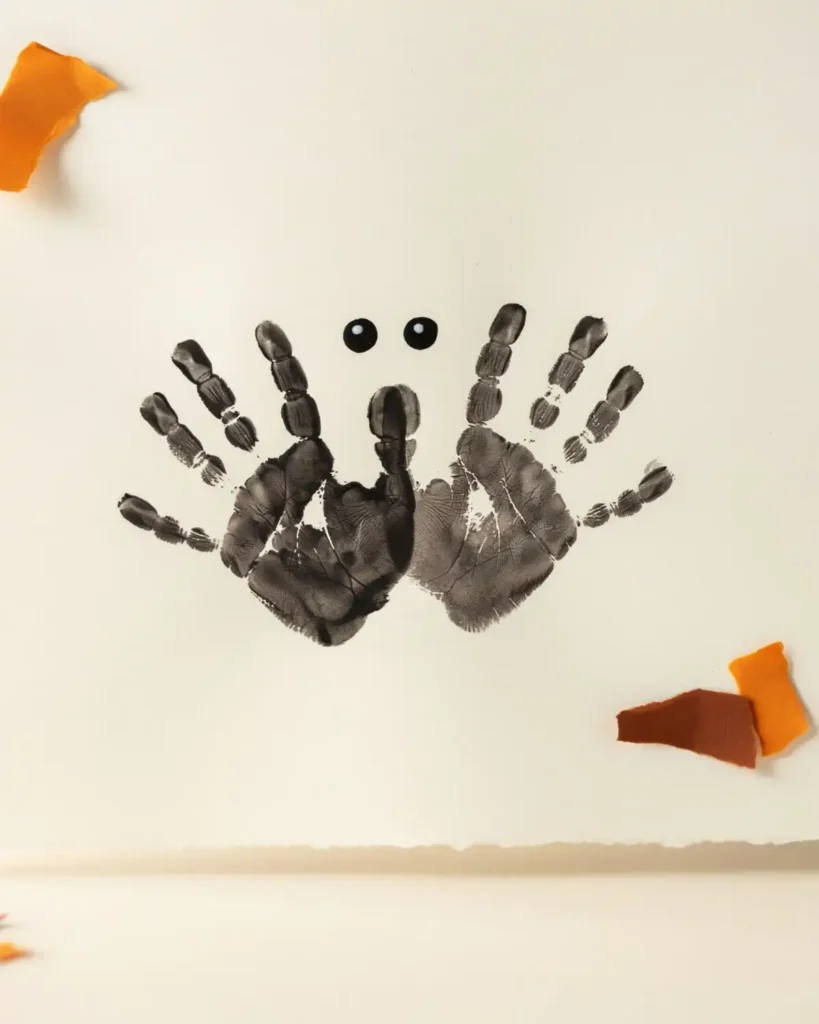
A spider handprint craft turns those tiny fingers into wonderfully wiggly spider legs. Instead of drawing eight neat legs, the handprint gives the spider a playful shape that could never come from a stencil. This is one of my favorite quick ideas for a baby’s first October because it looks festive without needing a complicated setup. Choose it when you want Halloween art that can be finished in minutes.
Make two overlapping black handprints with the palms meeting in the center. An adult can add simple eyes after the paint dries.
Skip loose googly eyes on anything the baby could reach; draw the eyes instead.
3. Baby Footprint Ghost
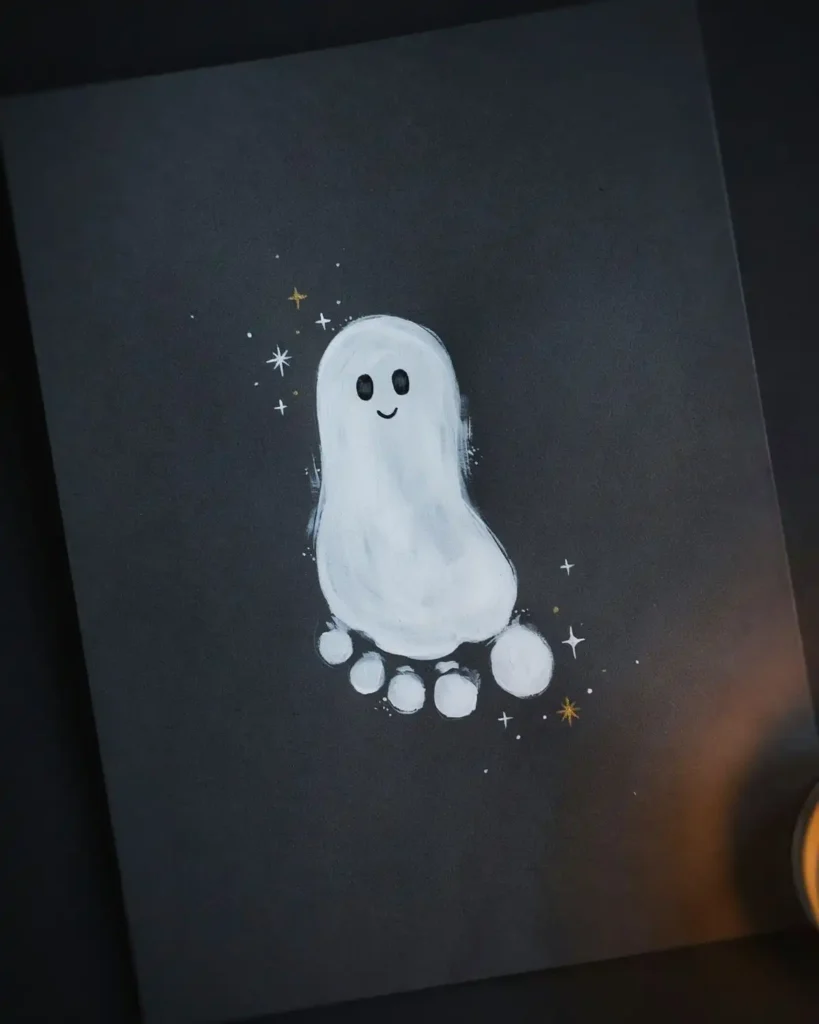
There is something ridiculously cute about turning one tiny foot into a ghost. The heel naturally becomes the head while the toes give the bottom a slightly spooky, floaty shape, so it needs much less decorating than most footprint Halloween projects. I like it on black cardstock where the white print immediately pops. It is perfect for baby first Halloween photos, memory books, or a framed October keepsake.
Use washable white paint for the footprint and let it dry completely. Add a simple face with a black marker.
Write “My First Halloween” and the year underneath.
4. Autumn Handprint Tree
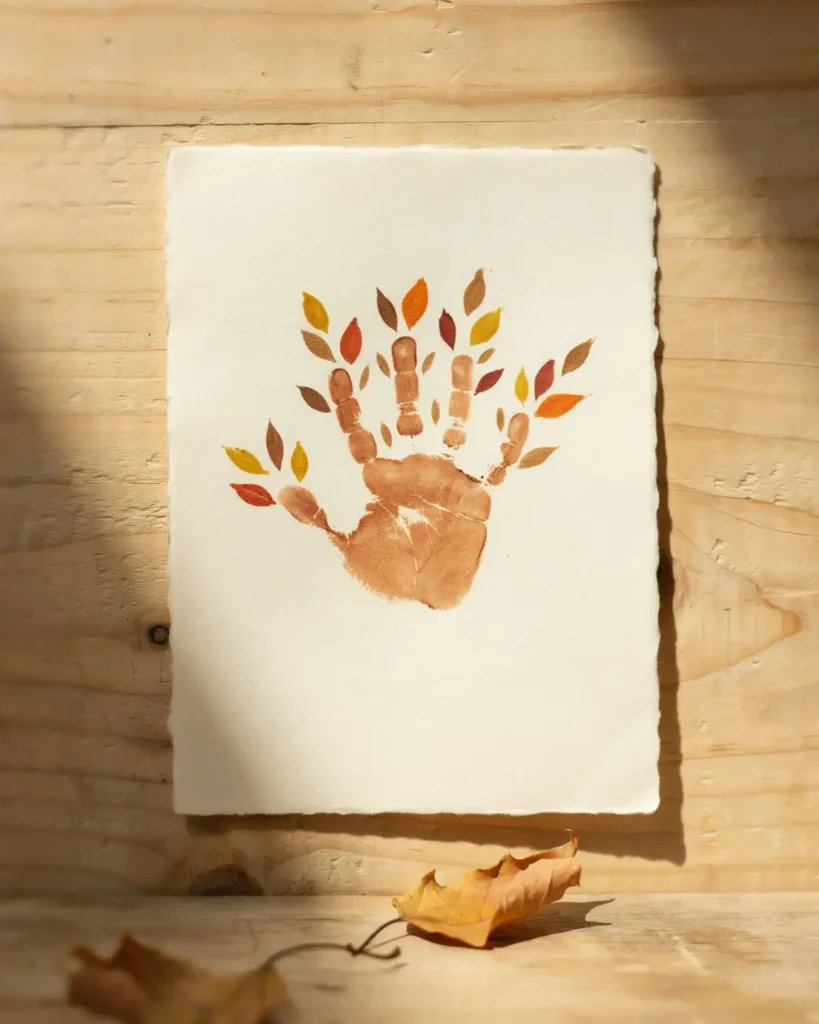
An autumn handprint tree captures fall without relying on the usual pumpkin theme. The palm and fingers create a beautifully imperfect tree shape, and colorful fingerprints can turn the branches into leaves. I would put this one on heavier cream paper because the rusty oranges, browns, and yellows feel almost like miniature fall artwork. It is a sweet choice if you are collecting fall handprint crafts year after year.
Make the handprint brown for the trunk and branches. Once dry, an adult can dab leaf shapes around it.
Try:
- Burnt orange
- Mustard yellow
- Rust red
- Warm brown
5. Handprint Turkey Keepsake
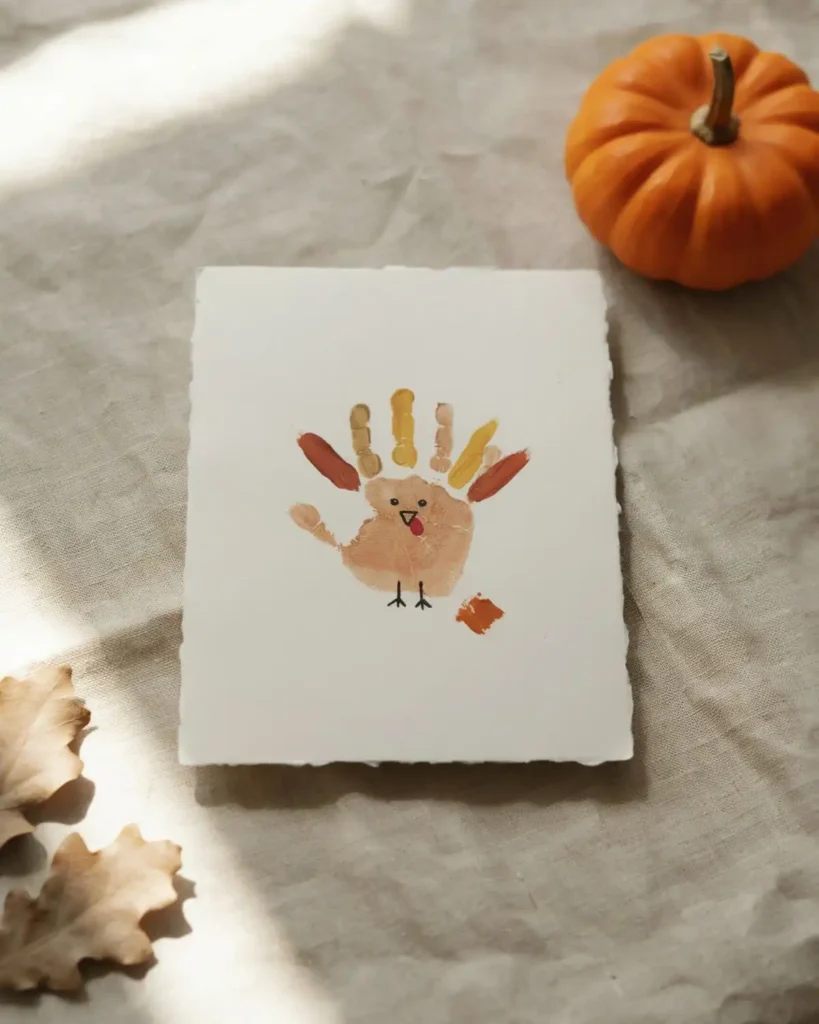
A hand already has exactly the shape a turkey craft needs. Five fingers spread into a colorful feather fan, which makes this feel more personal than gluing paper feathers around a generic turkey body. It is the kind of Thanksgiving baby craft I would date immediately because comparing the print with next year’s is half the fun. Make it if you want a seasonal piece that still feels like a real keepsake.
Use brown or several fall shades on the hand, then add a simple turkey body after the print dries.
A short “My First Thanksgiving” note makes it frame-ready.
6. Footprint Christmas Tree
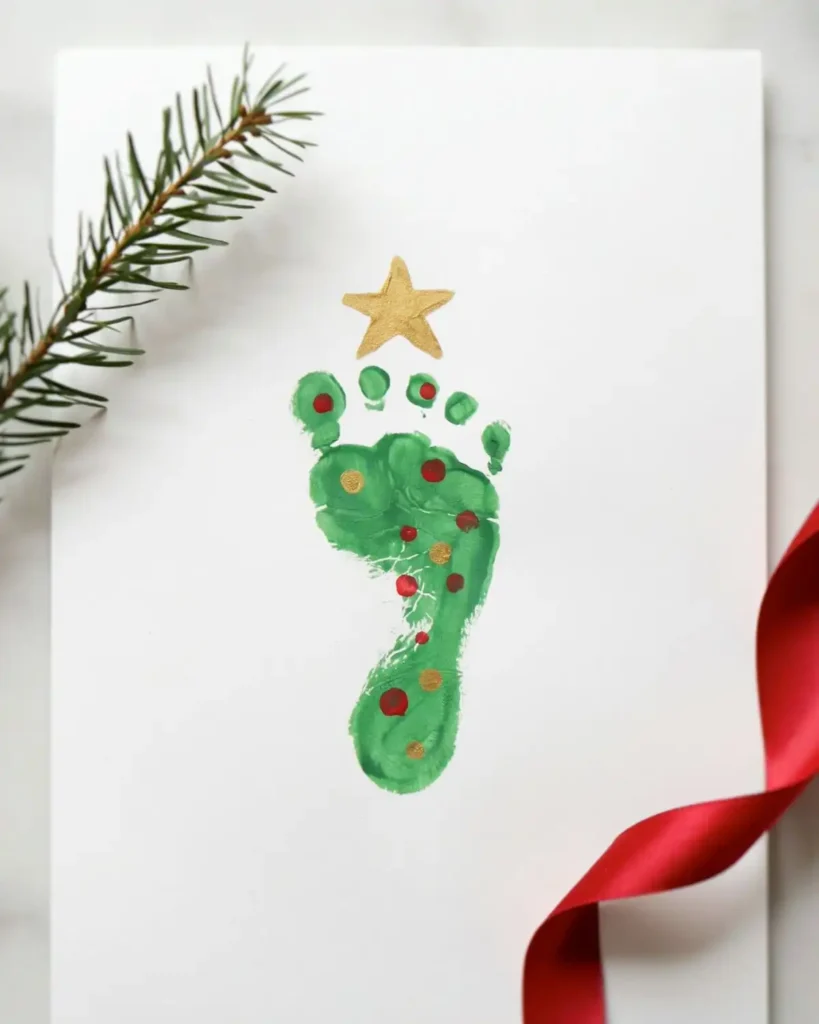
A green footprint can become a tiny Christmas tree with almost no effort. The toes create a naturally uneven base while the heel forms the top, giving it more personality than a perfectly cut paper triangle. This one works beautifully inside a Christmas card when you want relatives to receive something more personal than a photo alone. It is ideal for baby’s first Christmas because the actual footprint becomes part of the memory.
Turn the print upside down so the heel points upward.
An adult can decorate it with:
- Marker ornaments
- Painted dots
- A drawn star
- Baby’s name and year
7. Reindeer Footprint Art
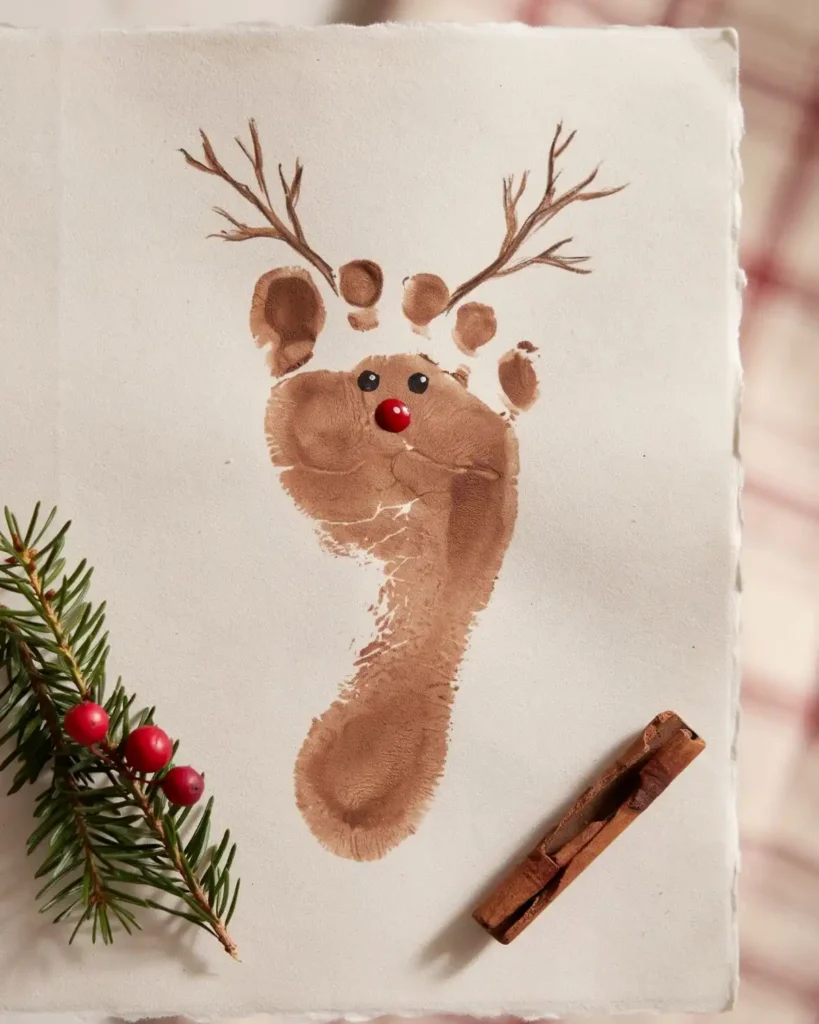
The long shape of a baby’s foot makes an adorable reindeer face. Compared with a regular reindeer drawing, that tiny footprint instantly tells you exactly how small your baby was that Christmas. I would make several copies at once because this design works on cards, framed prints, and grandparent gifts. Choose it when you want baby footprint art that looks unmistakably festive.
Use brown paint for the footprint. After it dries, add antlers, eyes, and a red nose with paint or marker.
For a cleaner keepsake, keep all decorative pieces drawn directly onto the paper.
8. Handprint Christmas Wreath
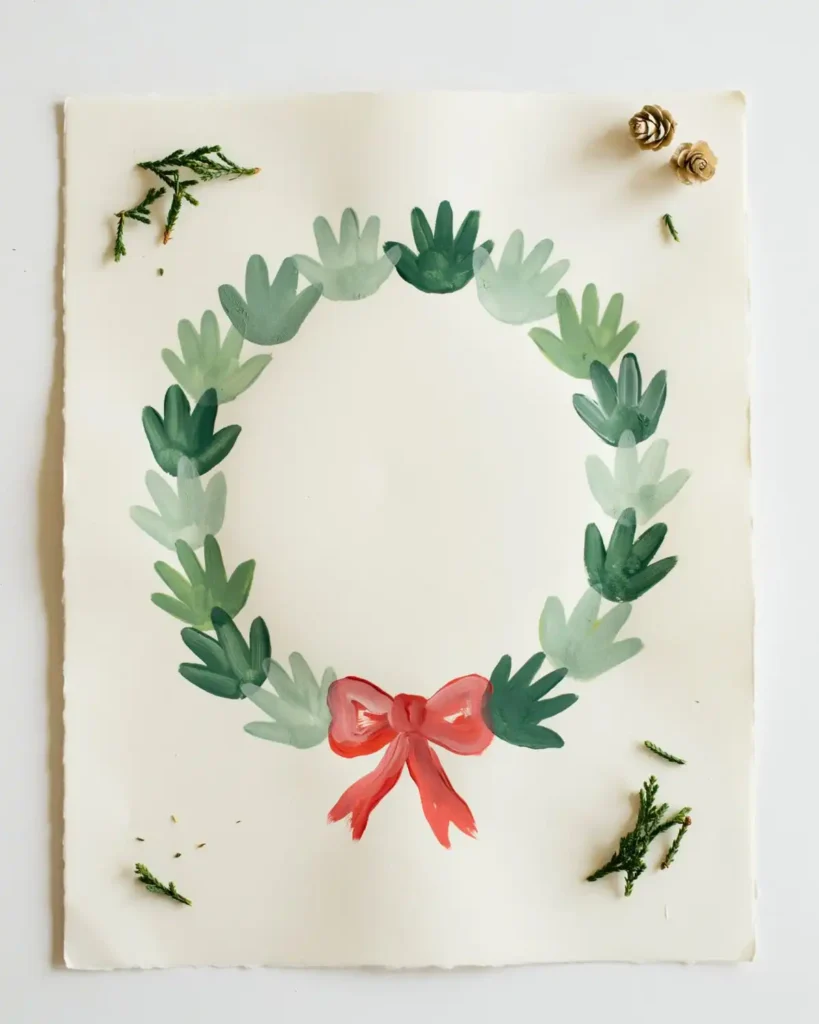
Several green handprints arranged in a circle make a Christmas wreath that feels full without requiring complicated crafting. What I like about this version is that the overlapping prints preserve the little finger shapes instead of hiding them beneath decorations. It is lovely on a larger sheet of paper where you have space to write baby’s name in the center. This works particularly well as family wall art during baby’s first holiday season.
You do not need to get every print in one session. Make prints on separate paper, cut them out yourself after they dry, and arrange them later.
Add a painted red bow at the bottom.
9. Footprint Snowman
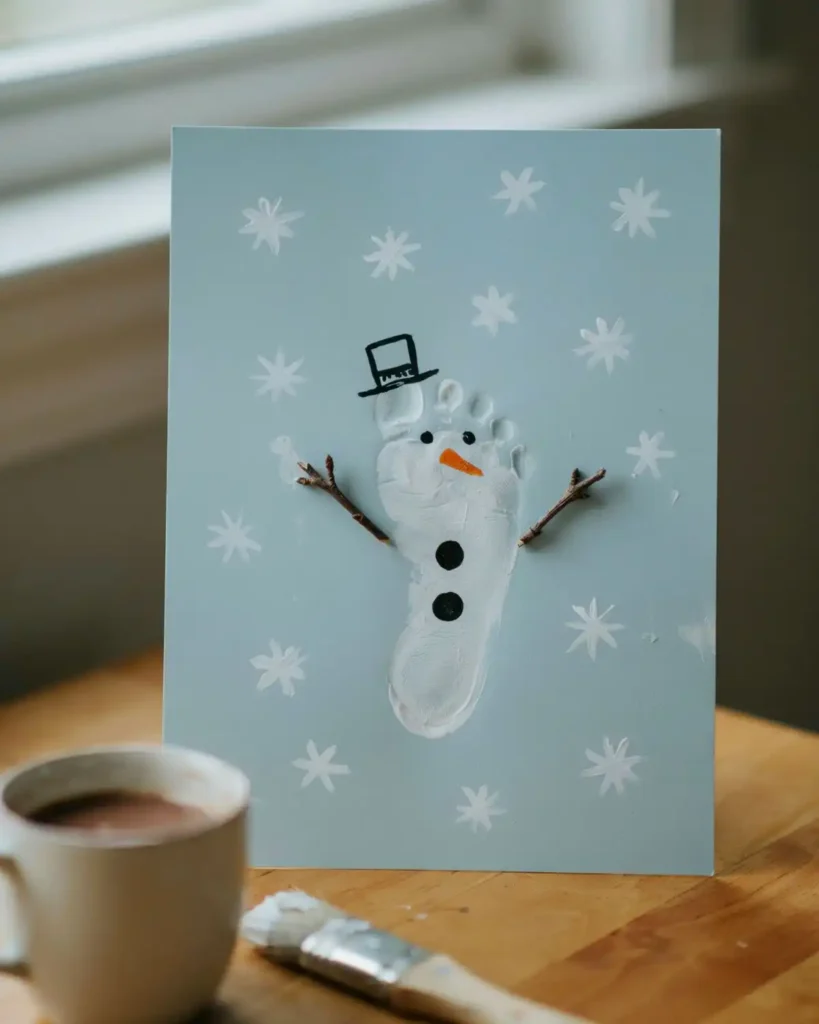
A white footprint can become a miniature snowman with the simplest black details. It is much easier than trying to get several perfectly stacked baby prints, and the unusual shape makes it feel playful rather than polished. I would use pale blue paper so the white paint has enough contrast. Try this when you want winter craft baby art that is not tied only to Christmas, or browse these winter crafts for kids for more cold-weather ideas.
Add a hat, buttons, tiny arms, and a carrot nose after the print dries.
Write baby’s age next to the footprint for an extra memory marker.
10. Penguin Footprint Keepsake
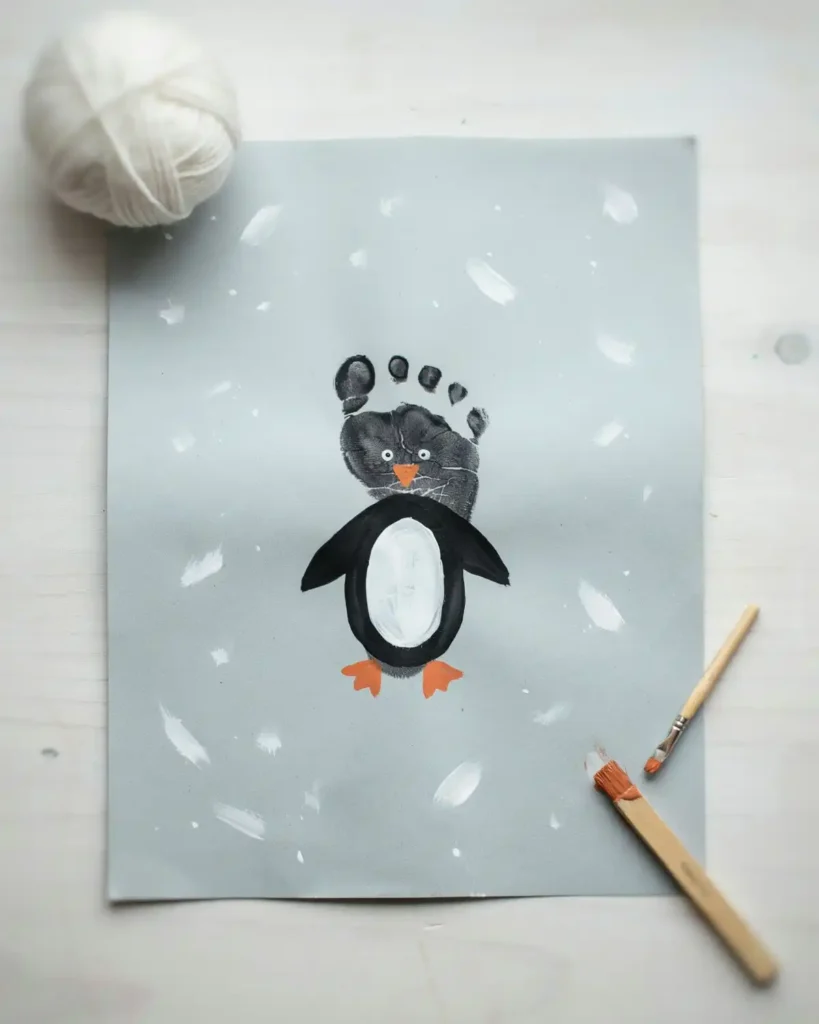
A black footprint is almost ready-made for a little penguin. The shape is more interesting than a basic oval body, and you can keep the design minimal enough that the footprint remains the star. This would be lovely in a winter nursery frame alongside a small photo from the same month. It is a good choice for parents who prefer simple seasonal art rather than bright holiday decorations.
Create the dark footprint first. Once completely dry, an adult can paint or draw the white belly and facial details.
A pale icy background makes the silhouette stand out.
11. Valentine’s Handprint Heart
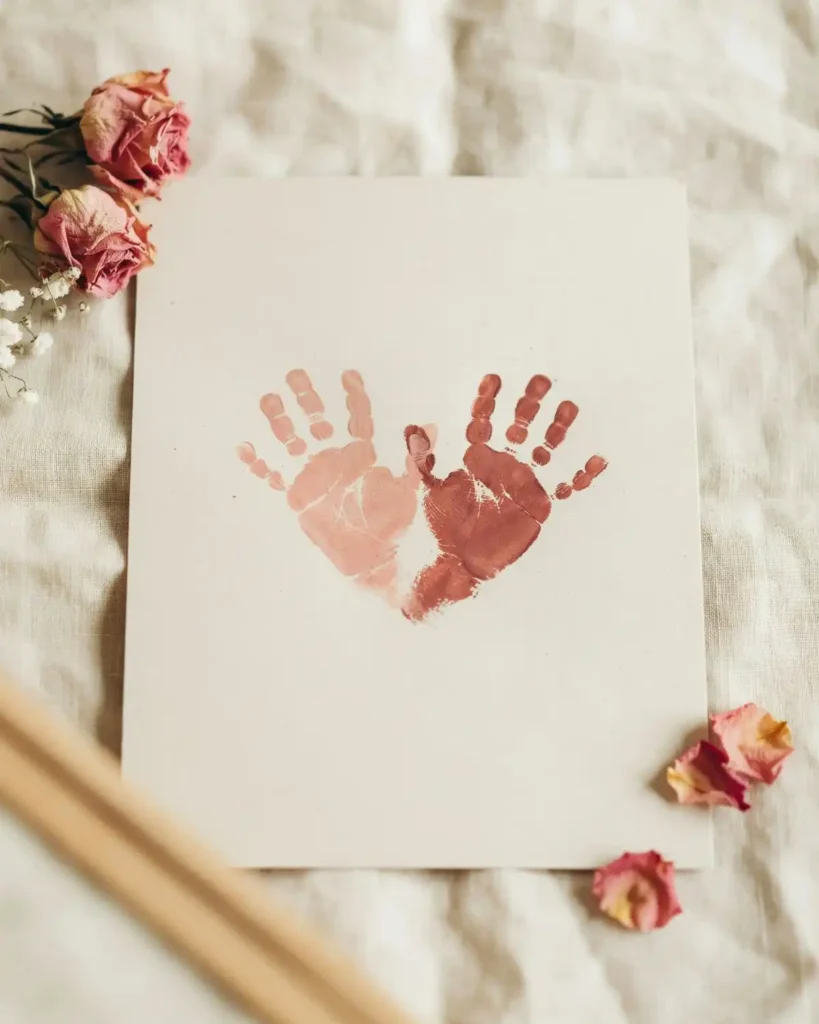
Two handprints angled toward each other form a beautifully imperfect heart. It has far more meaning than a cut-out paper heart because every little finger becomes part of the shape. I would make this for baby’s first Valentine’s Day and write the date underneath before framing it.It is one of the easiest keepsakes when you want sentimental infant art without lots of materials, and it pairs naturally with other Mother’s Day crafts when you’re making a gift for Mom.
Lemon8’s baby handprint craft example uses the same basic idea of pairing prints into a heart-shaped keepsake and recommends preparing materials in advance so the process stays quick.
Use red, pink, or another washable child-appropriate paint.
12. “LOVE” Hand and Footprint Art
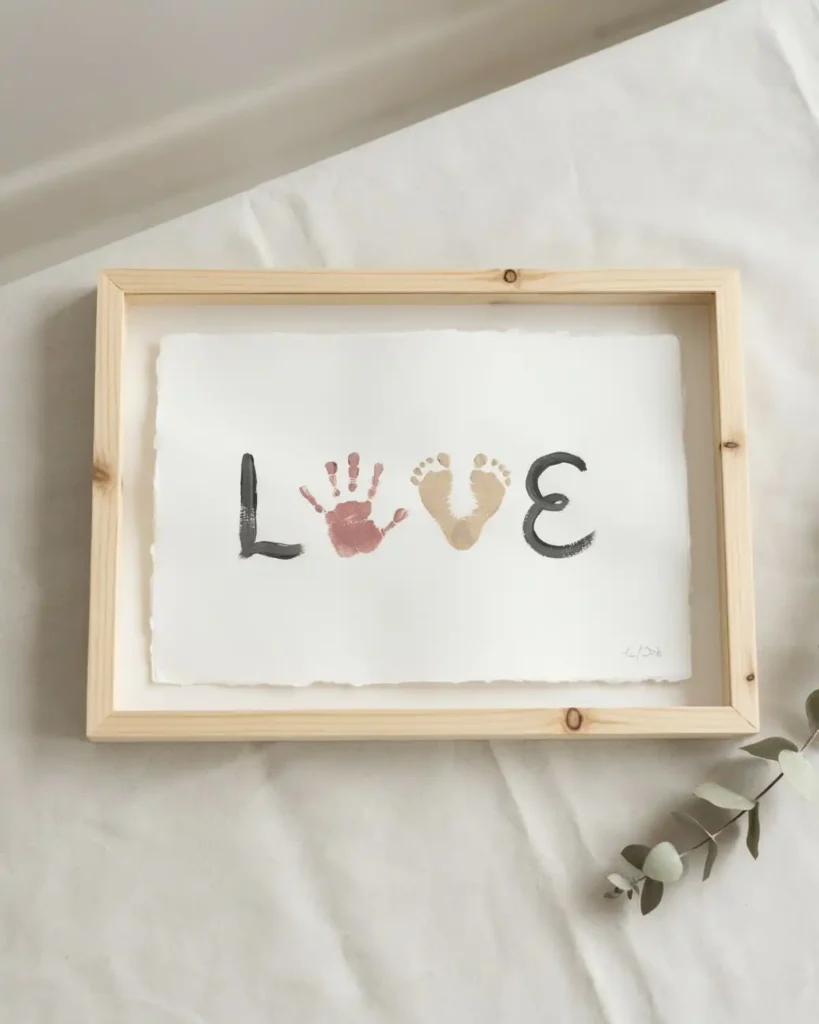
This design turns baby’s prints into part of the word LOVE. A handprint can replace the “O,” while two footprints can help create the “V,” giving ordinary nursery typography a personal twist. I especially like this idea as a parent or grandparent gift because it looks decorative even after Valentine’s Day is over. Make it when you want footprint crafts that feel more like finished wall art.
Sketch the letters lightly first, leaving spaces for the prints.
Once everything is dry, trace the letters neatly with a marker.
13. Handprint Flower Bouquet
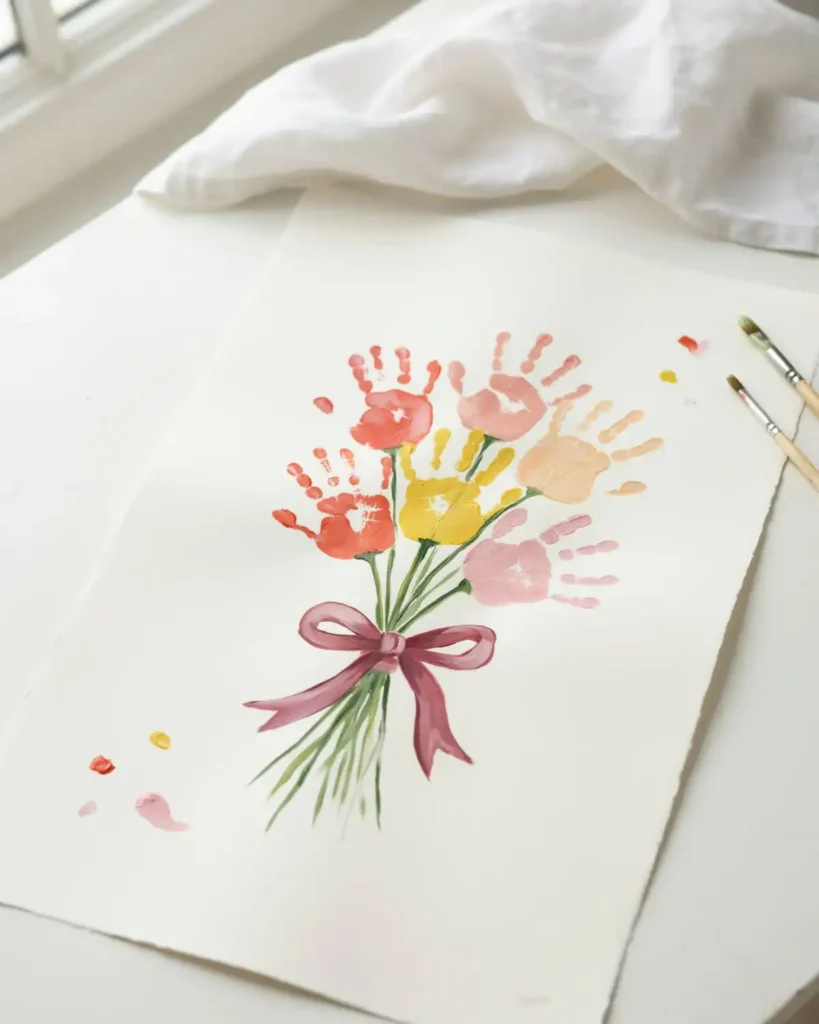
Baby handprints become flowers that never wilt. Instead of painting an ordinary bouquet, each bloom preserves the shape of the tiny fingers, which makes this one especially meaningful for Mother’s Day or a grandparent gift. I would mix two or three soft paint shades rather than making every flower identical. It works best when you want a sentimental craft that still looks cheerful enough to display.
Create several handprints on separate areas of the page. After drying, draw stems gathering into a bouquet.
Add a simple bow at the bottom.
14. Footprint Butterfly
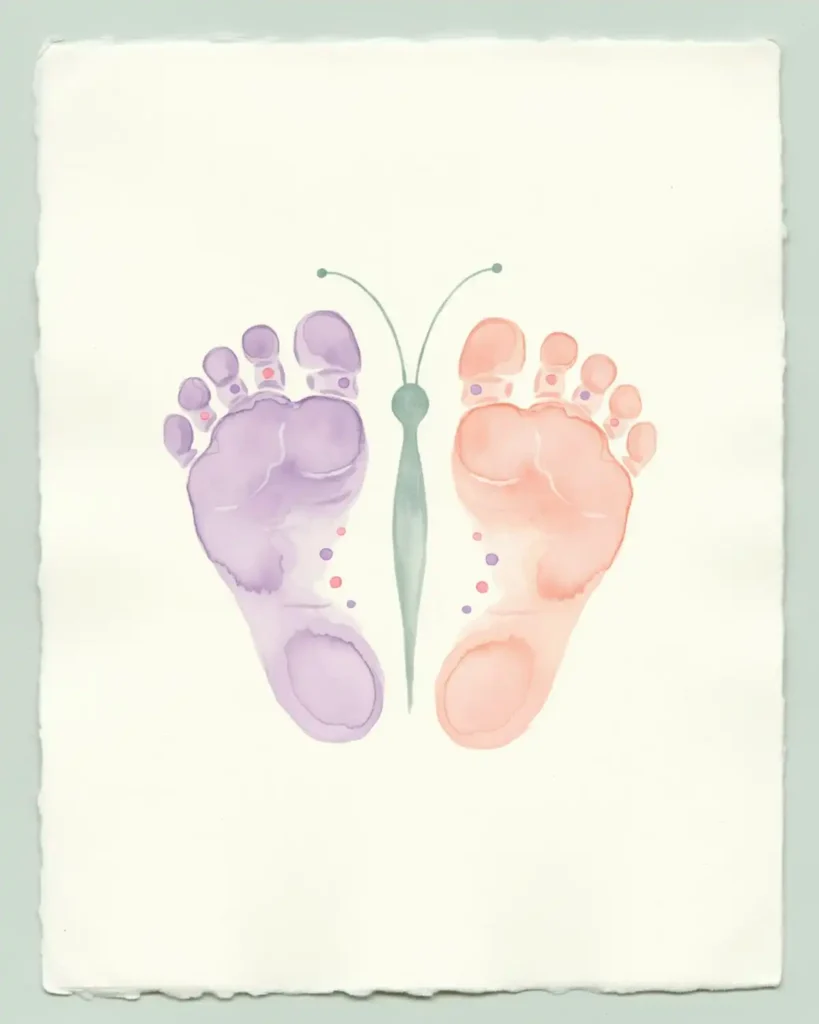
Two footprints positioned side by side form surprisingly convincing butterfly wings. The slight differences between the prints make the butterfly more charming than a perfectly symmetrical stencil. I would use two soft colors and add the baby’s first name between the wings. This is a lovely spring baby footprint art project when flowers have started to feel a little too predictable.
Press the footprints so the heels face inward.
An adult can draw:
- A small body
- Antennae
- Dots or simple wing details
15. Handprint Sunflower
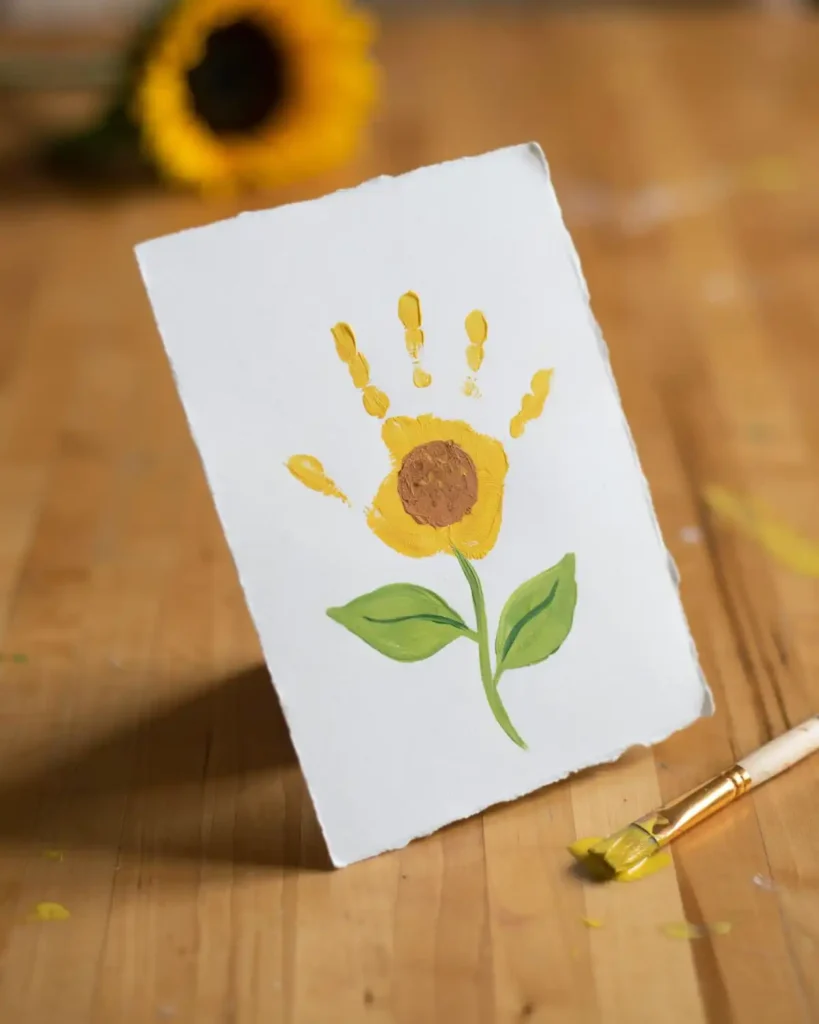
A yellow handprint can turn into a bold sunflower in seconds. The fingers create petals with natural movement, while a painted or drawn center finishes the flower without covering the original print. I like this for late-summer memory books because it feels bright but still keeps baby’s hand size easy to see. Choose it when you want a simple baby craft that photographs beautifully.
Use yellow paint for the handprint and add a brown center once dry.
A green stem and two leaves are enough to finish it.
16. Footprint Bee
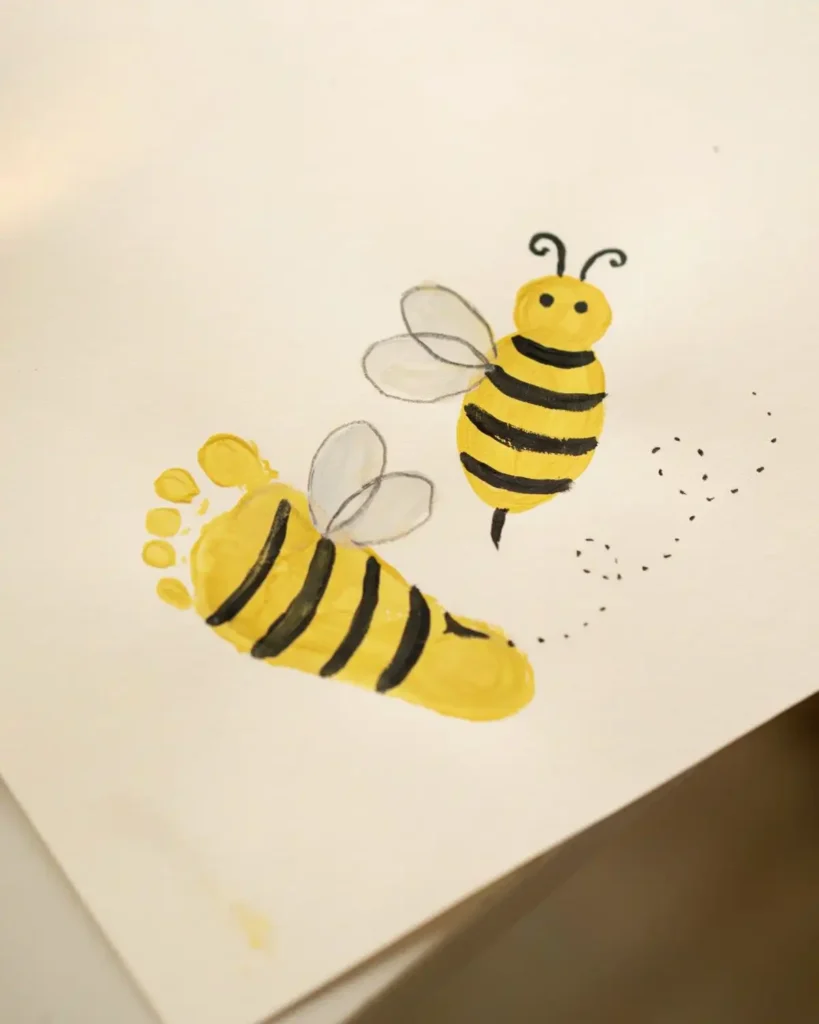
A yellow footprint becomes an adorable little bee once you add dark stripes and wings. Unlike a normal bee drawing, the tiny toes give it a funny shape that makes the finished piece unmistakably baby-made. I would pair this with a short “Bee Mine” or “Our Little Honey” message for a family keepsake. It is ideal for spring, Valentine’s Day, or a nursery display.
Make the yellow footprint first and allow it to dry.
Add stripes with marker rather than layering lots of wet paint.
17. Handprint Ladybug
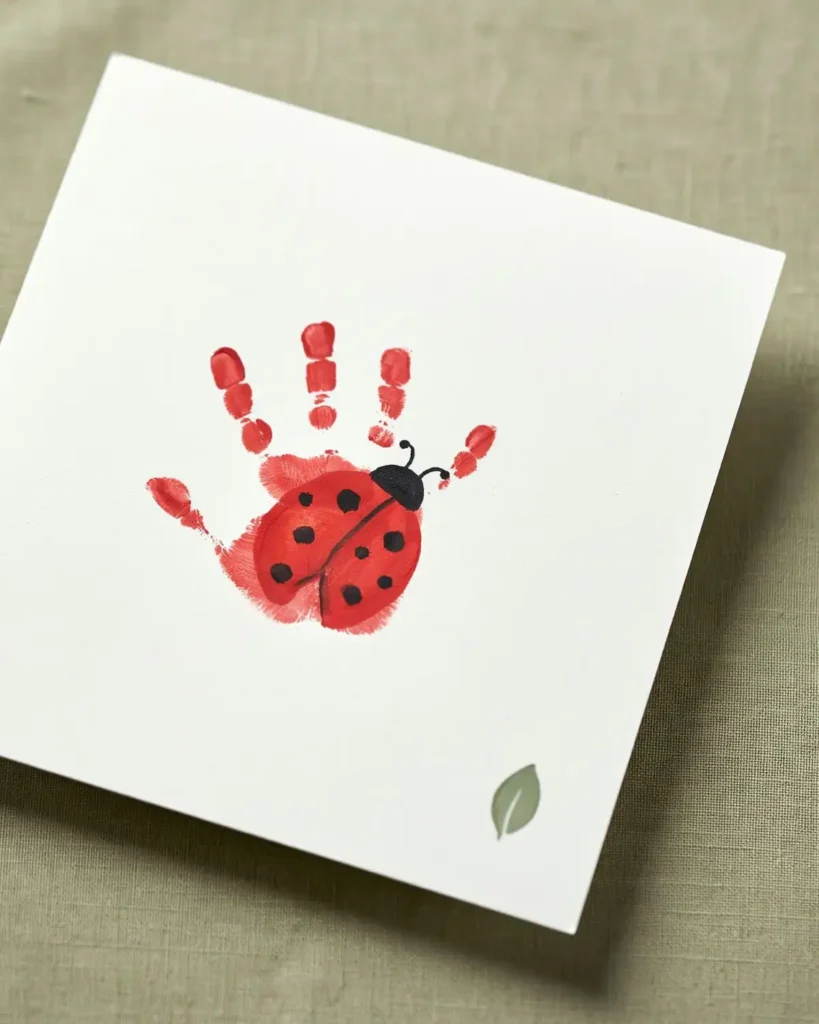
A red palm print can become a cheerful ladybug with only a few added details. The hand shape gives this craft more movement than a basic round ladybug, especially when the fingers are spread wide. I like it for spring because it looks colorful without needing a pile of embellishments. Try it when you want a fast handprint project that still feels complete.
Use red paint for the main print.
Once dry, add black dots, a head, and simple antennae with marker.
18. Footprint Bunny
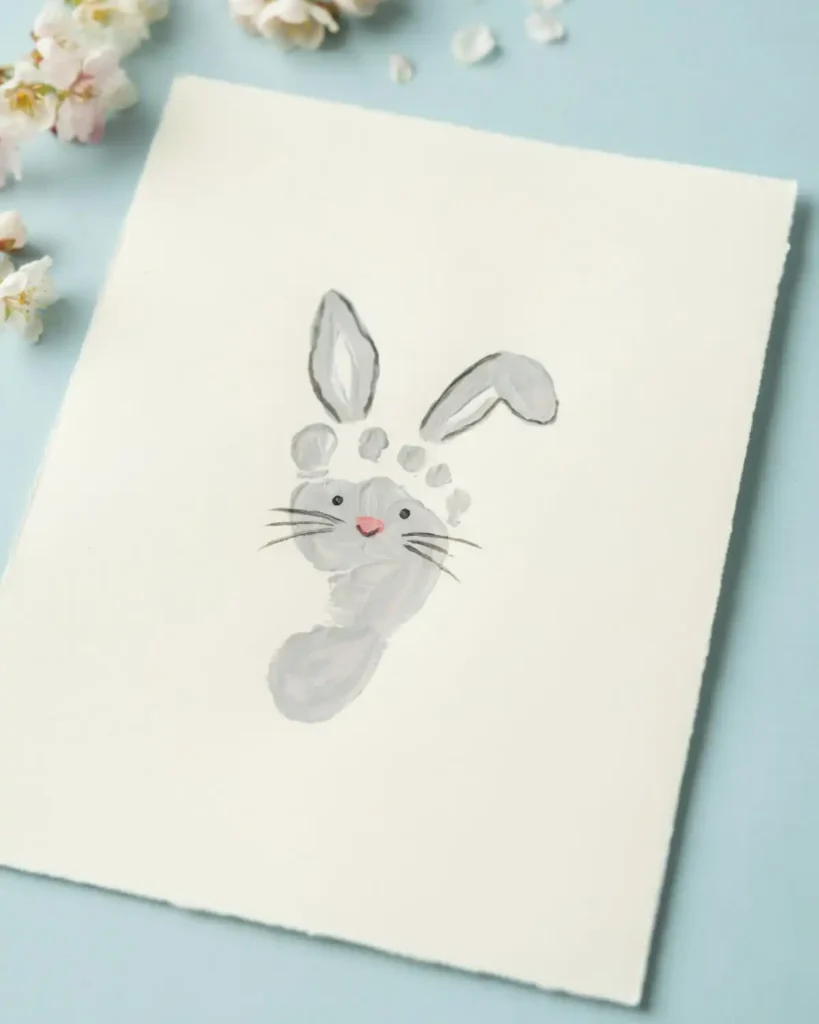
Baby feet are almost unfairly perfect for bunny shapes. The long print works as the body or ears, depending on the layout, and it feels much more personal than a generic Easter bunny template. I would make this one during baby’s first spring and add the exact date beside it. Choose it for Easter or anytime you want an animal-themed footprint craft with very little decorating.
Use a pastel shade, gray, or another soft color.
After the print dries, add simple bunny features with marker.
19. Handprint Chick
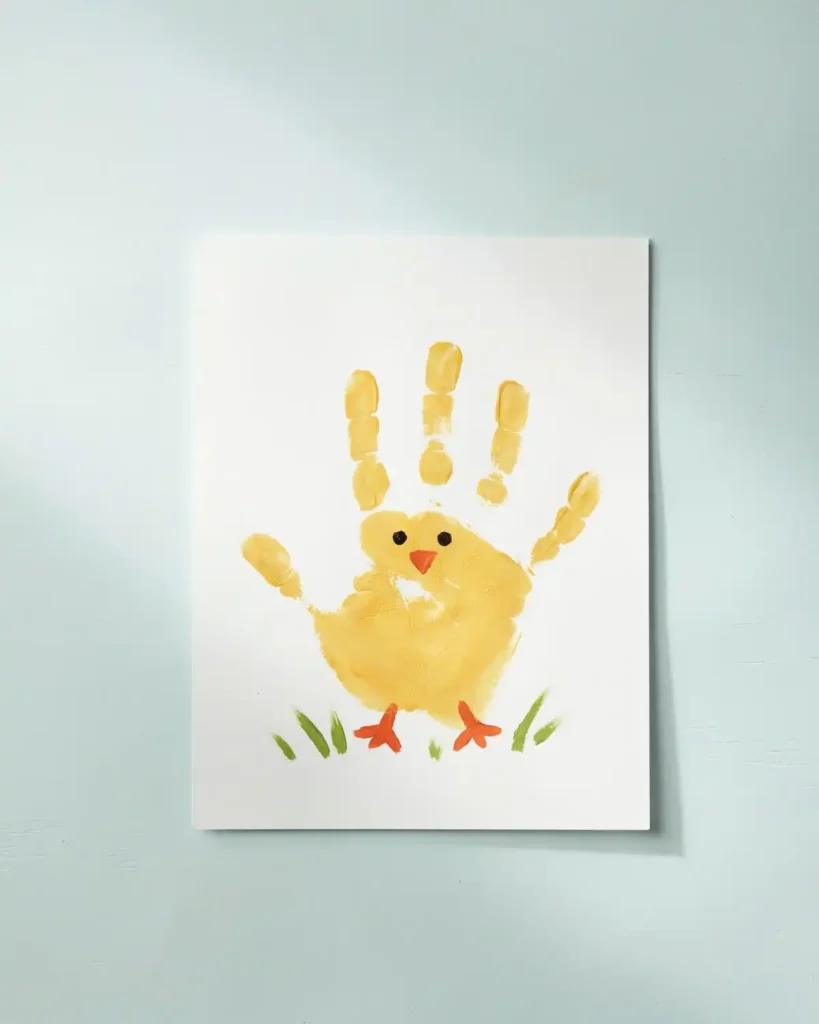
A yellow handprint instantly gives a baby chick fluffy-looking wings and feathers. It feels livelier than a plain painted oval because every finger adds shape to the little bird. I would put this on white cardstock with minimal details so the yellow print stays bright. It is perfect for Easter, spring, or a baby’s first seasonal scrapbook.
Press the hand firmly but quickly.
After it dries, draw a tiny beak, feet, and eye.
20. Footprint Duck
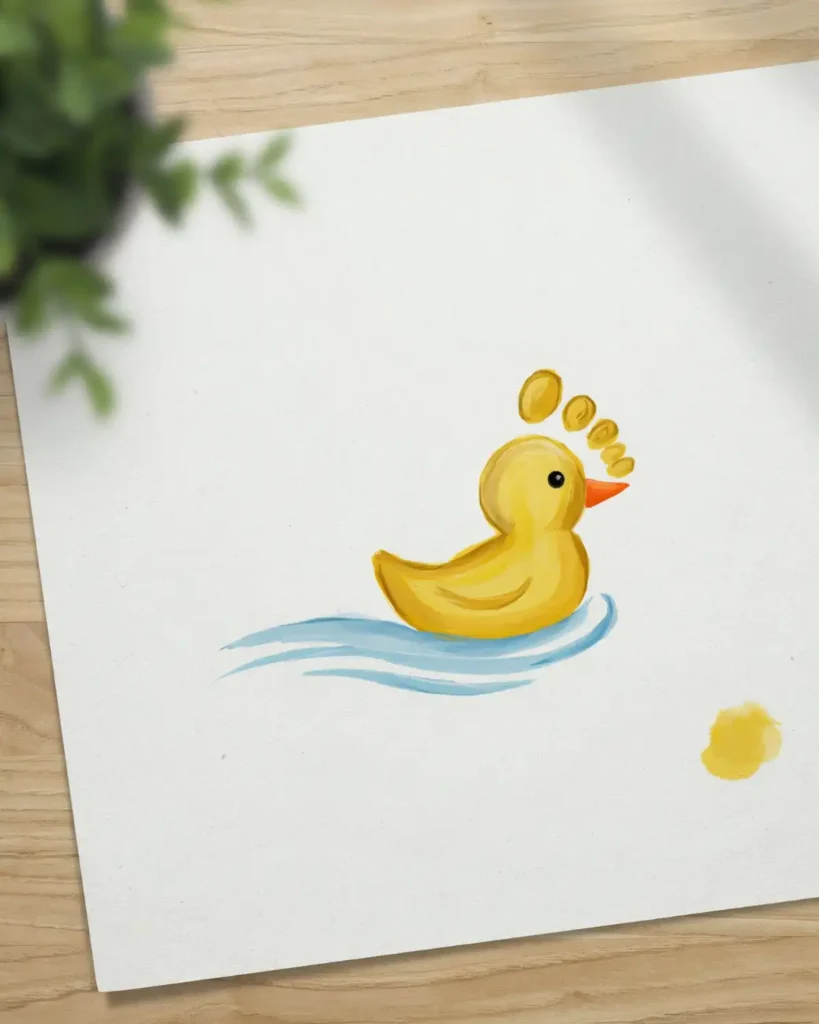
A yellow or orange footprint can become a sweet duck with a little imagination. The natural curve of the foot creates a shape that looks much more interesting than a perfectly round cartoon duck. I like this beside a small painted pond or a few simple blue lines, especially for spring memory pages. It is a good project when you want animal infant art without a complicated setup.
Create one clean footprint and let it dry fully.
Turn the paper whichever direction makes the footprint look most duck-like, then add the beak and eye.
21. Handprint Fish
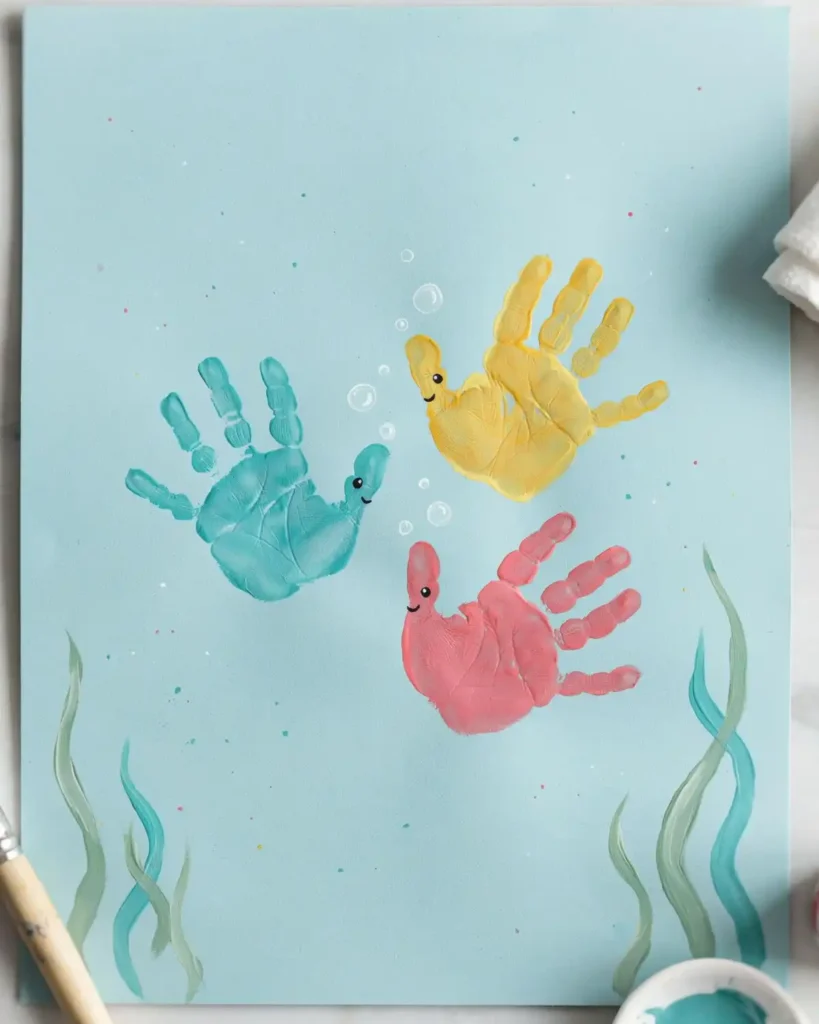
Spread fingers make excellent fish fins and tails. A handprint fish has instant movement, while a normal fish stencil can look a little too neat for baby art. I would make several prints in different colors and turn the page into an underwater scene. It is especially fun for summer or an ocean-themed nursery.
Use one paint color per print to avoid muddy shades.
Once dry, an adult can add bubbles, seaweed, or a simple ocean background.
22. Footprint Whale
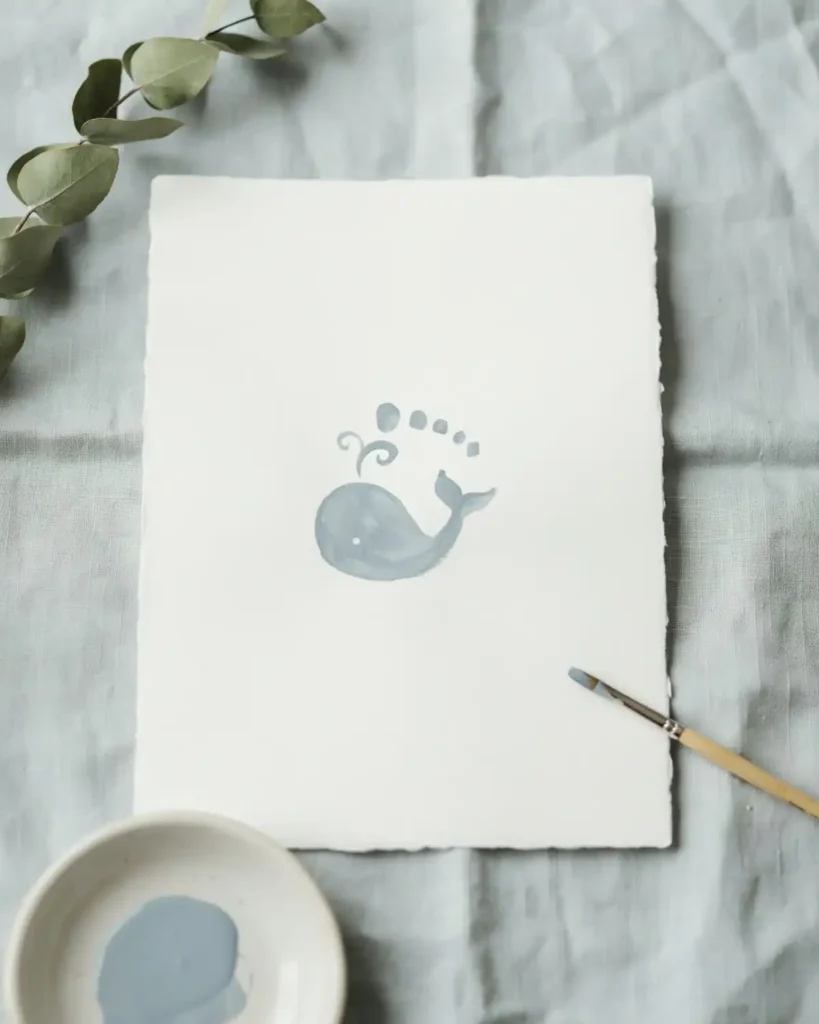
One small footprint can become an unexpectedly cute whale. Its long shape naturally works for the whale’s body, leaving only a tail and water spout to add afterward. I would keep this one in soft blue and gray shades for a calm nursery-style print rather than turning it into a busy ocean scene. Make it when you want baby footprint art that feels simple enough to frame.
Add the footprint first.
Once dry, draw a tail, eye, and small water spout.
A tiny caption such as “Whale Hello There” can finish it without overwhelming the print.
23. Handprint Elephant
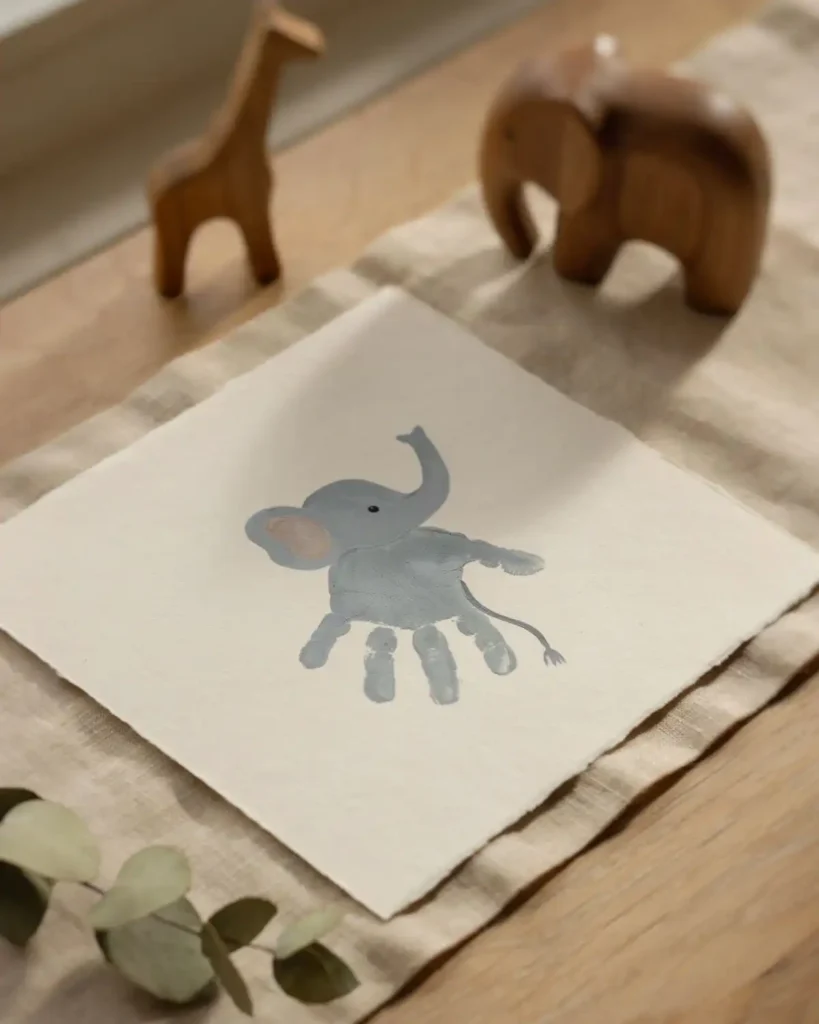
A handprint can become an elephant when the thumb turns into a trunk and the fingers suggest legs. That transformation is what makes this project so fun—the original hand is still easy to recognize even after the animal appears. I would use a muted gray-blue paint and keep the background white for a modern nursery look. It is a lovely craft baby keepsake for animal-themed rooms.
Position the thumb away from the other fingers when taking the print.
After drying, add an ear, eye, and little tail with marker.
24. Footprint Lion
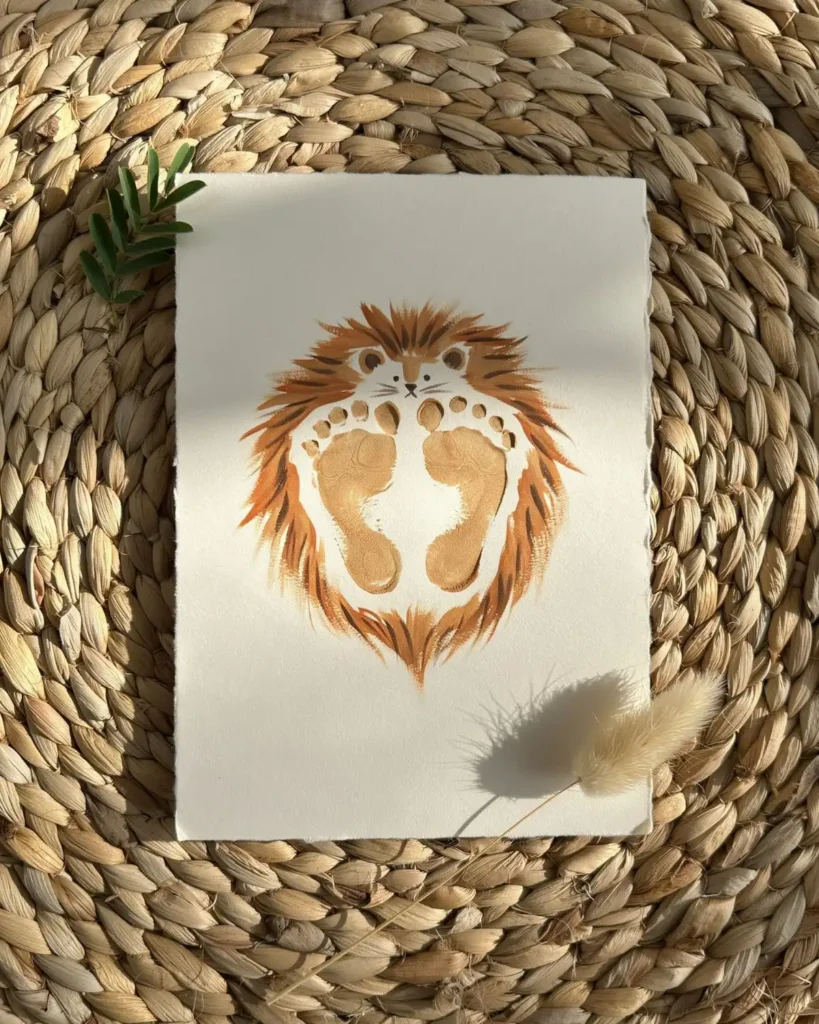
A footprint makes a quirky lion face or body once an adult adds a mane around it. Instead of covering the print with too many details, the mane can simply frame it so baby’s actual footprint stays obvious. I like this in warm golden, tan, and brown shades for a safari-themed nursery. Choose it when you want an animal keepsake that feels playful without looking overly busy.
Use yellow or tan paint for the footprint.
Once dry, draw or paint the mane around the outside.
25. Handprint Dinosaur
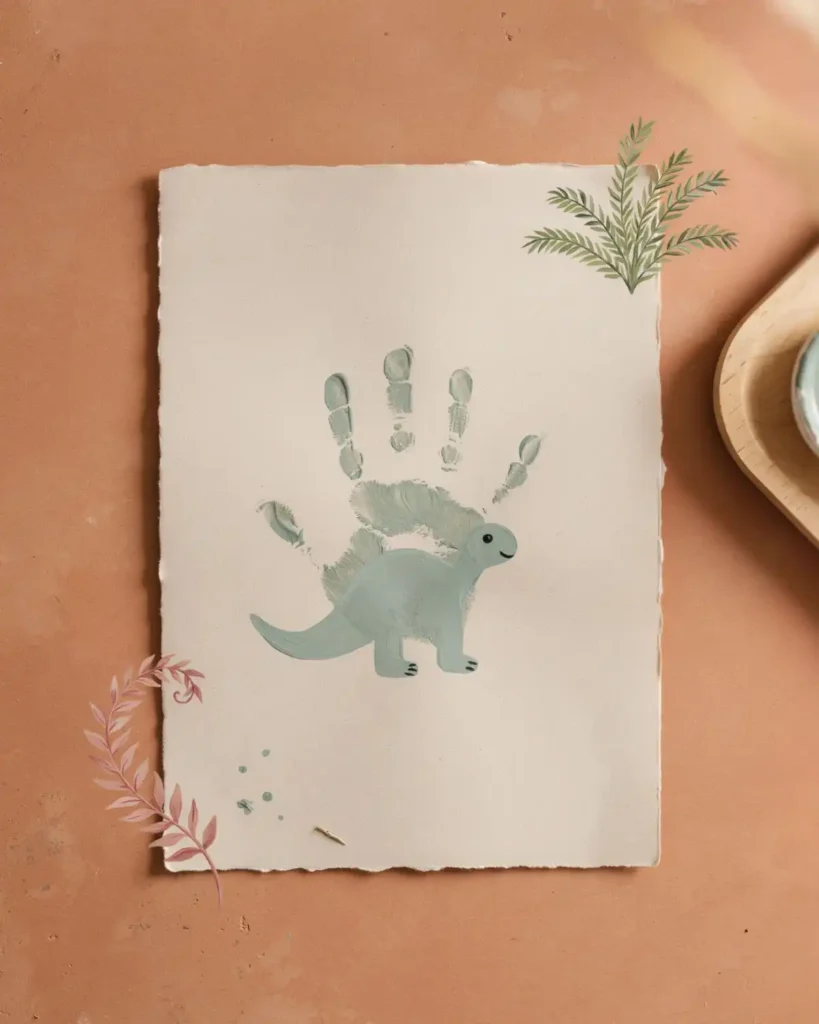
A green handprint already looks a little prehistoric when those five fingers become spikes, legs, or a dinosaur tail. It is much more fun than trying to make a polished dinosaur because the uneven print adds character automatically. I would save this for a first birthday memory book or dinosaur nursery theme. It is a strong choice when you want a baby craft that does not feel overly seasonal.
Turn the paper until the print suggests the dinosaur shape you like best.
Then add a head, tail, eye, and a few simple details.
26. Footprint Rocket
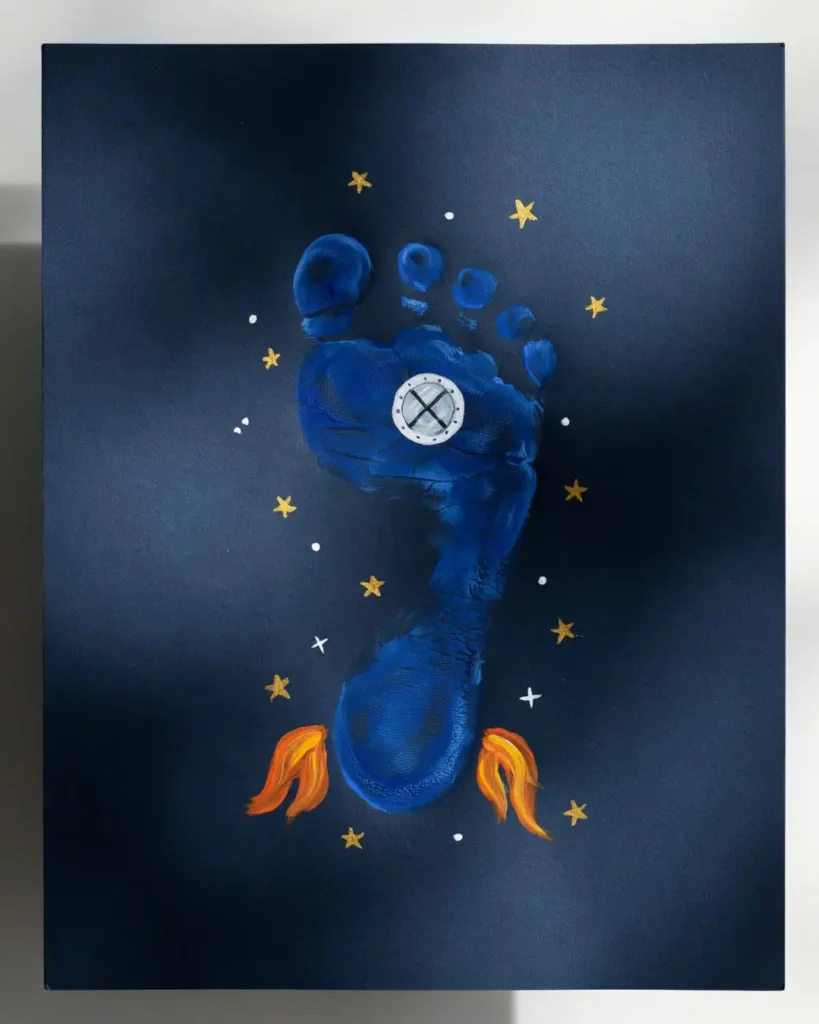
A long footprint makes a surprisingly good rocket body. The heel can become the nose, while the toes sit near the flames, giving you a design that feels completely different from the usual animal footprint crafts. I would add baby’s name among a few painted stars and keep everything else simple. It is a fun choice for a nursery, birthday, or “love you to the moon” keepsake.
Use silver, blue, red, or another bold washable paint.
Once dry, draw windows and flames around the print.
27. Handprint Family Tree
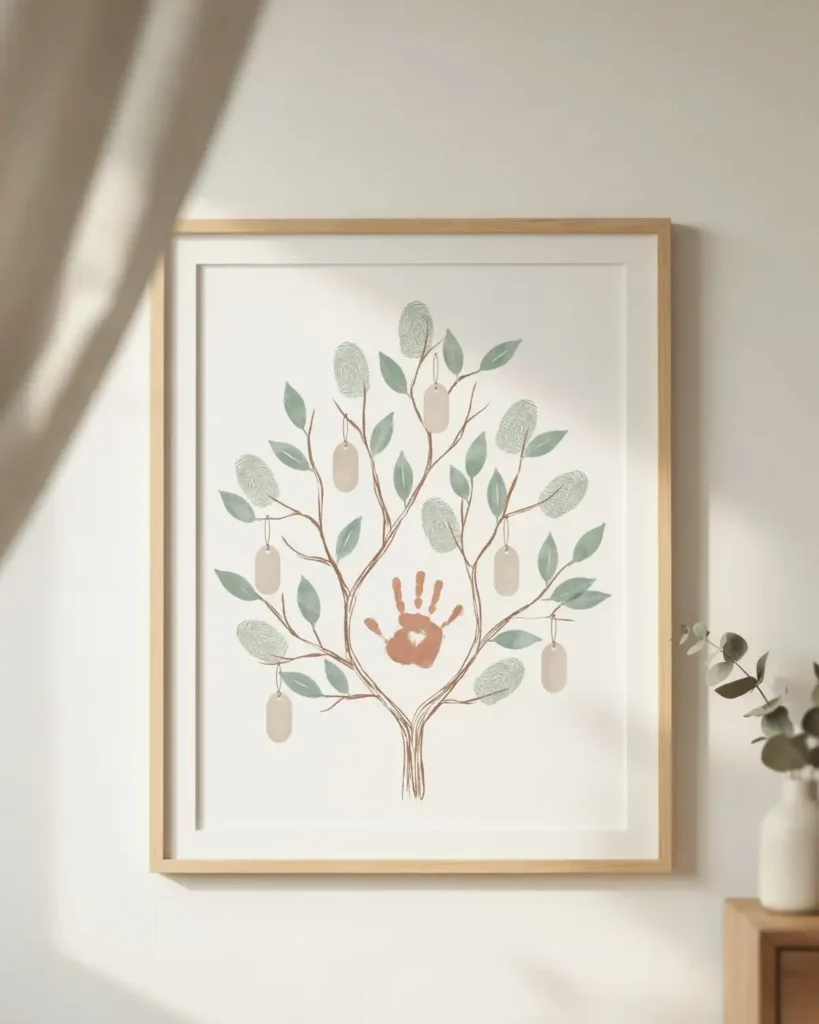
Instead of using fingerprints only as leaves, make baby’s full handprint the visual center of a little family tree. It feels more personal than a regular genealogy-style craft because the hand itself becomes part of the family story. I would add names and the year around it, then repeat the project annually to see how much the hand grows. This is especially meaningful as a grandparent gift.
Use brown for the tree structure and a contrasting shade for baby’s print.
Keep the lettering small so the handprint remains the focus.
28. Baby’s First Birthday Handprint
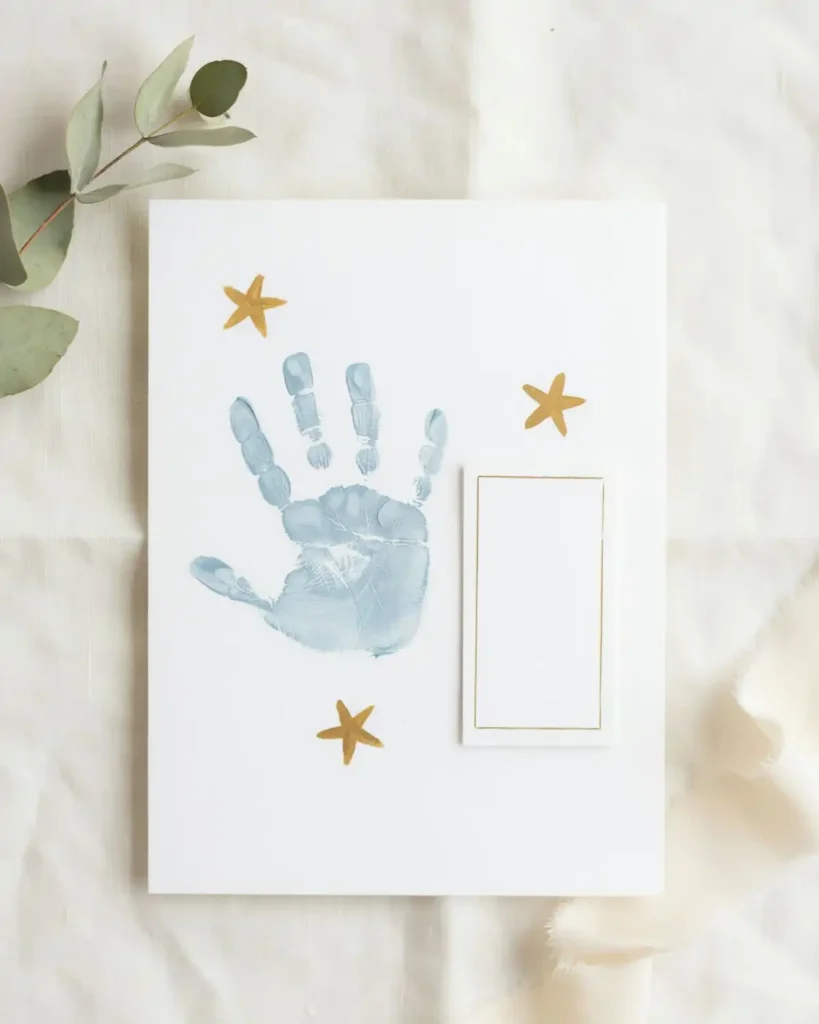
Not every handprint needs to become an animal or holiday character. A clean print beside baby’s name, birthday, age, and perhaps a small photo can be more powerful than an elaborate design. I love this approach because there is nothing to distract from how tiny that hand actually was. Use it if you want a timeless first-birthday keepsake rather than a theme-specific baby craft.
Add:
- Baby’s name
- First birthday date
- Age
- A short message
- Optional small photo
Frame it after the paint is completely dry.
29. Footprint Growth Timeline
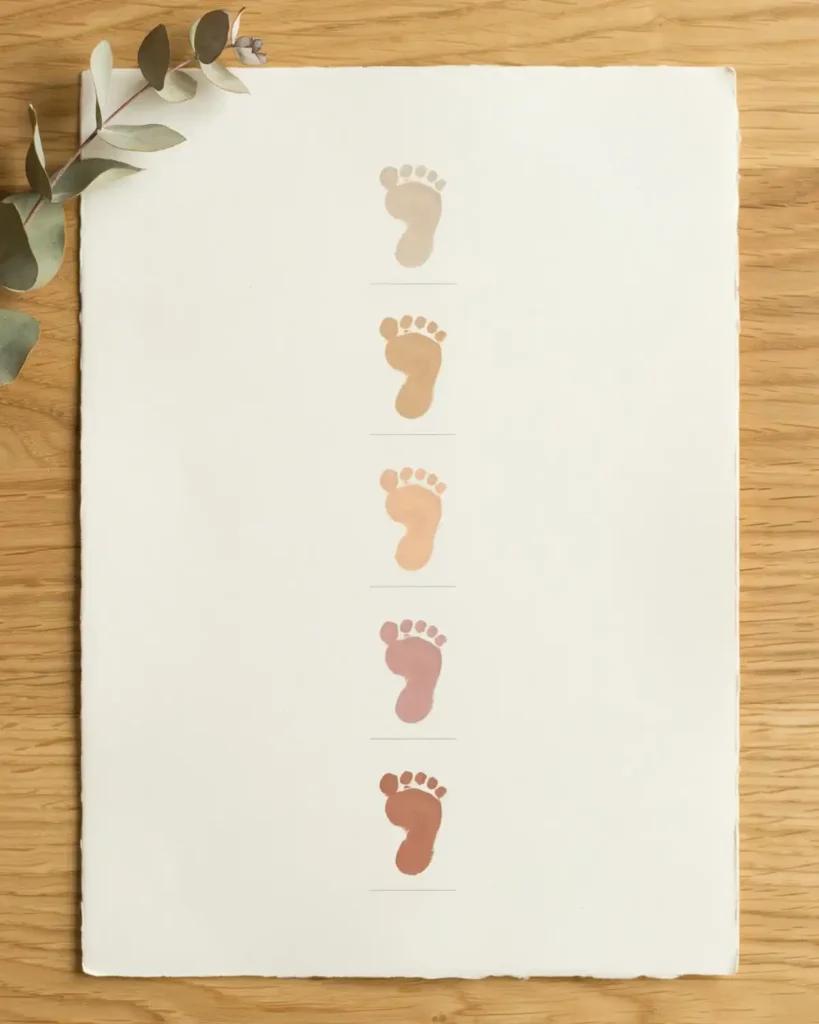
One footprint is sweet; several prints across the first year tell an entire story. Rather than turning each print into a different character, keep the design consistent so the change in size becomes the feature. I would take prints at a few meaningful ages and label each date underneath. This is one of the best footprint crafts for parents who enjoy documenting milestones.
For example:
- Newborn
- 3 months
- 6 months
- 9 months
- 12 months
CDC describes developmental milestones as skills children reach in how they play, learn, speak, act, and move; a footprint timeline is not a developmental assessment, but it can be a simple personal record of baby’s first year.
30. Halloween Monster Feet
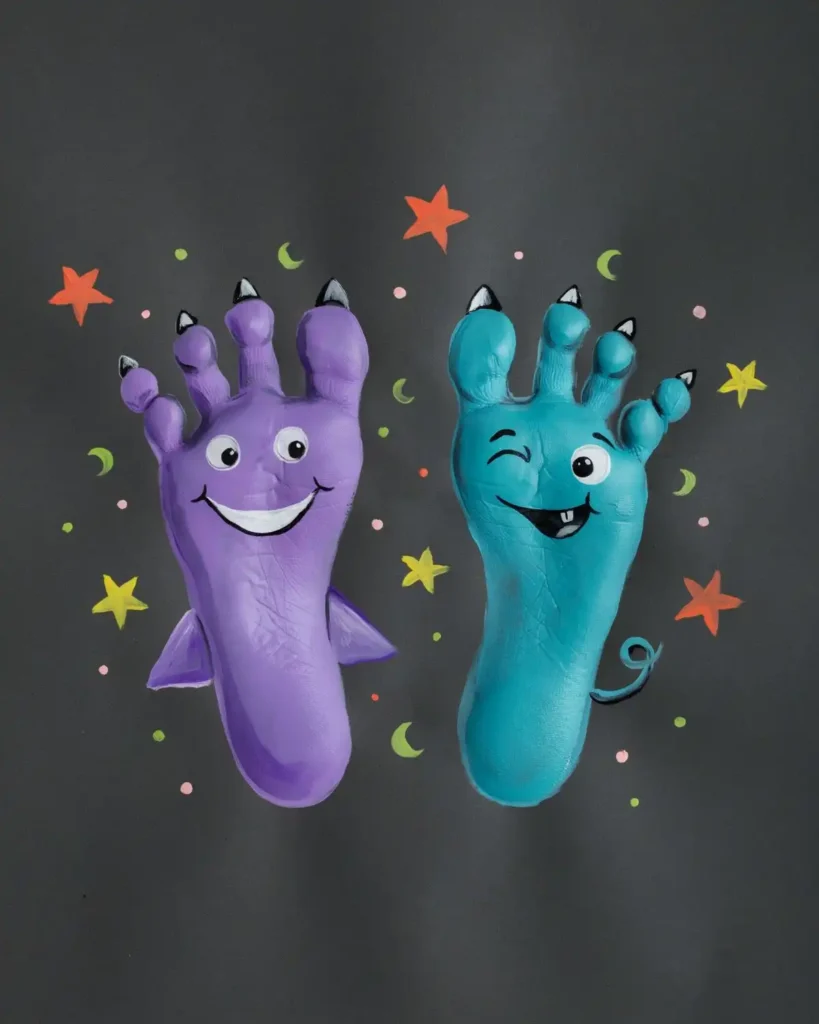
Not every Halloween craft needs to be orange pumpkins and white ghosts. Green, purple, or blue Halloween feet can become funny monsters with drawn claws and silly expressions, which makes this idea feel a little less predictable. I would create two prints side by side and let their uneven toes become part of the monster design. Pick this for baby first Halloween if you want something playful rather than spooky.
Use bold washable paint and let the footprints dry fully.
Draw the monster details yourself afterward.
31. My Tiny Hands and Feet Keepsake
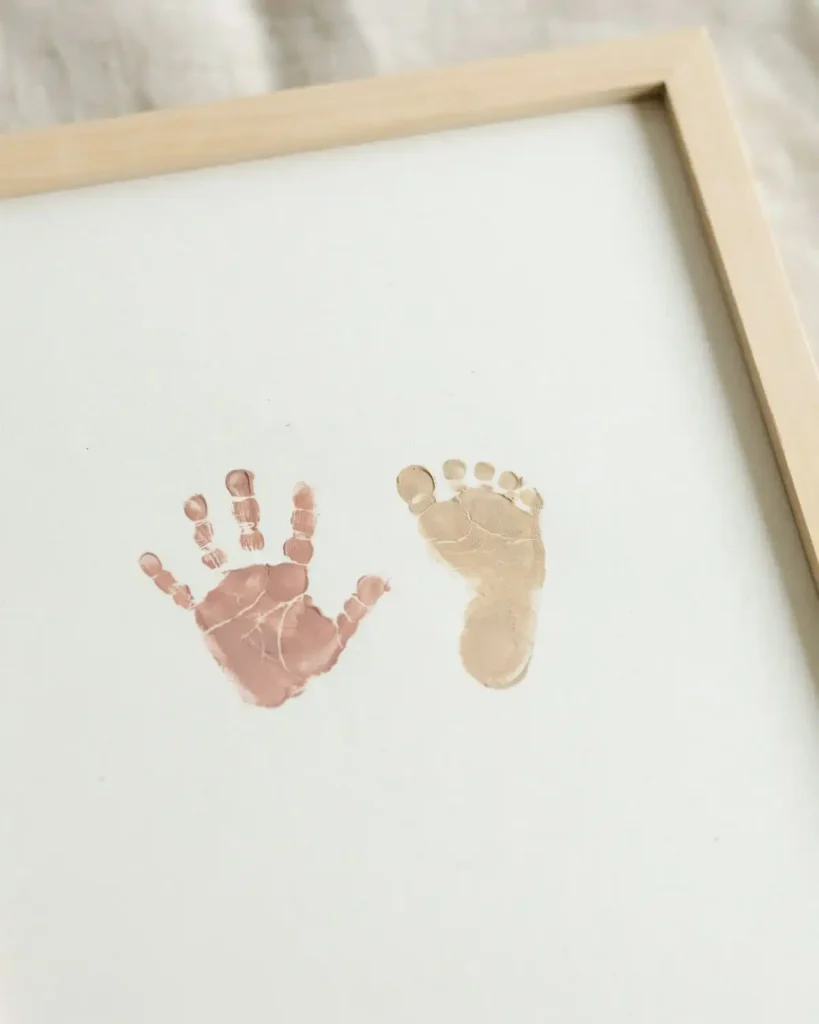
This is the one I would make even if I skipped every themed craft on the list. One handprint and one footprint beside baby’s name and date preserve both shapes without turning either into something else. That simplicity is what separates it from seasonal crafts—the finished piece will still make sense years from now. Make this when you want one classic piece of infant art to keep permanently.
Place the handprint and footprint next to each other with plenty of white space.
Underneath, write something simple such as:
“These little hands and feet won’t stay this little forever.”
Add baby’s name, age, and date.
How Can You Get a Clear Baby Handprint?
Use a thin, even layer of paint, support baby’s wrist or ankle, press gently, and lift the hand or foot straight up.
At a Glance:
- Prepare paper and cleanup supplies first.
- Apply paint thinly and evenly.
- Support the wrist or ankle.
- Press gently without sliding.
- Clean the skin promptly afterward.
The trick is to stop expecting perfection.
Spread the paint thinly and evenly rather than coating the hand heavily. Support baby’s wrist, lower the hand onto the paper, apply gentle even contact across the palm and fingers, then lift straight up.
For footprints, supporting the ankle often makes positioning easier.
Have a damp cloth ready and clean the skin promptly after the print. The Lemon8 example similarly emphasizes preparing everything first, keeping the session quick, working one hand at a time, and cleaning the paint off immediately after printing.
If your first print is smudged, keep it. Sometimes the wrinkled toes and crooked fingers are exactly what makes the finished keepsake feel real.
What Paint Should You Use for Baby Handprint and Footprint Crafts?
Choose art materials specifically intended for children, read the label carefully, and follow the manufacturer’s directions for use and cleanup.
At a Glance:
- Look for age-appropriate children’s art materials.
- Read safety and use instructions before starting.
- Keep paint away from baby’s mouth and eyes.
- Supervise the entire activity.
- Wash paint from the skin after printing.
Use art materials intended for children, follow all label directions, and avoid assuming that any random household or adult craft paint is suitable simply because it is water-based.
ACMI recommends the AP (Approved Product) Seal for young children. Its safety guidance explains that AP-certified materials have undergone toxicological evaluation and are certified for safe use as intended.
CPSC says art materials sold in the United States must undergo toxicological assessment at least every five years and carry an ASTM D-4236 conformity statement where practicable. It also notes that products specifically intended for children can be subject to additional children’s-product safety requirements.
For baby crafts, also keep the session supervised from beginning to end and keep all paint and craft supplies away from the mouth and eyes.
How Do You Turn Baby Footprint Art Into a Keepsake?
Add baby’s name, age, exact date, and occasion so the footprint records a specific moment rather than becoming just another craft.
At a Glance:
- Record the date immediately.
- Include baby’s age.
- Add the holiday or milestone.
- Keep one plain version for storage.
- Frame a favorite print for display.
The easiest way is to add context.
A cute print becomes far more meaningful ten years later when the paper also tells you exactly when it was made.
Include:
- Baby’s name.
- Baby’s age.
- The exact date.
- The occasion, such as “First Halloween.”
- A short message or caption.
For seasonal projects, I also like making one finished version for display and one plain print for the memory box.
The popularity of this keepsake format is easy to see in existing craft resources. Etsy’s baby handprint category includes thousands of listings spanning holiday prints, nursery pieces, cards, and personalized hand-and-footprint keepsakes, while Twinkl’s baby-art library organizes similar projects around animals, seasons, family, and celebrations.
Which Craft Is Best for Baby’s First Halloween?
A footprint ghost or pumpkin footprint art is ideal for baby’s first Halloween because each needs only one main print and minimal decorating.
At a Glance:
- Choose ghosts for the quickest footprint Halloween project.
- Try pumpkin footprint art for a fall theme.
- Make spider handprint craft art for classic Halloween.
- Use Halloween feet for funny monster designs.
For the easiest baby first Halloween project, choose a footprint ghost or pumpkin footprint art. Both need only one print, so you can finish the important part before your baby loses interest.
For something a little bolder, try:
- Spider handprint craft for classic Halloween colors.
- Monster Halloween feet for a playful look.
- Pumpkin footprint art for fall nursery décor.
- A footprint ghost for a simple first-Halloween card.
If I were making only one, I would choose the ghost and write the date directly under the print. It is recognizable instantly, yet baby’s footprint still remains completely visible.
Are Handprint Crafts Good Activities for Infants?
Handprint and footprint projects work best as short, adult-led keepsake activities rather than crafts an infant is expected to complete independently.
At a Glance:
- Keep sessions brief and fully supervised.
- Let the adult handle all decorating.
- Stop when baby becomes uncomfortable.
- Focus on the memory rather than perfection.
Handprint and footprint crafts are best viewed as adult-led keepsake activities, not projects that require an infant to follow craft instructions.
Babies develop at different rates. CDC explains that developmental milestones cover how children play, learn, speak, act, and move, and recommends age-appropriate interaction such as playing together and giving babies opportunities to use their hands.
For handprint crafts, the meaningful part is the shared experience and the memory you preserve—not producing a perfect piece of art.
Keep it short. Keep it supervised. And stop when your baby has had enough.
Frequently Asked Questions
What is the easiest handprint craft for a baby?
A single handprint flower, turkey, spider, or tree is usually easiest because you only need one clear print. Add the decorative details yourself after the paint dries.
What is the easiest footprint craft for an infant?
A footprint ghost or pumpkin is hard to beat. Both designs use the natural foot shape and need very little extra decorating.
How do I make pumpkin footprint art?
Cover the sole with a thin, even layer of child-appropriate washable paint, press it onto cardstock, and lift it straight up. Once dry, add a stem and vine to turn the footprint into a pumpkin.
Can I make handprint crafts for baby’s first Halloween?
Yes. Pumpkin footprints, footprint ghosts, monster feet, and a spider handprint craft are all simple footprint Halloween or handprint options. Keep the craft fully adult-supervised and use appropriately labeled children’s art materials.
How do I preserve baby handprint art?
Use sturdy acid-free paper if you plan to keep it long-term, let the print dry completely, write the date on the back, and store it flat or place it in a frame. Keeping the original away from moisture and direct sunlight can also help it stay looking better.
Final Thoughts
You do not need an elaborate craft room to make meaningful Baby and Infant Handprint Crafts.
A sheet of cardstock, appropriately selected paint, one tiny hand or foot, and a date can be enough.
Start with a footprint ghost for baby first Halloween, save a pumpkin as your favorite fall baby craft, make flowers in spring, and add a Christmas print when December comes around. Before long, those separate projects become a little collection showing just how quickly tiny hands and feet change.
That is what makes baby footprint art, handprint keepsakes, and simple infant art worth making.
The craft may take five minutes.
The print itself can stay with you for years.

![The Best 30+ Free Crochet Cat Patterns [Beginner-Friendly Guide]](https://crochetmind.com/wp-content/uploads/2025/04/1-The-Best-30-Free-Crochet-Cat-Patterns-Beginner-Friendly-Guide.webp)